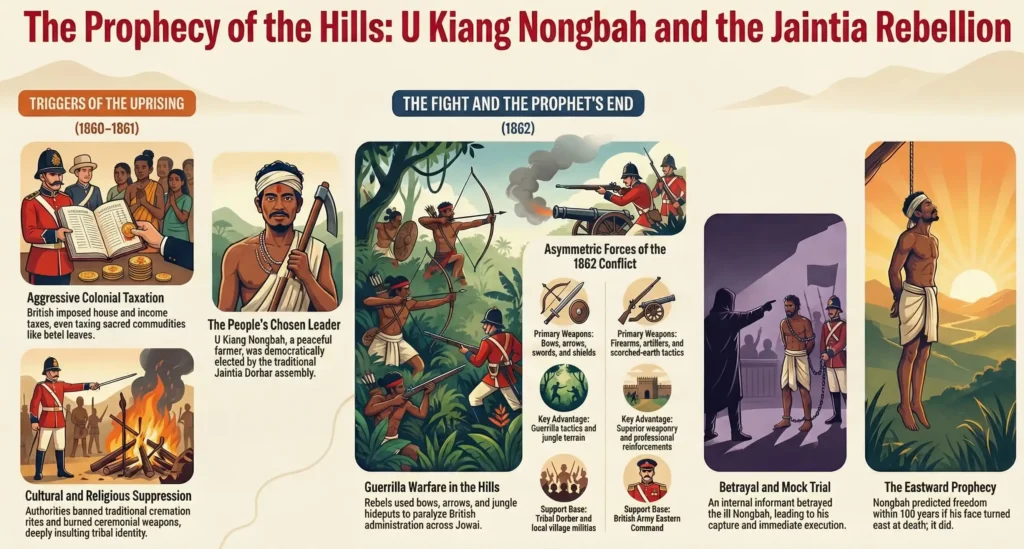
In 1862, deep in the mist-covered Jaintia Hills of present-day Meghalaya, a rebellion erupted that the British East India Company never saw coming — and never truly forgot. A peaceful farmer named U Kiang Nongbah, chosen by his own people through a traditional Dorbar assembly, rose to lead the Jaintia tribe against a relentless wave of colonial taxation, cultural suppression, and religious interference. From 1860 onwards, the British had imposed house tax, income tax, and even taxed humble betel leaves — commodities sacred to everyday tribal life. They banned traditional cremation rites, disrupted festivals, and burned sacred ceremonial weapons. When U Kiang Nongbah called for resistance, the hills answered. Police stations were torched, British outposts were attacked, and guerrilla warfare paralysed colonial administration across the Jaintia Hills. Though the rebellion was ultimately crushed by British military superiority and betrayal from within, U Kiang Nongbah faced his execution on 30 December 1862 with a prophecy on his lips — one that came true 85 years later, on 15 August 1947.
| Detail | Information |
|---|---|
| Event | Jaintia Rebellion (Kiang Nongbah Uprising) |
| Period | 1860–1862 CE (primary rebellion: 1862) |
| Location | Jaintia Hills, present-day West Jaintia Hills, Meghalaya |
| Leader | U Kiang Nongbah |
| Cause | British house tax (1860), income tax (1861), religious interference |
| British Commander | Colonel Richard Haughton; Deputy Commissioner Captain B.W.D. Murton |
| Key Allies | U Rangbah Thongni, U Manik Raitong |
| Tactics Used | Guerrilla warfare, stockades, bows, arrows, swords |
| Execution Date | 30 December 1862, Iawmusiang, Jowai |
| Legacy | Postage stamp (2001), Kiang Nangbah Government College (1967), annual martyrdom day on Dec 30 |
| Jaintia Kingdom Annexed | 15 March 1835 by British East India Company |
| State Today | West Jaintia Hills District, Meghalaya, India |
How U Kiang Nongbah Sparked the Jaintia Rebellion of 1862
A Kingdom Quietly Swallowed
Long before Meghalaya became a state on India’s map, the Jaintia Hills were ruled by one of the most fascinating kingdoms in the Northeast — the Jaintia Kingdom. The Jaintia Kingdom existed roughly from 500 AD to 1835 AD, extending from the eastern part of the Shillong Plateau across present-day Jaintia Hills, reaching into the plains of Bangladesh and northwards towards the Barak River valley in Assam. It was old, proud, and deeply rooted — a matrilineal society that passed its legacy through its women, practised its own faith, and governed through a system of chieftains called Dolois and Sirdars.
Then, in one swift colonial move, it was gone.
After a series of conflicts and disputes, the British finally marched to the Jaintia Kingdom and annexed it on 15 March 1835. The king was pensioned off with a modest monthly payment and quietly removed to Sylhet. The hills that had known a thousand years of their own governance now answered to a foreign administration that understood nothing of its people — and cared even less.
For a while, an uneasy quiet settled over the Jaintia Hills. The British were cautious, leaving the local hill administration to Dolois and Sirdars. But that arrangement was never going to last. Empires have a habit of reaching further than promised.
When Taxes Became a Declaration of War
For the Jaintia people, taxes weren’t just a financial burden. They were a statement — a reminder that they were subjects, not people. And between 1860 and 1862, the British stacked insult upon insult.
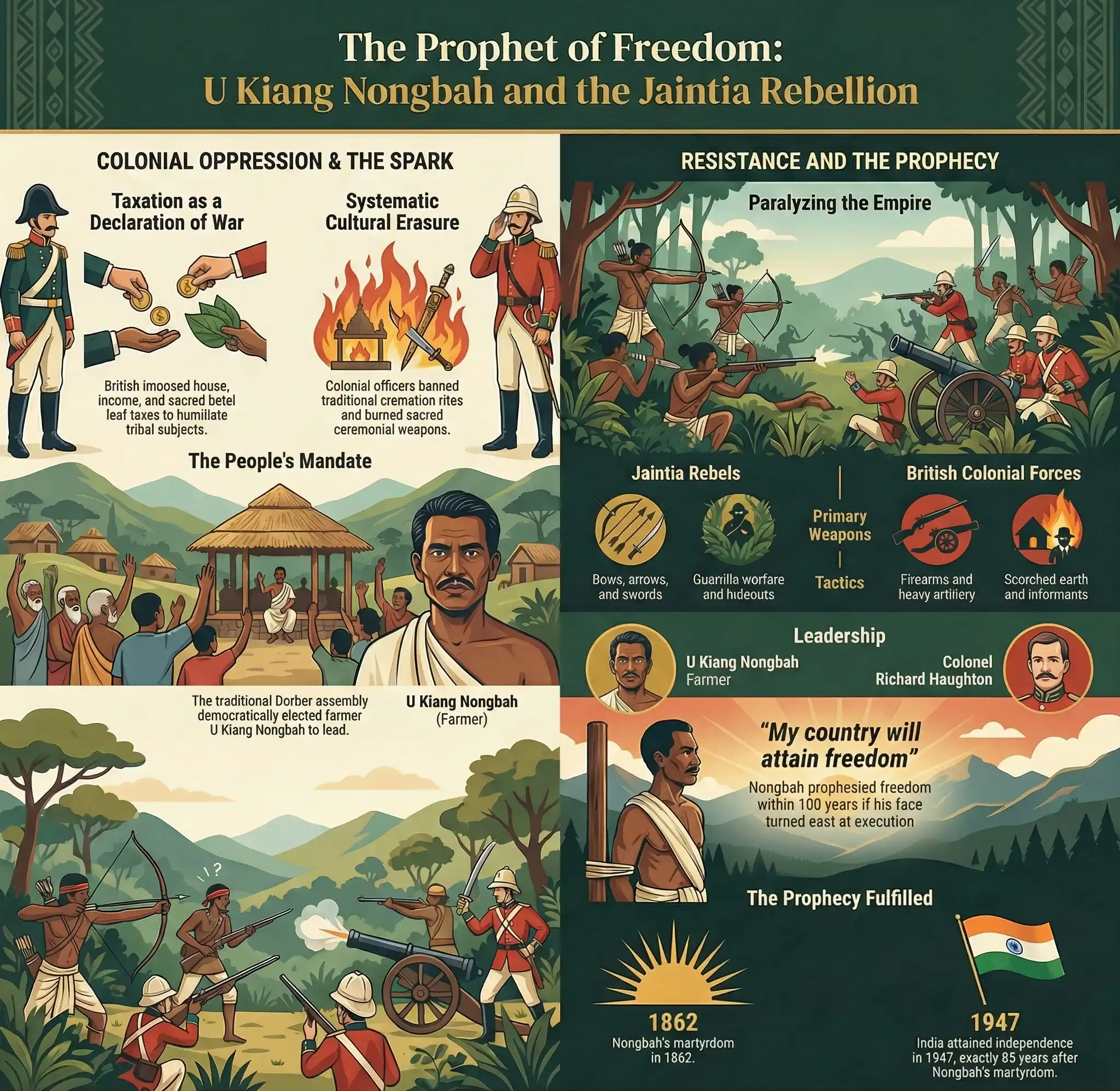
In 1860, the British imposed a house tax upon the people residing in the Jaintia Hills district of Meghalaya. In 1861, they introduced the income tax, which further hurt the people of the Jaintia Hills. There were also concerns regarding additional taxes being levied on betel and betel nuts — commodities that created a widespread financial burden among the Jaintias.
Betel leaves and nuts were not luxury items. They were part of every meal, every social gathering, every ritual offering. Taxing them was like taxing the air people breathed.
And then came the attacks on something even deeper — faith and tradition. The British interfered with the traditions and religious activities of the Jaintia people. They were not allowed to cremate the dead according to their tradition; some British officials burnt the weapons meant for a traditional dance. police stations were set up near cremation grounds. Missionary schools began replacing community learning. Sacred festivals were disrupted under the watchful eye of colonial officers.
Forced taxation, restrictions on their cultural practices, and disregard for tribal autonomy caused widespread resentment. The colonial government’s disregard for tribal customs and its attempts to convert the people to Christianity added to the growing unrest.
Something had to break.
India’s great tradition of David vs. Goliath battles
The Farmer Who Became a Freedom Fighter
U Kiang Nongbah was not born a warrior. A peaceful farmer, he was driven to protect his motherland when he saw how the British treated his fellow people, imposed unfair taxation, and disrupted their religious traditions.
He didn’t come from an aristocratic family. Born at a time when the British had annexed the Jaintia kingdom in 1835, Nongbah didn’t come from an aristocratic background. Belonging to a lineage of farmers, at a very early age, he was distraught by the policies the British had adopted.
What made U Kiang Nongbah extraordinary wasn’t just his bravery — it was his humility. Nangbah did not himself choose or wish to be a leader, but accepted the proposal as a gesture of respect for the collective wisdom and decision of the Great Jaintia Dorbar. His own community elected him. They trusted him with everything. And he never let them down.
Once chosen, he became famed for his efficient organisational capabilities. He coordinated all the rebellion activities, including making contacts with the Dolois and Sirdars, without causing any suspicion. He travelled across the Jaintia Kingdom and into neighbouring Khasi states, building alliances, gathering support, and quietly preparing for the moment that could not be delayed.
The Rebellion Erupts — and the Hills Burn
On January 20, 1862, the entire Jaintia Hills district was up in flames. The local police station and the treasury office at Jowai were burnt down by angry and rebellious villagers. They also set fire to its storehouse of weaponry and arsenal.
The British were caught completely off guard. Captain B.W.D. Murton, the then Deputy Commissioner of the Jaintia Hills, had said — “What was initially considered a disturbance by the British officers in the region, catapulted into an independent uprising because the British had misjudged and miscalculated the strength of the Jaintia people.”
The rebellion spread fast. The attacks spread to Mynso, Changpung, Raliang, Nartiang, Borato, Mookaian, Sutnga and other places in the Jaintia Hills. Guerrilla tactics — bows, arrows, swords, and the dense jungle itself — became the weapons of the Jaintia fighters. Guerrilla attacks with bows, arrows, swords and shields paralysed the British Administration as the attackers would swiftly escape to the jungles of Myngkrem, Myntdu and Myntwa.
Women, too, stood with their people. Women in Khasi, Jaintia, and Garo societies, known for their matrilineal traditions, provided logistical support and contributed to the preservation of cultural identity during the uprising. They cooked for the fighters, nursed the wounded, and moved the injured to safety in the dark hours of the night.
A wave of panic gripped the British forces which found it very difficult to suppress the rebellion. So thoroughly demoralised were they that on March 28, 1862, the administration of the Jaintia Hills was handed over to the then British Army Eastern Command. A people’s uprising had forced an empire to call in its army.
Betrayal, Capture, and the Last Words of a Prophet
the Koch Kingdom and Assam’s golden cultural era
Every great rebellion in history has its moment of betrayal. For U Kiang Nongbah, it came in December 1862.
The British, under the command of Colonel Richard Haughton, launched a counteroffensive using superior weaponry and reinforcements. Despite Nongbah’s best efforts, the resistance was eventually weakened by the British’s scorched-earth policies and the betrayal by local informants.
While the revolution was going on, Nongbah fell severely ill. Taking this opportunity, U Long Sutnga, a key member of his team, tipped off the police. The British captured him on December 27, 1862.
He was given no real trial. He was put on a mock trial and sentenced to death within three days of his capture, before the very eyes of the troops and the locals, to send a message that any resistance to the British rule would not be tolerated.
On 30 December 1862, U Kiang Nongbah was led to the gallows at Iawmusiang in Jowai. And then he did something extraordinary — he spoke.
His parting words from the gallows could never be forgotten: “Look at me closely, don’t bow down your heads, as I die on the gallows. If my head hangs to the east, my country will attain freedom within 100 years; if it hangs westwards, we will remain slaves for eternity.”
His face turned east.
And 85 years later, on 15 August 1947, India was free.
A Legacy That India Almost Forgot
The story of U Kiang Nongbah remained confined to the hills of Meghalaya for generations, unknown to the rest of India. The tribal communities in India have been largely ignored, especially in the north-eastern states, and very few people know about the once illustrious Jaintia tribe in Meghalaya and one of the greatest tribal leaders U Kiang Nongbah.
Slowly, the recognition has come. A postage stamp was issued by the Government of India to commemorate him in 2001. A government college was also opened at Jowai in 1967 in his honour. Every year on 30 December, the people of Meghalaya observe his martyrdom day — not as a political event, but as a deeply personal act of remembrance.
The Jaintia Rebellion of 1862 was never just about taxes. It was about the right of a people to exist on their own terms — to mourn their dead, celebrate their festivals, and live without asking permission. U Kiang Nongbah understood this with every bone in his body. And he paid for it with his life.
But his prophecy lived on.
how the Ahom Kingdom resisted Mughal expansion for centuries
Quick Comparison Table: Jaintia Rebels vs. British Colonial Forces (1862)
| Factor | Jaintia Rebels | British Colonial Forces |
|---|---|---|
| Leader | U Kiang Nongbah | Colonel Richard Haughton |
| Strength | Village militia, tribal fighters | Professional army + reinforcements |
| Weapons | Bows, arrows, swords, stockades | Firearms, artillery, scorched-earth tactics |
| Tactics | Guerrilla warfare, jungle hideouts | Military counteroffensive, informant network |
| Support Base | Entire Jaintia Hills, Dolois & Sirdars | British Army Eastern Command (from March 1862) |
| Key Weakness | Internal betrayal, illness of leader | Underestimated the scale of the uprising |
| Outcome | Rebellion crushed, leader executed | Administration restored, but at great cost |
| Legacy | National martyr, postage stamp, college | Last major attempt to suppress Jaintia identity |
Curious Indian: Fast Fact
the Garo tribe’s parallel struggle for cultural survival
- A Farmer, Not a General: U Kiang Nongbah was a simple farmer before he became a revolutionary. He never trained as a soldier — yet he paralysed British administration across an entire hill district.
- The Prophet of Freedom: His last words at the gallows predicted Indian independence within 100 years. India gained freedom 85 years later. To his people, he was not just a martyr — he was a seer.
- Women Warriors: In the matrilineal Jaintia society, women were not bystanders. They cooked for fighters, nursed the wounded, and moved the sick to safety — making them an invisible backbone of the rebellion.
- The Dorbar Chose Him: Nongbah didn’t want to be a leader. He was democratically chosen by the traditional Jaintia Dorbar — an ancient community assembly — and accepted out of duty, not ambition.
- India Remembered — Decades Later: The Government of India issued a commemorative postage stamp in his honour in 2001 — nearly 140 years after his execution. Better late than never.
- His Name Lives On: Kiang Nangbah Government College in Jowai, established in 1967, still carries his name — educating the very children of the hills he died to protect.
- Army Called In: The uprising was so powerful that by March 28, 1862 — just weeks after it began — the entire Jaintia Hills administration was transferred to the British Army Eastern Command. A farmer had forced an empire to summon its generals.
the Khasi tribe’s own fight for identity in Meghalaya
Conclusion
History has a way of remembering the wars fought with cannons and forgetting the ones fought with arrows. The Jaintia Rebellion of 1862 was fought with both — arrows in the jungle and words on the gallows. U Kiang Nongbah didn’t have an empire behind him. He had his people, his hills, his faith, and a deep, unshakeable belief that no foreign power had the right to tax a man’s grief, burn his traditions, or silence the songs of his ancestors. He lost the battle. But he won something far more lasting. In every December, when the mist rolls over the Jaintia Hills and the people of Jowai gather at Iawmusiang to remember their fallen farmer-hero, they are doing something quietly radical — they are refusing to forget. And in refusing to forget, they are finishing what U Kiang Nongbah started. India’s freedom has many fathers and mothers. Most of them never made it into the textbooks. This is one of them.
Who was U Kiang Nongbah?
U Kiang Nongbah was a Jaintia tribal freedom fighter from Jowai in present-day West Jaintia Hills district of Meghalaya. Born into a family of farmers, he was chosen by his community’s traditional Dorbar assembly to lead the resistance against oppressive British taxation and cultural interference in the 1860s.
What caused the Jaintia Rebellion of 1862?
The rebellion was triggered primarily by the British imposition of a house tax in 1860, followed by income tax in 1861, and additional taxes on betel leaves and betel nuts. The British also interfered with Jaintia religious customs — banning traditional cremation practices, disrupting festivals, and burning ceremonial weapons — which caused deep resentment.
How did U Kiang Nongbah fight the British?
He organised guerrilla attacks across the Jaintia Hills, burning British police stations and treasury offices, building stockades, storing grains, and manufacturing weapons. His fighters used bows, arrows, and swords, retreating swiftly into the dense forests to avoid British counterattacks
How was U Kiang Nongbah captured and executed?
He was betrayed by U Long Sutnga, a member of his own team, while seriously ill. The British captured him on 27 December 1862 and executed him at the gallows at Iawmusiang in Jowai on 30 December 1862 — just three days after his arrest.
What was U Kiang Nongbah’s famous last prophecy?
Standing at the gallows, he told his weeping people not to bow their heads, and declared that if his face turned east when he died, India would gain freedom within 100 years. His face turned east — and India gained independence 85 years later, in 1947.