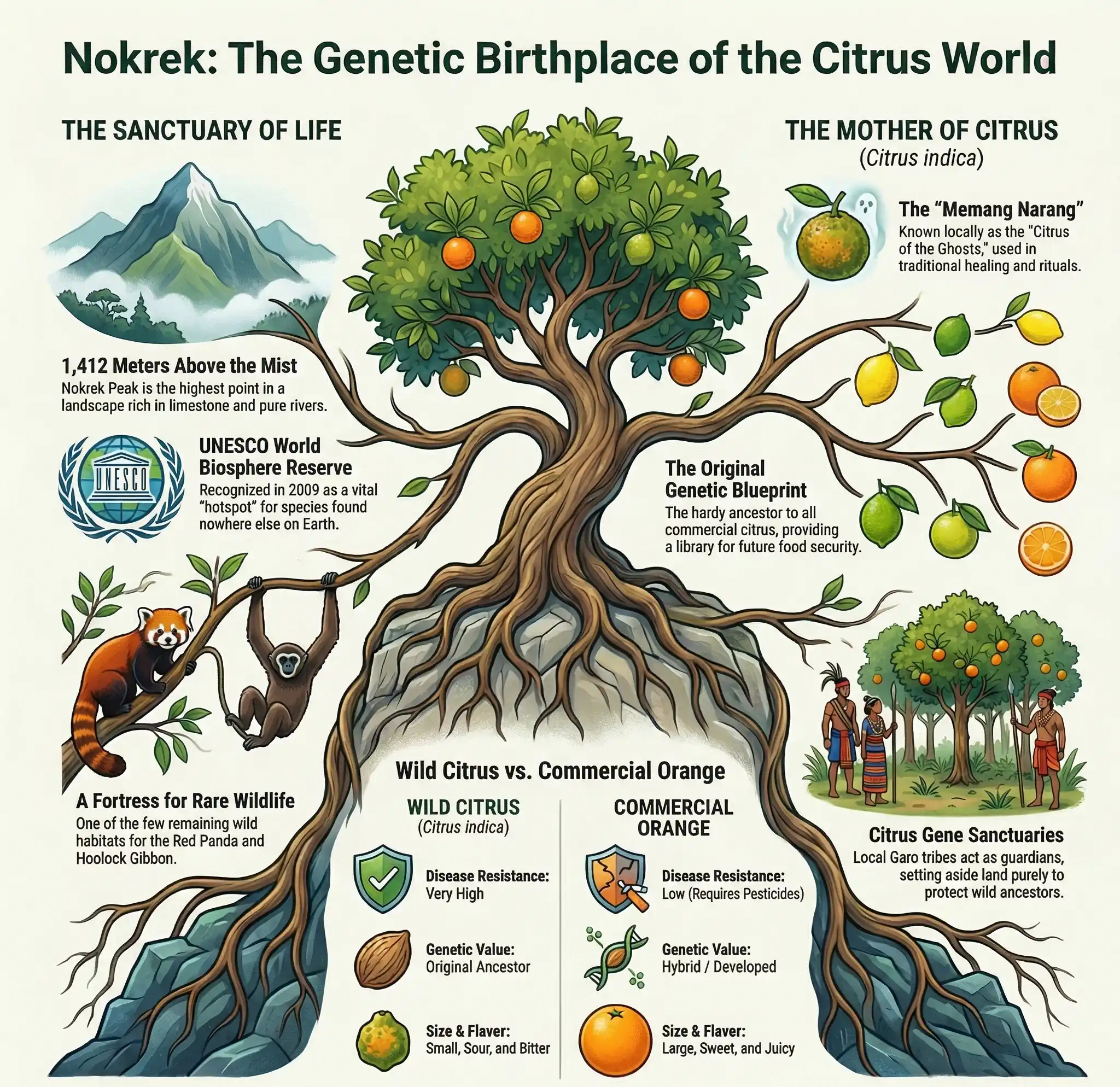
The Nokrek Biosphere Reserve is a breathtaking natural sanctuary located in the West Garo Hills of Meghalaya. It is famous not just for its stunning landscapes and red pandas, but for being the home of the 'Citrus indica,' believed to be the ancestor of all citrus fruits we eat today. This unique forest acts as a living laboratory where nature has preserved a piece of history for thousands of years. By protecting this tiny, wild orange, the local community and the world are keeping the genetic blueprint of our favorite fruits safe from extinction.
Fact Card
| Category | Details |
| Location | West Garo Hills, Meghalaya, India |
| Recognition | UNESCO World Biosphere Reserve (2009) |
| Key Species | Citrus indica (Memang Narang) |
| Highest Point | Nokrek Peak (1,412 meters) |
| Rare Wildlife | Red Panda, Asian Elephant, Hoolock Gibbon |
The air in the Garo Hills is thick with the scent of damp earth and wild blooms. As you climb the winding paths of the Nokrek Biosphere Reserve, the sounds of the modern world fade away, replaced by the rhythmic call of the Hoolock Gibbon. This isn’t just a forest; it is a time capsule. High up in these mist-covered peaks, a very special resident grows quietly in the shadows. It is a small, wild orange called the Memang Narang by the local Garo people. To the rest of the world, it is known as Citrus indica, the ancient mother of every lime, lemon, and orange you have ever tasted.
A walk through the green cathedral
Nokrek is a place of incredible beauty, where the trees seem to touch the clouds. The reserve covers a vast area of the Tura Range, providing a home for creatures that are rarely seen anywhere else on Earth. The forest floor is a carpet of rare orchids and ferns, while the canopy is alive with the movement of the elusive Red Panda. Walking here feels like stepping back into a time when the Earth was untouched. The highest point, Nokrek Peak, offers a view that stretches across the hills of Meghalaya, reminding every visitor of how vast and mysterious our natural world truly is.
The water here is pure and life-giving. Several important rivers, including the Simsang, find their beginnings in these hills. The locals believe the forest is a sacred gift, and when you see the crystal-clear streams cutting through the limestone rocks, it is easy to see why. This water doesn’t just sustain the animals; it nourishes the wild citrus trees that have survived here for centuries, hidden away from the changes of the outside world.
Meeting the ghost of the citrus world
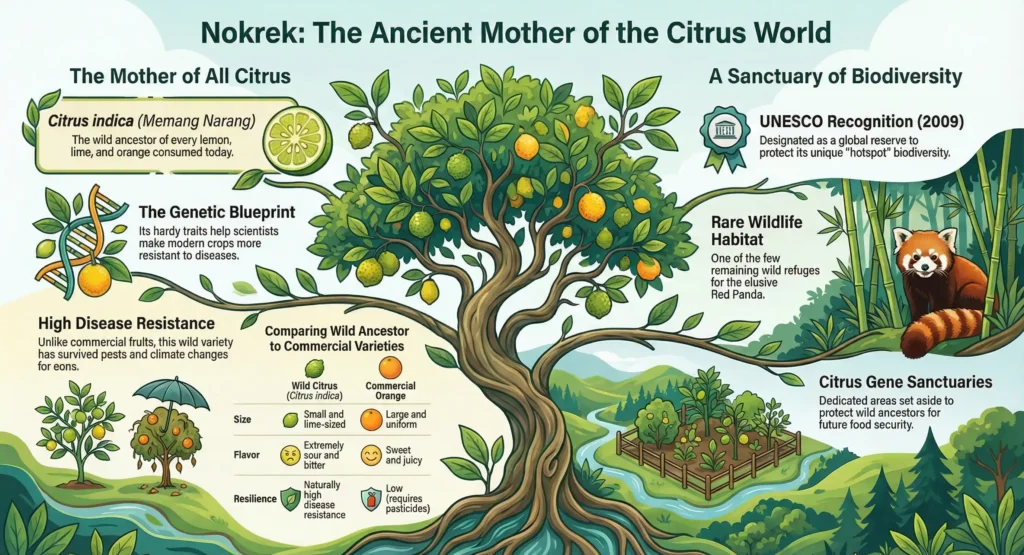
The true star of the Nokrek Biosphere Reserve is a fruit that most people would walk right past. The Citrus indica is small, round, and often quite sour. But inside its tough skin lies the genetic code that started it all. Scientists believe that almost all the citrus fruits we enjoy today—from the sweet oranges of Florida to the lemons of Italy—can trace their family tree back to these wild plants in Meghalaya. It is the original blueprint, a hardy survivor that has withstood pests, diseases, and climate changes for eons.
The Garo people call it Memang Narang, which translates to “Citrus of the Ghosts.” Legend says that the fruit is used by spirits, but in reality, it is a lifeline for our future food security. Because this wild ancestor is so strong, scientists study it to find ways to make our modern crops more resistant to diseases. If we lost the Nokrek Biosphere Reserve, we wouldn’t just lose a forest; we would lose the library of life that helps us feed the planet.
The guardians of the orange grove
The survival of this ancient fruit is thanks to the deep connection between the land and the people. The Garo tribes have lived in harmony with these hills for generations. They understand that the forest provides everything they need, from medicinal plants to clean water. Instead of cutting down the trees, they have become the primary defenders of the Nokrek Biosphere Reserve. They practice traditional farming methods that respect the boundaries of the wild, ensuring that the “ghost citrus” has room to grow.
In recent years, the community has worked closely with conservationists to create “Citrus Gene Sanctuaries.” This is a beautiful idea where specific areas are set aside purely to protect the wild ancestors of our food. It is a rare example of humans looking hundreds of years into the future. By guarding these small, wild trees, the villagers are ensuring that their grandchildren—and yours—will still live in a world where nature’s original flavors exist.
A sanctuary for the rare and the beautiful
While the citrus is famous, Nokrek is also a vital fortress for wildlife. It is one of the few places in India where the Red Panda still roams free in the wild. These gentle, rust-colored animals spend their days high in the bamboo thickets, away from the eyes of humans. Watching one move through the trees is a lesson in patience and grace. The reserve is also a major corridor for Asian Elephants, who travel through these hills as they have done for thousands of years.
The diversity of life here is staggering. From the tiny insects that pollinate the wild oranges to the massive elephants that shape the forest, every creature has a role to play. The Nokrek Biosphere Reserve teaches us that nothing in nature exists in isolation. The ancient citrus tree needs the forest soil, the soil needs the fallen leaves, and the leaves come from the trees protected by the people. It is a perfect circle of life that continues to thrive in this corner of Northeast India.
Why Nokrek matters to you
You might wonder why a small forest in Meghalaya matters to someone living in a busy city. The answer lies in your next glass of orange juice or the lemon in your tea. The Nokrek Biosphere Reserve is the guardian of the history of our food. In a world where many plants are disappearing, Nokrek stands as a symbol of hope. it shows us that if we give nature a little bit of space and a lot of respect, it can preserve its greatest treasures for us.
Visiting Nokrek is not just a holiday; it is a pilgrimage to the source of life. It reminds us to be curious about where our food comes from and to be thankful for the wild places that still exist. As the sun sets over the Tura Range, casting a golden glow over the green hills, you realize that the real mystery of Nokrek isn’t the ghosts of the past, but the promise of the future. It is a place where the air is cleaner, the water is purer, and the oldest orange tree in the world is still waiting to tell its story.
Quick Comparison Table
| Feature | Wild Citrus (Citrus indica) | Commercial Orange |
| Size | Small and lime-sized | Large and uniform |
| Flavor | Extremely sour/bitter | Sweet and juicy |
| Disease Resistance | Very High | Low (requires pesticides) |
| Genetic Value | Original Ancestor | Hybrid/Developed |
Curious Indian: Fast Facts
- Citrus indica is listed as an endangered species and is endemic to the Indian subcontinent.
- Nokrek was the first site in Northeast India to be added to the UNESCO World Network of Biosphere Reserves.
- The reserve is a “hotspot” for biodiversity, meaning it has a high number of species found nowhere else.
- The soil in Nokrek is rich in lime, which is believed to be one of the reasons why citrus thrives so well here.
- Unlike commercial citrus, the wild Memang Narang is very high in medicinal properties and is used in local traditional healing.
Conclusion
The Nokrek Biosphere Reserve is much more than a protected forest; it is a living testament to the resilience of nature. By sheltering the Citrus indica, this sanctuary preserves the very spark that gave us one of the world’s most beloved fruit families. The story of Nokrek is a reminder that our past and our future are deeply intertwined with the soil. Whether it is the playful Red Panda or the ancient “ghost citrus,” every inhabitant of this reserve contributes to a story of survival. As we move forward in a changing world, places like Nokrek give us the tools and the hope to protect the diversity of life on Earth. It is a treasure of India that belongs to the whole world, quietly growing in the mist-covered hills of Meghalaya.
Can tourists visit the Nokrek Biosphere Reserve?
Yes, but you often need permission from the forest department, and it is best to hire a local guide to navigate the dense forest trails.
When is the best time to visit Nokrek?
The months between October and May are ideal, as the weather is pleasant and the trails are less slippery than during the monsoon.
Where is the Citrus Gene Sanctuary located?
The sanctuary is integrated within the core and buffer zones of the Nokrek Biosphere Reserve to protect the wild citrus in its natural habitat.
Are there tigers in Nokrek?
While tigers are not the primary focus of Nokrek, the dense forests provide a habitat for various leopards and other smaller wild cats.
How do I reach Nokrek?
The nearest major town is Tura in Meghalaya. From there, you can take a local taxi to reach the base of the reserve.