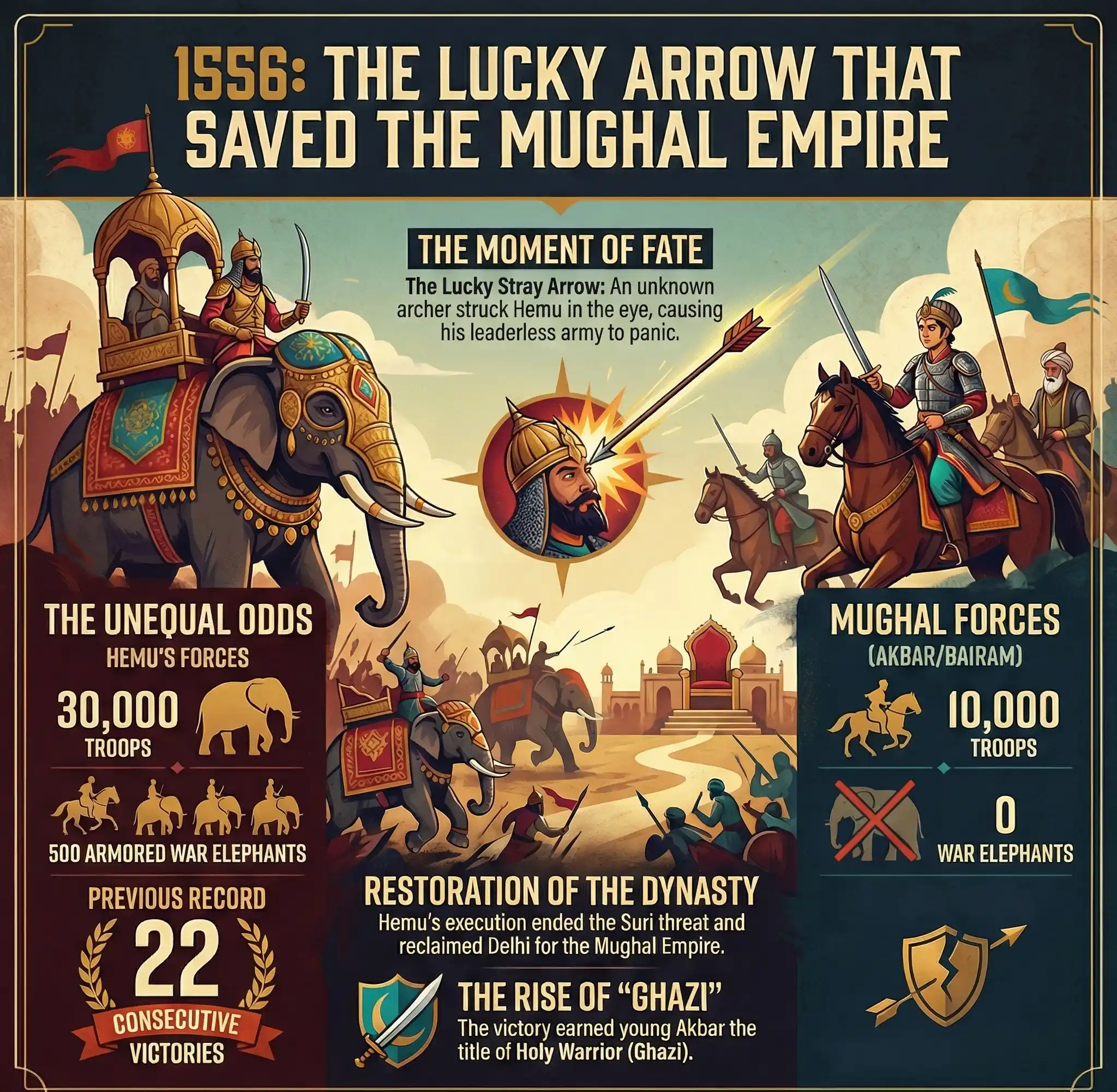
The Second Battle of Panipat, fought on November 5, 1556, was a decisive conflict between the forces of the Mughal Emperor Akbar and the army of Hemu (Hemchandra Vikramaditya), the Hindu general and Prime Minister of the Suri dynasty. Following the sudden death of Humayun, Hemu had captured Delhi and Agra, crowning himself King. The Mughals, led by the Regent Bairam Khan (as Akbar was only 13), met Hemu's massive force at the historic battlefield of Panipat. Despite Hemu's superior numbers and war elephants, the battle turned when a stray arrow struck Hemu in the eye, rendering him unconscious. His leaderless army panicked and fled. Hemu was captured and beheaded, cementing Mughal rule in India for the next three centuries.| Feature | Details |
| Date | November 5, 1556 |
| Location | Panipat (Haryana) |
| Mughal Commander | Bairam Khan (Regent for Akbar) |
| Opposing Commander | Hemu (Hemchandra Vikramaditya) |
| Mughal Strength | ~10,000 Cavalry |
| Hemu’s Strength | ~30,000 Cavalry + 500 War Elephants |
| Turning Point | Hemu struck in the eye by a stray arrow |
| Outcome | Decisive Mughal Victory |
| Result | Execution of Hemu; Akbar reclaims Delhi |
The Vacuum Power: Humayun’s Death
In January 1556, the Mughal Emperor Humayun died after falling down the stairs of his library in Delhi. His son, Akbar, was only 13 years old and campaigning in Punjab with his guardian, Bairam Khan. The empire was in peril. Sensing weakness, the Afghan remnants of the Suri dynasty rallied behind their most capable general, Hemu.
Battle of Talikota 1565: The Fall of the Vijayanagara Empire
The Rise of Hemu Vikramaditya
Hemu was a self-made man—a former saltpetre seller from Rewari who rose to become the Prime Minister of Adil Shah Suri. He was a military genius who had won 22 consecutive battles.
- Capture of Delhi: On October 7, 1556, Hemu defeated the Mughal governor Tardi Beg Khan at the Battle of Tughlaqabad and captured Delhi.
- Coronation: He declared himself an independent ruler, adopting the ancient title of Vikramaditya, becoming the first Hindu king to rule Delhi in centuries.
The Decision to Fight
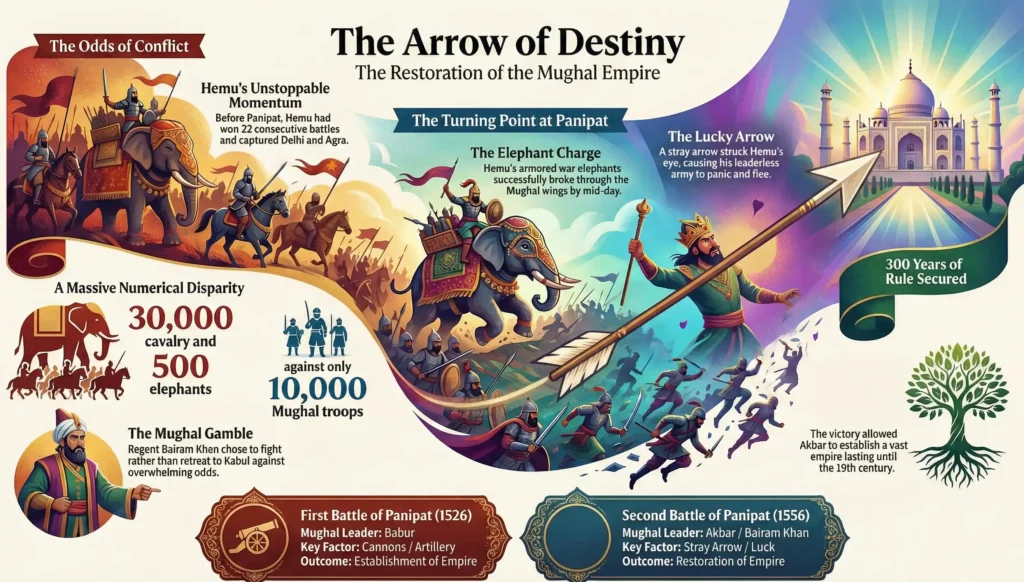
Upon hearing of the loss of Delhi, many Mughal generals advised retreating to Kabul. Bairam Khan refused. He executed the fleeing general Tardi Beg to instill discipline and ordered the army to march to Panipat. It was a gamble: 10,000 disheartened Mughals against Hemu’s 30,000 victorious troops and 500 war elephants.
The Battle: November 5, 1556
The armies met on the historic plains of Panipat, where Akbar’s grandfather Babur had won his empire 30 years earlier.
- The Elephant Charge: Hemu’s army was centered around his elephants, armored beasts that trampled the Mughal front lines. Hemu himself led the charge from his elephant, Hawai.
- Mughal Strategy: Bairam Khan kept the young Akbar safely in the rear. He ordered his archers to aim for the mahouts (elephant drivers) and the commanders.
Third Battle of Panipat 1761: The Day the Maratha Dream Died
The Lucky Arrow
By mid-day, Hemu was on the verge of victory. His elephants had broken the Mughal wings. Then, fate intervened. A stray arrow, fired by an unknown Mughal archer, struck Hemu in the eye. The arrow pierced his brain, and he collapsed unconscious in his howdah.
Seeing their invincible leader fall, the Afghan army panicked. Rumors spread that “Hemu is dead.” The soldiers broke rank and fled. The victory turned into a rout in minutes.
The Execution: “Ghazi”
Hemu’s elephant was captured and brought to the Mughal camp. Bairam Khan presented the unconscious Hemu to the young Akbar and asked him to behead the “infidel” to earn the title of Ghazi (Holy Warrior).
- The Legend: Some accounts say the 13-year-old Akbar refused to kill a dying man, so Bairam Khan drew his sword and beheaded Hemu himself. Other accounts suggest Akbar did strike the first blow.Hemu’s head was sent to Kabul to prove the victory, and his body was displayed at Purana Qila in Delhi.
Reign of Akbar 1556-1605: The Golden Age of the Mughal Empire
Quick Comparison Table: First vs. Second Battle of Panipat
| Feature | First Battle of Panipat (1526) | Second Battle of Panipat (1556) |
| Mughal Leader | Babur | Akbar / Bairam Khan |
| Opponent | Ibrahim Lodi | Hemu Vikramaditya |
| Key Factor | Cannons / Artillery | Stray Arrow / Luck |
| Outcome | Establishment of Mughal Empire | Restoration of Mughal Empire |
| Opponent Fate | Died in Battle | Captured and Executed |
Curious Indian: Fast Facts
- Hemu’s Origin: Hemu was not a Kshatriya warrior by birth; he was a Dhusar Baniya (merchant caste) who proved that military genius isn’t inherited.
- The Spoils: Along with the victory, the Mughals captured 1,500 elephants and the vast treasures of the Suri dynasty, funding Akbar’s future campaigns.
- Hemu’s Father: After the battle, the Mughals captured Hemu’s 80-year-old father. When he refused to convert to Islam, he was executed by the Mughal governor Pir Mohammad.
- Akbar’s Age: Akbar was so young that Bairam Khan essentially ruled the empire as Regent (Vakil) for the next four years until Akbar dismissed him in 1560.
Conclusion
The Second Battle of Panipat is one of the greatest “What Ifs” of Indian history. If that arrow had missed Hemu’s eye, the Mughal Empire might have ended in 1556, and a restored Hindu kingdom might have ruled North India. Instead, the battle re-established the Mughals, allowing Akbar to go on and build the syncretic, vast empire that defined medieval India. It proved that in war, fortune favors not just the brave, but sometimes the lucky.
Reign of Aurangzeb 1658-1707: The Zenith and Decline of the Mughals
If you think you have remembered everything about this topic take this QUIZ
Results


#1. The Second Battle of Panipat was fought on which date?
#2. Who commanded the Mughal forces as the Regent for the young Emperor Akbar?
#3. What ancient title did Hemu adopt after capturing Delhi and declaring himself King?
#4. What was the specific turning point that led to the defeat of Hemu’s army?
#5. Before rising to power as a general and king, what was Hemu’s original profession?
#6. How old was Emperor Akbar at the time of the Second Battle of Panipat?
#7. Which Mughal general was executed by Bairam Khan before the battle to instill discipline in the army?
#8. What was the fate of Hemu after he was captured in the battle?
Who fought the Second Battle of Panipat?
It was fought between Akbar’s Mughal forces (led by Bairam Khan) and Hemu Vikramaditya.
When was the battle fought?
It was fought on November 5, 1556.
How did the Mughals win the battle?
They won when a stray arrow hit Hemu in the eye, causing him to fall unconscious and his army to panic.
Who was Bairam Khan?
He was the Regent and Guardian of the young Akbar and the brilliant general who led the Mughal forces to victory.
What happened to Hemu after the battle?
He was captured unconscious and beheaded by Bairam Khan (or Akbar) in the Mughal camp.