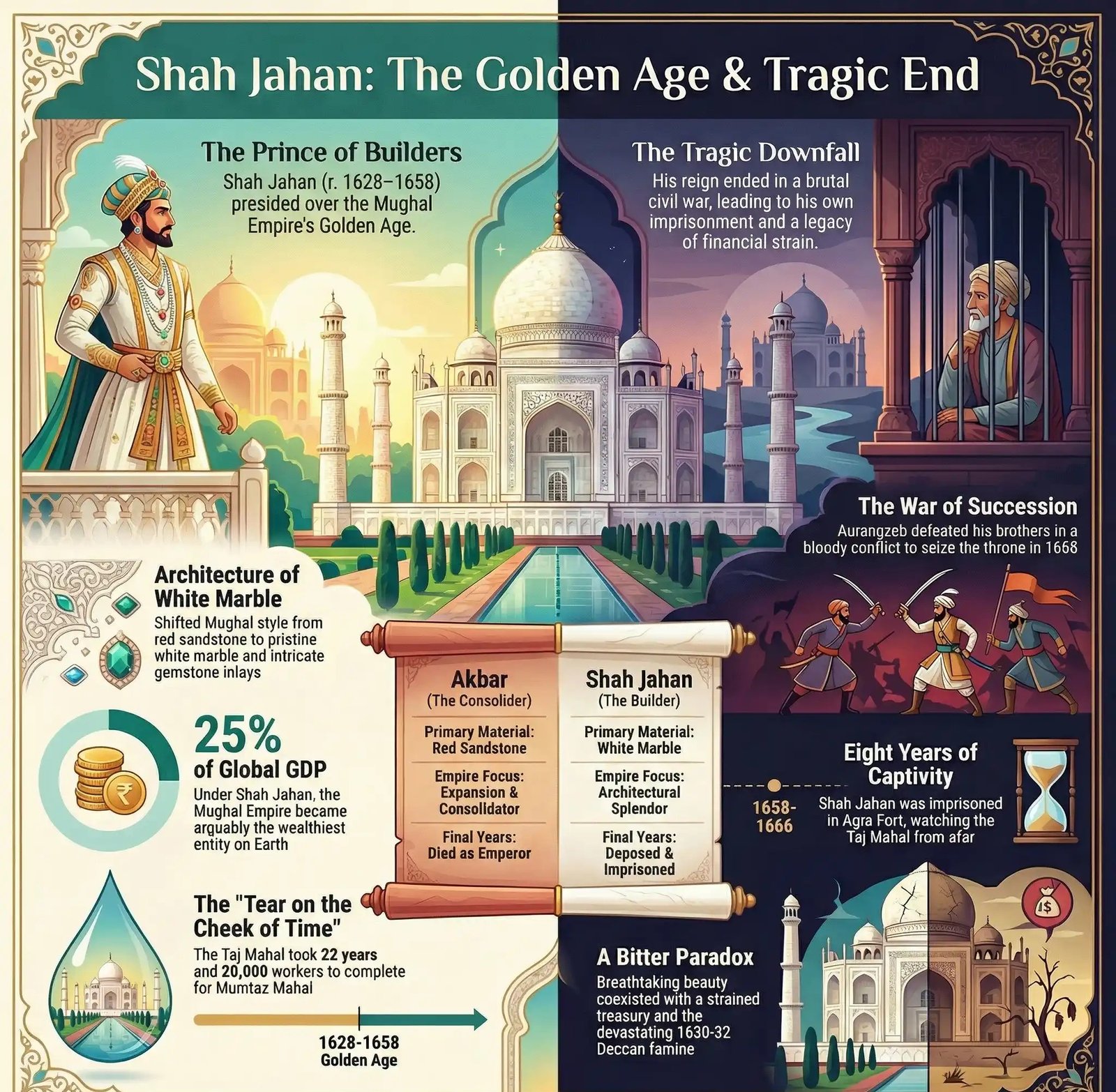
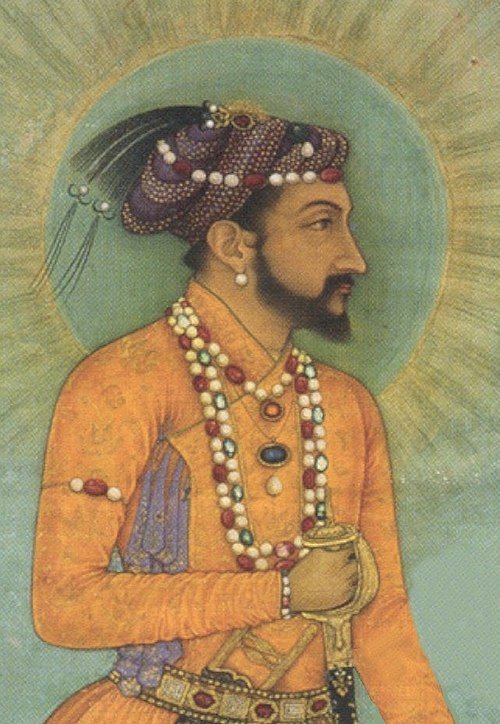
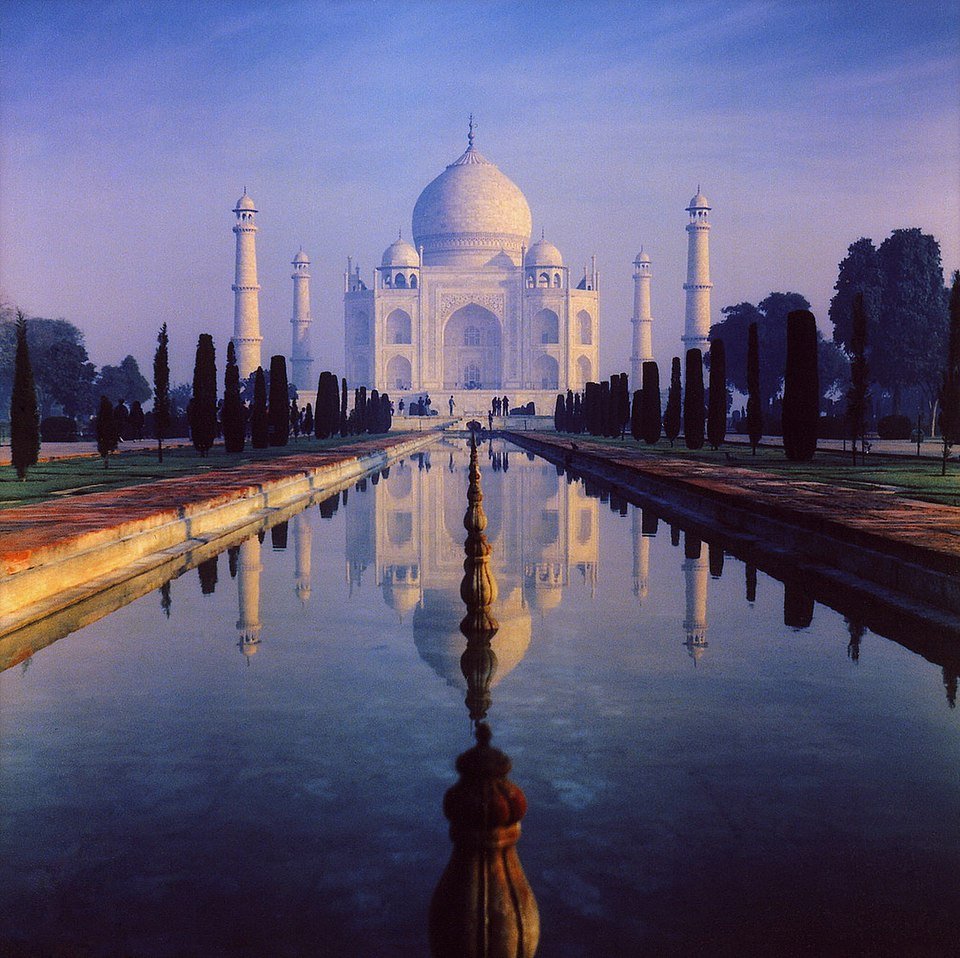
The Reign of Shah Jahan (1628–1658) is often called the “Golden Age” of the Mughal Empire. Born as Prince Khurram, he ascended the throne after a succession struggle in 1628. His rule is synonymous with architectural grandeur; he commissioned world-famous monuments like the Taj Mahal, the Red Fort (Lal Qila), and the Jama Masjid. Militarily, he expanded the empire into the Deccan, annexing Ahmednagar and forcing Bijapur and Golconda into submission. However, his heavy spending on monuments and wars strained the treasury. His reign ended tragically in 1658 when his son, Aurangzeb, defeated his other sons in a bloody War of Succession and imprisoned Shah Jahan in the Agra Fort for the final eight years of his life.
| Feature | Details |
| Reign Dates | 1628 – 1658 |
| Regnal Title | Shah Jahan (“King of the World”) |
| Birth Name | Prince Khurram |
| Father/Mother | Jahangir / Jagat Gosaini (Jodha Bai of Marwar) |
| Key Monuments | Taj Mahal, Red Fort, Jama Masjid, Peacock Throne |
| Key Wars | Annexation of Ahmednagar (1633), War of Succession (1658) |
| Wife | Mumtaz Mahal (Arjumand Banu Begum) |
| Burial Place | Taj Mahal, Agra |
The Prince of Builders
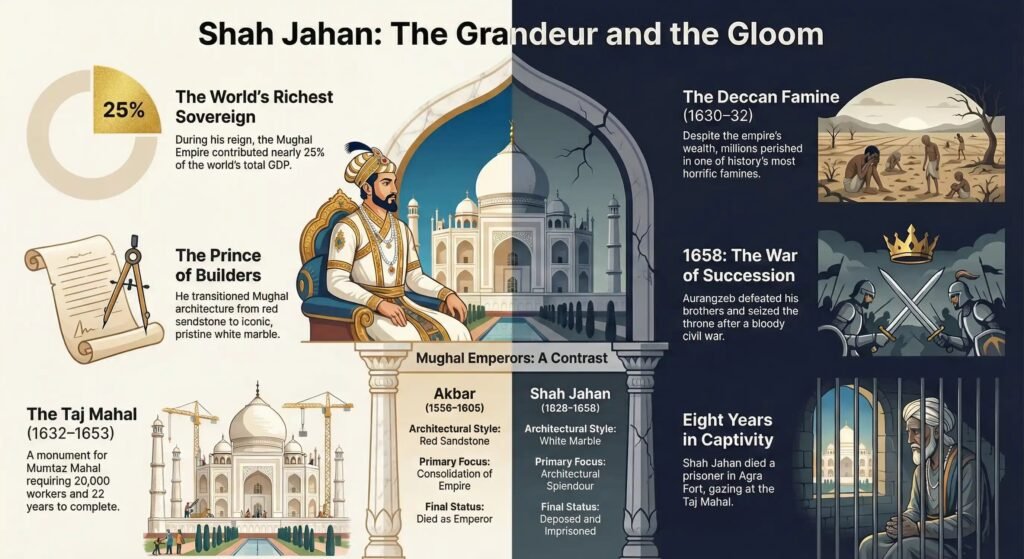
Shah Jahan is unique among Mughal emperors because his passion wasn’t just conquest; it was creation. His reign saw a shift from the red sandstone architecture of Akbar and Jahangir to the pristine white marble architecture.
- The Taj Mahal (1632–1653): Built in memory of his beloved wife, Mumtaz Mahal, who died giving birth to their 14th child. It took 22 years and 20,000 workers to complete this “tear on the cheek of time.”
- Shahjahanabad (Old Delhi): In 1639, he decided to shift the capital from Agra to Delhi. He built a new walled city, Shahjahanabad, which we now know as Old Delhi, centered around the Red Fort and Jama Masjid.
- The Peacock Throne: The fabulous Takht-i-Taus, encrusted with diamonds (including the Koh-i-Noor) and rubies, was built during his reign. It was later looted by Nadir Shah in 1739.
Establishment of the British Raj 1858: The Dawn of Imperial India
The Deccan Policy
While he loved art, Shah Jahan was also a ruthless general. He continued the Mughal push into the Deccan (South India).
- Ahmednagar: The Nizam Shahi kingdom, which had resisted the Mughals for decades under Malik Ambar, was finally annexed in 1633.
- Bijapur and Golconda: In 1636, he forced the sultans of Bijapur and Golconda to sign treaties accepting Mughal suzerainty and paying annual tribute.
The Famine of 1630-32
Despite the glamour, Shah Jahan’s reign witnessed one of the worst famines in Indian history. The Deccan Famine of 1630–32 killed millions. Contemporary accounts describe horrific scenes where parents sold their children for a piece of bread, and cannibalism was reported. While Shah Jahan set up soup kitchens (langars) and remitted some taxes, his relief efforts were insufficient compared to the scale of the tragedy.
Battle of Plassey 1757: The Betrayal That Changed India’s Destiny
The War of Succession (1657-1658)
In 1657, Shah Jahan fell ill, triggering a civil war among his four sons:
- Dara Shikoh: The eldest and Shah Jahan’s favorite. A liberal intellectual who translated the Upanishads into Persian.
- Shuja: Governor of Bengal.
- Aurangzeb: Governor of Deccan, a staunch orthodox Muslim and capable general.
- Murad: Governor of Gujarat.
Shah Jahan wanted Dara to succeed him, but Aurangzeb was the superior tactician. At the Battle of Samugarh (1658), Aurangzeb decisively defeated Dara Shikoh. He then executed Dara and Murad, drove Shuja into exile, and declared himself Emperor.
The Tragic End
Aurangzeb did not kill his father but imprisoned him in the Musamman Burj of the Agra Fort. For eight long years, the man who had ruled the world was confined to a few rooms, attended only by his devoted daughter Jahanara. Legend has it that he spent his days gazing across the river Yamuna at the Taj Mahal, the tomb of the woman he loved. He died in captivity in 1666 and was buried quietly beside Mumtaz Mahal.
Reign of Aurangzeb 1658-1707: The Zenith and Decline of the Mughals
Quick Comparison Table: Akbar vs. Shah Jahan
| Feature | Akbar (1556–1605) | Shah Jahan (1628–1658) |
| Architecture Style | Red Sandstone (Fatehpur Sikri) | White Marble (Taj Mahal) |
| Religious Policy | Secular (Sulh-i-kul) | More Orthodox than Akbar, but less than Aurangzeb |
| Capital | Agra / Fatehpur Sikri | Agra / Delhi (Shahjahanabad) |
| Focus | Consolidation of Empire | Architectural Splendor |
| End | Died as Emperor | Deposed & Imprisoned |
Curious Indian: Fast Facts
- The “Taj Black”: A popular myth suggests Shah Jahan planned to build a Black Taj Mahal for himself across the river, but modern excavations have found no evidence of this; the “black marble” ruins found were actually discolored white marble.
- Cutting Hands? The story that Shah Jahan cut off the hands of the Taj Mahal workers is a myth. There is no historical record of this atrocities; in fact, many workers helped build other monuments later.
- The Richest Man: During his reign, the Mughal Empire contributed nearly 25% of the world’s GDP. He was arguably the richest man on earth.
- Ustad Ahmad Lahori: The chief architect of the Taj Mahal was Ustad Ahmad Lahori, a Persian from Lahore.
Conclusion
The Reign of Shah Jahan remains a paradox. It was a time of breathtaking beauty and unbearable suffering. He gave India its most recognizable symbol, the Taj Mahal, but his extravagant spending on stone and marble sowed the seeds of financial ruin that would plague his successors. He ruled as the “King of the World” but died a prisoner, proving that even the grandest emperors are subject to the wheel of time.
Nadir Shah’s Invasion of Delhi 1739: The Massacre That Emptied India
If you think you have remembered everything about this topic take this QUIZ
Results


#1. During the devastating Deccan Famine of 1630–1632, what was a primary criticism of Shah Jahan’s relief efforts?
#2. Which of Shah Jahan’s sons was known as a liberal intellectual who translated the Upanishads into Persian?
#3. What does the source material conclude regarding the myth that Shah Jahan cut off the hands of the Taj Mahal workers?
#4. Who was the mother of Prince Khurram, the future Emperor Shah Jahan?
#5. What happened to the Peacock Throne, the jewel-encrusted seat of power created during Shah Jahan’s reign?
#6. In 1639, Shah Jahan decided to shift the imperial capital from Agra to which newly built city?
#7. Which kingdom was finally annexed by the Mughal Empire in 1633 after decades of resistance?
#8. Who attended to Shah Jahan during his final eight years of imprisonment in the Agra Fort?
What is the period of Shah Jahan’s reign?
Shah Jahan ruled from 1628 to 1658.
Why is his reign called the Golden Age of Architecture?
Because of the massive construction of masterpieces like the Taj Mahal, Red Fort, and Jama Masjid, using white marble and intricate pietra dura inlay work.
Who succeeded Shah Jahan?
His third son, Aurangzeb, succeeded him after defeating his brothers in a war of succession.
Where was Shah Jahan imprisoned?
He was imprisoned in the Agra Fort (Musamman Burj) by his son Aurangzeb.
What was Shah Jahan’s childhood name?
His name was Prince Khurram.