The Mature Harappan Phase (c. 2600–1900 BCE) represents the peak of the Indus Valley Civilization. It was a period of intense urbanization, characterized by a sudden transition from small regional cultures (Early Harappan) to large, highly standardized cities. This era is defined by its town planning (grid system), the use of baked bricks, a uniform system of weights and measures, and the widespread use of the Indus Script. The civilization spanned a vast area from Afghanistan to Gujarat, with major urban centers like Harappa, Mohenjo-daro, Dholavira, Rakhigarhi, and Lothal. It was a trade-based society that connected with Mesopotamia and Egypt, marking the First Urbanization of India.| Feature | Details |
| Duration | c. 2600 – 1900 BCE |
| Era | Bronze Age (Integration Era) |
| Key Cities | Harappa, Mohenjo-daro, Dholavira, Rakhigarhi, Kalibangan |
| Defining Feature | Urban Planning (Grid System) |
| Material Used | Burnt Bricks (Standard Ratio 1:2:4) |
| Drainage | Covered Drains, Manholes, Soak Pits |
| Trade Partner | Mesopotamia (called Meluhha) |
| Script | Pictographic (Undeciphered) |
| Political Structure | Likely a Merchant Oligarchy (No clear King/Army) |
The Integration Era: A Sudden Transformation
Around 2600 BCE, the diverse regional cultures of the Greater Indus Valley (like Kot Diji and Amri) suddenly coalesced into a single, unified civilization. Archaeologists call this the Integration Era.
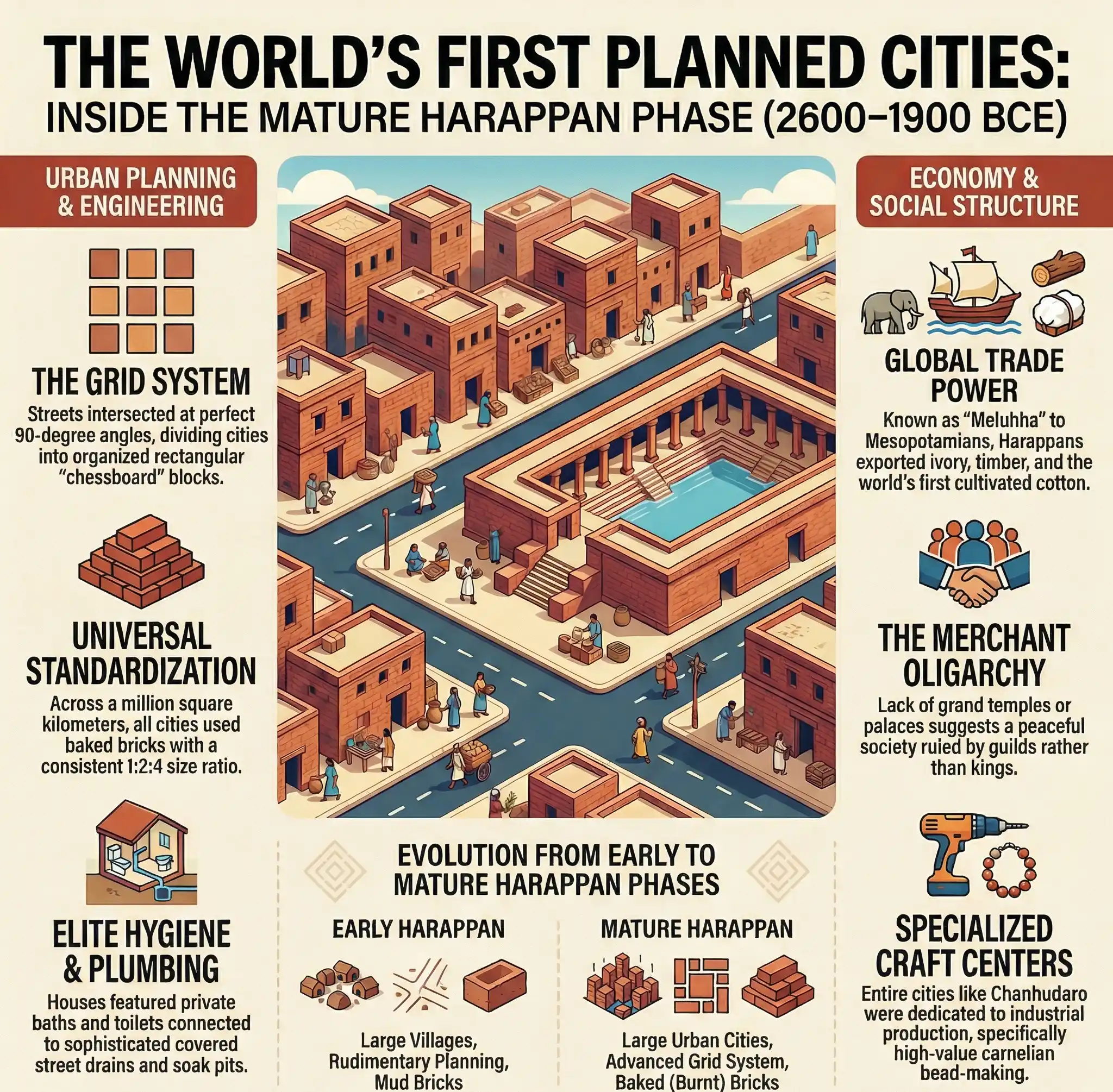
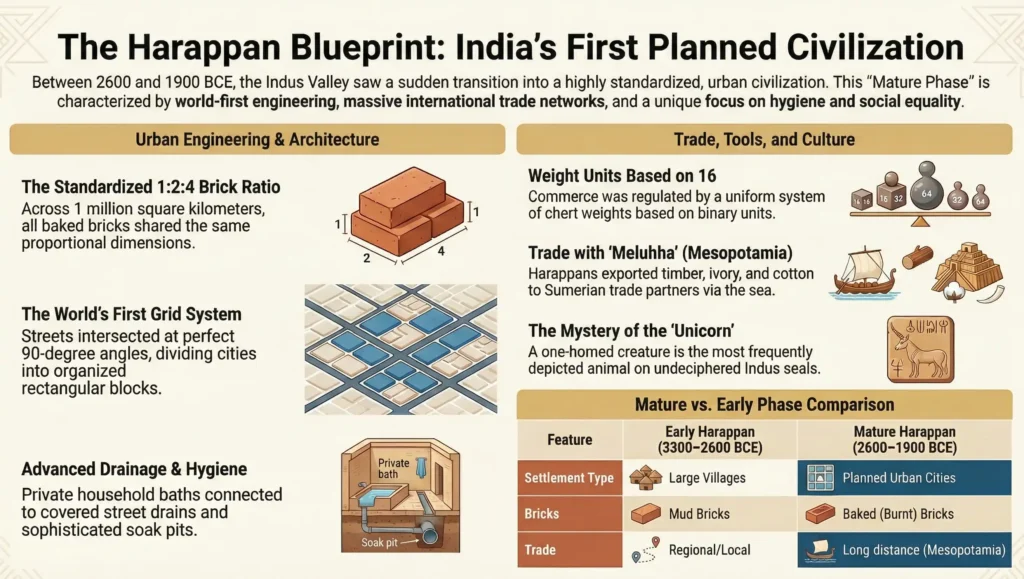
- Standardization: Suddenly, across a million square kilometers, everyone started using bricks of the same size ratio (1:2:4), the same system of chert weights (based on units of 16), and the same pottery styles.
- The “State” Question: This uniformity suggests a strong central authority or a highly cooperative guild system that enforced standards without the need for a massive military oppression.
Decline of the Indus Valley Civilization
Urban Planning: The Chessboard Cities
The most striking feature of this phase was Town Planning. Unlike the haphazard growth of Mesopotamian cities, Indus cities were planned before they were built.
- The Grid System: Streets cut each other at right angles (90 degrees), dividing the city into rectangular blocks.
- Citadel and Lower Town: Most cities were divided into two parts:
- The Citadel (Acropolis): A raised platform on the west, housing public buildings like the Great Bath and Granaries. It was likely for the elite/priests.
- The Lower Town: Located on the east, this was the residential area for the common people, buzzing with workshops and markets.
- The Great Bath: Found in Mohenjo-daro, this massive watertight tank (lined with bitumen/tar) suggests that ritual purity and bathing were central to their culture, a tradition that continues in India today.
Engineering Marvels: Drainage and Hygiene
The Harappans were obsessed with hygiene.
- Covered Drains: Every street had a covered drain flowing alongside it.
- Household Plumbing: Most houses had a private bathing area and a latrine that connected to the street drain through terracotta pipes. They had soak pits to filter waste before it entered the main sewage system—a level of engineering that Europe would not see until the Romans.
Early Vedic Period 1500-1000 BCE: The Age of the Rigveda
Economy: Trade and Crafts
The Mature Harappan economy was a mix of agriculture and high-value trade.
- Agriculture: They grew wheat, barley, mustard, and were the first people to cultivate Cotton. The massive Granaries found at Harappa and Mohenjo-daro indicate state-controlled grain storage.
- Craft Specialization: Cities like Chanhudaro were dedicated entirely to craft production, specifically bead-making (using Carnelian).
- International Trade: Indus seals have been found in Sumer (Mesopotamia) and Bahrain. The Mesopotamians called the Indus region Meluhha. They imported ivory, timber, lapis lazuli, and peacocks from India.
Society and Religion
- No Temples: Unlike Egypt or Sumer, no grand temples or palaces have been found.
- Worship: They worshipped nature and fertility. Key figures include:
- Pashupati Seal: A horned deity sitting in a yogic posture surrounded by animals (Proto-Shiva).
- Mother Goddess: Terracotta figurines suggesting a fertility cult.
- Sacred Trees/Animals: The Peepal tree and the Humped Bull were revered. The mysterious “Unicorn” is the most common animal on seals.
Rise of Jainism and Buddhism 6th Century BCE
Quick Comparison Table: Early Harappan vs. Mature Harappan
| Feature | Early Harappan (3300–2600 BCE) | Mature Harappan (2600–1900 BCE) |
| Settlement Type | Large Villages / Small Towns | Large Urban Cities |
| Planning | Rudimentary | Advanced Grid System |
| Writing | Proto-writing / Potters marks | Fully developed Indus Script |
| Trade | Regional | Long-distance (Mesopotamia) |
| Bricks | Mud Bricks | Baked (Burnt) Bricks |
| Crafts | Simple Copper/Stone tools | Specialized Bronze/Bead industries |
Curious Indian: Fast Facts
- The “Unicorn”: The most common animal depicted on Indus seals is a one-horned creature (Unicorn), which historians believe might be a mythical beast or a stylized profile of a bull.
- Peaceful People: Very few weapons of war (like swords or helmets) have been found compared to other civilizations, suggesting they were a relatively peaceful, trade-oriented society.
- Tsunami Defense: The city of Dholavira in Gujarat had massive stone walls and a sophisticated system of reservoirs, possibly to protect against tsunamis and manage fresh water.
- Did they have Pizza? They grew wheat and had ovens (tandoors), but no tomatoes! So, they likely ate tandoori rotis with lentil stews.
Conclusion
The Mature Harappan Phase was a flash of brilliance in human history. It demonstrated that a society could be prosperous, organized, and hygienic without being obsessed with war or monumental tombs. It laid the foundation for the “Indian way of life”—from the reverence for water and trees to the love for jewelry and cotton. While the cities eventually declined, the culture they created seeped into the soil, waiting to be reborn in the Second Urbanization.
Reign of Chandragupta Maurya: The First Empire of India
If you think you have remembered everything about this topic take this QUIZ
Results


#1. What is the defining feature of town planning during the Mature Harappan Phase?
#2. What was the highly standardized size ratio of the burnt bricks used across the civilization?
#3. By what name did the ancient Mesopotamians refer to the Indus Valley region?
#4. In which major city was the massive watertight tank known as “The Great Bath” discovered?
#5. The Harappans are credited with being the first people in the world to cultivate which crop?
#6. Unlike civilizations in Egypt or Sumer, which of these structures have archaeologists NOT found in Harappan cities?
#7. Which Harappan city featured massive stone walls and a sophisticated system of water reservoirs?
#8. What is the most common animal depicted on the seals of the Indus Valley Civilization?
What is the time period of the Mature Harappan Phase?
It lasted from roughly 2600 BCE to 1900 BCE.
Which city is known for the Great Bath?
Mohenjo-daro.
What was the main material used for construction?
Burnt (baked) bricks were used for major buildings and drains.
Did the Harappans use money?
No, they likely used a barter system, facilitated by standardized weights and seals for accounting.
What is the “Grid System”?
It is a method of town planning where streets intersect at right angles, creating rectangular blocks for houses.