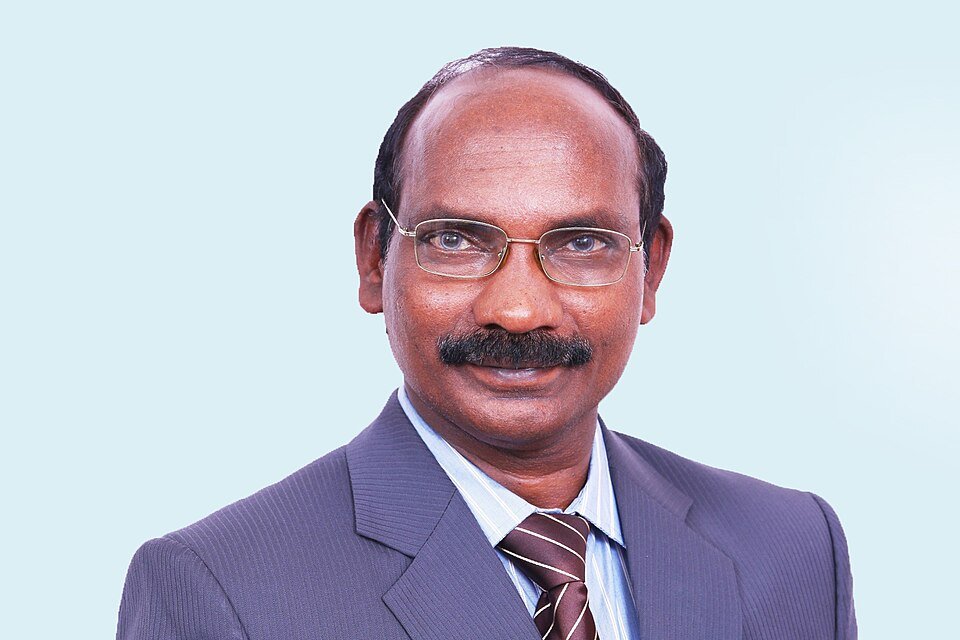
Dr. Kailasavadivoo Sivan (born 1957) is a distinguished Indian aerospace engineer and former Chairman of the Indian Space Research Organisation (ISRO). Born into a humble family of mango farmers in Sarakkalvilai, Tamil Nadu, he studied in a Tamil-medium government school and became the first graduate in his family. After completing degrees at MIT, IISc Bangalore, and IIT Bombay, he joined ISRO in 1982. Known affectionately as the "Rocket Man of India" for his mastery of launch vehicle technology, Sivan developed the critical SITARA trajectory simulation software and was the chief architect of the GSLV Mk-III rocket. His leadership was globally highlighted during the emotional Chandrayaan-2 lunar mission in 2019, turning a heartbreaking setback into a foundation for future success. He also launched the YUVIKA program to inspire young students in space science.| Feature | Details |
| Name | Dr. Kailasavadivoo Sivan (K. Sivan) |
| Birth Date | April 14, 1957 |
| Birthplace | Sarakkalvilai, Kanyakumari, Tamil Nadu |
| Profession | Aerospace Engineer, Scientist |
| Major Role | Former Chairman of ISRO (2018–2022) |
| Known As | “Rocket Man of India” |
| Key Contributions | SITARA Software, GSLV Mk-III, PSLV |
| Major Mission | Chandrayaan-2 (2019) |
| Alma Mater | Madras Institute of Technology (MIT), IISc, IIT Bombay |
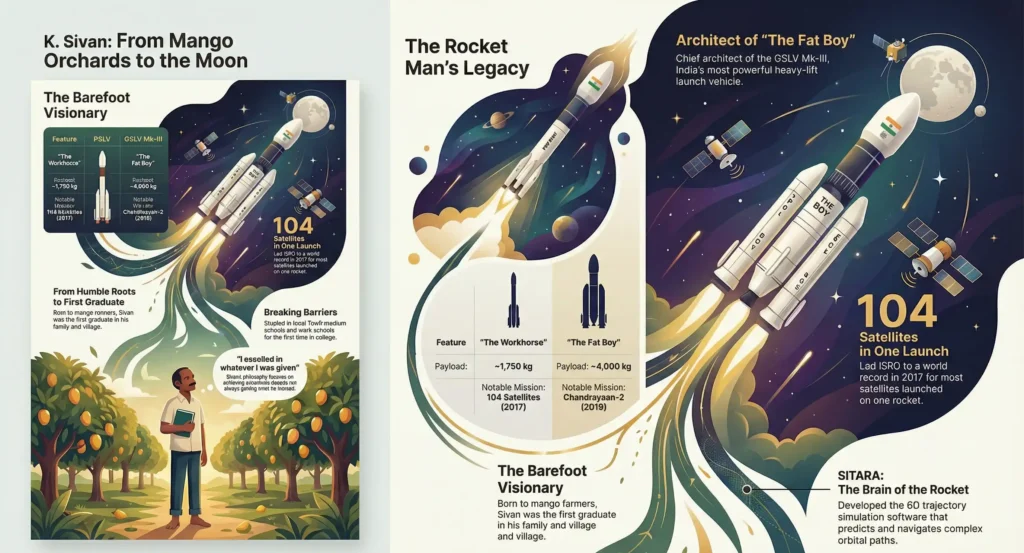
The Barefoot Visionary
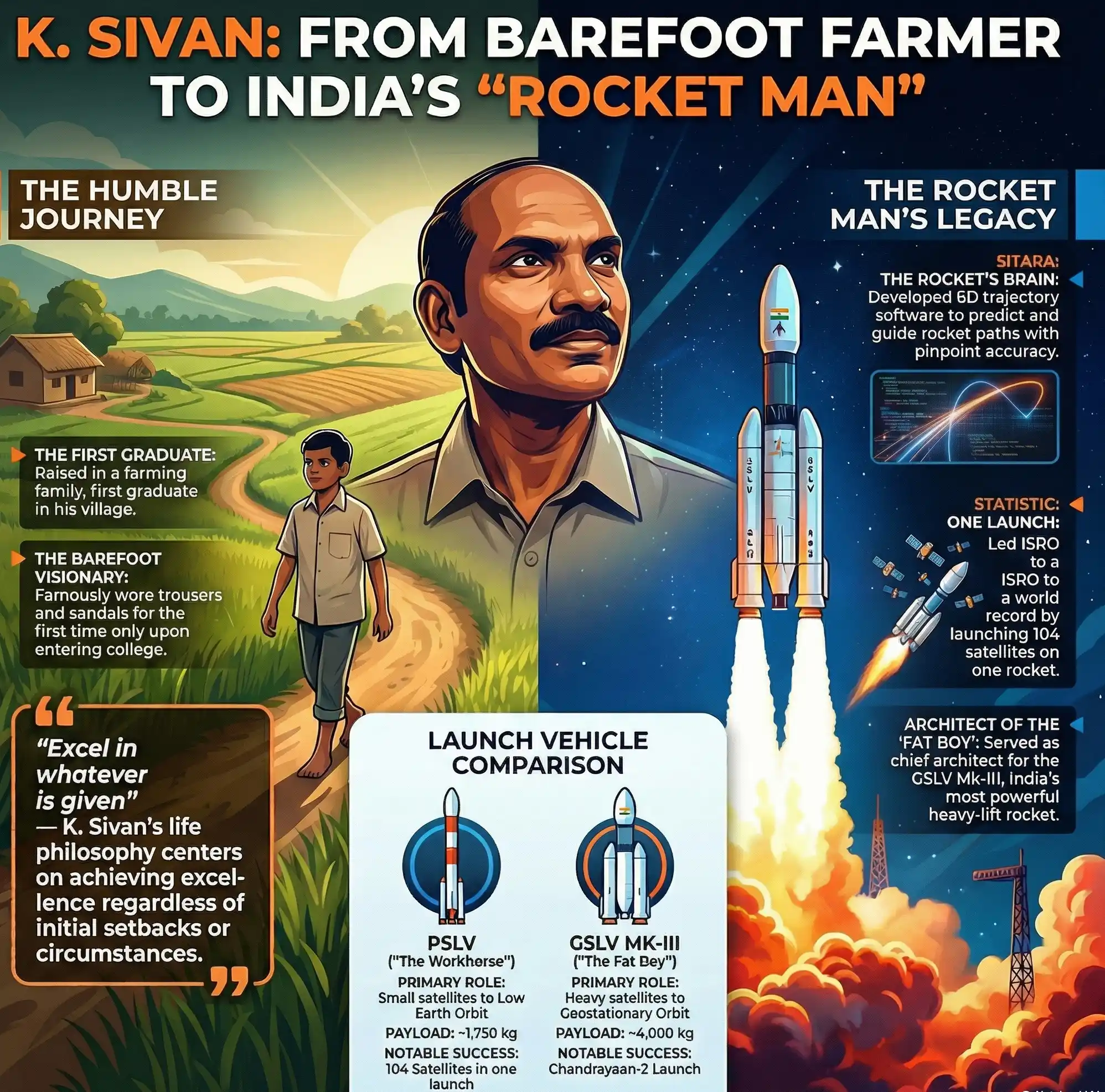
The journey of Dr. K. Sivan is one of the most powerful examples of how grit and a relentless pursuit of excellence can overcome extraordinary odds. Born on April 14, 1957, in a small village in Kanyakumari, Tamil Nadu, his childhood was defined by hard agricultural labor, not high-tech laboratories.
Sivan grew up helping his father in their mango orchards. He attended local government schools, studying entirely in the Tamil medium. His early life was so devoid of luxury that he famously wore a pair of trousers and sandals for the very first time only when he entered college at the Madras Institute of Technology (MIT). Before that, he walked barefoot in a traditional dhoti. He was not just the first graduate in his family; he was the first graduate in his entire village.
From Orchards to Orbits
His path to aerospace engineering was marked by financial hurdles. Initially, his father could not afford an engineering degree and urged him to study a Bachelor of Science in Mathematics instead. Despite initial resistance (even going on a hunger strike), Sivan relented and excelled in his BSc at Madurai University. Recognizing his son’s undeniable brilliance, his father later sold a portion of their land to fund Sivan’s dream of studying engineering at MIT.
His journey into space science accelerated at the Indian Institute of Science (IISc) in Bangalore, where he completed his Master’s in Aerospace Engineering. It was here that a professor nudged him toward rocket science. In 1982, he joined ISRO to work on the Polar Satellite Launch Vehicle (PSLV) project. Never one to stop learning, he completed his PhD from IIT Bombay in 2006 while working full-time.
Har Gobind Khorana: (1922- 2011)
The Architect of Trajectories: Major Achievements
Dr. Sivan earned the title “Rocket Man” because of his unparalleled mastery over launch vehicle technology.
- The SITARA Software: Early in his career, he developed a 6D trajectory simulation software called SITARA. This critical software acts as the brain behind ISRO launches, mathematically predicting and helping rockets navigate their complex path from Earth to orbit with pinpoint accuracy.
- GSLV Mk-III (The “Fat Boy”): Sivan was the chief architect of India’s most powerful launch vehicle, the GSLV Mk-III. This massive rocket gave India the heavy-lifting capability to launch large communication satellites and formed the backbone for future human spaceflight missions (Gaganyaan).
- Record-Breaking Launches: Under his leadership as Director of the Vikram Sarabhai Space Centre, ISRO set a stunning world record in 2017 by launching 104 satellites on a single PSLV rocket, showcasing India’s unmatched efficiency to the global space community.
Venkatraman Ramakrishnan: (1952- Present)
Chandrayaan-2: 15 Minutes of Terror
The defining moment of Sivan’s tenure as ISRO Chairman was the Chandrayaan-2 lunar mission in 2019. The world watched in awe as the Vikram lander descended toward the Moon’s unexplored South Pole. Sivan famously described the final automated landing phase as “15 minutes of terror.”
When ISRO lost communication with the lander just 2.1 kilometers above the lunar surface, the silence in the Mission Control Centre was deafening. The image of a tearful Sivan being consoled with a hug by Prime Minister Narendra Modi went viral, symbolizing the intense passion Indian scientists pour into their work.
However, Sivan’s true leadership shone in the aftermath. He immediately rallied his team, pointing out that the mission was 95% successful because the lunar orbiter was perfectly placed and functioning. This resilience laid the precise technological foundation for the triumphant landing of Chandrayaan-3 a few years later.
Manjul Bhargava: (1974- Present)
Quick Comparison Table: India’s Workhorse Rockets
| Feature | PSLV (Polar Satellite Launch Vehicle) | GSLV Mk-III (Launch Vehicle Mark-3) |
| Primary Role | Launching smaller satellites to Low Earth Orbit | Launching heavy satellites to Geostationary Orbit |
| Payload Capacity | ~1,750 kg (to Sun-Synchronous Orbit) | ~4,000 kg (to GTO) |
| Sivan’s Role | Early contributor to development | Chief Architect |
| Notable Mission | 104 Satellites in one launch (2017) | Chandrayaan-2 Launch (2019) |
| Nickname | “The Workhorse of ISRO” | “The Fat Boy” |
Curious Indian: Fast Facts
- YUVIKA Program: Passionate about democratizing space education, Sivan launched the Yuva Vigyani Karyakram (YUVIKA) program, an initiative to train young schoolchildren in space technology and catch future scientists early.
- The Philosophy of Excellence: Sivan’s life motto is a powerful lesson for students: “I didn’t always get what I wanted, but I excelled in whatever I was given.”
- Language is Not a Barrier: Sivan proved that a regional language background is not an impediment to global scientific brilliance. His success shattered the myth that English proficiency is required for technical genius.
Conclusion
Dr. K. Sivan is the embodiment of the great Indian dream. His life proves that it doesn’t matter if you start your journey walking barefoot through a village, as long as you keep your eyes fixed on the sky. He taught a nation that in science, there are no absolute failures—only data points for the next, better attempt. Through his brilliant trajectory software, his heavy-lift rockets, and his deeply human leadership, the “Rocket Man” ensured that India’s space program will soar for generations to come.
Har Gobind Khorana: (1922- 2011)
If you think you have remembered everything about this topic take this QUIZ
Results


#1. What popular nickname was given to Dr. K. Sivan due to his mastery of launch vehicle technology?
#2. Before entering the Madras Institute of Technology (MIT), Dr. Sivan famously walked barefoot in his village and wore which traditional garment?
#3. What is the name of the critical 6D trajectory simulation software developed by Dr. Sivan that helps rockets navigate their path to orbit?
#4. Under his leadership as Director of the Vikram Sarabhai Space Centre, ISRO set a world record in 2017 by launching how many satellites on a single PSLV rocket?
#5. Dr. Sivan was the chief architect of India’s most powerful launch vehicle, affectionately nicknamed “The Fat Boy.” What is its official name?
#6. How did Dr. Sivan famously describe the final automated landing phase of the Chandrayaan-2 Vikram lander?
#7. According to the comparison table, what is the approximate payload capacity of the GSLV Mk-III to Geostationary Transfer Orbit (GTO)?
#8. Passionate about democratizing space education, what program did Sivan launch to train young schoolchildren in space technology?
Why is K. Sivan called the “Rocket Man of India”?
He earned this title due to his mastery of launch vehicle technology, particularly his role as the chief architect of the heavy-lifting GSLV Mk-III rocket and his development of the SITARA trajectory software.
Where did K. Sivan complete his education?
He did his BSc at Madurai University, his engineering degree at Madras Institute of Technology (MIT), his Master’s at IISc Bangalore, and his PhD at IIT Bombay.
What happened during the Chandrayaan-2 mission?
Under his chairmanship, the mission successfully placed an orbiter around the Moon, but the Vikram lander unfortunately lost communication and crashed during its final descent to the lunar surface in 2019.
What is the SITARA software?
It is a 6D trajectory simulation software developed by Sivan early in his career at ISRO. It is used to plan and predict the precise flight path of ISRO’s rockets.
Did K. Sivan study in English medium schools?
No, he studied entirely in the Tamil medium in local government schools during his childhood, proving that language is not a barrier to scientific excellence.