The Indian National Congress (INC) was founded on December 28, 1885, in Bombay (Mumbai). It was the brainchild of a retired British civil servant, Allan Octavian Hume (A.O. Hume), who wanted to create a platform for educated Indians to vent their grievances—a "Safety Valve" to prevent another violent uprising like 1857. The first session was held at Gokuldas Tejpal Sanskrit College and was attended by 72 delegates. Presided over by Womesh Chandra Bonnerjee, the early Congress was a moderate body of lawyers and journalists pledging loyalty to the Crown. However, over the next few decades, it evolved from a debating club into a mass movement that would eventually force the British out of India.| Feature | Details |
| Founding Date | December 28, 1885 |
| Founding Location | Gokuldas Tejpal Sanskrit College, Bombay |
| Founder | A.O. Hume (Allan Octavian Hume) |
| First President | Womesh Chandra Bonnerjee |
| Number of Delegates | 72 |
| Viceroy at the Time | Lord Dufferin |
| Initial Objective | Administrative Reforms & “Safety Valve” |
| Evolution | Petition Politics -> Mass Movement |
The “Safety Valve” Theory
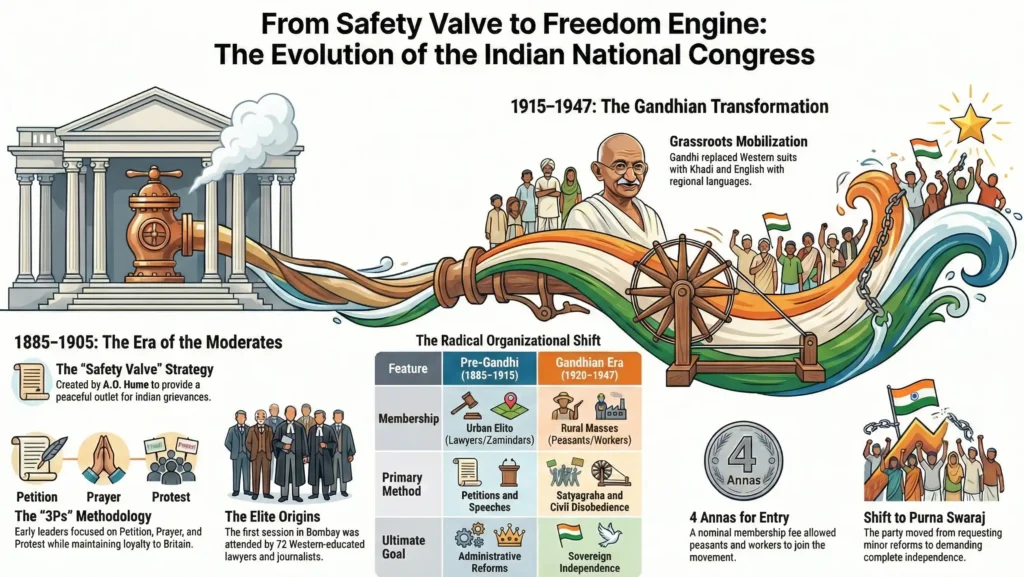
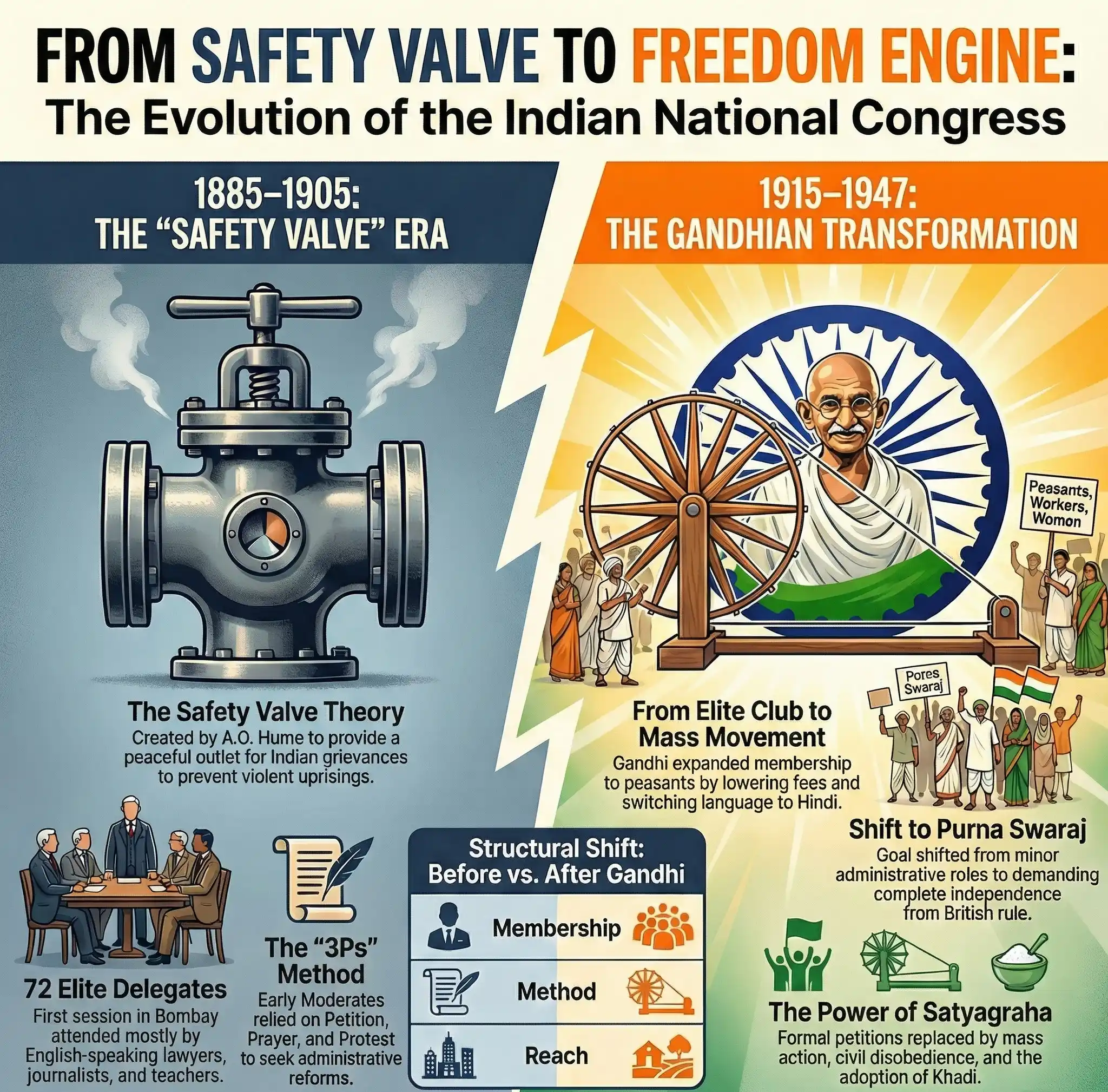
Why would a British officer found an Indian political party? The popular theory is that A.O. Hume had seen secret police reports indicating a massive unrest brewing among the Indian peasantry. To prevent a violent explosion, he wanted to provide a legal, peaceful outlet for Indian grievances. This is known as the “Safety Valve Theory”—using the Congress to release pressure before it blew up the Empire.
Lord Dufferin, the Viceroy, initially supported this idea, calling the Congress a “microscopic minority” that would help the government understand the natives better.
Partition of Bengal 1905: The Divide That United a Nation
The First Session: December 1885
The first meeting was originally scheduled for Poona (Pune), but a cholera outbreak forced the venue to shift to Bombay. On December 28, 1885, 72 delegates from across India gathered at Gokuldas Tejpal Sanskrit College.
- Who were they? Mostly lawyers, journalists, and teachers. They spoke in English and wore Western suits.
- What did they want? Not independence. They wanted civil service examinations to be held in India, reduction in military expenditure, and more Indians in the legislative councils. They ended the session by cheering “God Save the Queen.”
The Early Years: The Era of Moderates (1885–1905)
For the first 20 years, the Congress was dominated by “Moderates” like Dadabhai Naoroji, Pherozeshah Mehta, and Gopal Krishna Gokhale. Their method was “3Ps”—Petition, Prayer, and Protest. They believed in British justice and fair play. They wanted to be partners in the Empire, not rebels.
Dadabhai Naoroji, known as the “Grand Old Man of India,” gave the Congress its economic backbone with his “Drain Theory,” proving that Britain was bleeding India white. This intellectual awakening was crucial, even if their political methods were mild.
Muslim League Founded 1906: The Beginning of Communal Politics in India
The Split: 1907 Surat Session
The mild approach didn’t last. A younger generation, led by Bal Gangadhar Tilak, Lala Lajpat Rai, and Bipin Chandra Pal (Lal-Bal-Pal), grew impatient. They called the Moderates’ methods “political mendicancy” (begging).
- Moderates: Wanted reform through constitutional means.
- Extremists: Wanted Swaraj (Self-Rule) through mass action.
The tension boiled over at the Surat Session of 1907. Shoes were thrown, chairs were broken, and the Congress split into two factions. It would take nearly a decade for them to reunite at the Lucknow Session in 1916.
The Gandhian Transformation
The real transformation of the Congress happened after Mahatma Gandhi’s entry in 1915. He turned the Congress from a club of lawyers into a mass party.
- Language: He switched the language of Congress from English to Hindi and regional languages.
- Membership: He introduced a nominal membership fee of 4 Annas, making it affordable for peasants.
- Dress: The suits were replaced by Khadi.Suddenly, the Congress wasn’t just meeting once a year in December; it was in the villages, fighting for the farmer and the worker every day.
Jallianwala Bagh Massacre 1919: Inside the Tragedy That Ignited a Revolution
Quick Comparison Table: Pre-Gandhi vs. Post-Gandhi Congress
| Feature | Early Congress (1885–1915) | Gandhian Congress (1920–1947) |
| Membership | Elite (Lawyers, Zamindars) | Mass (Peasants, Workers, Women) |
| Goal | Administrative Reforms | Purna Swaraj (Complete Independence) |
| Method | Petitions & Speeches | Satyagraha & Civil Disobedience |
| Reach | Urban Cities | Villages & Rural India |
| Structure | Loose Annual Gathering | Organized Cadre-based Party |
Curious Indian: Fast Facts
- The First Woman President: Annie Besant (a British socialist) became the first woman president of the Congress in 1917. Sarojini Naidu was the first Indian woman president in 1925.
- A.O. Hume’s Ornithology: The founder of the Congress, A.O. Hume, was also a legendary ornithologist. He is often called the “Father of Indian Ornithology” and had a massive collection of bird skins.
- Dufferin’s Change of Heart: Within a few years, Viceroy Dufferin realized the Congress was becoming dangerous. He famously mocked it as a “microscopic minority” representing no one.
- The “Tryst with Destiny”: The Congress, which started by singing “God Save the Queen” in 1885, ended up raising the Tricolor in 1947 with Nehru’s historic speech.
Conclusion
The founding of the Indian National Congress in 1885 was a modest event with massive consequences. It created a “Idea of India”—a single political entity that transcended region, religion, and caste. What started as a safety valve became the engine of the world’s largest democracy. It proves that even the most polite conversations, if held with conviction, can eventually topple empires.
Non-Cooperation Movement 1920-1922: The Day India Said “No” to the British
If you think you have remembered everything about this topic take this QUIZ
Results


#1. Who was the retired British civil servant credited with founding the INC?
#2. Who presided over the very first session of the Congress in Bombay?
#3. How many delegates attended the first session of the Congress?
#4. The “Safety Valve Theory” suggests that the Congress was founded to:
#5. Which famous economic theory did Dadabhai Naoroji propose to prove Britain was bleeding India white?
#6. In which year did the Congress split into Moderates and Extremists at the Surat Session?
#7. Who was the first woman to become the President of the Indian National Congress in 1917?
Who founded the Indian National Congress?
It was founded by Allan Octavian Hume (A.O. Hume), a retired British civil servant.
When and where was the first session held?
The first session was held on December 28, 1885, at Gokuldas Tejpal Sanskrit College in Bombay.
Who was the first President of the INC?
Womesh Chandra Bonnerjee was the first President.
What is the “Safety Valve” theory?
It is the theory that the British founded the Congress to provide a safe, peaceful outlet for Indian grievances to avoid a violent rebellion like the 1857 Mutiny.
When did the Congress demand Complete Independence?
The Congress officially demanded Purna Swaraj (Complete Independence) at the Lahore Session in 1929 under Jawaharlal Nehru’s presidency.