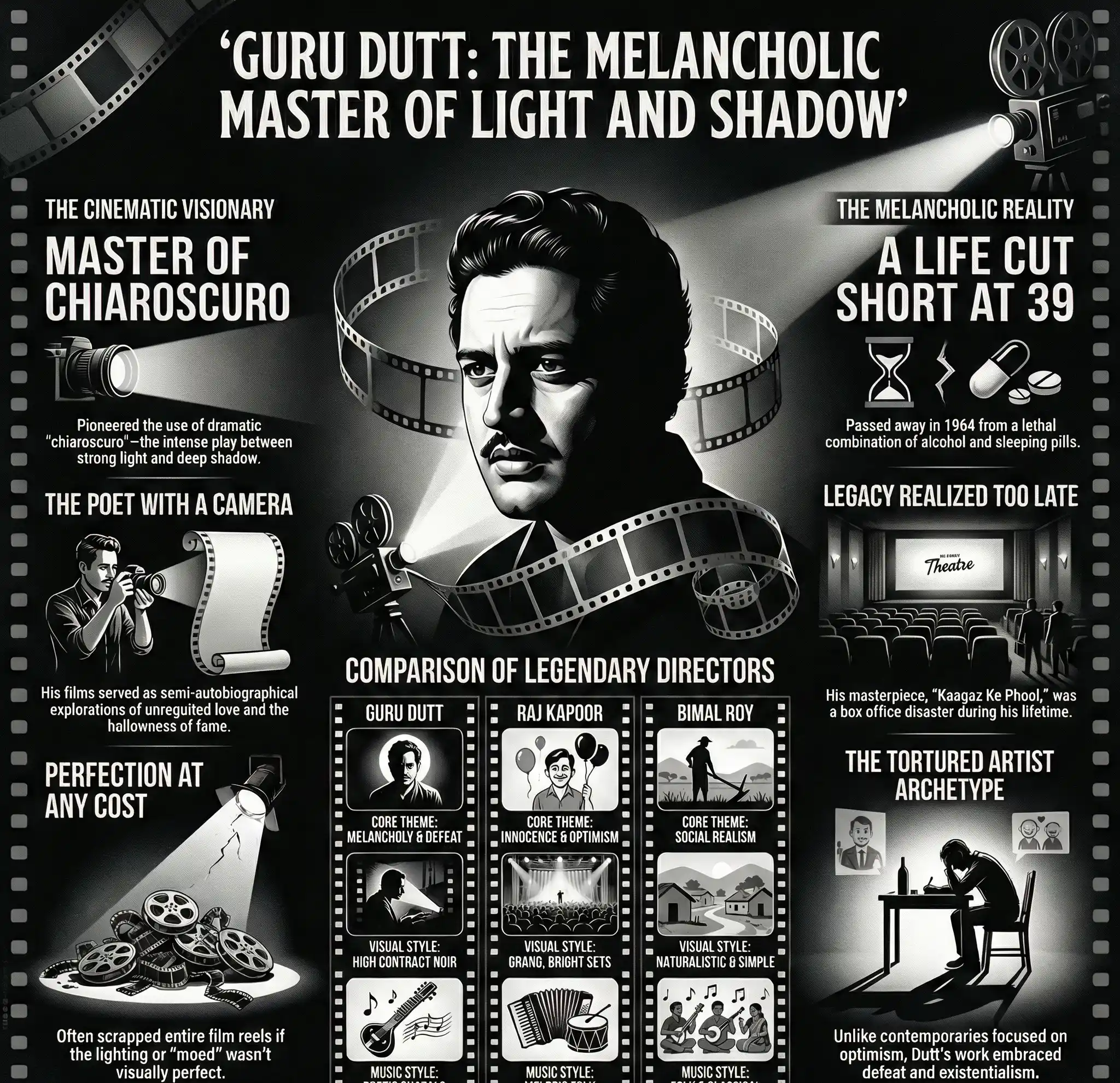
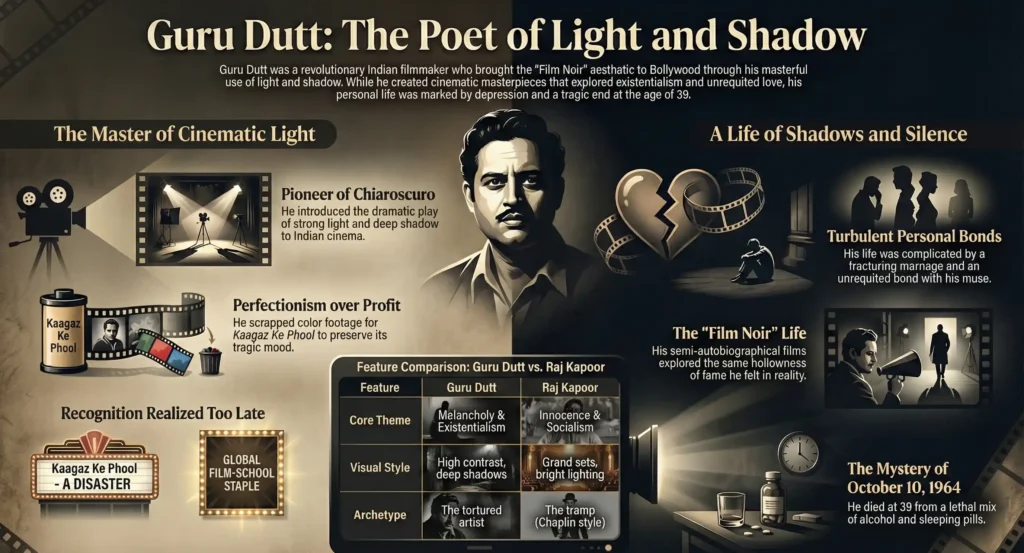
Guru Dutt was not just a filmmaker; he was a poet who wrote with a camera. Born Vasanth Kumar Shivashankar Padukone, he revolutionized Indian cinema with his use of shadow and light, bringing the "Film Noir" style to Bollywood. His films, often semi-autobiographical, explored the hollowness of fame and the pain of unrequited love. However, his on-screen tragedies bled into his real life. Struggling with a turbulent marriage to singer Geeta Dutt and an unverified but intense closeness with his muse Waheeda Rehman, Guru Dutt waged a lonely battle with depression. He passed away at the young age of 39 from an overdose of alcohol and sleeping pills—leaving behind a legacy that is as magnificent as it is melancholic.| Attribute | Details |
| Real Name | Vasanth Kumar Shivashankar Padukone |
| Date of Birth | July 9, 1925 |
| Birthplace | Bangalore, Mysore State (Now Karnataka) |
| Date of Death | October 10, 1964 (Aged 39) |
| Cause of Death | Overdose (Alcohol & Sleeping Pills) |
| Spouse | Geeta Dutt (m. 1953–1964) |
| Key Films | Pyaasa, Kaagaz Ke Phool, Sahib Bibi Aur Ghulam |
| Frequent Collaborators | V.K. Murthy (Cinematographer), Waheeda Rehman |
| Famous Relative | Amrita Rao (distant relative), Kalpana Lajmi (niece) |
The Man Who Spoke in Shadows
The Guru Dutt biography reads less like a success story and more like a haunting screenplay he might have written himself. While the world remembers him today as a visionary who gave us Pyaasa and Kaagaz Ke Phool, his contemporaries often saw a man deeply at odds with the world around him.
Born in 1925 in Bangalore, Guru Dutt’s early life was nomadic and financially unstable, moving between Calcutta and Bombay.6 This instability perhaps fostered the deep sense of restlessness that defined his adult life. He started his career as a telephone operator in Calcutta, but the mundane could not hold him.7 He found his way to the famous Prabhat Studios in Pune, where he struck up a friendship with another struggling actor, Dev Anand.8 They made a pact: if Guru Dutt became a director, he would cast Dev Anand; if Dev Anand became a producer, he would hire Guru Dutt. Remarkably, they kept this promise with the film Baazi (1951).
8 Remarkable Secrets in the Jagadish Chandra Bose Biography
The Master of Light and Darkness
Guru Dutt is often credited with introducing a distinct visual language to Hindi cinema.9 Along with his ace cinematographer V.K. Murthy, he pioneered the use of “chiaroscuro”—the dramatic play of strong light and deep shadow.10
This wasn’t just an aesthetic choice; it was a reflection of his internal state. In Kaagaz Ke Phool, the famous beam of light in the studio scene wasn’t just a technical marvel; it symbolized the loneliness of the protagonist. He was a perfectionist who would scrap entire film reels if the “mood” wasn’t right. This obsession often led to ballooning budgets and delayed schedules, earning him both awe and frustration from his producers.
The Muse and the Marriage
No Guru Dutt biography is complete without addressing the complex women in his life. He married the celebrated playback singer Geeta Roy (Geeta Dutt) in 1953.11 It was a love marriage that started with passion but slowly crumbled under the weight of professional egos and personal demons.12
Then came Waheeda Rehman. Dutt discovered her in a Telugu film and brought her to Bombay, grooming her into a star.13 Their on-screen chemistry in Pyaasa and Chaudhvin Ka Chand was palpable.14 Rumors of an intense, perhaps unrequited, romance swirled. While Waheeda Rehman has always maintained a dignified silence, industry insiders often cited this closeness as the final wedge in his already fracturing marriage with Geeta Dutt.15 The “forbidden” nature of this bond mirrored the tragic romances in his own films.
8 Fascinating Facts in the Homi Jehangir Bhabha Biography
The Mystery of October 10, 1964
The most enduring mystery of Guru Dutt’s life is his death. On the morning of October 10, 1964, he was found dead in his bed at his rented apartment on Pedder Road, Mumbai.16 He was only 39.17 The cause was identified as a lethal mix of alcohol and sleeping pills.18
Was it suicide? Or was it a tragic accident?
His brother, Atma Ram, and son, Arun Dutt, have often leaned toward the theory of an accidental overdose, citing that he had scheduled meetings for the next day.19 However, dark whispers persist. It is said that this was his third suicide attempt.20 He had been living alone, separated from Geeta, and was reportedly in a state of severe depression regarding his estrangement from his children.21 The unfinished film Baharen Phir Bhi Aayengi (later completed by Dharmendra) stands as a testament to a life cut short in its prime.22
A Legacy Realized Too Late
Tragically, Guru Dutt’s most personal film, Kaagaz Ke Phool (1959), was a colossal box office disaster upon release.23 The audience of the time could not understand its non-linear narrative and mournful tone. The failure devastated him, and he never officially directed a film again (though he ghost-directed much of Sahib Bibi Aur Ghulam).
Decades later, Kaagaz Ke Phool is now taught in film schools globally as a masterpiece.24 Like the protagonist of Pyaasa, the world recognized his genius only after he was gone.
7 Incredible Facts in the Satyendra Nath Bose Biography
Quick Comparison: The Directorial Giants
How does Guru Dutt compare to the other legends of his era, Raj Kapoor and Bimal Roy?
| Feature | Guru Dutt | Raj Kapoor | Bimal Roy |
| Core Theme | Melancholy, defeat, & existentialism | Innocence, socialism, & optimism | Social realism & rural struggle |
| Visual Style | High contrast, deep shadows (Noir) | Grand sets, bright lighting | Naturalistic, simple composition |
| Archetype | The tortured artist | The tramp (Charlie Chaplin style) | The common man |
| Music Style | Poetic, ghazal-heavy (Sahir Ludhianvi) | Melodic, folk-inspired | Folk & classical blend |
Curious Indian: Fast Facts
- The Name Change: He was born Vasanth Kumar.25 A childhood accident was deemed “unlucky,” so his parents changed his name to “Guru Dutt.”26
- The First Choice: For Pyaasa, Guru Dutt originally wanted Dilip Kumar to play the lead role of Vijay. Dilip Kumar declined, forcing Guru Dutt to step in—a move that created history.
- The Mobile Number: In the song “Sir Jo Tera Chakraye,” the car number plate shown is actually Guru Dutt’s real-life car number.
- Discovery of Johnny Walker: Guru Dutt discovered the comedian Johnny Walker (Badruddin Jamaluddin Kazi) on a bus. He was impressed by Kazi’s ability to entertain passengers while pretending to be a drunkard.
- Color Cinema: He shot two reels of Kaagaz Ke Phool in color but scrapped them because he felt the “tragedy” was better conveyed in Black & White.
Conclusion
The Guru Dutt biography serves as a stark reminder of the isolation that often accompanies brilliance. He was a man who could frame the perfect shot but could not frame a happy life for himself. His films were cries for help that turned into art. Today, as we watch the play of light and shadow in his classics, we are not just watching a movie; we are witnessing the soul of a man who gave everything to cinema, until he had nothing left to give.
10 Remarkable Facts About Meghnad Saha Life and Achievements
If you think you have remembered everything about this topic take this QUIZ
Results


#1. What was Guru Dutt’s real birth name before it was changed?
#2. With which famous actor did Guru Dutt make a pact at Prabhat Studios to help each other’s careers?
#3. Who was the ace cinematographer responsible for the distinct “light and shadow” (chiaroscuro) visual style in Guru Dutt’s films?
#4. Which Guru Dutt film was a colossal box office disaster upon release but is now considered a masterpiece?
#5. Who was Guru Dutt’s wife, a celebrated playback singer with whom he had a turbulent marriage?
#6. Guru Dutt originally wanted which actor to play the lead role of Vijay in the movie Pyaasa?
#7. Which comedian did Guru Dutt discover on a bus, impressed by his ability to entertain passengers?
#8. Guru Dutt passed away at the young age of 39 due to:
Was Guru Dutt’s death a suicide or an accident?
The official verdict remains ambiguous. While it was ruled an overdose of sleeping pills and liquor, many close associates and biographers believe it was a suicide due to his history of depression and two previous attempts. Family members, however, have often stated it could have been an accidental overdose due to insomnia.
Why did Guru Dutt stop directing films?
After the crushing commercial failure of Kaagaz Ke Phool (1959), Guru Dutt was heartbroken. He lost confidence in his ability to connect with audiences as a director and decided to produce and act only, though he reportedly ghost-directed Sahib Bibi Aur Ghulam.
What was the relationship between Guru Dutt and Waheeda Rehman?
While never officially confirmed as a romance, they shared a deep professional and personal bond. Guru Dutt was her mentor and launched her career. Their closeness is widely believed to have caused friction in Guru Dutt’s marriage, though Waheeda Rehman has always maintained that he was her mentor and nothing more.
Which is Guru Dutt’s most famous movie?
Pyaasa (1957) is widely considered his magnum opus. It was named one of the “100 Best Films of All Time” by Time magazine.
Who completed Guru Dutt’s last film?
At the time of his death, Guru Dutt was shooting for Baharen Phir Bhi Aayengi. After his passing, the lead role was reshot with actor Dharmendra.
Read More: https://curiousindian.in/rekha-october-1954-present/