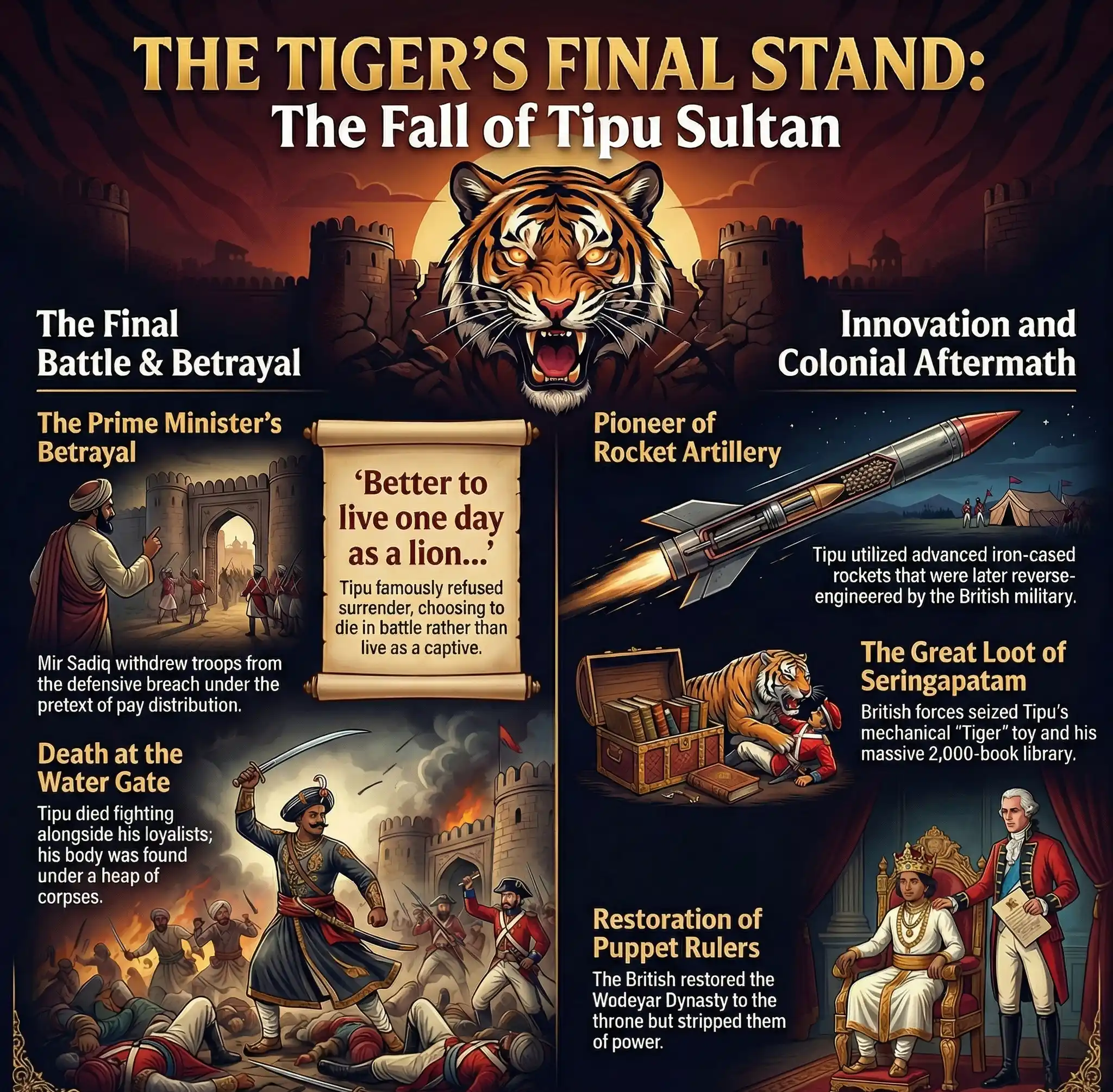
The Death of Tipu Sultan on May 4, 1799, marked the end of the Fourth Anglo-Mysore War and the collapse of the Kingdom of Mysore. Tipu Sultan, known as the "Tiger of Mysore," was the most formidable enemy of the British East India Company in South India. Facing a massive coalition of British, Nizam, and Maratha forces, Tipu defended his capital, Seringapatam (Srirangapatna). However, he was undone by the treachery of his own minister, Mir Sadiq, who pulled troops away from the breach at the critical moment. Tipu refused to surrender, famously declaring, "It is better to live one day as a lion than a hundred years as a jackal." He died fighting near the Water Gate, his body later found under a heap of corpses.| Feature | Details |
| Date of Death | May 4, 1799 |
| Location | Seringapatam (Srirangapatna), Mysore |
| Conflict | Fourth Anglo-Mysore War |
| British Commander | General George Harris / Lord Wellesley |
| Key Betrayer | Mir Sadiq (Prime Minister) |
| Famous Quote | “Better to live one day as a lion…” |
| Artifacts Looted | Tipu’s Tiger (Mechanical Toy), Sword, Ring |
| Succession | Wodeyar Dynasty restored (Puppet Rulers) |
The Thorn in the British Flesh
By 1799, Tipu Sultan was the only Indian ruler who actively sought alliances with foreign powers like Napoleonic France to drive the British out of India. This terrified the Governor-General, Lord Wellesley. Unlike other Indian princes who signed Subsidiary Alliances, Tipu modernized his army, introduced rocket technology (Mysorean rockets), and refused to bow down.
Wellesley decided that Tipu had to be eliminated. He assembled a massive force of over 50,000 troops, including the Nizam of Hyderabad’s army, and marched towards the island fortress of Seringapatam.
Jallianwala Bagh Massacre 1919: The Day the British Raj Lost its Soul
The Siege of Seringapatam
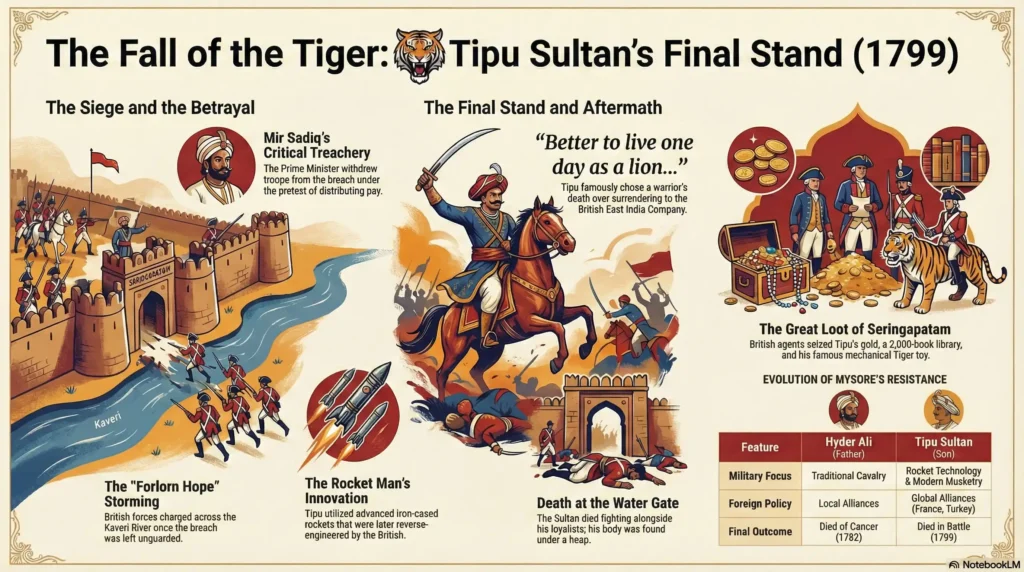
The siege began in April 1799. Tipu’s fortress was formidable, surrounded by the river Kaveri. For weeks, the British artillery pounded the walls, creating a breach. But the real damage was being done inside the walls. The British had successfully bribed key figures in Tipu’s court.
Mir Sadiq, Tipu’s Prime Minister, was the architect of the betrayal. On the afternoon of May 4, traditionally a time for rest, Sadiq reportedly withdrew the soldiers guarding the breach under the pretext of distributing their pay.
The Midnight of August 15: Freedom, Partition, and the Blood on the Map
The Final Hour
Sensing the breach was unguarded, the British “Forlorn Hope” (storming party) led by General David Baird charged across the river. Tipu was having his midday meal when he heard the commotion. He abandoned his lunch and rushed to the breach with his musket.
Unlike many rulers who would flee to safety, Tipu plunged into the fray. He shot several British soldiers with his own hand. As the British soldiers overwhelmed his guards, he was advised to surrender. He refused. A British soldier tried to snatch his jewel-encrusted swordbelt; Tipu slashed at him with his sword, wounding him. The soldier then shot Tipu in the temple, killing him instantly.
The Discovery of the Body
For hours, Tipu’s fate was unknown. That evening, General Baird (who had once been Tipu’s prisoner) went searching with torches. They found the Sultan’s body near the Water Gate, buried under a pile of dead loyalists. His eyes were open, and his body was still warm, leading the British to initially believe he was alive. He was stripped of his jewels, but his sword lay beside him.
Indian Rebellion of 1857: The First War of Independence
The Great Loot of Seringapatam
What followed was one of the most shameful episodes of British colonial history. The “Prize Agents” systematically looted the city.
- Tipu’s Tiger: A mechanical wooden toy of a tiger mauling a British soldier (Tipu’s favorite curiosity) was shipped to London. It is now in the Victoria and Albert Museum.
- The Library: Tipu’s massive library of 2,000 books was packed off to Oxford and Cambridge.
- The Gold: The sheer amount of gold and jewelry looted was so vast that soldiers were reportedly using gold coins to buy liquor, unaware of their value.
The Aftermath
With Tipu gone, the British restored the old Wodeyar Hindu dynasty to the throne of Mysore, but stripped them of real power. Mysore became a “Subsidiary State.” Tipu’s sons were exiled to Vellore (and later Calcutta). The “Tiger” was silenced, and the path was clear for British dominance over the entire Indian peninsula.
Establishment of the British Raj 1858: The Dawn of Imperial India
Quick Comparison Table: Hyder Ali vs. Tipu Sultan
| Feature | Hyder Ali (Father) | Tipu Sultan (Son) |
| Relationship with British | Wary rivalry; fought 1st & 2nd Wars | Implacable hatred; fought 3rd & 4th Wars |
| Military Innovation | Traditional Cavalry focus | Rocket Technology & Modern Musketry |
| Foreign Policy | Local alliances | Global alliances (France, Turkey, Afghanistan) |
| Religious Policy | Largely Secular/Pragmatic | More controversial; seen as zealous by some |
| End | Died of Cancer (1782) | Died in Battle (1799) |
Curious Indian: Fast Facts
- The Rocket Man: Tipu is considered the pioneer of rocket artillery. His iron-cased rockets were so effective that the British reverse-engineered them to create the Congreve Rocket used in the Napoleonic Wars.
- The Betrayer’s End: Mir Sadiq did not enjoy his reward. As he tried to escape the fort to join the British, he was recognized by Mysorean soldiers and hacked to death on the spot.
- Napoleon’s Letter: Napoleon Bonaparte actually wrote a letter to Tipu Sultan from Egypt in 1799, promising to come to his aid, but the letter was intercepted by the British, sealing Tipu’s fate.
- The Tiger Emblem: Everything in Tipu’s court—from his throne to his soldiers’ uniforms—bore the stripe of the tiger (Bubri). He famously said he would rather live like a tiger than a sheep.
Conclusion
The Death of Tipu Sultan was the tragic finale of 18th-century Indian resistance. While historians debate his internal policies, there is no debating his courage. He was the only Indian monarch to die on the battlefield fighting the British. His fall taught India a bitter lesson: that foreign conquerors often succeed not because of their own strength, but because of the “Mir Sadiqs” within our own gates.
Annexation of Punjab 1849: The Fall of the Sikh Empire
If you think you have remembered everything about this topic take this QUIZ
Results


#1. On which date did Tipu Sultan die, marking the end of the Fourth Anglo-Mysore War?
#2. Who was the treacherous minister who betrayed Tipu Sultan by withdrawing troops from the breach?
#3. Tipu Sultan is famous for which defiant quote regarding his philosophy of life?
#4. Tipu Sultan is considered a pioneer of which military technology that was later reverse-engineered by the British?
#5. Which famous mechanical artifact, depicting a tiger mauling a British soldier, was looted and is now in the Victoria and Albert Museum?
#6. Which French leader wrote a letter to Tipu Sultan promising aid, which was intercepted by the British?
#7. After Tipu Sultan’s death, which dynasty was restored to the throne of Mysore by the British?
#8. Tipu Sultan’s body was found near which specific location in the fortress of Seringapatam?
How did Tipu Sultan die?
Tipu Sultan was shot in the head by a British soldier near the Water Gate of Seringapatam while defending his capital on May 4, 1799.
Who betrayed Tipu Sultan?
His Prime Minister, Mir Sadiq, betrayed him by withdrawing troops from the breach in the fort walls to allow the British to enter.
What happened to Tipu Sultan’s sword?
It was taken as a war trophy to Britain. It changed hands many times and was eventually bought by Vijay Mallya at an auction in 2004 and brought back to India.
What is “Tipu’s Tiger”?
It is a famous mechanical organ shaped like a tiger mauling a European soldier. It produces roaring sounds and the soldier’s cries. It is currently displayed at the V&A Museum in London.
Which war ended with Tipu’s death?
The Fourth Anglo-Mysore War (1799) ended with his death.