The Battle of Talikota, fought on January 23, 1565, was a watershed moment in Indian history. It marked the collapse of the Vijayanagara Empire, the last major Hindu kingdom in South India. The battle was fought between the forces of Vijayanagara, led by the de facto ruler Aliya Rama Raya, and a grand alliance of the four Deccan Sultanates (Bijapur, Bidar, Ahmednagar, and Golconda). Fought near the villages of Rakkasagi and Tangadigi, the battle ended in a disastrous defeat for Vijayanagara. Rama Raya was captured and beheaded on the battlefield. The defeat paved the way for the Sack of Hampi, where the magnificent capital was looted, burned, and destroyed for six months, leaving behind the desolate ruins we see today.| Feature | Details |
| Date | January 23, 1565 |
| Location | Talikota / Rakkasagi-Tangadigi (Karnataka) |
| Vijayanagara Leader | Aliya Rama Raya (Regent) |
| Sultanate Leaders | Ali Adil Shah (Bijapur), Nizam Shah (Ahmednagar), Qutb Shah (Golconda), Barid Shah (Bidar) |
| Force Strength | Vijayanagara: ~100,000 |
| Key Factor | Sultanate Artillery & Betrayal of Gilani Brothers |
| Outcome | Total Destruction of Vijayanagara Army |
| Aftermath | Destruction of Hampi (Capital City) |
The Glory Before the Fall
By the mid-16th century, the Vijayanagara Empire was at its zenith. Its capital, Hampi, was likely the second-largest city in the world after Beijing. European travelers like Domingo Paes described it as “as large as Rome and very beautiful,” overflowing with gold, diamonds, and temples.
The empire was ruled nominally by Sadashiva Raya, but the real power lay with his son-in-law and regent, Aliya Rama Raya. Rama Raya was a brilliant but arrogant diplomat. For decades, he had kept the neighboring Deccan Sultanates weak by pitting them against each other—helping Bijapur against Ahmednagar one year, and switching sides the next.
Reign of Akbar 1556-1605: The Golden Age of the Mughal Empire
The Unholy Alliance
Rama Raya’s policy of “divide and rule” eventually backfired. The Sultans realized that their mutual bickering was only making Vijayanagara stronger. In a historic move, the four rival Sultanates—Bijapur, Ahmednagar, Golconda, and Bidar—put aside their differences. They formed a “Grand Alliance” (Jihad) cemented by inter-dynastic marriages, with the sole aim of destroying Vijayanagara.
The Battle Formation
The two massive armies met south of the Krishna River.
- Vijayanagara: Rama Raya, despite being in his 80s, commanded the center. His brothers, Tirumala and Venkatadri, commanded the wings. They relied heavily on their massive cavalry and war elephants.
- The Sultanates: They had a secret weapon—Artillery. The Sultans had engaged Turkish gunners and possessed superior cannons that could fire over long distances.
The Day of Disaster: January 23, 1565
The battle began with a Vijayanagara advantage. Their sheer numbers pushed the Sultanate wings back. It looked like another victory for Rama Raya.
However, the tide turned due to two factors:
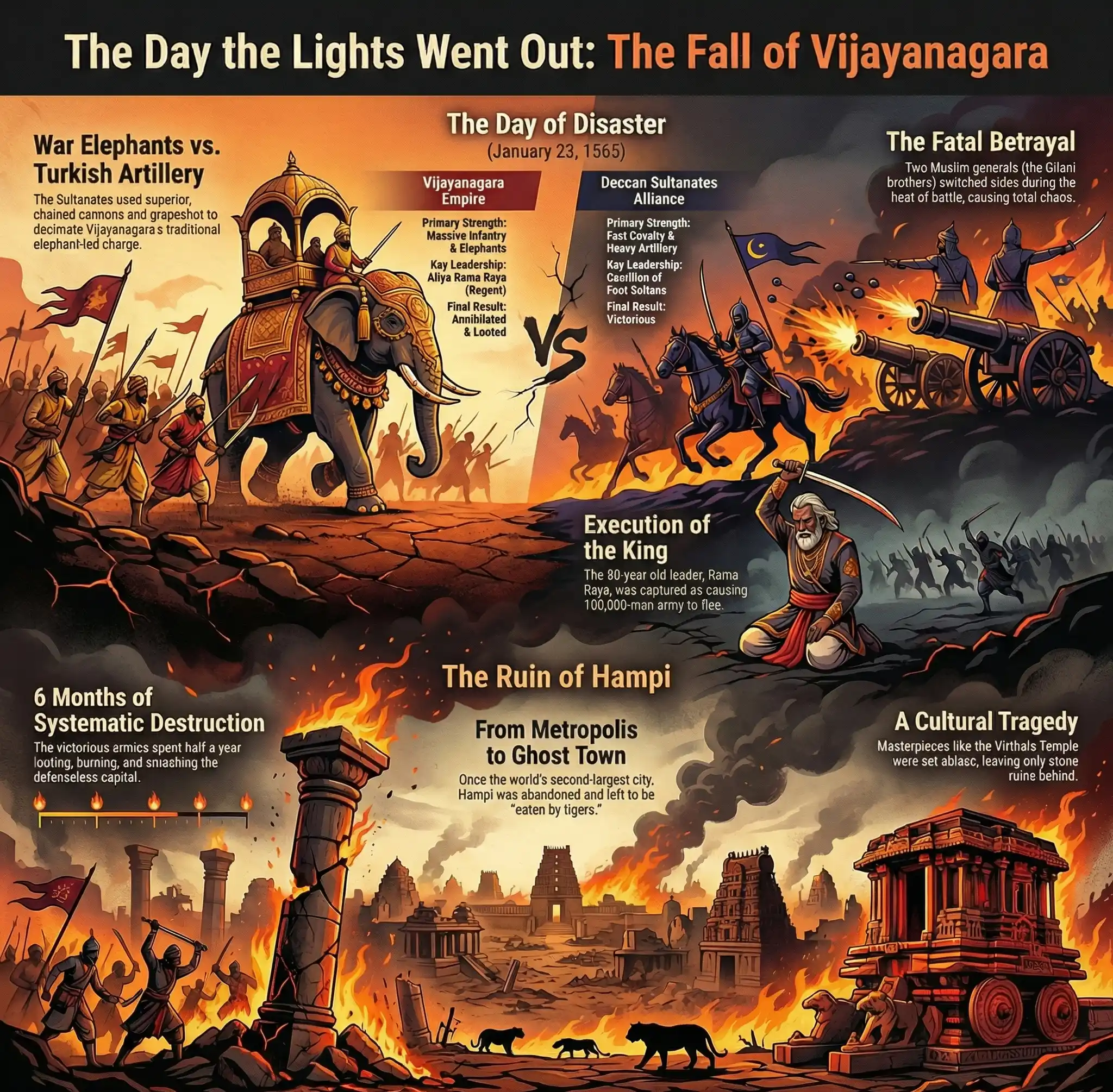
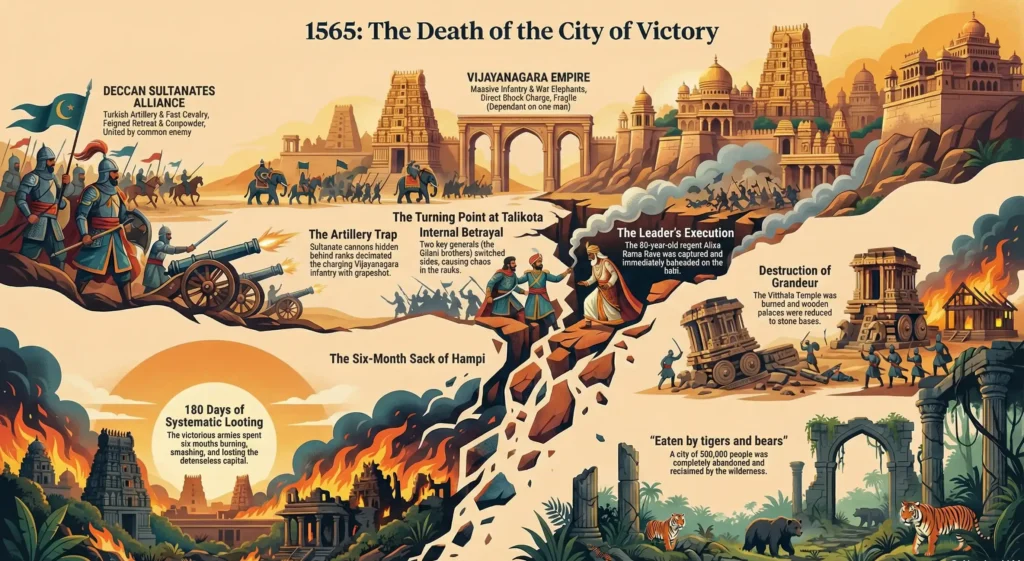
- The Artillery Trap: The Sultanate center feigned a retreat, drawing the Vijayanagara infantry forward. Suddenly, the Sultanate ranks parted to reveal rows of heavy cannons tied together with chains. They opened fire with grapeshot (bags of nails and metal), decimating the Vijayanagara charge.
- The Betrayal: Historical accounts suggest that two Muslim generals in the Vijayanagara army (the Gilani brothers), whom Rama Raya had treated like his own sons, switched sides at the critical moment, creating chaos in the ranks.
Third Battle of Panipat 1761: The Day the Maratha Dream Died
The Death of Rama Raya
In the confusion, Rama Raya’s elephant was surrounded. He was captured and brought before Hussain Nizam Shah of Ahmednagar. The Sultan immediately beheaded him. The sight of their leader’s head mounted on a spear caused the Vijayanagara army to panic and flee. The river ran red with blood.
The Sack of Hampi
What followed was one of the greatest cultural tragedies in history. The victorious Sultanate armies rested for three days and then marched to the capital, Hampi.
The city was defenseless. For six months, the soldiers looted, burned, and smashed.
- Temples: The idols were smashed, and the sacred fires were extinguished. The Vitthala Temple complex was set ablaze.
- Palaces: The wooden structures of the royal enclosure were burned down (the stone bases remain today).
- Wealth: Gold, diamonds, and precious stones were carted away on elephants.The city, once home to 500,000 people, was abandoned and “eaten by tigers and bears.”
Death of Tipu Sultan: The Fall of the Tiger of Mysore
Quick Comparison Table: Vijayanagara vs. Deccan Sultanates
| Feature | Vijayanagara Empire | Deccan Sultanates Alliance |
| Strength | Massive Infantry & War Elephants | Fast Cavalry & Turkish Artillery |
| Strategy | Shock Charge | Feigned Retreat & Gunpowder |
| Leadership | Aliya Rama Raya (Octogenarian) | Young Coalition of Sultans |
| Unity | Fragile (Dependent on one man) | United by common enemy |
| Outcome | Annihilated | Victorious |
Curious Indian: Fast Facts
- A Forgotten Empire: The battle was so decisive that Robert Sewell titled his famous history of Vijayanagara “A Forgotten Empire.” The empire didn’t just fall; it was erased.
- The Name: The battle is historically called “Talikota,” but it actually took place 40km away at Rakkasagi and Tangadigi. The Sultans merely camped at Talikota.
- Rama Raya’s Age: Aliya Rama Raya was believed to be over 80 years old when he led the army into battle, sitting in a palanquin/howdah.
- The Survival: The empire technically survived for another century under the Aravidu dynasty (operating from Penukonda and Chandragiri), but it was a shadow of its former self.
Conclusion
The Battle of Talikota serves as a brutal reminder that military might is useless without diplomatic foresight. Rama Raya’s arrogance united his enemies, and his failure to modernize his army (ignoring artillery) cost him his head. The ruins of Hampi today stand as a silent, haunting monument to the day the lights went out in South India.
Reign of Aurangzeb 1658-1707: The Zenith and Decline of the Mughals
If you think you have remembered everything about this topic take this QUIZ
Results


#1. The Battle of Talikota, which led to the fall of the Vijayanagara Empire, was fought on which date?
#2. Who was the de facto ruler and regent leading the Vijayanagara forces during the battle?
#3. The battle was fought between Vijayanagara and an alliance of how many Deccan Sultanates?
#4. Which specific military advantage did the Sultanates possess that played a decisive role in their victory?
#5. The battle is historically named “Talikota,” but it was actually fought near which two villages?
#6. What was the fate of the magnificent capital city of Hampi after the battle?
#7. Which two generals in the Vijayanagara army reportedly betrayed Rama Raya at a critical moment?
#8. Aliya Rama Raya was known for his diplomatic strategy of “divide and rule.” Which rival powers did he pit against each other?
When was the Battle of Talikota fought?
It was fought on January 23, 1565.
Who was the leader of the Vijayanagara forces?
Aliya Rama Raya, the regent and de facto ruler, led the forces.
Who defeated the Vijayanagara Empire?
A coalition of four Deccan Sultanates: Bijapur, Ahmednagar, Golconda, and Bidar.
Why is Hampi in ruins?
After the defeat at Talikota, the victorious Sultanate armies sacked, looted, and burned the capital city of Hampi for six months, leaving it in ruins.
Did the Vijayanagara Empire end immediately?
The city was destroyed, but the empire limped on for another century from new capitals like Penukonda and Chandragiri, though it never regained its power.