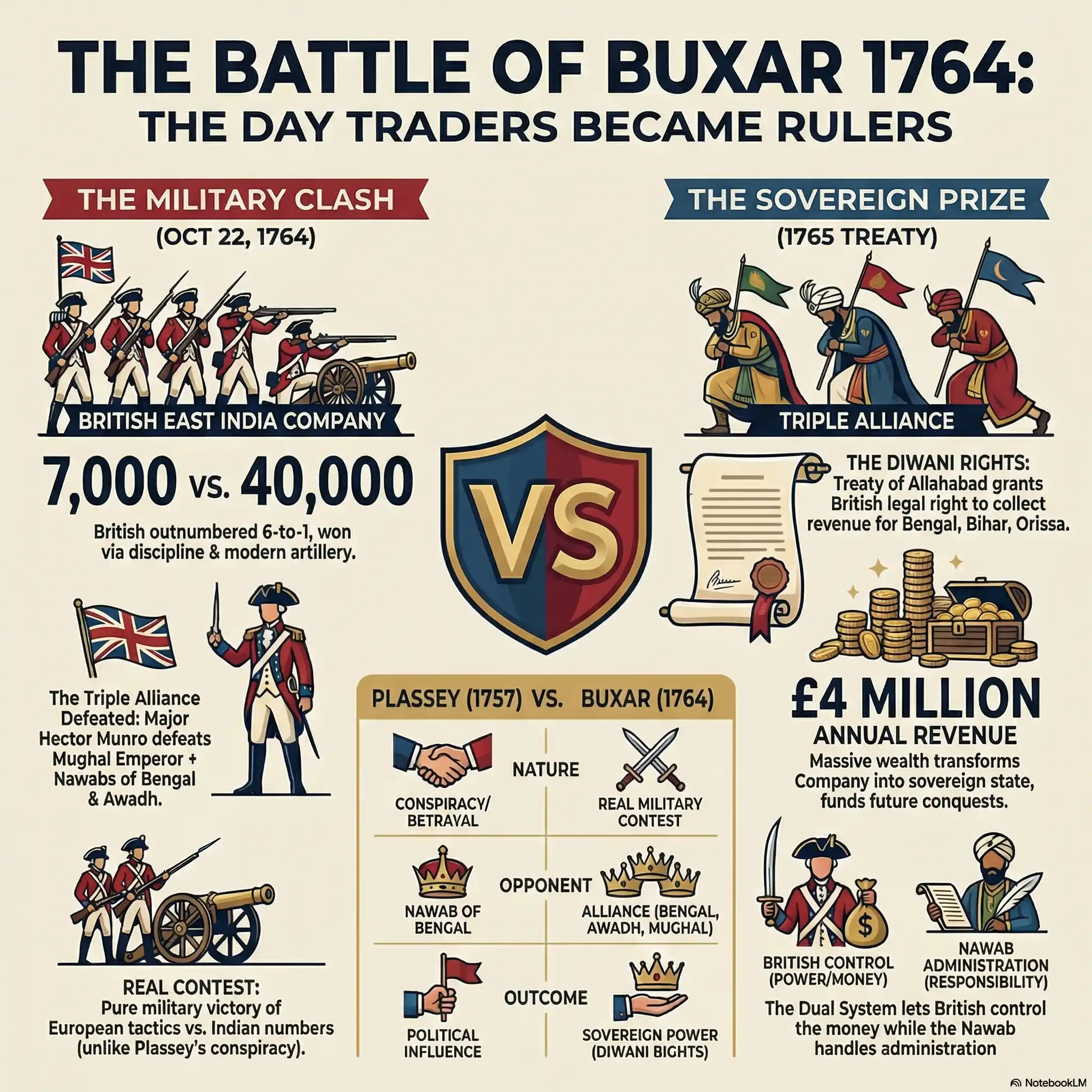
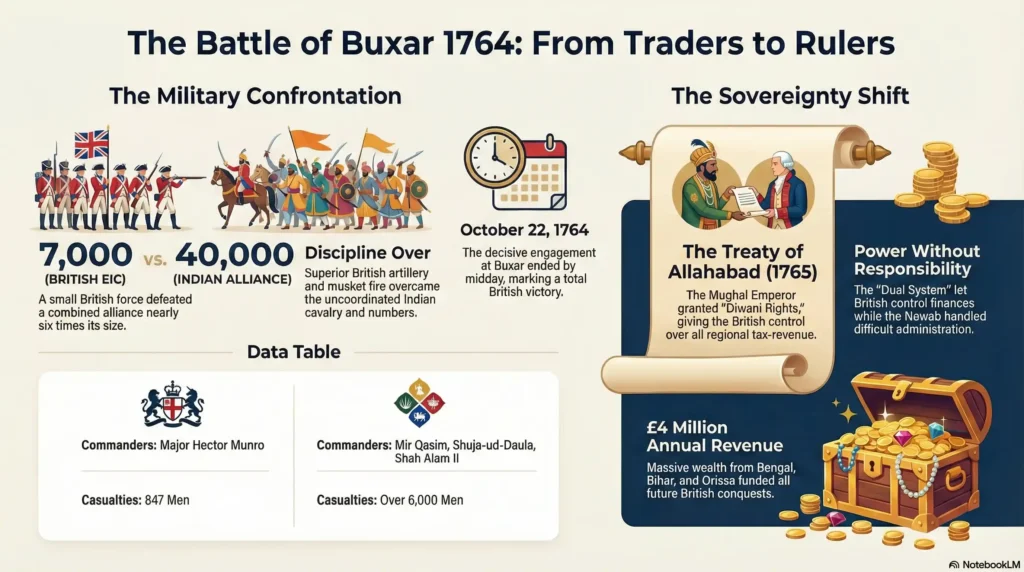
The Battle of Buxar, fought on October 22, 1764, was the most decisive military engagement in the history of British India—even more significant than Plassey. It was fought between the British East India Company, led by Major Hector Munro, and a combined alliance of three Indian rulers: Mir Qasim (Nawab of Bengal), Shuja-ud-Daula (Nawab of Awadh), and Shah Alam II (Mughal Emperor). Despite being vastly outnumbered, the British forces won due to superior discipline and artillery. The victory led to the Treaty of Allahabad (1765), which granted the Company the Diwani Rights (right to collect revenue) for Bengal, Bihar, and Orissa, effectively making a trading corporation the sovereign ruler of Eastern India.| Feature | Details |
| Date | October 22, 1764 |
| Location | Buxar (Bihar) |
| British Commander | Major Hector Munro |
| Indian Alliance | Mir Qasim, Shuja-ud-Daula, Shah Alam II |
| Force Strength | British: ~7,000 vs. Alliance: ~40,000 |
| Outcome | Decisive British Victory |
| Resulting Treaty | Treaty of Allahabad (1765) |
| Key Consequence | Grant of Diwani Rights (Revenue Collection) |
The Road from Plassey to Buxar
After the Battle of Plassey (1757), the British installed Mir Jafar as a puppet Nawab of Bengal. But when he failed to meet their endless financial demands, they replaced him with his son-in-law, Mir Qasim.
Mir Qasim, however, was no puppet. He was an able administrator who tried to strengthen his position.
- Capital Shift: He moved his capital from Murshidabad to Munger (Bihar) to distance himself from British intrigue in Calcutta.
- Army Modernization: He hired European mercenaries to train his soldiers in modern warfare.
- The Trade War: The immediate trigger for the war was the abuse of Dastaks (trade permits). British officials were using them for private trade to avoid taxes, while Indian merchants had to pay full tax. To level the playing field, Mir Qasim abolished all duties on internal trade. This furious the British, who saw it as a loss of their privilege.
Annexation of Punjab 1849: The Fall of the Sikh Empire
The Grand Alliance
Driven out of Bengal by the British, Mir Qasim fled to Awadh (Oudh). There, he formed a formidable confederacy with:
- Shuja-ud-Daula: The powerful Nawab Wazir of Awadh.
- Shah Alam II: The Mughal Emperor, who was living in exile in Awadh.
Together, they assembled an army of over 40,000 men. It seemed impossible for the small British force to withstand the combined might of Northern India’s greatest rulers.
The Battle: October 22, 1764
The two armies met at Buxar, a fortified town on the banks of the Ganges. The British were led by Major Hector Munro, a ruthless but brilliant tactician.
The battle began at dawn. The Indian alliance relied on their cavalry and numbers, but they lacked coordination. Shuja-ud-Daula’s forces were the only ones who fought seriously. Mir Qasim, seeing the tide turn, fled with his treasures, never to be heard of again. The British discipline and rapid musket fire decimated the Indian ranks. By midday, the battle was over. The British had lost only 847 men, while the alliance suffered over 6,000 casualties.
Indian Rebellion of 1857: The First War of Independence
The Treaty of Allahabad: The Real Conquest
The military victory at Buxar was consolidated by a diplomatic masterstroke. Robert Clive returned to India to sign the Treaty of Allahabad in August 1765.
- With Shah Alam II: The Emperor granted the Diwani Rights of Bengal, Bihar, and Orissa to the East India Company. In return, he was given an annual pension of 26 Lakh rupees and the districts of Kora and Allahabad. The Emperor essentially became a British pensioner.
- With Shuja-ud-Daula: Awadh was returned to him, but he had to pay a war indemnity of 50 Lakh rupees. Awadh became a “buffer state” between the British and the Marathas.
The Dual System of Government
Following Buxar, Clive introduced the infamous Dual System of Government in Bengal.
- Diwani (Revenue): Controlled by the British (Power without Responsibility).
- Nizamat (Administration): Controlled by the Nawab (Responsibility without Power).This system led to the ruthless exploitation of Bengal, culminating in the horrific Bengal Famine of 1770.
Death of Tipu Sultan: The Fall of the Tiger of Mysore
Quick Comparison Table: Plassey vs. Buxar
| Feature | Battle of Plassey (1757) | Battle of Buxar (1764) |
| Nature | Battle of Conspiracy/Betrayal | Real Military Contest |
| Opponent | Nawab of Bengal (Siraj-ud-Daulah) | Alliance (Bengal, Awadh, Mughal) |
| Significance | Foothold in Bengal | Control of Northern India |
| British Leader | Robert Clive | Hector Munro |
| Outcome | Political Influence | Sovereign Power (Diwani) |
Curious Indian: Fast Facts
- The Vanishing Nawab: Mir Qasim, once the ruler of Bengal, died in total obscurity and poverty in Delhi in 1777. His family could not even afford a funeral shroud.
- Munro’s Brutality: Before the battle, when a few sepoys in the British army tried to mutiny, Hector Munro brutally executed them by blowing them from cannons—a tactic later used in 1857.
- The Emperor’s Tent: During the battle, Shah Alam II didn’t actively participate. After the defeat, he simply switched sides and set up his tent next to the British camp, asking for their protection.
- The Revenue: The Diwani rights gave the British access to an estimated revenue of £4 million annually—wealth that funded their future conquests in India.
Conclusion
The Battle of Buxar 1764 was the final nail in the coffin of Indian independence in the 18th century. Unlike Plassey, which was won by treachery, Buxar was won by firepower. It proved that Indian armies, no matter how large, were no match for European discipline. The grant of Diwani rights transformed the East India Company from a merchant body into a sovereign power, setting the stage for 190 years of colonial rule.
Establishment of the British Raj 1858: The Dawn of Imperial India
If you think you have remembered everything about this topic take this QUIZ
Results


#1. The Battle of Buxar was fought on which date?
#2. Who was the British commander who led the East India Company forces to victory at Buxar?
#3. Which three Indian rulers formed the alliance against the British at Buxar?
#4. What crucial right was granted to the East India Company by the Treaty of Allahabad (1765)?
#5. Mir Qasim moved his capital from Murshidabad to which city to distance himself from British interference?
#6. What was the immediate economic trigger for the conflict between Mir Qasim and the British?
#7. Which system of government did Robert Clive introduce in Bengal after the victory at Buxar?
#8. What happened to Shah Alam II, the Mughal Emperor, after the defeat at Buxar?
Who fought in the Battle of Buxar?
The battle was fought between the British East India Company (led by Hector Munro) and the alliance of Mir Qasim (Bengal), Shuja-ud-Daula (Awadh), and Shah Alam II (Mughal Emperor).
When was the Battle of Buxar fought?
It was fought on October 22, 1764.
What were the Diwani Rights?
Diwani Rights gave the East India Company the legal authority to collect revenues from the provinces of Bengal, Bihar, and Orissa.
Who signed the Treaty of Allahabad?
Robert Clive signed the treaty on behalf of the British with Shah Alam II and Shuja-ud-Daula in 1765.
Why is Buxar considered more important than Plassey?
While Plassey gave the British a foothold, Buxar demonstrated their military superiority over the combined might of North Indian rulers and gave them legal control over India’s richest provinces.