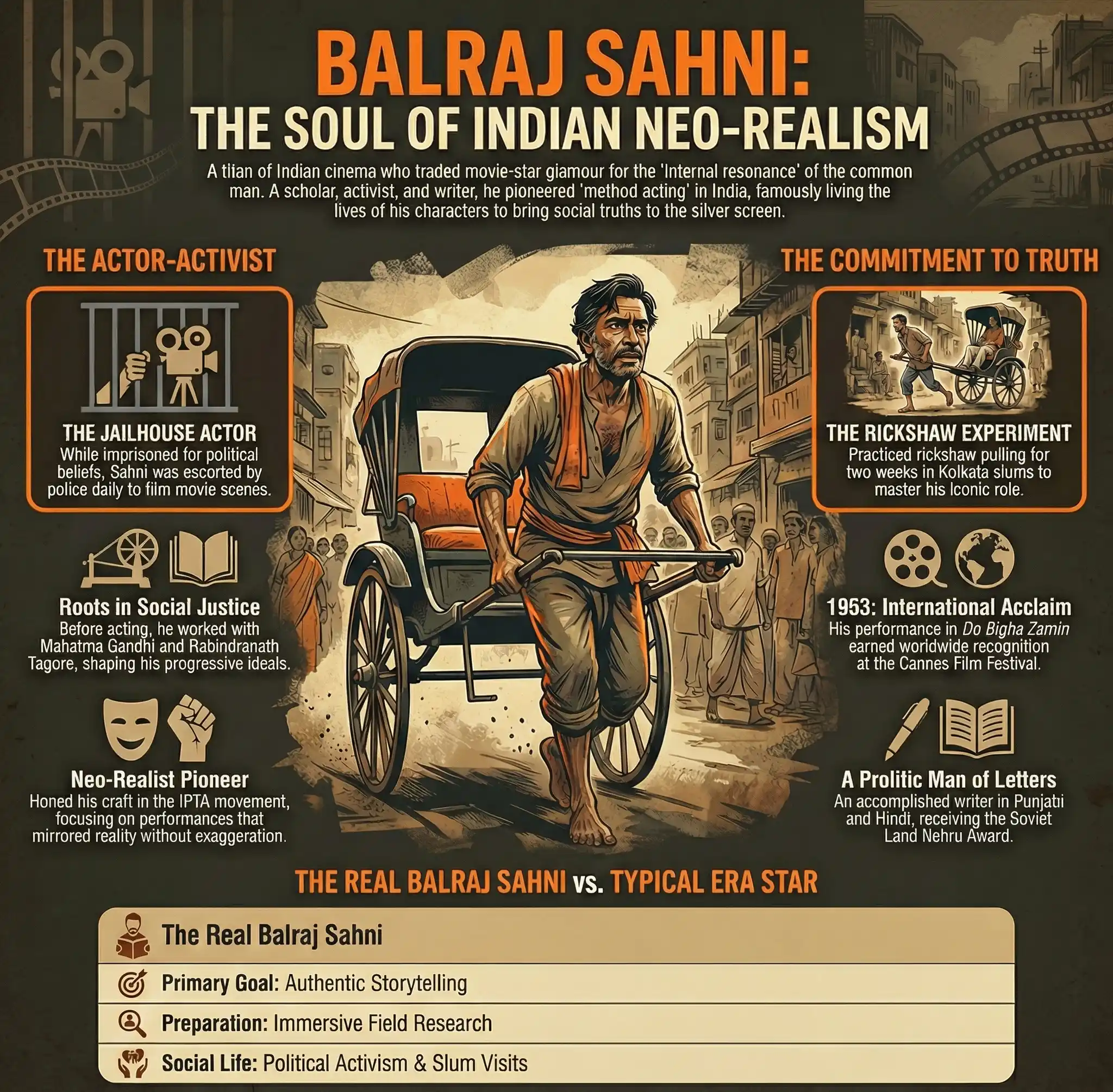
Balraj Sahni was a titan of Indian cinema and literature, best remembered for his soulful and realistic portrayals of the common man. Born in Rawalpindi and educated in Lahore, he lived a multifaceted life as a teacher at Shantiniketan, a journalist working with Mahatma Gandhi, and a broadcaster for the BBC in London. His entry into the film industry marked a shift toward neo-realism, particularly through his association with the IPTA theatre movement. Sahni's performance in Do Bigha Zamin earned international acclaim, and he remained a staunch activist and intellectual throughout his life, leaving behind a legacy of integrity, literary brilliance, and cinematic excellence that continues to inspire actors today.| Feature | Details |
| Full Name | Yudhishthir Sahni (Balraj Sahni) |
| Born | May 1, 1913 (Rawalpindi, British India) |
| Died | April 13, 1973 (Bombay, India) |
| Education | MA in English & Hindi (Government College, Lahore) |
| Iconic Film | Do Bigha Zamin (1953) |
| Awards | Padma Shri (1969) |
The Soul of a Neo-Realist
In the golden era of Indian cinema, while many stars were building monuments to glamour, one man was busy building a bridge to the truth. Balraj Sahni’s acting career was never about the spotlight; it was about the stories that hid in the shadows of society. He didn’t just play characters; he inhabited their souls, their pain, and their quiet dignity. To understand the man, one must look past the greasepaint and into a life lived with extraordinary purpose.
Born as Yudhishthir Sahni in 1913, his early years in Rawalpindi were shaped by the progressive ideals of the Arya Samaj. This foundation of social justice would become the compass for his entire life. He was a brilliant academic, but his heart was restless. Before he ever stepped in front of a camera, he walked the halls of Shantiniketan with Rabindranath Tagore and edited “Nai Talim” with Mahatma Gandhi. These weren’t just bullet points in a Balraj Sahni biography; they were the experiences that gave him the “internal resonance” he brought to every role.
6 Unfoldings in the Subrahmanyan Chandrasekhar Biography
From the BBC to the Streets of Bombay
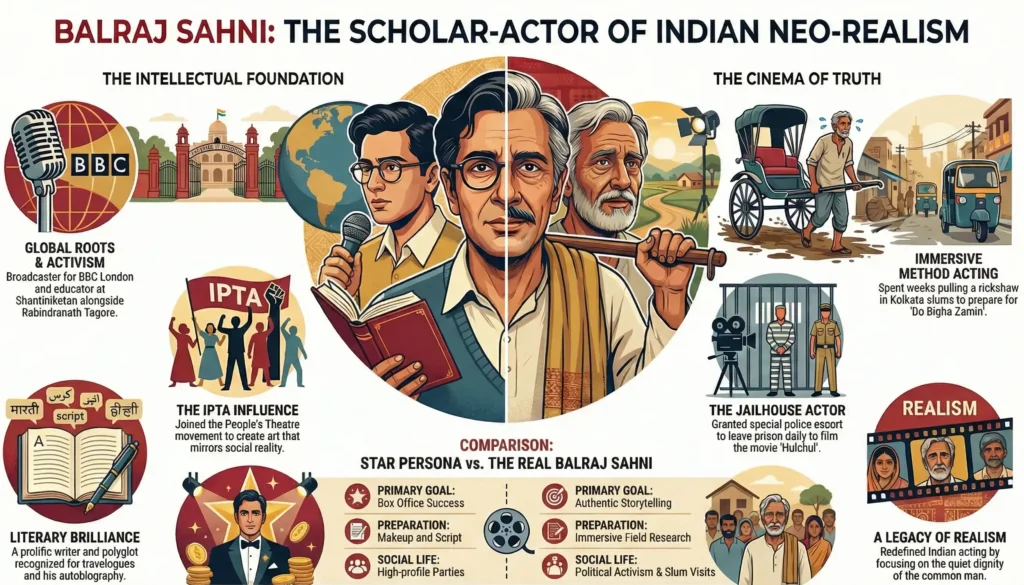
The transition to the arts was a journey of global proportions. Sahni spent several years in BBC London as a Hindi broadcaster during the tumultuous years of World War II. Returning to India, he found his calling in the IPTA theatre movement, a collective of artists who believed that art should serve the people. It was here that he honed his craft, learning that the most powerful performance is the one that mirrors reality without exaggeration.
His debut in Insaaf (1946) was just the beginning. However, life dealt him a crushing blow in 1947 when his wife, Damayanti, passed away. Broken but resilient, Sahni channeled his personal grief into a profound empathy for the downtrodden. He became a man of the masses, often seen in the company of workers and activists, a habit that eventually led to his arrest. In an anecdote that sounds like fiction but is entirely true, Sahni was allowed to leave jail during the day to film his scenes, only to return to his cell at night. This commitment to his work, even behind bars, speaks volumes about the man’s character.
7 Incredible Facts in the Satyendra Nath Bose Biography
The Masterpiece: Do Bigha Zamin
If there is one film that defines his legacy, it is Bimal Roy’s Do Bigha Zamin. As the Do Bigha Zamin actor, Sahni played Shambhu Mahato, a farmer forced to become a rickshaw puller in the harsh streets of Kolkata. To prepare for the role, Sahni didn’t just read a script; he lived it. He spent days in the scorching summer heat of Kolkata, physically pulling a rickshaw, learning the rhythm of the puller’s breath and the callousness of the pavement.
This was “method acting” before the term was popular in India. When the film reached the Cannes Film Festival, international audiences were mesmerized. They didn’t see an actor; they saw the face of human suffering and resilience. This role cemented Balraj Sahni’s acting career as the gold standard for realism. He proved that an actor’s greatest tool isn’t a loud voice, but a quiet, observational eye.
A Man of Letters and Logic
Beyond the screen, Sahni was a prolific writer. His Balraj Sahni literary works are as essential as his films. He wrote with a raw honesty, whether he was documenting his travels in his famous travelogues like Mera Pakistani Safarnama or reflecting on his own life in his autobiography, Meri Filmi Aatmakatha. His writing was recognized with the Soviet Land Nehru Award, proving that his intellect was as sharp as his acting was deep. You can find his literary works cited in many academic discussions on Punjabi and Hindi literature today.
In his later years, films like Kabuliwala and Garm Hava showcased a mature artist who could convey a world of emotion with just a look. In Garm Hava, his final film, he portrayed a man caught in the crosshairs of Partition—a role that felt deeply personal given his own roots in Rawalpindi. The film remains a haunting masterpiece, a fitting final act for a man who never stopped asking the difficult questions.
The Legacy of Integrity
Balraj Sahni never lost his connection to the “Curious Indian” spirit—the desire to explore, to learn, and to empathize. He was honored with the Padma Shri in 1969, but his real reward was the respect of the common man he so often portrayed. He taught us that acting is not an act of deception, but an act of revelation.
His life tells us that you can be a star and a scholar, an actor and an activist, a celebrity and a human being. He walked the streets of Bombay not as a god of the silver screen, but as a student of life, always observing, always feeling, and always telling the truth.
8 Fascinating Facts in the Homi Jehangir Bhabha Biography
Comparison: The Professional vs. The Persona
| Feature | The Star Persona | The Real Balraj Sahni |
| Primary Goal | Box Office Success | Authentic Storytelling |
| Preparation | Makeup and Script | Immersive Field Research |
| Social Life | High-profile Parties | Political Activism & Slum Visits |
| Legacy | Award-winning Roles | Revolutionary Literature & Realism |
Curious Indian: Fast Facts
- A Family of Talent: His brother, Bhisham Sahni, was the celebrated author of the legendary novel Tamas.
- The BBC Stint: He was one of the first Indians to work as a Hindi broadcaster for the BBC in London (1940-44).
- Jailhouse Actor: He was actually in prison for his political beliefs while filming Hulchul; he was granted special permission to visit the set daily under police escort.
- The Rickshaw Experiment: He reportedly practiced rickshaw pulling for over two weeks in the slums of Kolkata to get the physical gait of Shambhu Mahato right.
- Polyglot: He was fluent in English, Hindi, Punjabi, and several other Indian languages, which aided his literary career.
Conclusion
The journey of Balraj Sahni’s acting career is a testament to the power of empathy. He moved through life not as a passenger, but as a witness to the human condition. By choosing roles that challenged the status quo and writing words that touched the soul, he ensured that his presence would be felt long after the final curtain call. For every “Curious Indian” today, his life serves as a blueprint for how to live with both passion and principle.
8 Remarkable Secrets in the Jagadish Chandra Bose Biography
If you think you have remembered everything about this topic take this QUIZ
Results


#1. What was Balraj Sahni’s birth name before he became famous?
#2. Before his film career, Balraj Sahni taught at Shantiniketan and worked with which famous leader on the journal “Nai Talim”?
#3. During World War II, Balraj Sahni worked as a Hindi broadcaster for which international organization?
#4. To prepare for his role as a rickshaw puller in the film Do Bigha Zamin, what method did Sahni use?
#5. Which unique event occurred while Balraj Sahni was filming due to his political activism?
#6. Which of the following is a famous travelogue written by Balraj Sahni?
#7. Which film is considered his final masterpiece, where he portrayed a man caught in the aftermath of Partition?
#8. Balraj Sahni’s brother, Bhisham Sahni, is the celebrated author of which legendary novel?
10 Remarkable Facts About Meghnad Saha Life and Achievements
What is Balraj Sahni’s most famous film?
While he had many hits, Do Bigha Zamin (1953) is widely considered his most influential work, marking a turning point for neo-realist cinema in India.
Was Balraj Sahni involved in politics?
Yes, he was a committed member of the Communist Party and was heavily involved with the Indian People’s Theatre Association (IPTA), which focused on social and political issues.
Did Balraj Sahni write his own books?
Absolutely. He was a distinguished writer in Punjabi and Hindi. His autobiography, Meri Filmi Aatmakatha, is considered one of the best memoirs in Indian literature.
Read More: https://curiousindian.in/bhushan-kumar-november-1977-present/