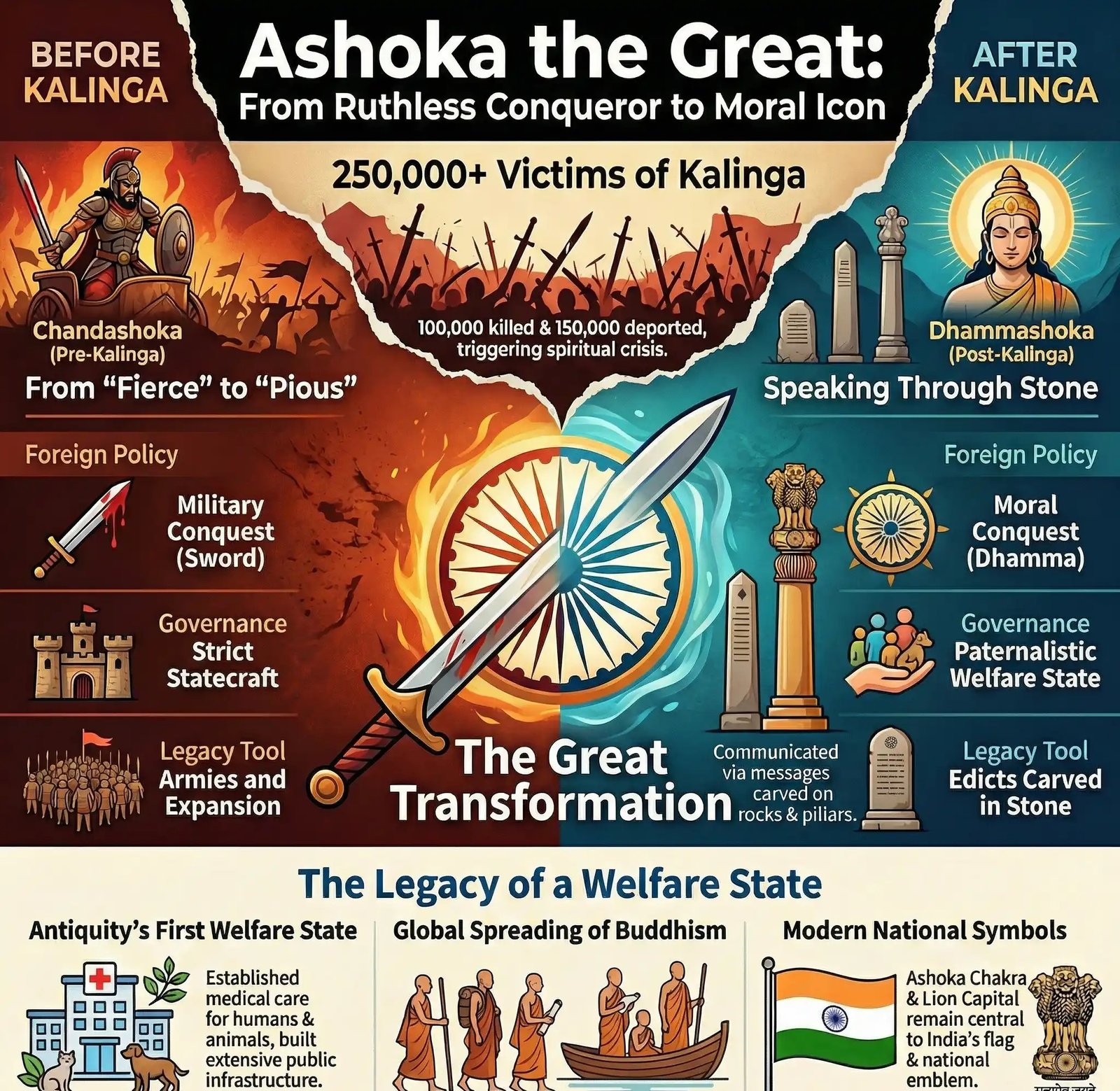
Ashoka Maurya (r. c. 268–232 BCE), known as Ashoka the Great, was the third ruler of the Mauryan Empire. Grandson of Chandragupta Maurya and son of Bindusara, he inherited a massive empire and expanded it further by conquering the state of Kalinga (c. 261 BCE). However, the horrific bloodshed of the Kalinga War triggered a profound spiritual crisis, leading him to renounce aggressive warfare (Digvijaya) and embrace Buddhism. He replaced it with the policy of Dhamma (moral conquest). His reign is uniquely documented through his Edicts—messages carved on rocks and pillars across the subcontinent, advocating for non-violence, religious tolerance, and animal welfare, effectively establishing one of antiquity's earliest welfare states.| Feature | Details |
| Reign | c. 268 – 232 BCE |
| Dynasty | Mauryan Empire |
| Capital | Pataliputra (Patna) |
| Turning Point | Kalinga War (c. 261 BCE) |
| Core Policy | Dhamma (Prakrit for Dharma) |
| Medium of Message | Rock Edicts and Pillar Edicts |
| Script Used | Brahmi, Kharoshthi, Greek, Aramaic |
| Council Convened | Third Buddhist Council (Pataliputra) |
| Legacy | Ashoka Chakra (Indian Flag), Lion Capital (National Emblem) |
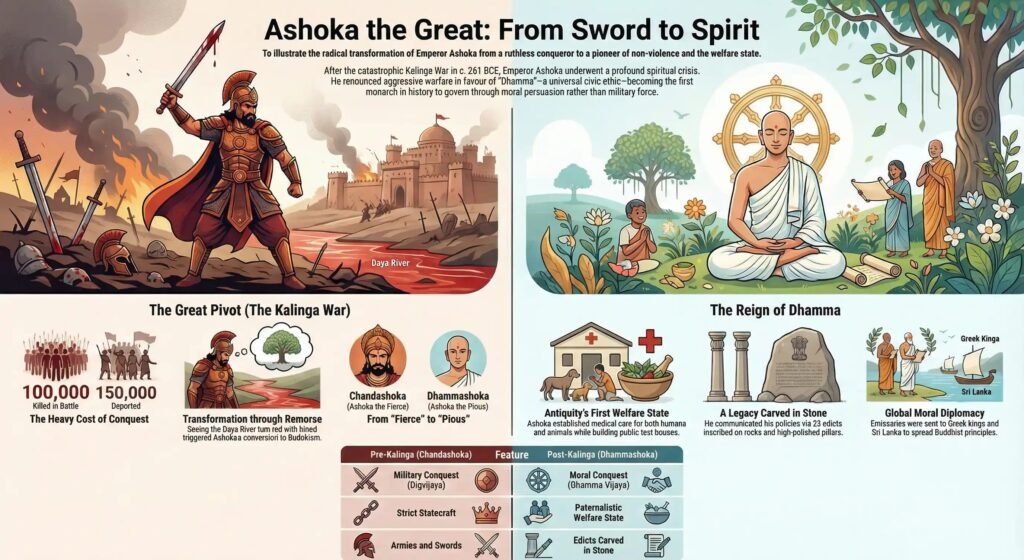
The Early Years: Chandashoka (Ashoka the Fierce)
Before he became a pacifist, Ashoka was a quintessential ancient monarch. According to Buddhist legends, he was initially known as Chandashoka (Fierce Ashoka) due to his ruthless pursuit of power. He served as the governor of strategic provinces like Ujjain and Taxila during his father Bindusara’s reign, violently putting down rebellions. When Bindusara died, a brutal war of succession broke out. Legends claim Ashoka killed 99 of his half-brothers to secure the throne, though historical evidence for this is debated.
Reign of Harshavardhana: The Empire of Benevolence
The Kalinga War: A River of Blood
In c. 262–261 BCE, eight years after his coronation, Ashoka launched a massive campaign against the independent state of Kalinga (modern-day Odisha). Kalinga controlled the vital land and sea routes to South India.
- The Carnage: The war was devastating. According to Major Rock Edict XIII, 150,000 people were deported, 100,000 were killed in battle, and many times that number perished from disease and famine.
- The Pivot: Walking through the battlefield, seeing the Daya River turn red with blood, Ashoka experienced deep remorse. This event triggered his conversion to Buddhism and his vow to never fight a war of aggression again.
The Policy of Dhamma
Ashoka replaced the sound of the war drum (Bheri Ghosha) with the sound of righteousness (Dhamma Ghosha). His concept of Dhamma was not a specific religion, but a universal civic ethic meant to bind a diverse empire.
- Core Principles: Obedience to parents, kindness to servants, generosity to the poor, non-violence towards all living beings (Ahimsa), and moderation in spending.
- Religious Tolerance: In an era where kings frequently persecuted rival sects, Ashoka advocated for pluralism. Major Rock Edict XII specifically warns that praising one’s own faith while disparaging others harms religion itself.
- Welfare State: He planted shade trees (Banyan) and mango groves along roads, dug wells, and built rest houses. Remarkably, Major Rock Edict II details the establishment of medical care for both humans and animals.
The Edicts: Writing on Stone
Ashoka is the first Indian king to speak directly to his people through inscriptions.
- The Medium: He had his messages carved on sheer rock faces, boulders, and highly polished sandstone pillars.
- The Language: To ensure the common people understood, he used Prakrit (written in Brahmi and Kharoshthi scripts). In the northwestern frontiers (Kandahar), he used Greek and Aramaic.
- The Bureaucracy: He created a special cadre of officials called Dhamma-mahamatras to inspect the provinces, ensure justice, and promote the welfare of the people.
Rise of Jainism and Buddhism 6th Century BCE
Global Diplomacy and Buddhism
Ashoka did not just preach at home; he practiced moral diplomacy abroad.
- The Greek Kings: Major Rock Edict XIII proudly names five contemporary Hellenistic kings—including Antiochus of Syria and Ptolemy of Egypt—to whom he sent emissaries of Dhamma.
- Spreading Buddhism: He convened the Third Buddhist Council at Pataliputra to purify the Sangha (monastic order). He famously sent his son Mahinda and daughter Sanghamitra to Sri Lanka, establishing Buddhism as a pan-Asian religion.
Reign of Akbar 1556-1605: The Golden Age of the Mughal Empire
Quick Comparison Table: Pre-Kalinga vs. Post-Kalinga Ashoka
| Feature | Pre-Kalinga (Chandashoka) | Post-Kalinga (Dhammashoka) |
| Foreign Policy | Military Conquest (Digvijaya) | Moral Conquest (Dhamma Vijaya) |
| Religion | Vedic/Brahmanical (likely Shiva worshipper) | Devout Buddhist (Lay Follower) |
| Hunting/Food | Royal Hunts (Vihara Yatra), Meat eating | Pilgrimages (Dhamma Yatra), Vegetarianism |
| Governance | Strict Kautilyan Statecraft | Paternalistic Welfare State |
| Legacy Tool | Armies and Swords | Edicts carved in Stone |
Curious Indian: Fast Facts
- The Warning to the Forest Tribes: Despite his pacifism, Ashoka did not disband his army. In his edicts, he sternly warns the “forest dwellers” (tribals) to mend their ways or face punishment, showing he retained coercive power.
- Deciphering the Edicts: Ashoka’s edicts were a mystery for over 1,500 years because the Brahmi script was forgotten. It was finally deciphered in 1837 by a British scholar named James Prinsep.
- National Symbols: Modern India adopted the Lion Capital of Ashoka (from the Sarnath pillar) as its National Emblem, and the Ashoka Chakra (the 24-spoke wheel of Dhamma) is at the center of the Indian national flag.
- Personal Name: For a long time, historians did not know who “Devanampiya Piyadasi” (Beloved of the Gods, He who looks on with affection) was. It was only after the discovery of the Maski edict in 1915 that the title was definitively linked to the name “Ashoka”.


Conclusion
Ashoka the Great redefined what it means to be a powerful monarch. He proved that an empire could be held together not just by the fear of the sword, but by the strength of an ethical idea. While his empire collapsed 50 years after his death, his legacy outlived his dynasty. By exporting Buddhism to Asia and leaving behind a blueprint for a welfare state in stone, Ashoka remains a beacon of compassionate governance in world history.
Reign of Chandragupta Maurya: The First Empire of India
If you think you have remembered everything about this topic take this QUIZ
Results


#1. Prior to his spiritual transformation, for what specific reason was Ashoka known as ‘Chandashoka’?
#2. What primary strategic advantage did the independent state of Kalinga hold that motivated Ashoka’s invasion?
#3. According to Major Rock Edict XII, how did Ashoka view the act of disparaging other people’s faiths?
#4. Which specific administrative measure did Ashoka implement to ensure the welfare of his subjects and the promotion of Dhamma?
#5. How did the linguistic approach in Ashoka’s edicts vary in the northwestern frontiers, such as Kandahar?
#6. Which pair of individuals is credited with establishing Buddhism as a pan-Asian religion by travelling to Sri Lanka?
#7. What was the historical significance of the Maski edict discovered in 1915?
#8. Despite his commitment to non-violence (Ahimsa), how did Ashoka maintain order among the ‘forest tribes’?
Which war changed the life of Emperor Ashoka?
The Kalinga War (c. 261 BCE).
What is “Dhamma” in the context of Ashoka?
Dhamma was Ashoka’s policy of a universal civic ethic based on non-violence, tolerance, and social responsibility.
Which script was primarily used for Ashoka’s Edicts?
The Brahmi script (used to write the Prakrit language).
Who deciphered the Ashokan Edicts?
James Prinsep in 1837.
What are the modern national symbols derived from Ashoka?
The Lion Capital of Sarnath (National Emblem) and the Ashoka Chakra (in the National Flag).