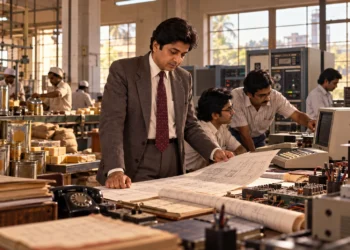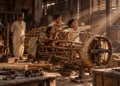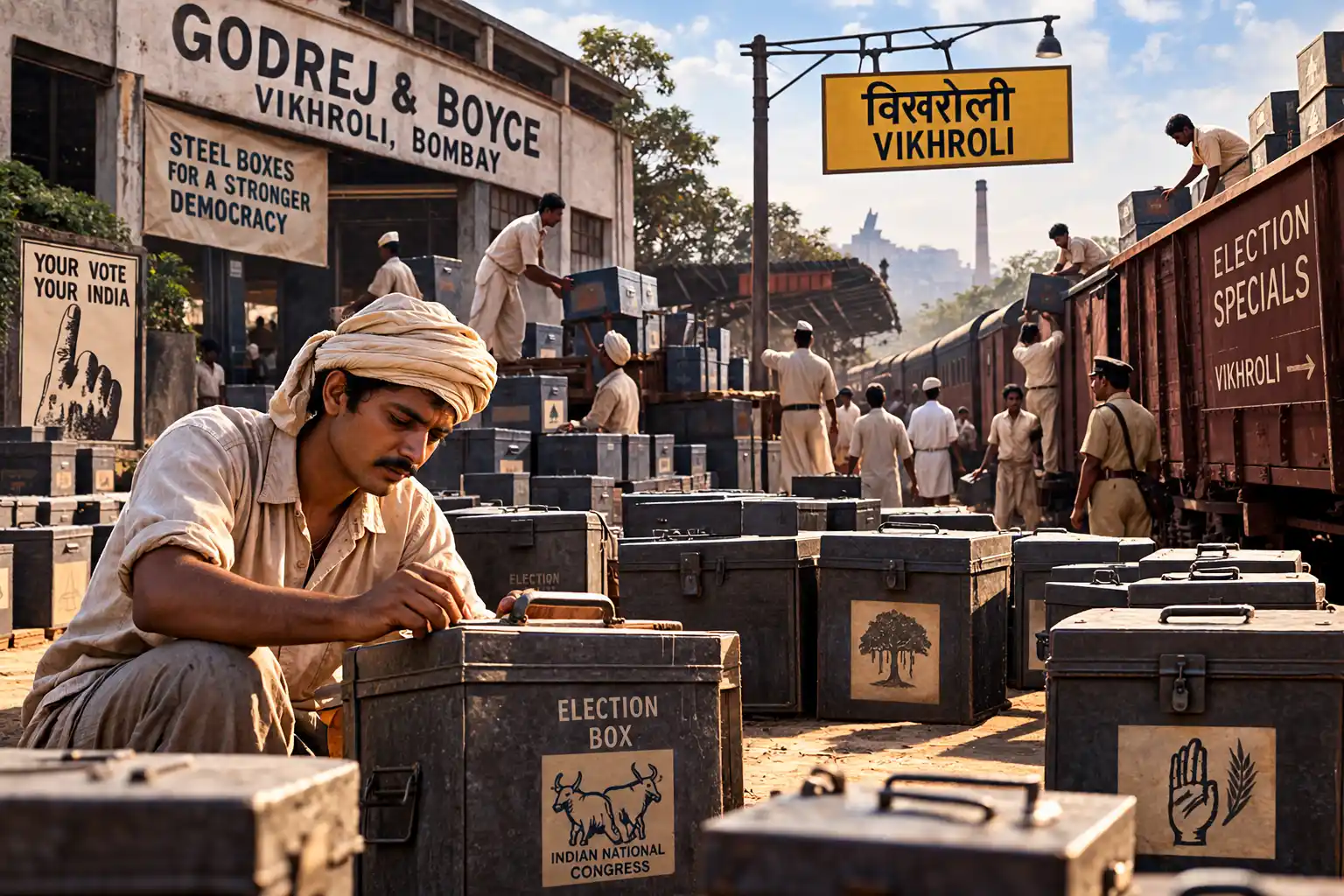
In July 1951 the Godrej & Boyce factory at Vikhroli, outside Bombay, started making steel boxes. It made about 15,000 of them a day. On some days it made 22,000. They were loaded onto trains at Vikhroli station that the railwaymen called election specials, and over 68 working days 12,83,371 boxes left the factory for 23 states.
The design had come from the shop floor. Steel was scarce and had to be paid for in foreign exchange the country did not have, and a worker named Nathalal Panchal came up with a box that was strong, hard to tamper with and cheap to make.
Godrej was one supplier among several. The whole election needed more than 2.5 million boxes, which took 8,200 tons of steel. The reason it needed so many is the best way into the story of how India voted for the first time.
The mathematician
The man who ordered the boxes was Sukumar Sen. He was born in 1899, studied at Presidency College in Calcutta and then at London University, where he won a gold medal in mathematics. He joined the Indian Civil Service in 1921. By the time of Independence he was chief secretary of West Bengal. In March 1950 he was made India’s first Chief Election Commissioner.
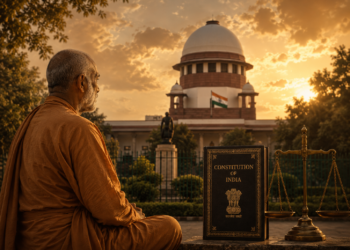
The Constitution had just promised a vote to every adult. Jawaharlal Nehru wanted the election held by the spring of 1951. Sen, who had done the arithmetic, asked him to wait.
The arithmetic was this. There were about 176 million Indians aged 21 or over. Roughly 85 in every 100 of them could not read or write. They lived across more than a million square miles. And they would be choosing the state assemblies on the same day as Parliament, so about 4,500 seats were being filled at once. Almost none of the voters had ever cast a ballot for anything.
Writing down 173 million names
First they had to be found. Enumerators went from door to door. Most people had no record of when they were born, so deciding who had turned 21 was often an estimate made on the doorstep.
Then the names had to be typed. The Election Commission hired 16,500 clerks on six-month contracts to do nothing else, and the rolls they produced used up 380,000 reams of paper. The final count of registered voters was 173,212,343.
One problem Sen had not expected. In much of northern India, women would not give their own names to a stranger. They had been entered on the rolls as somebody’s mother or somebody’s wife. Sen called this a “curious senseless relic of the past” and ordered that every voter be listed by her own name. Where the name could not be got, the entry was struck out. About 2.8 million women lost their vote in 1952 that way. There was an outcry, and Sen said the outcry was a good thing, because the prejudice would be gone by the next election.
A box for every candidate
The harder question was how a person who could not read would choose between names on a piece of paper.
Sen’s answer was to take the names off the paper. Every party was given a picture. The Congress had a pair of yoked bullocks. The Jana Sangh had an oil lamp, the Socialists a banyan tree, the Communists a sickle and ears of corn. The open hand, which Indians now connect with the Congress, belonged in 1951 to a faction of the Forward Bloc.
Then each candidate was given a ballot box of his own, with his symbol pasted on it. The voter was handed a ballot paper, went behind a screen where the boxes stood in a row, and dropped the paper into the box with the picture he wanted. Nothing had to be marked and nothing had to be read. That is why more than 2.5 million boxes were needed.
To stop anyone voting twice, Indian scientists made an ink that stayed on the skin for about a week. Each voter’s finger was marked with it. The election used 389,816 small bottles of the stuff.
None of this would work if people did not know about it. A documentary film explaining the vote was shown in more than 3,000 cinemas through 1951, and All India Radio ran programmes on the electoral roll and how to use a polling booth.
On the ground, 56,000 presiding officers ran the polling with about 280,000 helpers, and 224,000 policemen stood guard. The historian Ramachandra Guha, whose account of the election is the fullest, counts 224,000 polling booths. The Election Commission’s own tables list 196,084 polling stations, 27,527 of them set aside for women. Bridges were built to reach some hill villages. The Navy carried the rolls out to islands in the Indian Ocean.
The first votes, before the snow
Most of India voted in January and February of 1952. One corner could not wait that long. In Chini tehsil, high in what is now the Kinnaur district of Himachal Pradesh, the passes would be shut by snow well before then. So Chini voted on 25 October 1951.
A schoolteacher there named Shyam Saran Negi had been put on polling duty that day. He asked if he could cast his own vote before he went to his post, and the officer let him. He is remembered as independent India’s first voter. He voted in every election after that and died in November 2022, aged 106, a few days after sending in his last ballot.
The rest of the country followed in 68 stages. Polling ended on 21 February 1952.
What the boxes held
A little under half of those on the rolls turned out. There were 1,949 candidates from 53 parties for the 489 seats in the Lok Sabha. The Congress took 364 of them with 45 per cent of the vote. The Communists came a distant second with 16.
Voters did not simply defer to famous names. B.R. Ambedkar, who had chaired the drafting of the Constitution that gave them the vote, lost in Bombay North Central to Narayan Kajrolkar, by 123,576 votes to 138,137. Acharya Kripalani lost in Faizabad, in the same election that his wife Sucheta won in New Delhi.
The first Lok Sabha met in April 1952. The following year Sudan asked for Sukumar Sen to come and run its first election too.
He had one more piece of arithmetic to do at home. When the counting was over he had the steel boxes collected and put into store. In 1957 India voted again, and by one account the bill was 45 million rupees lower, because the boxes were already there.
Test your knowledge
Answer 5 questions about the story.
When was India’s first general election held?
India held its first general election between 1951 and 1952, with polling staggered across different regions.
Who was the first Chief Election Commissioner of India?
Sukumar Sen oversaw the organization of India’s first general election.
Why were separate ballot boxes used in the first election?
Each candidate had a separate ballot box carrying a symbol, making voting more accessible to citizens who could not read candidate names.
Why did voting begin early in parts of the Himalayas?
Some mountain constituencies voted ahead of the winter because snowfall could make polling locations inaccessible.
What made India’s first election historically unusual?
Universal adult franchise was implemented on an enormous scale soon after independence, despite low literacy and major logistical challenges.
Sources and further reading
Ramachandra Guha, India After Gandhi: The History of the World’s Largest Democracy (Picador, 2007)
Ramachandra Guha, "The Travails of India’s first election commissioner", The Caravan: https://caravanmagazine.in/vantage/ramachandra-guha-indias-first-election-commissioner
Election Commission of India, Report on the First General Elections in India, 1951-52
"India’s First Elections: Finally, the Nation Speaks", Live History India: https://livehistoryindia.com/story/eras/indias-first-elections-finally-india-speaks
Ornit Shani, How India Became Democratic: Citizenship and the Making of the Universal Franchise (Cambridge University Press, 2018)