How the Masked Dances of Hemis Monastery Offer Liberation in Ladakh
High in the Indus valley of Ladakh, at an altitude where the air is thin and the sky is a shade of blue that does not exist at lower elevations, the monks of Hemis Monastery put on their masks once a year and become something other than monks. They become the wrathful and compassionate deities of the Tantric Buddhist pantheon, moving through a courtyard that has served as a sacred stage for over three centuries, their robes spinning in the high-altitude wind, their masks expressing the full range of enlightened emotion from terrifying fury to absolute serenity. The Hemis Festival is not a performance. It is a ritual enactment of the most fundamental truths of Vajrayana Buddhism, offered to every being present as a direct transmission of liberation. The monks dance so that the audience does not have to be reborn.
Vishwakarma Puja and the Ancient Theology Behind Worship of Tools
The Monastery at the Edge of Everything
The road to Hemis from Leh follows the Indus river southward through a landscape that operates at a scale that human beings are not evolutionarily prepared to process comfortably. The mountains on either side are not simply large. They are of a different category of largeness, bare rock faces rising thousands of metres above the valley floor in colours of ochre and rust and grey that change character entirely as the sun moves through the high-altitude sky.
Hemis Monastery sits back from the road in a side valley, a cluster of white-walled buildings with red-painted upper stories pressed against the base of a cliff that rises almost vertically above it. The monastery has been here, in some form, since 1672. The cliff has been here considerably longer.
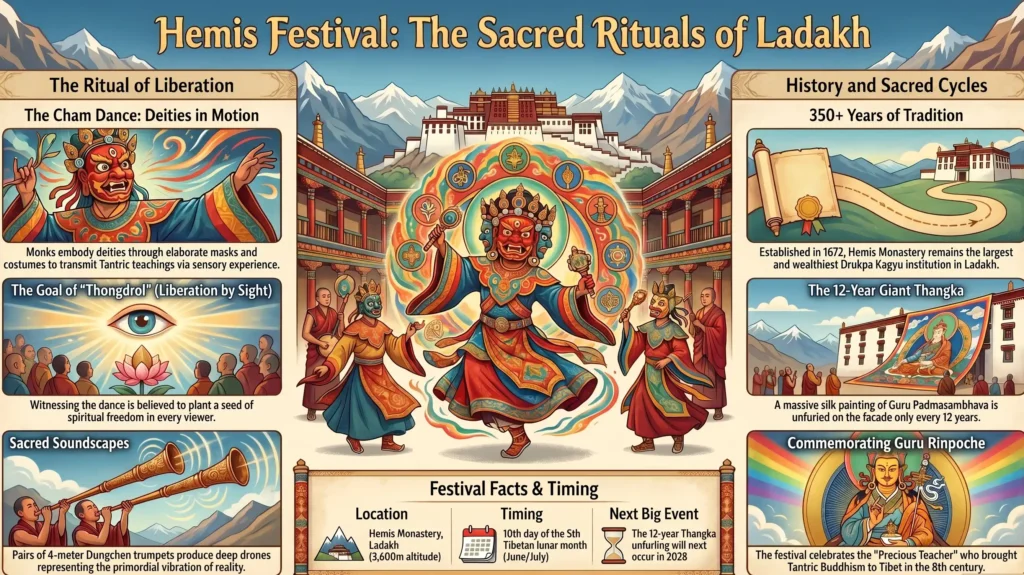
On the two days of the Hemis Festival each summer, this quiet compound transforms. The courtyard that is ordinarily a space of meditative stillness becomes the stage for one of the most extraordinary ritual performances in the Buddhist world. Monks who have spent months preparing their roles emerge in masks and costumes of breathtaking complexity and begin to move to the sound of the longest horns, the deepest drums, and the most penetrating cymbals in the Himalayan musical tradition. They are not monks, in these moments. They are deities, and what they are doing is offering every person present the possibility of liberation.
Padmasambhava: The Birth That Changed the Buddhist World
Ancient Agricultural Myths That Shape the Magh Bihu Harvest Festival
The Hemis Festival exists to celebrate a birth. Not the birth of a human being in any ordinary sense, but the birth of Guru Padmasambhava, called Guru Rinpoche, the precious teacher, whose arrival in the eighth century transformed the religious landscape of the Himalayan world so completely that it has never recovered its prior shape.
Padmasambhava was born, according to tradition, not from a womb but from a lotus flower on a lake called Dhanakosha in what is now Pakistan. The date of his birth in the Tibetan lunar calendar is the tenth day of the fifth month, Tsechu, and this is the day that the Hemis Festival commemorates, every year.
The historical Padmasambhava was an Indian Tantric master invited to Tibet by King Trisong Detsen in the eighth century to overcome the obstacles that were preventing the establishment of Buddhism in Tibet. These obstacles were understood in the Tantric framework as the resistance of indigenous Tibetan spirits to the arrival of the dharma, and Padmasambhava’s role was to subjugate these forces, not by destroying them but by converting them into protectors of the Buddhist teachings. The Cham dance that is performed at Hemis enacts this subjugation in ritual form. The festival is not simply a celebration of a birthday but a re-enactment of the foundational act through which Buddhism established itself in the Tibetan cultural world.
When the monks of Hemis perform the Cham on the tenth day of the fifth month, they are creating the conditions for Padmasambhava’s continued presence in the world, enacting the ritual through which his blessings are renewed and distributed to every being present. The festival is an act of invocation as much as it is an act of commemoration.
The Drukpa Kagyu Tradition and Hemis Monastery
Hemis Monastery is the largest and wealthiest monastery in Ladakh and one of the most important institutions of the Drukpa Kagyu school of Tibetan Buddhism. The Kagyu school traces its lineage through Indian and Tibetan masters to the yogi Milarepa, one of the most beloved figures in the entire Tibetan Buddhist tradition. The Kagyu school is known for its emphasis on direct, experiential transmission of Buddhist teachings through the relationship between teacher and student.
The Drukpa Kagyu takes its name from the dragon, druk in Tibetan, whose thunder was heard at the founding of the tradition’s primary monastery in Tibet in the twelfth century. Bhutan’s national name, Druk Yul, the land of the thunder dragon, reflects the Drukpa Kagyu’s centrality to Bhutanese Buddhist culture, and the school’s presence in Ladakh through institutions like Hemis connects the Ladakhi Buddhist world directly to the Bhutanese and Tibetan religious landscapes.
Hemis Monastery was established in its current form in 1672 under the patronage of the Ladakhi king Sengge Namgyal, who invited the Drukpa Kagyu master Stagtsang Raspa Nawang Gyatso to establish a monastery in the Hemis valley. The royal patronage that has sustained Hemis across three and a half centuries remains active today through the Namgyal dynasty of Ladakh. The monastery’s considerable wealth has allowed Hemis to maintain a large monastic community, an extensive library of Buddhist texts, a remarkable collection of thangka paintings and ritual objects, and the material resources required to produce the elaborate costumes, masks, and musical instruments that the Cham dance requires.
The Cham Dance and the Nature of Enlightened Presence
To watch the Cham dance at Hemis without understanding its theological foundation is to witness something beautiful and somewhat bewildering. To watch it with an understanding of Vajrayana Buddhist philosophy is to encounter something of extraordinary intellectual and spiritual density, a form of teaching so complete in its use of the full sensory apparatus of the human being that its practitioners could reasonably claim that liberation itself is available through it.
The Cham is a sacred masked dance performed by trained monks at major festivals across the Himalayan Buddhist world. Each monastery preserves its own choreography, masks, and theological narrative. The Hemis Cham is specific to the Drukpa Kagyu tradition and was established by Stagtsang Raspa in the seventeenth century.
The theological foundation of the Cham lies in the Vajrayana understanding that the enlightened mind is not separate from the phenomenal world but is expressed through and within it. The deities of the Tantric Buddhist pantheon are not external beings but are manifestations of the mind’s enlightened qualities, appearing in specific forms to communicate specific aspects of the awakened state to beings who have not yet recognised their own Buddha nature.
When a monk wears the mask of a wrathful deity during the Cham dance, he has spent months in meditation on that deity’s form, mantra, and essence. By the time he dances, the monk and the deity are understood to be the same, and the masked figure moving through the monastery courtyard is understood as a genuine manifestation of enlightened presence. This is the mechanism through which the Cham dance transmits liberation to those who witness it. Seeing the form of an enlightened deity is understood to plant a seed of liberation in the mindstream of the witness. The seed may not ripen in this lifetime but across many lifetimes, and the eventual liberation of the witness is thereby made more certain. The monks dance so that everyone present moves closer to freedom from suffering.
Masks, Music, and Sacred Space
The masks worn by the monks during the Hemis Cham are among the most remarkable objects in the Himalayan artistic tradition. The wrathful deity masks are enormous constructions of painted papier-mache, yak hide, and metal ornamentation that can weigh several kilograms. These masks represent the Dharmapala, the protectors of the dharma, whose fierce expressions communicate not anger but the fierce compassion of a mind that has overcome all obstacles to liberation. Their fierceness is a form of love, confronting the forces of ignorance that keep beings trapped in suffering.
The Stag masks, worn by the deer-headed attendants of Yama the lord of death, are among the most visually distinctive elements. Yama appears as Dharmaraja, the king of dharma, flanked by his attendants and preceded by the offering of a human-shaped torma figure representing the ego and its attachments. The ritual destruction of this figure enacts the cutting through of the fundamental delusion of a fixed, permanent self.
The Black Hat dancers, called Shanag in Tibetan, wear large black felt hats with wide silk streamers. Their dance is the most sustained and meditative of the Cham sequences, involving slow, precise movements that communicate undistracted awareness. The Black Hat dance traces its origin to the historical episode in which a Buddhist monk concealed a weapon in his Black Hat to gain access to the anti-Buddhist Tibetan king Langdarma and assassinate him, ending a period of persecution. The dance commemorates this act while functioning as a meditation teaching about decisive action arising from compassionate motivation.
The musical accompaniment of the Hemis Cham is not background sound but a theological participant in the ritual. The Dungchen, the long ceremonial trumpet typically between two and four metres in length, produces a deep resonant drone whose vibration is felt in the body. The sound represents the primordial sound of the dharma, calling all beings to attention. The Gyaling, a double-reed oboe-like instrument, cuts through with clarity, representing the arising of specific forms within the ground of being. Together they model the relationship between emptiness and form central to Buddhist philosophy.
The Kangling is a trumpet made from a human femur bone, reflecting the tradition’s engagement with death and impermanence as teachers. The Rolmo are large cymbals marking the rhythmic structure of the dance. The Damaru, the small double-headed drum, is most directly associated with Padmasambhava himself, its rapid sound understood as awakened awareness cutting through confusion.
The Twelve-Year Thangka and Cosmic Renewal
Every twelve years, corresponding to the Tibetan astrological cycle of the monkey year in which Padmasambhava is said to have been born, the Hemis Festival includes a ritual that occurs at no other time and draws pilgrims from across the Himalayan Buddhist world: the unfurling of the great thangka.
The thangka is an enormous painted scroll depicting Guru Padmasambhava in his primary form, surrounded by his eight manifestations, his twenty-five principal disciples, and the protective deities of the Drukpa Kagyu tradition. Its dimensions are extraordinary, covering a significant portion of the Hemis Monastery’s facade when fully unfurled. The painting was completed over several years by master thangka painters working within the strict iconographic guidelines of the Tibetan Buddhist artistic tradition. The pigments are traditional mineral and organic colours, and the gold used is genuine ground gold applied with the precision the tradition requires.
The unfurling of the thangka at the twelve-year festival is accompanied by the most complete version of the Cham dance, with all figures represented and the full ritual sequence performed in its most elaborate form. The combination of the enormous painted presence of Padmasambhava on the monastery’s facade and the living enactment of his teachings through the Cham creates a simultaneity of visual and kinetic sacred content that practitioners describe as an experience of unusual intensity and openness. The last twelve-year thangka unfurling occurred in 2016, drawing pilgrims from across Ladakh, Tibet, Bhutan, Nepal, and the global Buddhist community. The next will occur in 2028.
Ladakh’s Buddhist Civilization and the Festival’s Place Within It
Ancient Agricultural Myths That Shape the Magh Bihu Harvest Festival
The Hemis Festival exists within and expresses the specific cultural world of Ladakh, whose Buddhist civilisation is one of the most complete and distinctive surviving expressions of Himalayan culture. Ladakh’s Buddhist civilization developed in relative geographic isolation, protected by the Himalayan ranges that separate it from the plains of northern India and the plateaus of Tibet. This isolation allowed a specific synthesis of Indian, Tibetan, and Central Asian cultural and religious influences to develop into a distinctive Ladakhi cultural identity expressed in every dimension of life.
The Hemis Festival is the largest and most celebrated event in Ladakh’s ritual calendar, the moment when the entire community’s relationship with the Drukpa Kagyu tradition, with Padmasambhava, and with the monastery that has been the spiritual centre of Ladakhi life for three and a half centuries finds its most complete public expression. Ladakhi families travel from distant villages to attend. Nomadic communities from the Changthang plateau make the festival a destination in their seasonal movements.
For Ladakhi Buddhists, attending the Hemis Festival is not comparable to attending a cultural event or even an ordinary religious festival. It is an encounter with the tradition’s living heart, a renewal of the relationship between the community and its primary protective deity, and an opportunity to receive the blessing of Padmasambhava’s presence that the Cham enacts.
The Ladakhi cultural world has been under increasing pressure from rapid modernisation, accelerated by the region’s strategic military significance and its growing importance as a tourism destination. The 2019 reorganisation that made Ladakh a Union Territory directly administered by the central government has created specific challenges for Hemis Monastery, the monastic community that performs the Cham, and the Ladakhi Buddhist civilisation that gives the festival its meaning.
The Tourist, the Pilgrim, and What the Festival Actually Is
The Hemis Festival today draws two distinct types of visitor whose experience of the same event differs so fundamentally that they might almost be attending different occasions. The distinction is not a moral one, and both are welcome, but the difference between what they receive from the festival illuminates what the Cham dance is actually for.
The tourist typically arrives with a camera and experiences the Cham primarily as a visual spectacle of remarkable richness. The masks, the costumes, the music, the dramatic movements of the dancers, the extraordinary mountain setting, all of this is genuinely spectacular and justifies the journey on purely aesthetic grounds. What the tourist receives is a vivid sensory experience and a set of images that will populate their memory and their social media feed.
What the Ladakhi Buddhist pilgrim receives is categorically different, not because they have access to something hidden from the tourist, but because they bring to the same event a framework of understanding that transforms its meaning entirely. They know who Padmasambhava is, not as a historical figure but as a living presence whose blessings are available in this moment, renewed by the Cham being performed. They know what each mask represents and what the destruction of the torma figure means. They understand that the music is not accompaniment but transmission. They know that being present at the Cham, with whatever quality of faith and attention they can bring, plants a seed of liberation in their mindstream that will bear fruit across however many lifetimes it takes.
The festival was not made for the tourist. It was made for the pilgrim. Understanding what it was made for is the condition for understanding what it actually is.
The Mountains Hold the Teaching
The Hemis Festival happens at 3600 metres above sea level, in a valley of the Indus that receives less than ten centimetres of rainfall per year, surrounded by mountains that were ancient before the first Buddhist teaching was given. The landscape is not incidental to the festival. It is one of its most active participants.
The thin air of Ladakh does something specific to consciousness, not something dramatic but something real: a mild, persistent quality of heightened clarity, of edges being slightly sharper than they are at lower altitudes. The Ladakhi Buddhist tradition has always understood this quality of Himalayan atmosphere as conducive to meditation, and the placement of monasteries at altitude reflects an understanding that the physical environment supports the interior work the tradition requires.
When the Dungchen sounds at Hemis and its drone fills the valley, the mountains are not simply a backdrop to the sound. They receive it, reflect it, transform it. The sound that is recorded on a phone in the Hemis courtyard and the sound that plays back in a city apartment at sea level are acoustically similar and experientially incomparable. Something happens to that sound in the specific physical conditions of that valley that cannot be reproduced anywhere else.
This is what the monks who have spent their lives at Hemis understand, that visitors discover for the first time and carry home as the festival’s most indelible gift. The mountains are part of the teaching. The altitude is part of the practice. The cold air on the face in the June morning before the Cham begins is part of what makes the Cham what it is.
Padmasambhava promised to return whenever sentient beings call on him with sincere devotion. On the tenth day of the fifth Tibetan month, in the courtyard of Hemis Monastery, in the valley of the Indus, at 3600 metres above sea level, the monks of the Drukpa Kagyu tradition have been calling on him every year for over three centuries. In the theology of the tradition, he is already here.
Mythological Origins of the Kumbh Mela and Descent of the Ganga
If you think you have remembered everything about this topic take this QUIZ
Results


#1. Hemis Monastery, the largest and wealthiest monastery in Ladakh, is a premier institution of which school of Tibetan Buddhism?
#2. The Hemis Festival is celebrated annually on the tenth day of the fifth Tibetan lunar month to commemorate the birth anniversary of which eighth-century Indian Tantric master?
#3. Under the patronage of which historic king of the Namgyal dynasty was Hemis Monastery established in its current form in 1672?
#4. What is the name of the sacred, masked dance performed by trained monks that acts as a visual and sensory transmission of Tantric teachings?
#5. Which iconic instrument played at the festival can reach lengths of up to four meters and is always played in pairs to produce a deep, resonant drone?
#6. The Black Hat dancers of the Hemis ritual, known for their slow and highly meditative movements, are called by what Tibetan name?
#7. A massive, sacred thangka painting of Guru Padmasambhava is unfurled on the monastery’s facade only once every how many years?
#8. According to the Quick Comparison Table, what sets the environmental setting of the Takthok Tsechu festival apart from the Hemis Festival?
What is the Hemis Festival and why is it celebrated?
The Hemis Festival is a two-day annual gathering at Hemis Monastery in Ladakh’s Leh district, celebrated on the tenth day of the fifth Tibetan lunar month to mark the birth anniversary of Guru Padmasambhava, the eighth-century Indian Tantric master who brought Vajrayana Buddhism to Tibet. The festival is centred on the Cham dance, a sacred masked dance performed by the monastery’s monks that enacts the defeat of negative forces and transmits Tantric Buddhist teaching to every being present. In the Drukpa Kagyu theological understanding, witnessing the Cham plants a seed of liberation in the mindstream of the witness, making the festival an act of collective compassion as much as a celebration.
What is the Cham dance and what does it mean in Vajrayana Buddhist theology?
The Cham dance is a sacred masked dance performed by trained monks at major Himalayan Buddhist festivals. In Vajrayana theology, the monks who wear the masks of specific deities are not pretending to be those deities but have through months of meditation preparation dissolved the boundary between themselves and the deity they embody. The masked figure moving through the courtyard is understood as a genuine manifestation of enlightened presence. Witnessing the Cham is understood to plant a seed of liberation in the mindstream of every witness regardless of their religious background, because the enlightened awareness manifested through the dance interacts with the Buddha nature present in every sentient being.
What is the significance of the twelve-year thangka unfurling at Hemis?
Every twelve years, in the Tibetan astrological monkey year in which Padmasambhava is said to have been born, the Hemis Festival includes the unfurling of an enormous thangka painting depicting Guru Padmasambhava on the monastery’s facade. The thangka is too large to be displayed in any interior space and covers a significant portion of the monastery’s exterior wall when fully displayed. Its unfurling is accompanied by the most complete version of the Cham dance and draws pilgrims from across Ladakh, Tibet, Bhutan, Nepal, and the global Buddhist world. The last unfurling occurred in 2016 and the next will be in 2028.
What musical instruments are used at the Hemis Festival and what do they represent?
The primary instruments of the Hemis Cham music include the Dungchen, a long ceremonial trumpet up to four metres in length played in pairs producing a deep resonant drone representing the primordial sound of the dharma; the Gyaling, a penetrating double-reed instrument representing the arising of specific forms within the ground of being; the Kangling, a trumpet made from or shaped like a human femur bone associated with death and liberation practices; the Rolmo, large cymbals that mark the rhythmic structure of the dance; and the Damaru, a small double-headed drum directly associated with Padmasambhava himself. Each instrument is both a musical and a theological participant in the ritual.
How should visitors prepare for attending the Hemis Festival?
Visitors should check the exact dates of the Hemis Festival each year as they follow the Tibetan lunar calendar and shift annually. Travel to Leh from major Indian cities is by air, and altitude acclimatisation of at least two to three days in Leh before travelling to Hemis at 3600 metres is strongly recommended. The festival draws very large crowds particularly for the main Cham performance days and accommodation in Leh should be booked several months in advance. Visitors are welcome to photograph the public Cham performances but should observe the guidelines of the monastery regarding respectful behaviour in the sacred space. Approaching the festival with awareness of its theological significance rather than purely as a visual spectacle will significantly deepen the experience.
Sources & References
Hemis Monastery’s foundation and Drukpa Kagyu tradition — Hemis Monastery was established in 1672 under Ladakhi king Sengge Namgyal and represents one of the largest and wealthiest monasteries in the Drukpa Kagyu school of Tibetan Buddhism, maintaining a continuous royal patronage relationship with the Namgyal dynasty across three and a half centuries of institutional and ritual life.
Guru Padmasambhava and the Hemis Festival commemoration — The Hemis Festival celebrates the birth anniversary of Guru Padmasambhava on the tenth day of the fifth Tibetan lunar month (Tsechu), an eighth-century Indian Tantric master traditionally understood as bringing Vajrayana Buddhism to Tibet, with the festival understood as an act of invocation renewing Padmasambhava’s living presence rather than merely commemorating a historical birthday.
The Cham dance as ritual transmission of liberation — The Cham is a sacred masked dance in which monks transform through meditation into manifestations of specific Tantric deities, and Vajrayana theology understands witnessing the Cham as planting a seed of liberation in the mindstream of every viewer regardless of religious background or understanding, functioning as a direct transmission mechanism available to all beings present.
The twelve-year thangka unfurling and cosmic cycle — Every twelve years in the Tibetan monkey year, an enormous thangka painting of Guru Padmasambhava is unfurled on Hemis Monastery’s facade accompanied by the most elaborate Cham performance, drawing pilgrims across the Himalayan Buddhist world, with the last occurrence in 2016 and the next scheduled for 2028.
Ladakh’s Buddhist civilization and contemporary pressures — Hemis Festival occupies the central place in Ladakh’s surviving Himalayan Buddhist civilization, representing both a spiritual renewal of the community’s relationship with Padmasambhava and Drukpa Kagyu teachings and a focal point under pressure from modernisation, tourism development, and the institutional reorganisation of Ladakh as a Union Territory since 2019.