How Bhangarh Fort’s Abandoned Stones Became India’s Most Celebrated Mystery
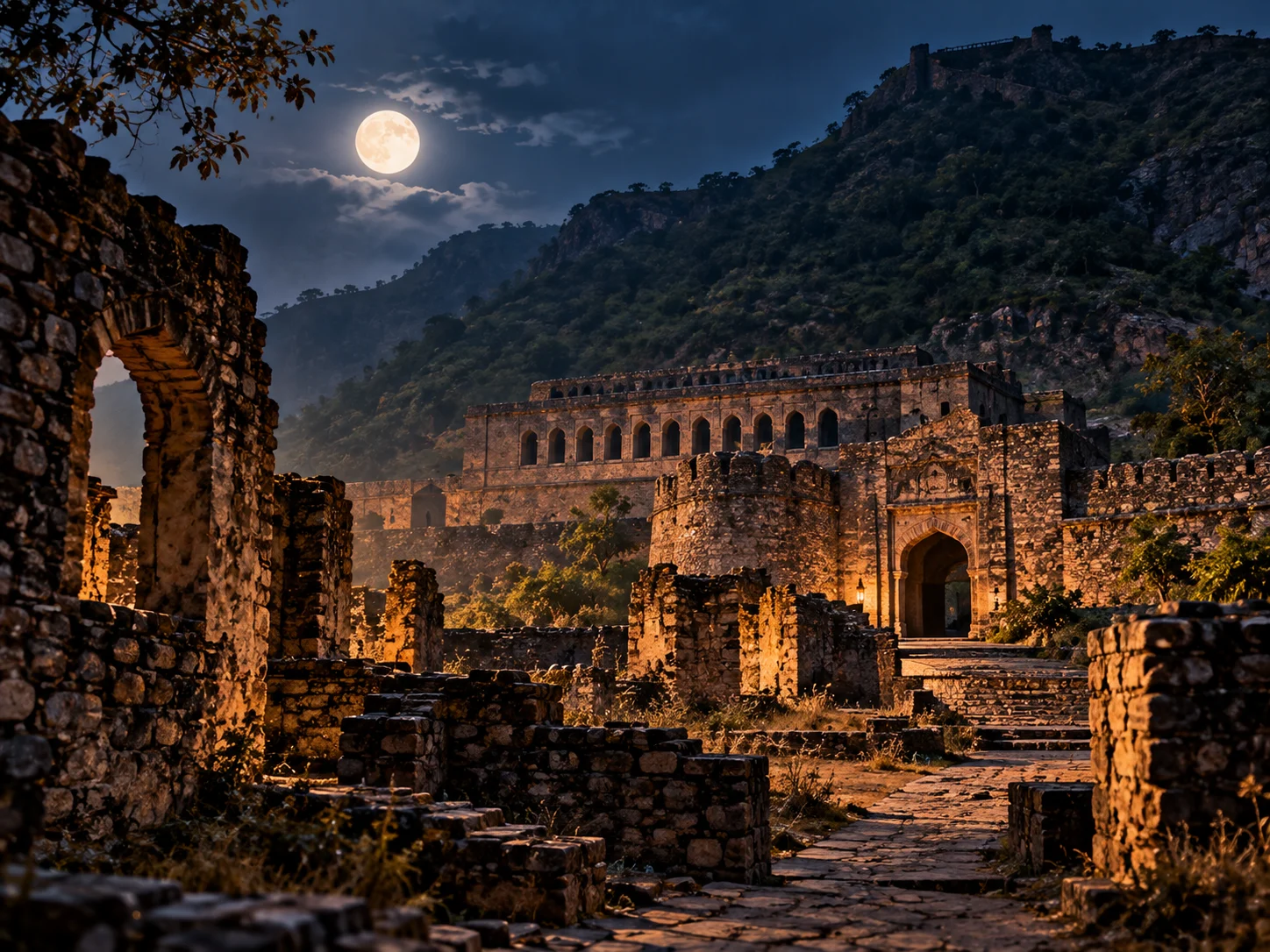
Bhangarh sits in the foothills of the Aravalli range in Rajasthan’s Alwar district, about eighty-five kilometres from Jaipur, with the particular quality of stillness that abandoned places accumulate over centuries, a stillness that is not quiet because the wind moves through the broken walls and the temple towers constantly and the birds that nest in the ruins are not silent, but that is nevertheless profoundly still in the way that a city emptied of its people becomes still, carrying the shape of habitation without the substance of it. The Archaeological Survey of India has placed a board at the entrance warning visitors not to enter after sunset, which is the kind of institutional acknowledgment of a legend that manages to take the legend seriously without quite admitting that it does. The cursed city of Bhangarh has been drawing people toward that board and then past it for a very long time.
Mythological Origins of the Kumbh Mela and Descent of the Ganga
A City Built and Then Forgotten
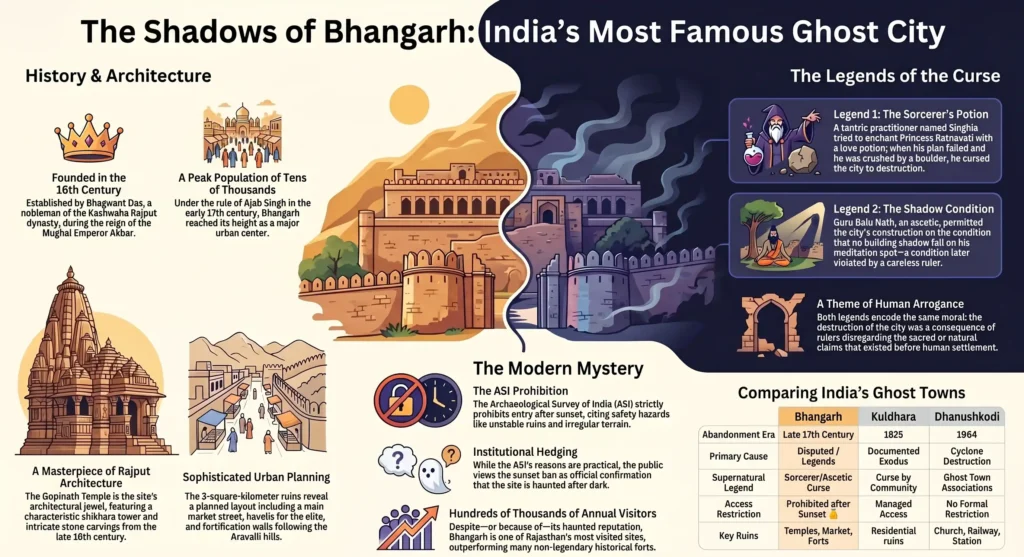
Bhangarh is a late sixteenth-century fortified city whose ruins, spread across approximately three square kilometres in the Aravalli foothills, have become the most celebrated site of supernatural legend in India. The city was established during the reign of Bhagwant Das of the Kachwaha Rajput dynasty, reached its peak under Ajab Singh in the early seventeenth century, and was subsequently abandoned under circumstances that the historical record has not fully explained and that local tradition has filled with two competing legends of supernatural cursing. The Archaeological Survey of India’s prohibition on entry after sunset has given institutional weight to the legends and made Bhangarh simultaneously one of India’s most visited heritage sites and its most famous ghost town.
Approaching Bhangarh from the road that runs through the Sariska Tiger Reserve, the ruins announce themselves before the signboard does. The temple towers rise above the treeline, intact enough to suggest a skyline and ruined enough to suggest its absence. The havelis, the market stalls, the residential quarters, the temples, and the fortification walls are all there in the sense that their stone remains, but the life that filled them departed so completely that the departure itself became the most interesting thing about them.
Most abandoned cities in the world are abandoned for reasons that are, at their core, economic or military. The trade route shifted. The river changed course. The garrison withdrew. The invader came and did not leave. Bhangarh’s abandonment is not undocumented in this sense, but the partial quality of the historical explanations, the gaps and uncertainties in a record that should be more complete given how recently the city was inhabited, has given the legends that fill those gaps an unusual amount of room to breathe.
The Kachwaha Foundation
How the Bhotiya Weavers of Uttarakhand Kept a Himalayan Textile Tradition Alive
Bhangarh was established in the latter part of the sixteenth century by Bhagwant Das, a general and nobleman of the Kachwaha Rajput dynasty of Amber, the kingdom that would eventually become the state of Jaipur. The Kachwaha rulers had developed a sophisticated relationship with the Mughal Empire under Akbar, providing military service and administrative capability in exchange for political recognition and the security of their territorial position in Rajasthan.
Bhagwant Das himself was a significant military figure who served Akbar and who was the father of Man Singh, one of the most celebrated of all Mughal commanders and one of the Rajput nobles whose service to the Mughal court was most consequential for both the empire and the Rajput kingdoms of Rajasthan. The establishment of Bhangarh was part of the broader pattern of Kachwaha territorial consolidation in the Alwar region during this period.
The city was built in the relatively flat ground at the foot of the Aravalli hills, with the natural topography of the hillside providing both a defensive advantage and the elevated position for the fortification walls that run along the higher ground above the main urban area. The planning of Bhangarh reflected the urban design conventions of its era, with the temples positioned at the highest and most visible points of the settlement, the commercial district along a central market street, and the residential areas laid out in a pattern that organized social hierarchy spatially.
The city reached its greatest extent and presumably its greatest population under Ajab Singh, a descendant of Bhagwant Das, in the early seventeenth century. The market at Bhangarh, which archaeological surveys have found to extend along a significant main street with the remains of individual shops and stalls clearly distinguishable, suggests a commercial life of considerable activity. The population at its peak is estimated to have been in the tens of thousands, though precise figures from this period are not available.
The Legend of Singhia and the Enchanted Oil
The more dramatically compelling of the two primary legends associated with Bhangarh’s abandonment involves a figure named Singhia, described in local tradition as a tantric practitioner of considerable power who fell fatally in love with the princess of Bhangarh, a woman of exceptional beauty named Ratnavati.
Singhia is said to have used his tantric knowledge to prepare a love potion that he intended to administer to Ratnavati through scented oil that she or her attendants were purchasing in the market. The princess became aware of the enchanted oil, either through her own perception or through a warning, and she threw the oil onto a large boulder near where Singhia was standing. The boulder, enchanted by the potion, began to roll toward Singhia and crushed him. As he died, he cursed the city, declaring that Bhangarh would be destroyed and that no one who remained within its walls would survive.
Shortly afterward, according to the legend, Bhangarh was attacked by the army of the Ajmer kingdom and destroyed, its population killed or dispersed, the princess herself among the dead.
This legend has several of the structural qualities that oral tradition tends to preserve best across long periods, a clear cause and effect relationship, a specific act of supernatural transgression, a named supernatural agent, and a consequence proportionate to the transgression. Folklorists who have studied the legends of Bhangarh note that the Singhia legend belongs to a broader category of stories about tantric practitioners who misuse their knowledge for purposes of personal desire and suffer catastrophic consequences. These stories are widely distributed across Rajasthan and reflect both the genuine historical presence of tantric practice in the region and the moral framework within which that practice was evaluated by the communities that lived alongside it.
The Ascetic’s Shadow Condition
Why Paliwal Brahmins Left Kuldhara in a Single Night and Never Returned
The second legend is older and in some ways more architecturally specific. It concerns an ascetic named Guru Balu Nath who is said to have been meditating in the area that became Bhangarh before the city was built. When Ajab Singh or, in some versions, Bhagwant Das himself sought the ascetic’s permission to build the city on the land where he meditated, the ascetic gave his permission on a specific condition: the buildings of the city must not cast their shadow on his place of meditation. If any shadow fell on him, the city would be destroyed.
The building proceeded with this condition in mind. For some time, according to the legend, the condition was observed. Then a later ruler, either through carelessness or through deliberate disregard of the condition, allowed the construction of a building that violated the shadow prohibition. The shadow fell on the ascetic’s place of meditation. The city was cursed and subsequently destroyed.
This legend is more historically specific than the Singhia story in one important respect. It implies a physical relationship between the city’s architecture and the site of the ascetic’s meditation that should be traceable in the ruins. Several researchers who have examined the site have noted that there is a particular spot near the ruins that local tradition identifies as the ascetic’s meditation place, and that the spatial relationship between this spot and the surrounding ruins does suggest the kind of shadow condition the legend describes.
The shadow legend also belongs to a well-documented category of Indian folk narrative about the relationship between human construction and the sacred presences that inhabit particular landscapes, the idea that the natural and sacred topography of a place carries claims on human activity that must be respected under threat of supernatural consequence.
What the Historical Record Shows and Doesn’t Show
The historical record of Bhangarh’s abandonment is frustratingly incomplete for a city that was inhabited as recently as the seventeenth century and that was part of the well-documented Kachwaha Rajput political world. The Mughal administrative records of the period, the accounts of travelers and chroniclers, and the genealogical histories of the Kachwaha dynasty provide some information about the region but do not provide a clear account of the specific circumstances of Bhangarh’s abandonment.
What the historical record does suggest is that Bhangarh declined and was eventually abandoned during the second half of the seventeenth century, a period of considerable political turbulence across Rajasthan associated with the later years of the Mughal Empire and the succession crises that followed Aurangzeb’s death in 1707. The specific mechanism of the city’s decline, whether sudden military destruction, gradual administrative neglect, plague, famine, or some combination of these factors, is not clearly established.
The Archaeological Survey of India has conducted surveys of the Bhangarh site that have identified the extent of the ruins and provided basic documentation of the surviving structures, but comprehensive archaeological excavation that might clarify the historical circumstances of the city’s abandonment has not been carried out. The site’s protected status and the challenges of archaeological work in a location that receives significant tourist traffic have contributed to this gap in the record.
The Temples and the Architecture of a Lost City
How Titu Singh’s Past Life Memories Led to a Murder Conviction in Agra
The temples that survive at Bhangarh are architecturally significant. The Gopinath Temple, the Someshwar Temple, and the Mangla Devi Temple are all constructed in the Rajput architectural tradition, with the characteristic shikhara towers and intricately carved stone facades that represent the finest craft of sixteenth and seventeenth-century Rajasthan. The Archaeological Survey of India has recognized these temples as protected monuments of national importance, and their preservation, however incomplete, provides the clearest architectural evidence of the city’s former quality.
The Gopinath Temple at the center of the settlement is the most architecturally significant surviving structure, its shikhara tower rising above the surrounding ruins with the authority of a building designed to be the visual focal point of a city. The interior of the temple retains sculptural elements of considerable quality, and the proportions of the structure give a clear sense of the ambition and capability of the craftsmen who built Bhangarh at its height.
The market street that runs through the center of the settlement is unusual in the completeness with which the individual commercial spaces can be identified. The stone platforms and divided spaces that formed individual shops are still distinguishable, and the length of the market gives a sense of the commercial activity that the city sustained at its peak. The market at Bhangarh was not a minor adjunct to a military garrison but a substantial commercial center serving a significant urban population.
The residential areas, less well preserved than the temples and the market, nevertheless retain enough structure to give a sense of the density of the urban fabric. The havelis, the large residential compounds of the wealthier families, are distinguishable from the smaller domestic structures by their scale and by the quality of the remaining stonework. Together they suggest a city that was genuinely urban rather than simply a military encampment that happened to have a temple.
The ASI Sign and Its Meanings
The Archaeological Survey of India’s decision to place a notice at the Bhangarh entrance prohibiting entry after sunset is one of the more intriguing acts of institutional hedging in the history of Indian heritage management. The ASI is a scientific organization responsible for the documentation, preservation, and management of India’s archaeological and architectural heritage. It does not, as an institutional matter, endorse supernatural explanations for historical events.
And yet the sign is there. The prohibition is real, backed by whatever administrative authority the ASI can bring to bear on visitors to a protected monument. Officials who have been asked to explain the prohibition have generally cited safety concerns, the genuine danger of navigating uneven ruins, exposed excavations, and unstable structures in darkness, as the primary justification.
The safety explanation is legitimate. Bhangarh’s ruins include genuinely hazardous conditions, broken flooring, deep wells, unstable walls, and the kind of topographic irregularity that makes nighttime navigation without adequate lighting seriously dangerous. The prohibition serves a real conservation and safety function regardless of whatever supernatural dimension observers have read into it.
But the sign has become inseparable from the legend, functioning in the popular imagination as an official acknowledgment that something about Bhangarh at night is genuinely other than ordinary. The institutional prohibition has amplified rather than dampened the supernatural reputation, giving the legends the particular frisson that comes from seeming to be taken seriously by a body that professionally takes only the empirically verifiable seriously.
What Haunting Actually Means
Every genuinely interesting haunted place raises a question that goes beyond the binary of whether the supernatural explanations are literally true. The question is what the haunting means, what it is encoding, what it is trying to say about the place and its history and the human experience of encountering a place where something ended so completely that only the architecture of the ending remains.
Bhangarh’s legends, both the Singhia story and the Balu Nath story, are about the violation of conditions. In both cases, a city is built in relation to something that was there before it, a sacred practitioner, a natural presence, a set of claims on the landscape that preceded human settlement. In both cases, the city’s rulers either through malice or through carelessness violate the conditions under which the prior presence permitted human intrusion. In both cases, the city is destroyed as a consequence.
This is not a story about supernatural evil. It is a story about the consequences of human arrogance toward the things that were there before human construction began, toward the sacred geography, toward the ascetic who was meditating on the hillside before anyone decided to build a city there, toward the natural order within which human settlement is always, in some sense, a negotiated presence rather than an unconditional right.
Read in this way, the legends of Bhangarh are less about ghosts and more about what a city owes to the landscape it inhabits and the consequences of forgetting that debt. The ruins that remain are the evidence of a debt that was not paid. The sign at the entrance is the reminder that the debt has not been forgiven.
Bhangarh will not resolve itself into either pure history or pure legend for anyone who visits it with honest attention. The ruins are genuinely historical, the remnants of a real city built by a real dynasty in a real political context that the historical record, however incompletely, documents. The legends are genuinely cultural, the accumulated meaning that three centuries of local tradition, popular imagination, and media amplification have layered onto a set of stones that stopped being a city sometime in the seventeenth century.
What makes Bhangarh interesting is not the question of whether the supernatural explanations are literally true. What makes Bhangarh interesting is the question of what the ruins are, what a city that has been completely emptied of its inhabitants retains of the life that filled it, and what human beings do with that retention when they encounter it.
The ASI sign tells you not to enter after sunset. The ruins tell you that something ended here with a completeness that ordinary endings do not usually achieve. The legends tell you why, in the language that tradition uses for things it knows cannot be reduced to administrative record. All three are worth reading.
Goddess Kamakhya and Mythology Behind the Ambubachi Mela
If you think you have remembered everything about this topic take this QUIZ
Results


#1. In which century was the fortified city of Bhangarh established?
#2. During the reign of which Kachwaha Rajput dynasty ruler was Bhangarh founded?
#3. Under which ruler did the city of Bhangarh reach its greatest extent and peak population in the early seventeenth century?
#4. According to popular local legend, what was the profession or identity of the figure named Singhia who cursed the city?
#5. What specific condition did the ascetic Guru Balu Nath set before permitting the construction of the city?
#6. Which temple is considered by architectural historians to be the most significant surviving structure at the center of the Bhangarh ruins?
#7. What official reason does the Archaeological Survey of India give for prohibiting entry into Bhangarh between sunset and sunrise?
#8. What is the approximate area covered by the ruins of the abandoned fortified city of Bhangarh?
Why is Bhangarh considered India’s most haunted place?
Bhangarh carries this reputation through a combination of factors that have reinforced each other across centuries. The city was abandoned under historically unclear circumstances, creating an explanatory gap that local tradition filled with supernatural legends. The scale and completeness of the ruins create an atmosphere of absolute abandonment unusual even among deserted Indian cities. The Archaeological Survey of India’s prohibition on entry after sunset has been widely interpreted in popular culture as official endorsement of the supernatural associations. And successive generations of media coverage have amplified and standardized the site’s haunted reputation until Bhangarh and haunted India have become effectively synonymous in the popular imagination.
What are the two main legends about Bhangarh’s curse?
The first involves a tantric sorcerer named Singhia who attempted to enchant the princess Ratnavati using a love potion and was killed when the princess threw the enchanted oil onto a boulder that then crushed him. Before dying he cursed the city, and it was subsequently destroyed. The second involves an ascetic named Guru Balu Nath who gave permission for the city to be built on condition that no building’s shadow would fall on his meditation place. When a later ruler violated this condition, the city was cursed and destroyed. Both legends belong to well-documented categories of Indian folk narrative about supernatural transgression and its consequences.
What is the historical explanation for Bhangarh’s abandonment?
The historical record does not provide a clear single explanation. What is established is that the city declined and was abandoned during the second half of the seventeenth century, a period of political turbulence across Rajasthan associated with the decline of Mughal authority and the succession crises that followed Aurangzeb’s reign. Whether the specific mechanism was military attack, plague, famine, administrative neglect, or some combination remains unclear because comprehensive historical documentation and archaeological excavation of the site have not been completed.
What survives at Bhangarh today and what does it tell us about the city?
The surviving structures include three significant temples, the Gopinath Temple being the most architecturally important, an identifiable market street with individual shop spaces still distinguishable, residential havelis, smaller domestic structures, and fortification walls following the Aravalli hillside topography. Together these tell us that Bhangarh was a genuinely urban center of significant scale, with sophisticated temple architecture, active commercial life, and a socially differentiated residential population, rather than simply a military garrison or administrative outpost.
Is it actually illegal to enter Bhangarh at night?
Entry to Bhangarh between sunset and sunrise is prohibited under the Archaeological Survey of India’s management regulations for the protected monument site. The stated reasons for the prohibition are safety concerns related to the genuinely hazardous conditions that the unlit ruins present at night, including unstable structures, exposed excavations, and irregular terrain. Violation of ASI entry regulations for protected monuments can result in legal consequences under the Ancient Monuments and Archaeological Sites and Remains Act, though enforcement at the Bhangarh site specifically has been inconsistent.
Sources & References
Bhangarh’s founding and historical period — Established in the late sixteenth century by Bhagwant Das, father of the Mughal commander Man Singh, Bhangarh became a significant Rajput urban center under Ajab Singh in the early seventeenth century, with populations estimated in the tens of thousands and evidence of substantial commercial activity along its market street.
The Singhia sorcerer legend and tantric practice — The legend of Singhia’s enchanted love potion and curse belongs to a documented category of Rajasthani folklore about tantric practitioners who misuse sacred knowledge for personal desire, reflecting both the historical presence of tantric practice in medieval Rajasthan and the moral frameworks through which communities evaluated such practice.
The Guru Balu Nath and sacred landscape tradition — The ascetic’s shadow condition legend reflects broader Indian folk narrative traditions about sacred presences inhabiting landscapes before human settlement, with researchers noting the spatial relationship between the identified meditation spot and surrounding ruins appears consistent with the legend’s physical requirements.
Abandonment causes and historical gaps — The city declined and was abandoned during the late seventeenth century amid political turbulence following Aurangzeb’s death and the succession crises of Mughal decline, though the specific mechanism—military destruction, plague, famine, or administrative neglect—remains unclear due to incomplete historical documentation and the absence of comprehensive archaeological excavation.
ASI restrictions and contemporary visitation — The Archaeological Survey of India’s sunset entry prohibition, officially justified on safety grounds regarding hazardous ruins, has been widely interpreted as institutional acknowledgment of the site’s legendary status, and the site receives hundreds of thousands of annual visitors drawn primarily by its supernatural reputation despite substantial historical and architectural merit.