Yaoshang is a five-day spring festival celebrated by the Meitei community of Manipur, beginning on the full moon night of the month of Lamta. Rooted in Vaishnavite devotion and ancient seasonal traditions, it combines the lighting of sacred bonfires, folk dances like Thabal Chongba, playful water throwing, sports competitions, and community singing called Sankirtana. It is often called Manipuri Holi, though its cultural depth reaches far beyond color throwing. Yaoshang reveals how a community in Northeast India has held on to its identity, its faith, and its joy through centuries of change.| Detail | Information |
| Festival Name | Yaoshang |
| Also Known As | Manipuri Holi |
| Location | Manipur, Northeast India |
| Duration | Five days |
| Timing | Full moon day of Lamta (February to March) |
| Primary Community | Meitei community of Manipur |
| Key Rituals | Thabal Chongba, Yaoshang Mei Thaba, Nakatheng |
| Governing Body | Traditional village clubs (Meira Paibis and Lup) |
| UNESCO Recognition | Sankirtana (related tradition) inscribed in 2013 |
| Associated Deity | Lord Thangjing and Lord Krishna |
How Yaoshang Resists Packaging and Remains Genuinely Alive
There is a particular kind of quiet that falls over Imphal in the days before Yaoshang. Markets hum with preparation. Mothers stitch new clothes for children. Old men sit in temple courtyards talking about the bonfire sites their grandfathers used to choose. And then, on the full moon night of Lamta, the quiet breaks entirely.
A flame rises.
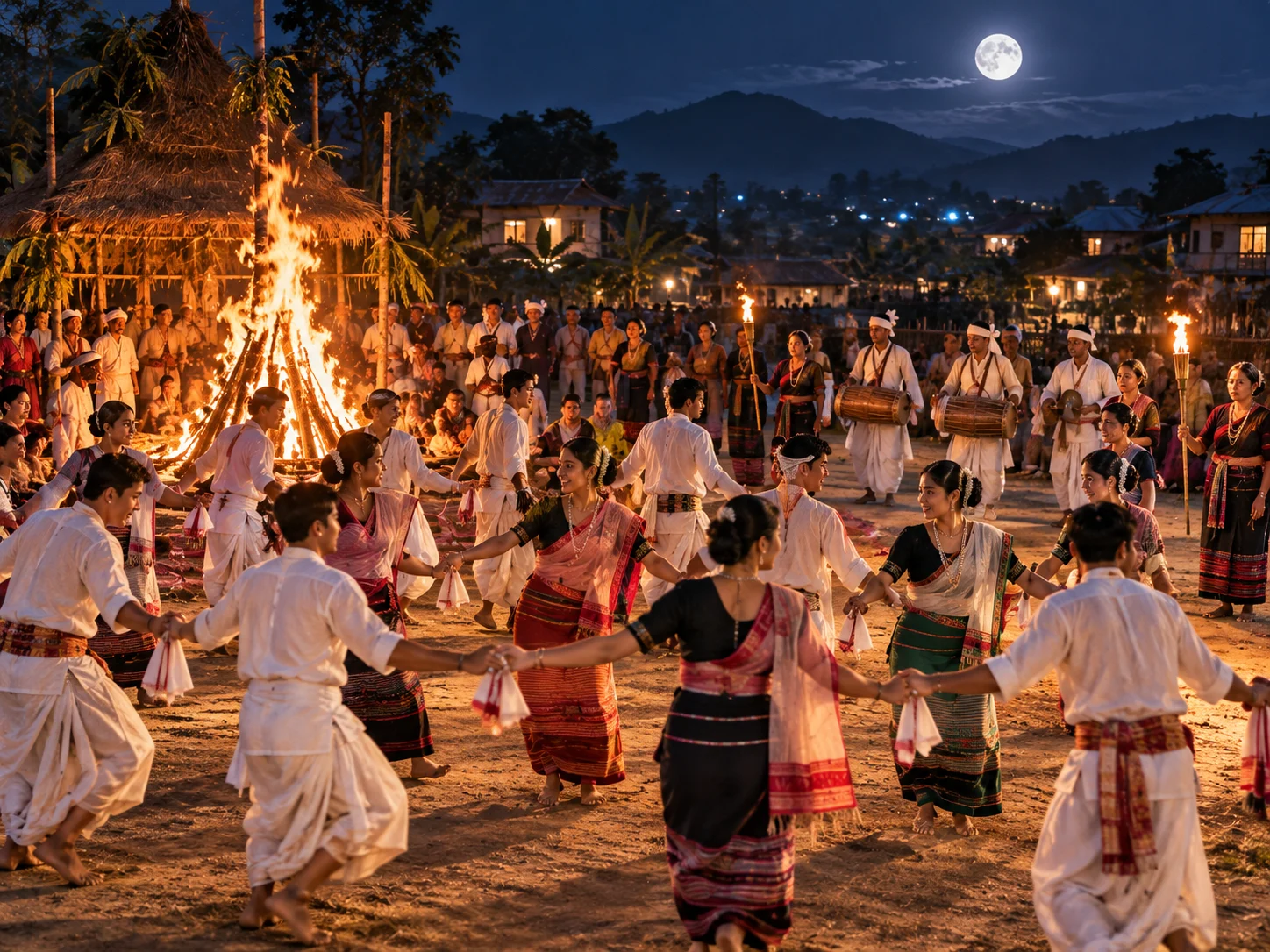
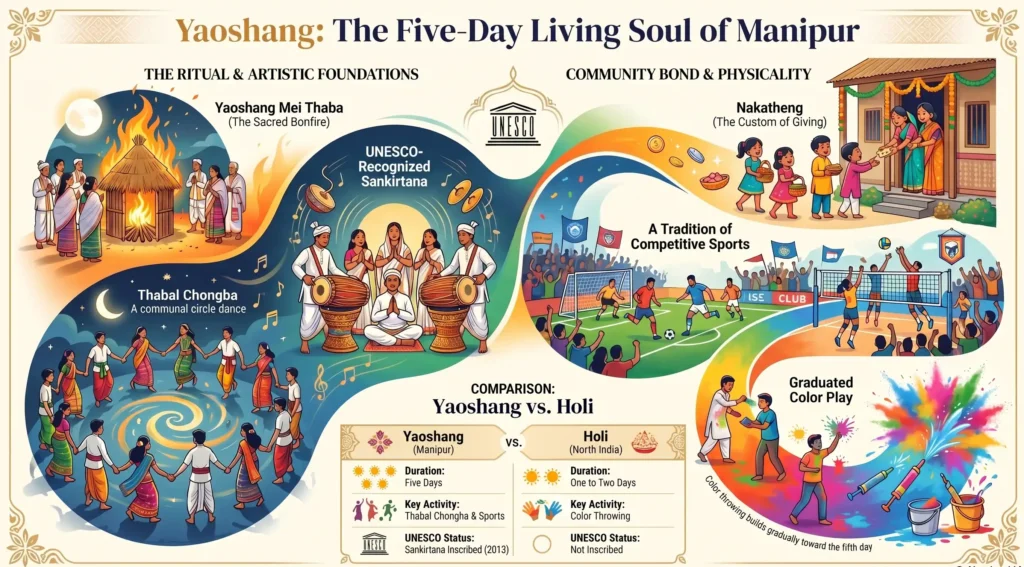
That first fire, called Yaoshang Mei Thaba, is not decorative. It is a ritual act of letting go, a burning away of the old so the new season can enter cleanly. Effigies made of straw and bamboo are set alight at neighbourhood thatched huts called Yaoshang, and the community gathers not in silence but in song. This is how the festival begins, and it is exactly how it has begun for several hundred years.
Yaoshang is a five-day spring festival celebrated by the Meitei community of Manipur, beginning on the full moon night of the month of Lamta, which falls between late February and mid-March in the Gregorian calendar. Rooted in both Vaishnavite devotion and the older indigenous Sanamahi faith, it combines sacred bonfires, folk dances like Thabal Chongba, playful water throwing, sports competitions, and the devotional singing called Sankirtana. It is often called Manipuri Holi, though its cultural depth and history reach far beyond color throwing. Yaoshang reveals how a community in Northeast India has held on to its identity, its faith, and its joy through centuries of change.
The Roots That Go Deeper Than Holi
Most people outside Manipur hear the phrase “Manipuri Holi” and assume Yaoshang is simply a regional variation of the pan-Indian color festival. That assumption sells the festival short by several centuries.
Yaoshang predates the widespread adoption of Vaishnavism in Manipur, which itself arrived in the early eighteenth century under King Pamheiba. Before Krishna entered the spiritual imagination of the Meitei people, the spring festival already existed in some form tied to the worship of Lord Thangjing, a deity central to the Meitei indigenous faith called Sanamahism. When Vaishnavism took root, the festival did not disappear. It transformed. It absorbed Krishna’s story, particularly the legends of his playful youth in Vrindavan, and became something entirely new without forgetting what it once was.
This layering is what makes Yaoshang intellectually fascinating. You can read it as a purely Hindu festival and be largely correct. You can also read it as a survival of pre-Vaishnavite Meitei culture and be equally correct. Both readings live inside the same bonfire. According to the Encyclopaedia of Indian Festivals published by Sahitya Akademi, Yaoshang represents one of the clearest examples in Northeast India of religious syncretism expressed through public celebration rather than theological debate.
Thabal Chongba: Dancing Toward Each Other
On the first night of Yaoshang, after the bonfire has been lit, the open grounds of neighbourhoods across Imphal and the Imphal Valley fill with dancers. The dance is called Thabal Chongba, which translates loosely as dancing in the moonlight, and it is one of the most socially significant folk dances anywhere in India.
Young men and women form large circles, holding hands or linking through handkerchiefs, and they move together in steps that are deceptively simple to watch and surprisingly difficult to master. Traditionally, Thabal Chongba was one of the few sanctioned spaces where young Meitei men and women could interact freely, exchange glances, and sometimes, quietly, fall in love. That social function has not entirely disappeared. Even today, families allow young people a freedom during Thabal Chongba that ordinary social custom would otherwise restrict. The dance is accompanied by a drum called the Dholak and folk songs that shift between devotion and gentle romance. Standing at the edge of a Thabal Chongba circle, you can feel the particular electricity of a community choosing joy together. The anthropologist T.C. Hodson, writing in The Meitheis in 1908, noted the communal dance tradition during spring festivals in Manipur as a deeply embedded social institution, one that served as a form of cultural cohesion far beyond its entertainment value.
Poush Mela and the Baul Singers Who Keep Shantiniketan’s Soul Alive
Nakatheng and the Gentle Extortion of Spring
One of the most charming features of Yaoshang, particularly for children, is the practice of Nakatheng. On the mornings of the festival days, groups of children travel from house to house singing traditional songs and asking for small gifts of money or sweets. The practice is neither begging nor charity in any formal sense. It is closer to what the Irish call a custom right, something the community has agreed, generation by generation, belongs to the young.
Householders who refuse to give are gently teased. Those who give generously earn a kind of neighbourhood reputation for good spirit. The children pool their collections and use the money to fund small neighbourhood sports events and gatherings during the festival. This practice mirrors similar customs found in festivals across the world, from the English tradition of wassailing to the Japanese Bon Odori preparations, suggesting that spring festivals across cultures tend to evolve similar mechanisms for redistributing community resources through joy rather than obligation.
Water, Colour, and the Fifth Day
The water and colour throwing associated with Yaoshang arrives later in the festival, building through the days until it peaks on the fifth day. Unlike the singular explosion of colour on Holi elsewhere in India, Yaoshang’s colour play is graduated and social. Neighbours drench each other. Friends arrive at doorsteps with pichkaris. Even strangers are fair targets if they are smiling.
The colours used were traditionally derived from natural sources including flowers of the flame of the forest tree, called Palash, which produces a vivid orange-red. In recent decades synthetic colours have become common, though several community organisations in Manipur have campaigned for a return to natural pigments, citing both environmental concerns and a desire to reconnect with older practice.
Sankirtana: When the Singing Does Not Stop
Running through all five days of Yaoshang, sometimes in the background and sometimes at its emotional centre, is Sankirtana. This is the devotional singing and drumming tradition of the Meitei Vaishnavas, and it is so culturally significant that UNESCO inscribed Manipuri Sankirtana on its Representative List of Intangible Cultural Heritage of Humanity in 2013.
During Yaoshang, Sankirtana is performed in temples, in open grounds, and in private homes. Male performers in white costumes play the Pung drum and cymbals while singing devotional compositions in praise of Krishna. The performances can last through the night. Audience members are not passive. They sway, they respond, they weep sometimes at particularly beautiful passages. If Thabal Chongba is the body of Yaoshang, Sankirtana is its soul.
The Pung drum itself is considered sacred and is never placed on the ground during performance, a practice that reflects the spiritual weight carried by this musical tradition within Meitei culture.
Kharchi Puja: Where Fourteen Deities Cleanse the Soul of Tripura
The Sports That Nobody Talks About
One aspect of Yaoshang that receives almost no attention outside Manipur is its robust tradition of competitive sports. During the five days, neighbourhoods organise tournaments in football, volleyball, and traditional Meitei games. These are not casual kickabouts. They are fiercely contested and draw significant community spectatorship.
The sports element reflects a philosophy embedded in Yaoshang that the festival is not only spiritual and artistic but physical. The body is celebrated along with the spirit. Young people are expected to dance, to compete, to be present in their full physical energy during this period. This holistic vision of celebration, in which music, devotion, social interaction, and physical competition all share equal standing, is part of what distinguishes Yaoshang from festivals that are purely ritual in character.
Yaoshang in the Modern City
Imphal today is a city navigating the tensions between rapid modernisation and deep cultural loyalty. Yaoshang sits at the centre of that tension in interesting ways. On one hand, the festival has never been more publicly visible. State government celebrations, cultural programmes broadcast on Doordarshan, and social media coverage have given Yaoshang a national profile it did not have a generation ago.
On the other hand, some community elders express concern that the inner life of the festival is thinning. The neighbourhood Yaoshang huts, once built and managed by young men of the locality as a community responsibility, are sometimes now assembled more casually. The songs of Nakatheng are not always remembered accurately by younger children. These concerns are not new. Every living tradition worries about the same thing in every generation. What is remarkable about Yaoshang is that despite urbanisation, migration, and decades of political conflict in Manipur, the festival has remained genuinely alive and genuinely participatory.
The Meira Paibis and the Keepers of the Flame
No account of Yaoshang is complete without acknowledging the Meira Paibis, the women torch bearers of Manipur who serve as social guardians in Meitei communities. During Yaoshang, the Meira Paibis play a quiet supervisory role, ensuring that the late-night dances and gatherings remain safe and respectful. Their presence is both protective and symbolic. The torch they carry is not merely a light source. It is an assertion that this community has always held itself accountable to its own values, even in its most joyful and unguarded moments.
The Meira Paibis as an institution have been documented extensively by scholars including Binalakshmi Nepram in her research on women’s movements in Manipur, and their role during Yaoshang is a reminder that the festival’s freedom is not accidental. It is protected.
Tarnetar Fair: The Umbrella Processions That Carry Gujarat’s Soul
Quick Comparison Table
| Feature | Yaoshang (Manipur) | Holi (North India) | Bihu (Assam) | Pongal (Tamil Nadu) |
| Duration | Five days | One to two days | Three days | Four days |
| Primary Deity | Krishna and Lord Thangjing | Krishna and Radha | No specific deity | Sun God Surya |
| Signature Activity | Thabal Chongba dance | Colour throwing | Bihu dance and feast | Sugarcane harvest rituals |
| Community Role | Neighbourhood Lup clubs central | Family and public gatherings | Community and family | Family and temple rituals |
| UNESCO Recognition | Sankirtana inscribed 2013 | Not inscribed | Not inscribed | Not inscribed |
| Indigenous Element | Strong, Sanamahi tradition present | Limited | Moderate | Strong agricultural roots |
| Sports Component | Yes, formal tournaments | Rarely | Yes, traditional games | Rarely |
Curious Indian: Fast Facts
- Yaoshang takes its name from the thatched hut erected in each neighbourhood where the bonfire ritual begins on the first night of the festival.
- The Thabal Chongba dance is traditionally performed only under moonlight, which is why the festival always begins on the full moon night of the Meitei month of Lamta.
- Manipuri Sankirtana, the devotional singing that runs through Yaoshang, uses a drum called the Pung, which is considered sacred and is never placed on the ground during performance.
- The flame of the forest flower, known locally as Kanglarei Numit Kappa, was the traditional source of orange colour used during Yaoshang’s colour play before synthetic dyes became common.
- Yaoshang’s Nakatheng tradition was once the primary way young men of a neighbourhood raised funds to build and decorate the local Yaoshang hut each year.
- Some historians believe that the word Yaoshang derives from an older Meitei term referring to a temporary shelter built during seasonal transitions, suggesting the festival has pre-agricultural roots.
- The five days of Yaoshang do not follow a uniform national calendar. Villages and neighbourhoods across Manipur sometimes vary their start dates based on local almanac traditions.
- Manipur has one of the highest per-capita participation rates in classical and folk dance in India, a fact that many cultural scholars trace directly to the training ground that festivals like Yaoshang provide from childhood.
What Makes Yaoshang Matter Beyond Manipur
India has hundreds of spring festivals. What makes Yaoshang worth knowing beyond the borders of Manipur is the completeness of its vision. It addresses the spiritual, the social, the physical, and the artistic all within five continuous days. It does not segregate these dimensions of human life. It insists they belong together.
In an era when urban festivals increasingly become ticketed experiences managed by event companies, Yaoshang remains stubbornly communal. It belongs to the neighbourhood, to the Lup clubs, to the children collecting coins at doorsteps, to the old man who remembers exactly where his grandfather lit the first fire.
Yaoshang is not a festival that asks for your attention. It earns it, slowly, through the smell of a bonfire on a cold February night, through the sound of Pung drums drifting across a valley, through the sight of hundreds of people holding hands in a circle under the moon. What the festival carries is not simply religious tradition, though that is present and alive. It carries an entire theory of how a community should celebrate itself, with its body and its voice, with its children at the front door asking for coins, with its elders keeping watch so the young can be free, with its musicians playing through the night because the music, like the season, cannot be rushed.
For the rest of India, Yaoshang is a reminder that the Northeast is not a cultural footnote. It is a source. Its traditions are old, layered, and alive in ways that deserve far more than occasional tourist curiosity. They deserve study, respect, and the kind of sustained attention that changes how we understand what this country actually is. Yaoshang will return next spring. The moon will be full. The fire will be lit. And Manipur will dance.
Rann Utsav Under the Full Moon: Where the Salt Desert Comes Alive
If you think you have remembered everything about this topic take this QUIZ
Results


#1. On which specific night does the five-day Manipuri spring festival of Yaoshang always begin?
#2. What is the name of the sacred initial bonfire ritual that marks the start of the Yaoshang festival?
#3. Before the arrival of Vaishnavism, the ancient roots of this spring festival were originally tied to the worship of which indigenous Meitei deity?
#4. What does the literal translation of the popular folk dance “Thabal Chongba” mean?
#5. Which traditional children’s practice involves traveling door-to-door to collect small gifts of money or sweets for community sports funding?
#6. Which traditional Meitei musical and devotional singing tradition performed during Yaoshang was inscribed by UNESCO as Intangible Cultural Heritage in 2013?
#7. What sacred instrument used during devotional singing is treated with extreme reverence and never placed directly on the ground?
#8. Which local institution of women torchbearers serves as the protective and social guardians during the late-night festival gatherings?
How long does Yaoshang last and when does it take place?
Yaoshang lasts for five days and begins on the full moon night of the Meitei month of Lamta, which falls between late February and mid-March in the Gregorian calendar. The exact date shifts each year according to the lunar calendar, so it is worth checking the Manipur cultural calendar for the precise dates each season.
What is the difference between Yaoshang and Holi?
While both festivals involve colour throwing and celebrate the arrival of spring, Yaoshang is a distinctly Meitei cultural event with roots in both Vaishnavite devotion and the older indigenous Sanamahi faith. It includes the Thabal Chongba moonlit folk dance, Sankirtana devotional music performances, neighbourhood bonfire rituals, children’s door-to-door Nakatheng tradition, and formal sports competitions, none of which are part of mainstream Holi celebrations.
What is Thabal Chongba and why is it significant?
Thabal Chongba is a traditional moonlit folk dance performed during Yaoshang in which young men and women form large circles and dance together to drumming and folk songs. It is culturally significant because it represents one of the few traditionally sanctioned spaces in Meitei society where young people of different genders could interact openly, making it both an artistic and a social institution.
Is Yaoshang only celebrated in Imphal?
Yaoshang is celebrated across the Imphal Valley and many parts of Manipur where the Meitei community lives. While Imphal sees the largest and most organised celebrations, the festival is a neighbourhood-level event, meaning it is observed in villages and towns throughout the Meitei heartland with local variations in ritual practice and timing.
Can travellers and tourists attend Yaoshang celebrations?
Yes, Yaoshang is a community festival that has historically welcomed visitors with warmth. The Manipur Tourism Board has promoted Yaoshang as a cultural tourism event. Visitors are generally welcome to observe and participate in the Thabal Chongba dances and colour celebrations. It is advisable to check with local cultural organisations or the Manipur Tourism Department for specific event locations and any community guidelines before attending.