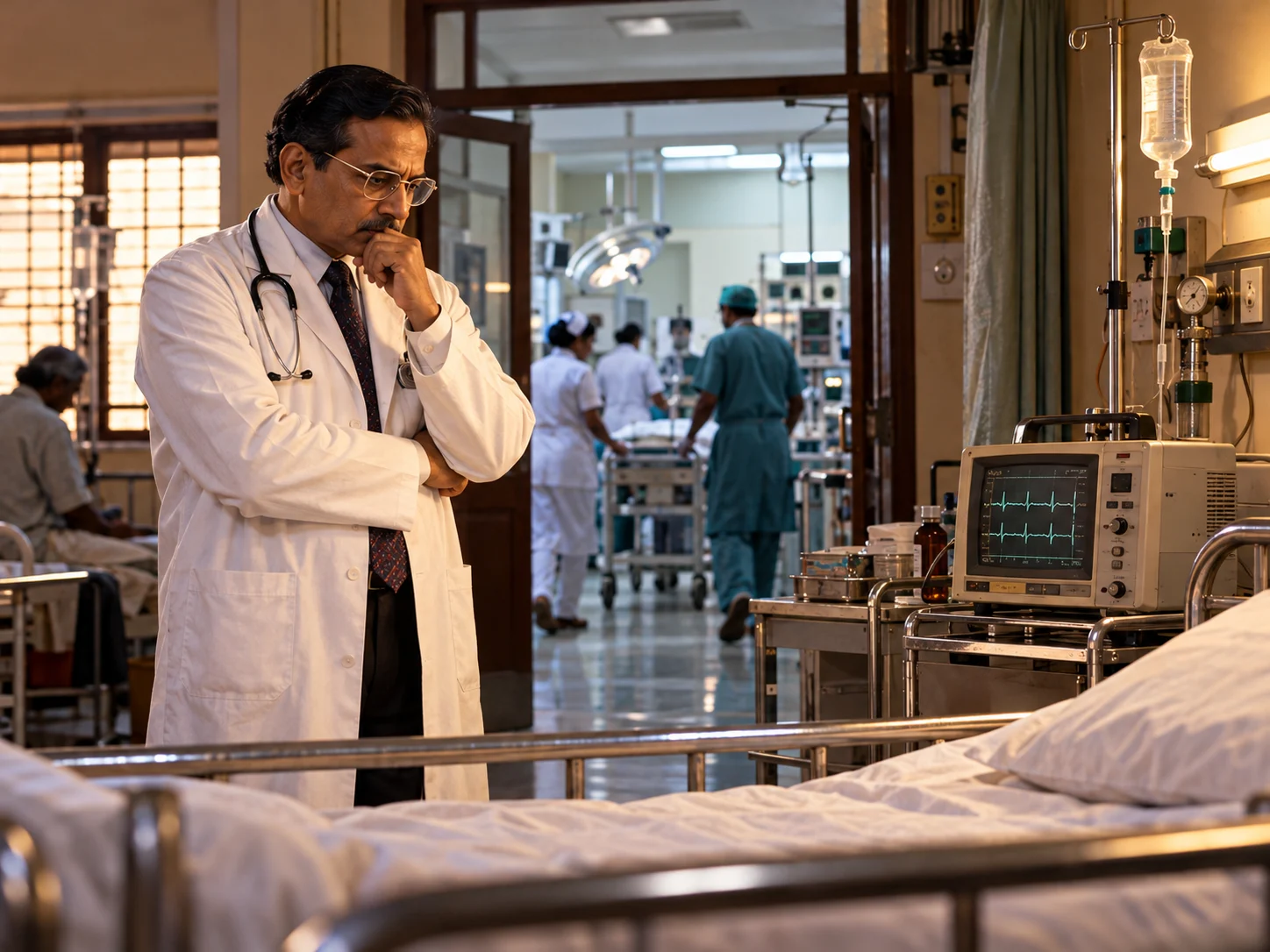
Dr. Prathap Chandra Reddy founded Apollo Hospitals in Chennai in 1983 after the death of a patient who could not afford to travel to the United States for cardiac surgery. A cardiologist who had practiced in America and returned to India with a vision of world-class healthcare on Indian soil, he built the institution that created the concept of the private multi-specialty hospital in India, pioneered medical tourism and permanently altered the relationship between Indian patients and the quality of care available to them within their own country.| Detail | Information |
| Subject | Dr. Pratap Reddy and Apollo Hospitals |
| Full Name | Dr. Prathap Chandra Reddy |
| Born | 5 February 1933, Aragonda, Andhra Pradesh, India |
| Profession | Cardiologist, Healthcare Entrepreneur |
| Company Founded | Apollo Hospitals, 1983 |
| Founded At | Chennai, Tamil Nadu, India |
| Trigger Event | Death of a patient who could not afford US treatment |
| Current Status | Apollo Hospitals is Asia’s largest healthcare group |
The Hospital That Came Home
Dr. Prathap Chandra Reddy founded Apollo Hospitals in Chennai in 1983 after the death of a patient who could not afford to travel to the United States for cardiac surgery. A cardiologist who had practiced in America and returned to India with a vision of world-class healthcare on Indian soil, he built the institution that created the concept of the private multi-specialty hospital in India, pioneered medical tourism and permanently altered the relationship between Indian patients and the quality of care available to them within their own country. He was born on 5 February 1933 in Aragonda, Andhra Pradesh.
The India That Dr. Reddy Returned To
The India that Dr. Prathap Chandra Reddy returned to in the 1970s after years of medical practice in the United States was a country where serious illness often meant either traveling abroad for treatment or accepting a standard of care that was dramatically below what medical science of the period could provide. Public hospitals were underfunded, overcrowded and understaffed. Private medicine existed but had not developed the infrastructure of specialist care, advanced diagnostics and surgical capability that patients with complex conditions required.
For most Indians who needed procedures like open heart surgery, the choice was stark. Travel to the United States or Europe, at a cost that was beyond the reach of all but the very wealthy, or manage without. For the large majority who could not afford international travel, managing without was the only option, and managing without often meant dying of conditions that were entirely treatable by the standards of contemporary medicine.
Dr. Reddy had seen what world-class healthcare looked like. He had practiced it in America. And he had come home to India with the conviction that what he had seen should be available to Indian patients on Indian soil.
The Patient Whose Death Catalyzed Everything
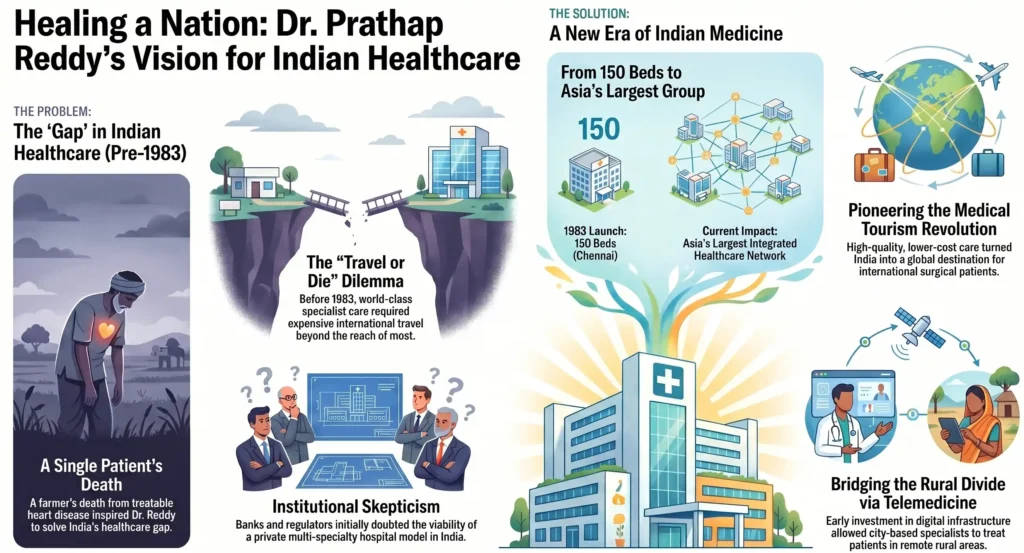
The specific patient whose death catalyzed the founding of Apollo Hospitals was a farmer from Andhra Pradesh who presented with a cardiac condition requiring open heart surgery. The surgery was available in the United States. The cost of traveling there and undergoing the procedure was completely beyond the patient’s means. There was nothing available in India at the time that could address his condition adequately.
He died.
Dr. Reddy has spoken about this moment directly in numerous interviews. The death was not unusual in the context of Indian healthcare at the time. Patients died regularly of conditions that were treatable elsewhere. What was unusual was the effect it had on the cardiologist who could not save him. Rather than accepting the gap between what Indian healthcare offered and what medical science could provide as a fixed condition of the environment he was working in, Dr. Reddy decided the gap itself was the problem to be solved.
That decision, made in the grief of a specific patient’s death, was the founding impulse of Apollo Hospitals. Everything that followed was an attempt to close the gap that the farmer’s death had made impossible to ignore.
Building the First Private Multi-Specialty Hospital
When Dr. Reddy proposed building a private multi-specialty hospital in Chennai in the early 1980s, the response from the Indian establishment was almost uniformly skeptical. The concept of a large, well-equipped private hospital offering specialist care across multiple disciplines simultaneously did not fit the existing categories of Indian healthcare. Small private nursing homes existed. Government hospitals existed. The kind of institution Dr. Reddy was proposing, combining the specialist depth of a major American medical center with the accessibility of Indian geography, was something that most people in the Indian healthcare and financial establishment did not believe was viable.
The skepticism was expressed through the standard institutional mechanisms. Banks were reluctant to lend. Regulatory approvals moved slowly. Potential investors questioned the business model. The Indian government’s approach to private healthcare at the time was not actively supportive of large private hospital development, reflecting a socialist-influenced policy environment that regarded private profit in healthcare with some suspicion.
Dr. Reddy navigated these obstacles through a combination of personal conviction, family mobilization and creative financing. His five daughters became involved in the Apollo enterprise at various stages of its development, providing a family commitment that gave the institution a continuity of leadership that purely investor-driven enterprises sometimes lack. He raised capital from sources including the Indian diaspora in the United States, where his medical network and personal reputation gave him access to potential investors who understood what he was trying to build.
Apollo Hospitals opened in Chennai in 1983 with 150 beds and a commitment to providing the quality of care that Dr. Reddy had experienced in the United States. The response from patients was immediate and definitive. People who had been traveling abroad for treatment began coming to Apollo instead. People who had been managing without specialist care because they could not afford international travel found that world-class care was now available within India.
Double Ikat Patola of Patan and Why It Takes a Year to Weave
Medical Tourism and the Unintended Consequence
One of the unintended consequences of Apollo’s success was the development of medical tourism as a significant economic and healthcare phenomenon in India. As Apollo and the institutions that followed its model demonstrated that Indian hospitals could provide specialist care at international standards, international patients began traveling to India for procedures that were available at home but at costs that were dramatically higher.
The economics of medical tourism to India rest on a combination of factors that Apollo helped establish: the quality of specialist medical training available to Indian doctors, the lower cost of skilled medical labor in India relative to Western countries, the development of hospital infrastructure that meets international standards and the administrative systems required to serve international patients including language capability, coordination with international insurance systems and the management of travel and accommodation logistics.
Medical tourism has become one of the significant economic contributions of the private healthcare sector that Apollo pioneered, with foreign exchange earnings representing a meaningful economic benefit alongside the more obvious benefit of making specialist healthcare available to populations that could not otherwise access it.
Affordable Excellence
From its earliest days, Apollo Hospitals operated on a model that attempted to combine high quality care with pricing that made it accessible to Indian middle-class patients rather than only to the very wealthy. This balance was not always easy to maintain. World-class medical equipment is expensive. Trained specialist physicians command premium salaries. The infrastructure required for complex surgical procedures and intensive care represents enormous capital investment.
Dr. Reddy addressed this challenge through scale. A large hospital with high patient volumes can spread the fixed costs of equipment, infrastructure and specialist staffing across more patients, reducing the cost per patient while maintaining the quality of care. The model required consistent investment in expansion and in the development of the patient volumes that made the economics work.
The expansion of Apollo beyond its founding Chennai hospital into a network that eventually covered major cities across India was driven partly by this economic logic. Each new hospital required significant capital investment. Each new hospital, once established, contributed to the network’s overall scale and to the cross-subsidization that allowed the group to serve patients across a range of economic circumstances.
How the Khasi Tribe of Meghalaya Flips Gender Roles?
Telemedicine and Rural Reach
One of the dimensions of Dr. Reddy’s vision that has become increasingly significant over the decades is his early recognition that the geographic concentration of specialist healthcare in major cities was itself a form of healthcare inequality that needed to be addressed. The patients who needed open heart surgery in the 1980s were not only those who could not afford international travel. They were also those who could not afford the journey from rural Andhra Pradesh to Chennai, the cost of accommodation during treatment and the loss of agricultural income during the recovery period.
Apollo’s investment in telemedicine infrastructure, which began earlier than most Indian healthcare institutions recognized the technology’s potential, was driven by this recognition. If specialist expertise could be transmitted to patients in rural and semi-urban locations rather than requiring patients to travel to the expertise, the reach of world-class healthcare could extend significantly beyond the cities where Apollo’s hospitals were physically located.
Apollo’s telemedicine programs have connected rural patients with specialist physicians for diagnosis, treatment planning and follow-up in ways that reduce the cost and disruption of accessing specialist care without reducing its quality.
How the Murugappa Group Built a Silent Empire in Southern India
Quick Comparison Table
| Feature | Dr. Pratap Reddy, Apollo | Devi Shetty, Narayana Health | Ashwin Naik, Vaatsalya | Biocon, Kiran Mazumdar Shaw |
| Primary Focus | Multi-specialty hospitals | Cardiac surgery, affordable care | Rural healthcare | Biopharmaceuticals |
| Model | Premium and affordable tiers | High volume low cost surgery | Community based clinics | Research and manufacturing |
| Founded | 1983 | 2000 | 2005 | 1978 |
| Scale | Asia’s largest hospital group | Major Indian hospital network | Rural clinic network | Asia’s largest biopharma |
| Primary Innovation | Private hospital concept in India | Factory model cardiac surgery | Rural healthcare access | Affordable biologics |
Curious Indian: Fast Facts
- Apollo Hospitals was founded in Chennai in 1983 with 150 beds, triggered by the death of a patient who could not afford cardiac surgery abroad.
- Dr. Prathap Chandra Reddy practiced medicine in the United States before returning to India with the conviction that Indians should not have to leave their country for world-class care.
- Apollo is now Asia’s largest integrated healthcare group, operating hospitals across India and internationally.
- Dr. Reddy’s five daughters have all been involved in the Apollo enterprise, providing family continuity of leadership across decades.
- Apollo was among the first Indian hospital groups to invest significantly in telemedicine infrastructure to reach patients in rural and semi-urban areas.
- The Confederation of Indian Industry has documented medical tourism as one of the significant economic contributions of the private healthcare sector that Apollo pioneered.
- Dr. Reddy received the Padma Vibhushan in 2010 for his contribution to Indian healthcare.
- The Apollo model of the large private multi-specialty hospital did not exist in India before Dr. Reddy built the first one in Chennai in 1983.
How Azim Premji Turned Cooking Oil Into a Technology Empire
The Legacy and the Unfinished Work
Dr. Prathap Chandra Reddy received the Padma Vibhushan in 2010, one of India’s highest civilian honors, in recognition of his contribution to Indian healthcare. The recognition was appropriate and came later than his achievement warranted, reflecting a broader pattern in how Indian society has sometimes been slow to recognize the contributions of private enterprise to public welfare.
The healthcare system that Apollo helped create is vastly better than the one that existed when the farmer from Andhra Pradesh died of a cardiac condition he should not have died from. Cardiac surgery that was unavailable in India in 1983 is now performed routinely in multiple cities. Cancer treatment that required international travel is now available domestically. The gap between what medical science can provide and what Indian patients can access has narrowed dramatically, and Apollo’s role in that narrowing is fundamental.
But the work is not finished. The gap between urban and rural healthcare access remains large. The cost of specialist care, even at the reduced levels that competition and scale have produced, remains beyond the reach of significant portions of the Indian population. The public healthcare system, which serves the majority of Indians, has not benefited proportionally from the development of private healthcare excellence that Apollo catalyzed.
These are the unfinished dimensions of the vision that began with a farmer’s death in Andhra Pradesh and a cardiologist’s decision that the gap it revealed was a problem worth solving. One death changed Indian healthcare. The work of changing what remains is still beginning.
5 Chilling Truths of Lal Bahadur Shastri Death Mystery
If you think you have remembered everything about this topic take this QUIZ
Results


#1. What specific tragedy directly inspired cardiologist Dr. Prathap Chandra Reddy to found Apollo Hospitals in 1983?
#2. Where did Dr. Prathap Chandra Reddy open India’s first private multi-specialty hospital?
#3. How did Dr. Reddy successfully raise part of the initial capital needed to establish Apollo Hospitals despite local financial skepticism?
#4. Which breakthrough business trend did Apollo Hospitals pioneer by offering international-standard care at fraction of Western costs?
#5. To expand the reach of specialist healthcare into rural and semi-urban areas, which infrastructure did Apollo invest in early on?
#6. In which year did Dr. Prathap Chandra Reddy receive the prestigious Padma Vibhushan award for his monumental contribution to Indian healthcare?
#7. Where did Apollo Hospitals launch its pilot telemedicine project in the year 2000?
#8. How did Apollo Hospitals strategically achieve “affordable excellence” to make premium care accessible to middle-class patients?
What was the specific event that led Dr. Pratap Reddy to found Apollo Hospitals?
The founding of Apollo was triggered by the death of a patient from Andhra Pradesh who needed open heart surgery but could not afford the cost of traveling to the United States for the procedure. Dr. Reddy, who had practiced in America and had returned to India, could not provide the surgery in India because the infrastructure did not exist. The patient died of a condition that was entirely treatable by the standards of the time. That death became the organizing impulse for everything that followed.
What was innovative about Apollo Hospitals when it opened in 1983?
The concept of a large private multi-specialty hospital offering specialist care across multiple disciplines simultaneously did not exist in India before Apollo. Existing private healthcare consisted primarily of small nursing homes. Government hospitals were underfunded and overcrowded. Apollo introduced the model of a well-equipped private institution combining specialist depth, advanced diagnostics and surgical capability in a single facility accessible to Indian patients without requiring international travel.
How did Apollo Hospitals contribute to the development of medical tourism in India?
By demonstrating that Indian hospitals could provide specialist care at international standards, Apollo created the conditions for international patients to travel to India for procedures that were available at home but at dramatically higher cost. The combination of internationally trained Indian physicians, lower labor costs, developing hospital infrastructure and administrative systems to serve international patients established India as a medical tourism destination, with Apollo as the pioneer institution.
What role did Apollo play in developing telemedicine in India?
Apollo invested in telemedicine infrastructure earlier than most Indian healthcare institutions recognized its potential, driven by Dr. Reddy’s recognition that geographic concentration of specialist care in cities was itself a form of healthcare inequality. Apollo’s telemedicine programs have connected rural patients with specialist physicians for diagnosis and treatment planning, extending the reach of specialist care beyond the cities where its hospitals are physically located.
What is Dr. Pratap Reddy’s legacy in Indian healthcare?
Dr. Reddy’s legacy is the transformation of Indian healthcare from a system in which serious conditions required international travel to one in which world-class specialist care is available domestically. He created the private multi-specialty hospital model in India, pioneered medical tourism, invested in telemedicine and built an institution that narrowed the gap between what medical science can provide and what Indian patients can access. He received the Padma Vibhushan in 2010 for this contribution.