When Cloth Became the Only Home They Could Carry
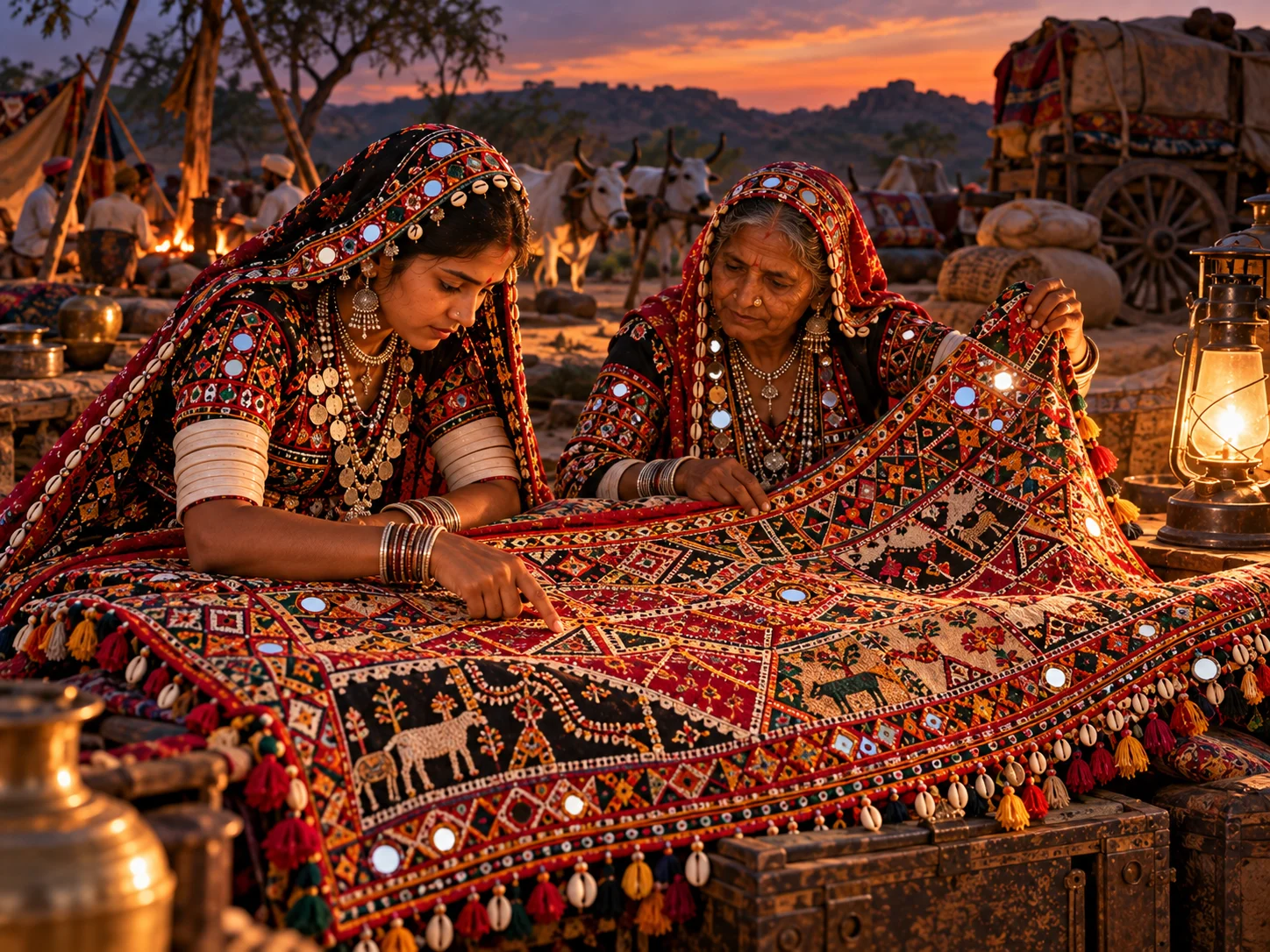
Banjara embroidery is one of India’s most visually striking textile traditions, practiced by the Banjara community, a nomadic tribe that traveled across the Indian subcontinent for centuries as traders and transporters of grain, salt, and essential goods. The craft uses mirrors, cowrie shells, beads, and vibrantly colored geometric thread work stitched onto cotton fabric. But beyond its visual intensity, Banjara embroidery carries something more significant. Each pattern, color combination, and mirror placement is a form of cultural record keeping, a way of preserving identity, geography, and memory across generations of people who had no permanent home to pass those memories through. The craft holds a GI tag for its Karnataka variation and continues to be practiced by artisan communities across five Indian states.
People Who Carried Their History on Their Backs
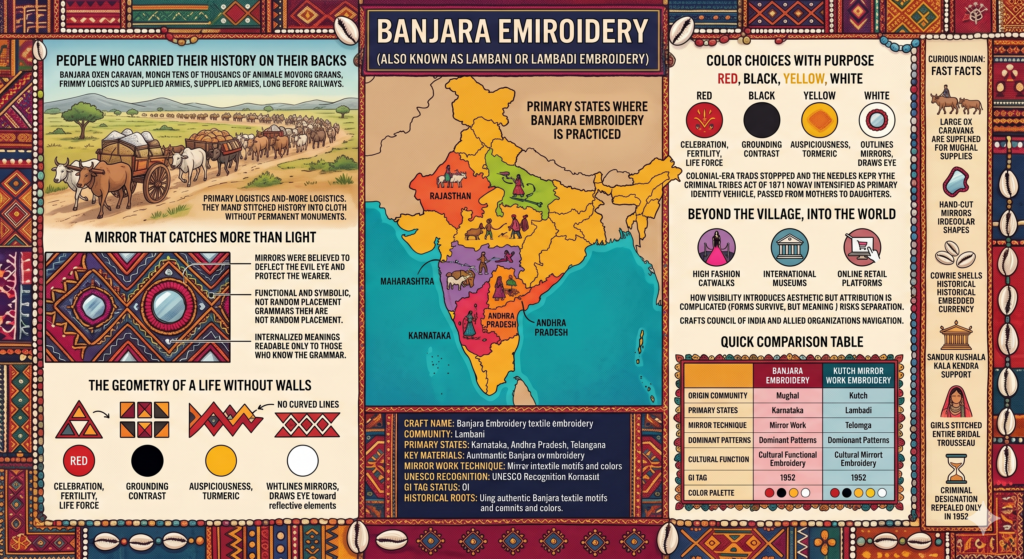
The Banjara are among the most widely traveled communities in Indian history. Known across different regions as Lambani, Lambadi, Sugali, or Vanjari, they were for centuries the primary logistics network of the Indian subcontinent. Long before railways and motorized transport, it was the Banjara who moved grain across the Deccan plateau, who carried salt from the coasts into landlocked kingdoms, who supplied armies on campaign and fed cities in drought.
Historical records from the Mughal period, referenced in studies held at the Indira Gandhi National Centre for the Arts, describe Banjara caravans of tens of thousands of oxen moving across the landscape, carrying commodities that entire regions depended on for survival. The community was economically indispensable. Yet because they moved constantly, they built no monuments, left no inscriptions in stone, and accumulated no fixed property that history could point to later and say, here is what they made.
What they made was cloth. And into that cloth they stitched everything they could not afford to leave behind.
Cowries, Coins, and Textile Memory of the Lambadi Tribe
A Mirror That Catches More Than Light
The most immediately striking element of Banjara embroidery is the mirror work. Small circular or geometric pieces of hand-cut mirror glass, known in textile scholarship as shisha, are stitched firmly into the fabric using a surrounding web of thread that holds them in place without adhesive. The effect under natural light is startling. A single garment or wall hanging can catch sunlight from multiple angles simultaneously, producing a shifting, living quality that flat fabric never achieves.
But the mirrors were not chosen for their beauty alone. Among Banjara communities, mirrors embedded in clothing and household textiles were believed to deflect the evil eye and protect the wearer from malevolent forces encountered on the road. A nomadic people moving through unfamiliar territories, crossing the boundaries of different kingdoms, languages, and social systems, needed protection they could carry with them. The mirror was both talisman and textile element, functional and symbolic at the same time.
The positioning of mirrors within Banjara embroidery is never random. Specific arrangements carry specific meanings within the community’s visual language. A central mirror surrounded by a particular geometric formation might indicate a woman’s marital status. A border pattern repeated at precise intervals might identify the regional sub-group within the broader Banjara community that the wearer belongs to. These are not meanings that can be read from the outside without deep familiarity with the tradition. They are an internal language, written in thread and glass, readable only to those who know the grammar.
The Geometry of a Life Without Walls
Banjara embroidery uses no curved lines. Every pattern is built from triangles, squares, diamonds, and zigzag formations assembled with a precision that speaks to long practice and deliberate intention. This geometric vocabulary is found across nomadic textile traditions globally, from the kilims of Central Asia to the embroideries of the Rabari community in Kutch, and textile scholars have noted that the preference for angular geometry in nomadic crafts is often connected to the absence of architectural reference points.
Settled communities design their textiles with the curves and organic forms of the natural world around them, the flowers in their gardens, the arches of their doorways, the roundness of their cooking vessels. Nomadic communities carry their visual world with them. The geometry of Banjara embroidery is the geometry of the road itself, of directions and distances, of cardinal points and pathways, rendered in thread because thread was the medium available.
The color choices in Banjara embroidery are equally purposeful. Red, black, yellow, and white dominate the palette across most regional variations of the craft. Red in Banjara textile culture carries associations with celebration, fertility, and life force. Black provides the grounding contrast that makes the other colors visible. Yellow, often associated with turmeric and auspiciousness in subcontinental culture broadly, appears in border formations. White threads frequently outline the mirror placements, drawing the eye toward the reflective elements that anchor each composition.
The Craft Researcher at the Crafts Council of India has documented that within different Banjara sub-groups across Karnataka, Andhra Pradesh, and Telangana, specific color combinations function as regional identifiers, allowing community members to recognize where another Banjara person’s family originated simply by reading the embroidery on their clothing.
The Disputed and Fascinating Origins of Kashmiri Pashmina
When the Roads Stopped and the Needles Kept Moving
The story of Banjara embroidery cannot be told without acknowledging what happened to the community that created it. As colonial era policies disrupted traditional trade routes and the Criminal Tribes Act of 1871 designated the Banjara among the communities classified as hereditary criminals, the economic foundation of Banjara life collapsed systematically. The great ox caravans that had moved commodities across the subcontinent were no longer needed. The community was pushed toward settlement, toward agricultural labor, toward the margins of an economic system that had no place for nomadic traders.
The embroidery continued. In fact, as the external world that had given the Banjara their economic identity was dismantled around them, the textile tradition intensified in cultural importance. It became the primary vehicle through which identity, memory, and community belonging were transmitted across generations. Girls learned embroidery from their mothers and grandmothers not simply as a skill but as an inheritance. The patterns they learned were the patterns their families had carried across the Deccan plateau for centuries.
According to documentation maintained by the Karnataka Hastha Shilpa Abhivrudhi Nigama, the state body responsible for handicraft development in Karnataka, there are currently over 1,000 active Lambani embroidery artisans registered in the Sandur region of Ballari district alone, which is considered the heartland of the Karnataka variation of the craft. The GI tag awarded to Lambani embroidery in 2010 brought formal recognition and some degree of market access, but the deeper challenge of sustaining fair artisan income and preventing design appropriation without attribution remains an ongoing conversation in Indian craft policy circles.
Beyond the Village, Into the World
In recent decades, Banjara embroidery has traveled far beyond the communities that created it. Fashion designers working with heritage textiles, both within India and internationally, have incorporated Banjara mirror work into contemporary collections. The UNESCO documentation of intangible cultural heritage traditions in South Asia has brought increased scholarly attention to the craft. Retail platforms and craft cooperatives have created new market channels for Banjara artisans, though the question of whether artisans at the base of that supply chain receive equitable compensation remains a persistent concern raised by craft economists and social researchers.
The visual language of Banjara embroidery has also influenced Indian cinema and performance costume design, appearing in Bollywood productions and classical dance costumes where its mirror work and geometric intensity translate powerfully under stage and screen lighting. This visibility has introduced the aesthetic to audiences with no direct connection to the Banjara community or its history.
What gets complicated in this process of wider circulation is attribution. When a garment inspired by Banjara embroidery is sold without reference to its origin community, the cultural memory encoded in those patterns, the directions, the identities, the nomadic histories, becomes decoration without context. The craft survives in form while the meaning risks being separated from it. This tension between preservation and appropriation is one that the Crafts Council of India and allied organizations continue to navigate in their advocacy for community-centered craft economies.
How Phulkari Embroidery Became a Celebration of Womanhood in Punjab
The Tradition That Refused to Disappear
There is something quietly extraordinary about the fact that the most visually exuberant textile tradition in the Deccan was created by people who owned almost nothing permanently. The Banjara carried no land deeds, no ancestral homes, no stone monuments. They carried cloth. And into that cloth they pressed everything that mattered, their routes, their identities, their protections, their relationships, their sense of who they were and where they had come from.
The mirrors in a Banjara embroidery piece do not simply reflect light. They reflect a history of movement across one of the most complex and layered landscapes in the world. The geometric patterns do not simply fill space. They encode directions, identities, and memories in a visual language developed over centuries of life on the road.
That this tradition survived colonial criminalization, economic displacement, and the long erosion of nomadic cultural economies is itself a remarkable fact. It survived because women kept stitching. Because mothers passed patterns to daughters not just as craft knowledge but as the most important inheritance they had to give.
The Banjara embroidery that appears today in fashion collections, museum exhibitions, and craft market stalls carries all of that history in its threads, whether the person wearing it knows the story or not. The more people come to know the story, the more the mirrors in those textiles have the chance to reflect something real.
The Elephanta Trimurti and the Three Faces of an Infinite God
Double Ikat Patola of Patan and Why It Takes a Year to Weave
If you think you have remembered everything about this topic take this QUIZ
This quiz no longer existsWhat is Banjara embroidery and where does it come from?
Banjara embroidery is a traditional textile craft practiced by the Banjara community, a historically nomadic tribe also known as Lambani, Lambadi, or Sugali across different regions of India. The craft originated from the community’s nomadic lifestyle and uses mirrors, beads, cowrie shells, and geometric thread work on cotton fabric. It is primarily practiced in Karnataka, Andhra Pradesh, Telangana, Maharashtra, and Rajasthan.
Why do Banjara textiles use so many mirrors?
Mirrors in Banjara embroidery serve both protective and communicative functions. Traditionally, mirrors were believed to deflect the evil eye and protect wearers during travel through unfamiliar territories. Structurally, the placement and arrangement of mirrors within geometric patterns also communicate information about the wearer’s identity, clan, and regional origin within the broader Banjara community.
Does Banjara embroidery have a Geographical Indication tag?
Yes. The Lambani embroidery of Karnataka, which is the Karnataka regional variation of Banjara embroidery, was awarded a Geographical Indication tag in 2010, recognizing its unique cultural and geographic origin. This provides legal protection against unauthorized reproduction and misrepresentation of the craft.
How did colonial rule affect the Banjara community and their embroidery tradition?
The Criminal Tribes Act of 1871 designated the Banjara among communities classified as hereditary criminals, criminalizing their nomadic movement and effectively dismantling their traditional role as long distance traders. This forced settlement disrupted their economic identity but paradoxically intensified the cultural importance of embroidery, which became the primary medium for preserving community identity and memory across generations.
How is Banjara embroidery different from Kutch mirror work?
While both traditions use shisha mirror work and share some geometric sensibilities, they come from distinct communities and regions. Banjara embroidery is rooted in the nomadic Lambani community of the Deccan and uses a predominantly angular geometric vocabulary in red, black, yellow, and white. Kutch mirror work comes from settled and semi nomadic communities in Gujarat and incorporates a wider range of motifs including floral and figurative elements alongside geometric patterns.
Sources & References
Banjara community and historical nomadic trade — Banjara tribe also known as Lambani Lambadi Sugali Vanjari across different regions; historically nomadic traders and commodity transporters across Indian subcontinent; primary logistics network before modern transport; moved grain across Deccan plateau carried salt from coasts to landlocked kingdoms supplied armies fed cities in drought; economically indispensable yet left no monuments or stone inscriptions; built no fixed property history could reference; moved continuously making cloth their primary cultural record keeping medium.
Mughal era and ox caravan documentation — Mughal period historical records describing Banjara caravans of tens of thousands of oxen moving across landscape; carried commodities entire regions depended on for survival; Indira Gandhi National Centre for the Arts holding studies documenting this trade network; scale and economic importance well documented in historical archives; foundation of Banjara economic identity and social position.
Shisha mirror work and protective symbolism — small circular or geometric hand-cut mirror glass pieces called shisha stitched firmly using thread web without adhesive; effect under natural light producing startling shifting living quality from multiple angle sunlight catching; mirrors embedded in clothing household textiles believed to deflect evil eye protecting wearers from malevolent forces during travel; talisman and textile element simultaneously functional and symbolic; protection for nomadic people moving through unfamiliar territories crossing kingdom boundaries languages social systems; protection carried on body.
Mirror placement as identity encoding — mirror positioning in Banjara embroidery never random with specific arrangements carrying specific meanings within community’s visual language; central mirror surrounded by particular geometric formation indicating woman’s marital status; border patterns repeated at precise intervals identifying regional sub-group within broader Banjara community; meanings readable only to those deeply familiar with tradition; internal language written in thread and glass; grammar understood only within community.
Geometric pattern vocabulary and road mapping — Banjara embroidery using no curved lines building from triangles squares diamonds zigzag formations with precision from long practice and deliberate intention; found across nomadic textile traditions globally from Central Asian kilims to Rabari Kutch embroideries; preference for angular geometry connected to absence of architectural reference points; settled communities designing with natural world curves and organic forms surrounding them; nomadic communities carrying visual world with them; Banjara geometry being geometry of road itself directions distances cardinal points pathways rendered in thread as available medium.
Color symbolism and regional identification — red black yellow white dominating palette across regional variations; red carrying associations with celebration fertility life force; black providing grounding contrast making other colors visible; yellow associated with turmeric and auspiciousness appearing in border formations; white threads outlining mirror placements drawing eye toward reflective elements anchoring each composition; Crafts Council of India documenting that specific color combinations within different Banjara sub-groups function as regional identifiers allowing recognition of family regional origin from textile patterns alone.
Criminal Tribes Act impact and embroidery intensification — Criminal Tribes Act 1871 under British colonial rule designated Banjara among communities classified as hereditary criminals criminalizing nomadic movement; designation repealed 1952 after Indian independence; colonial policies disrupting traditional trade routes economic foundation of Banjara life collapsing; ox caravans no longer needed community pushed toward settlement agricultural labor economic system margins; embroidery paradoxically intensifying in cultural importance as external economic identity dismantled; textile tradition becoming primary vehicle for transmitting identity memory community belonging across generations; girls learning embroidery from mothers grandmothers as inheritance not simply skill; patterns learned being patterns families carried across Deccan plateau for centuries.
Contemporary Lambani artisan communities and institutional support — Karnataka Hastha Shilpa Abhivrudhi Nigama state body responsible for handicraft development documenting over 1000 active Lambani embroidery artisans in Sandur Ballari district heartland of Karnataka variation; GI tag awarded Lambani embroidery 2010 bringing formal recognition and market access; deeper challenge of sustaining fair artisan income and preventing design appropriation without attribution remaining ongoing Indian craft policy conversation; Sandur Kushala Kala Kendra institutional support since 1980s.
Global circulation and attribution challenges — recent decades Banjara embroidery traveling beyond origin communities with fashion designers both Indian and international incorporating mirror work into contemporary collections; UNESCO documentation of intangible cultural heritage traditions South Asia bringing scholarly attention; retail platforms and craft cooperatives creating market channels; question of equitable compensation at artisan supply chain base; visual language influencing Bollywood and classical dance costume design; mirror work and geometric intensity translating powerfully under stage screen lighting; visibility introducing aesthetic to audiences without direct Banjara connection; complication of wider circulation being attribution issue; garments inspired by Banjara embroidery sold without origin community reference; cultural memory encoded in patterns becoming decoration without context; craft surviving in form while meaning risking separation; tension between preservation and appropriation navigated by Crafts Council of India and allied organizations in community-centered craft economy advocacy; bridal trousseau assembly across years representing multi-generational preparation; hand-cut mirror glass producing irregular shapes modern machine cut mirrors cannot replicate; survival of tradition despite colonial criminalization economic displacement erosion of nomadic cultural economies because women kept stitching.