Chittagong, 18 April 1930: sixty-five revolutionaries raided the British armoury and won. By dawn, they understood what victory looked like when the ammunition was nowhere to be found
At ten o’clock on the night of April 18, 1930, Surya Sen gave the order.
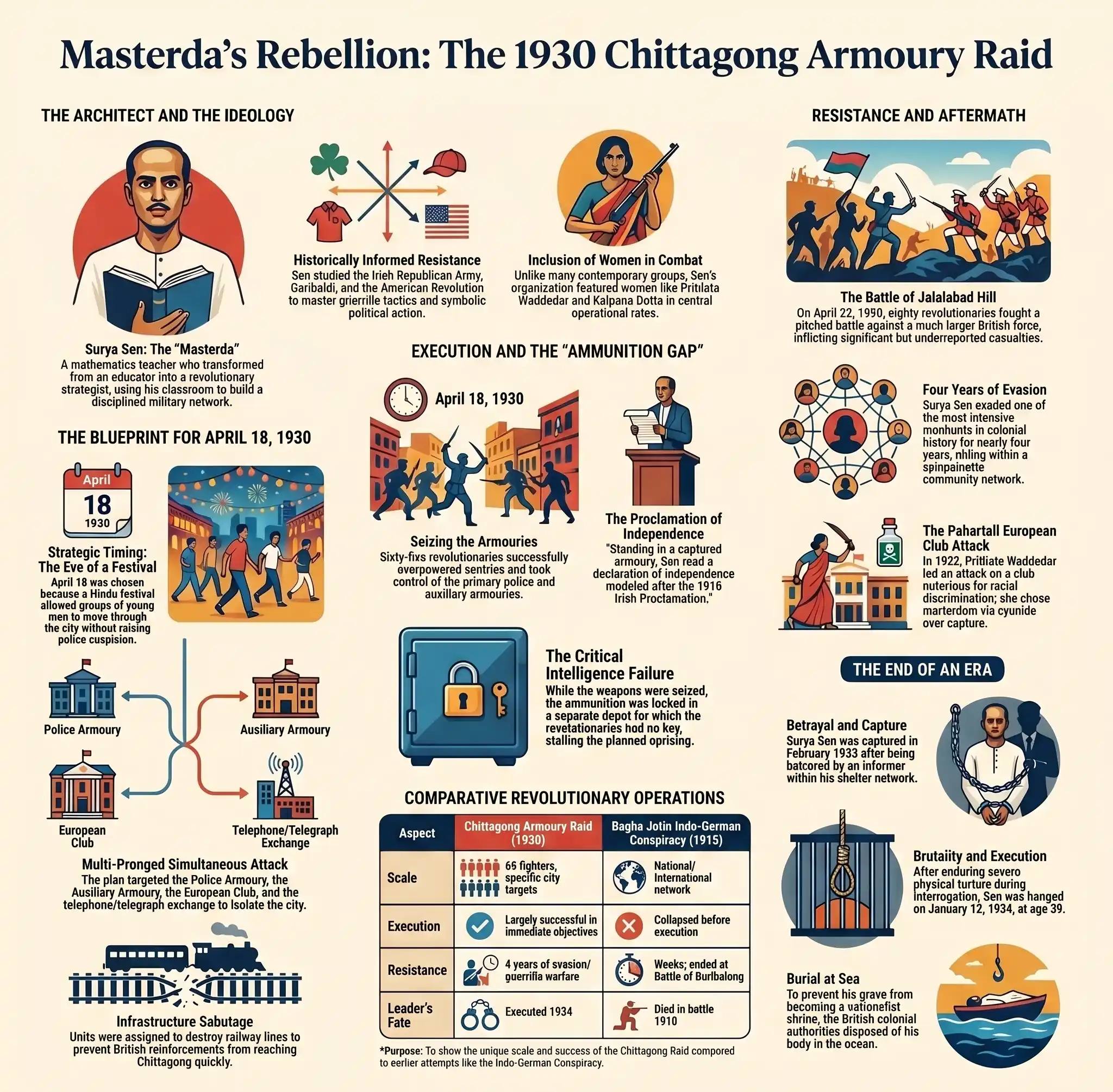
Sixty-five young men from the Indian Republican Army—most in their teens and twenties, trained in Chittagong, inspired by the Easter Rising in Ireland, taught to believe that armed struggle was the only language the British understood—moved toward the police armoury.
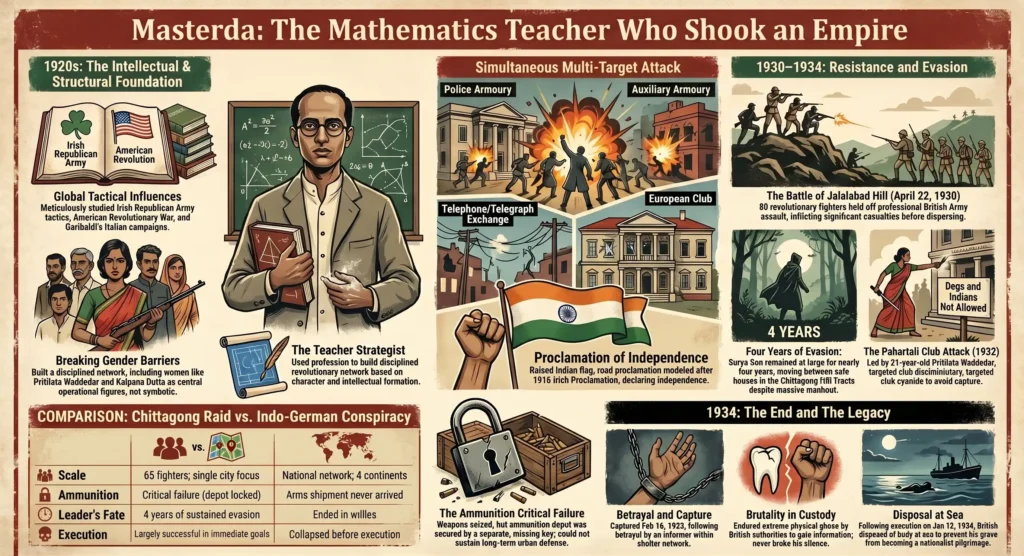
The plan was elaborate. They would seize the armoury and take the guns. They would cut the telegraph and telephone lines, severing Chittagong from Calcutta. They would raid the European Club and take hostages. They would loot the imperial banks to gather money for future uprisings. They would free jailed revolutionaries. They would seize a city and hold it, even if only for a day. They would show that the British could be fought.
Surya Sen, who they called Masterda—the Master—was thirty-six years old. He had been a maths teacher. For years, he had taught young people the handling of weapons and the making of bombs. He had written their names on the rolls of his classroom. Now he was writing them into history.
The raid was fast and brutal. One group, led by Ganesh Ghosh, rushed the police armoury and captured it. They raised the Indian National Flag. Another group moved toward the telegraph office and severed the lines. The telephone exchange went dead. The trains stopped. For a few hours, Chittagong was isolated from the rest of the Raj.
At the armoury, the revolutionaries found what they were looking for: guns. Rifles. Revolvers. Weapons enough to arm sixty-five young men and more. They took them. They carried them. They felt the weight of the rifles in their hands and understood that they held, literally, the means of revolution.
But as they searched the armoury, desperation began to set in. They looked for ammunition. Bullets. Cartridges. The shells that would make the guns into anything more than metal tubes and wood and iron.
There was none. The British had stored the ammunition somewhere else.
By the time British reinforcements arrived from Calcutta, Surya Sen knew they had to leave.
Despite this, Surya Sen gathered the revolutionaries at dawn on the steps of the armoury. He took a military salute. He raised the national flag. And he proclaimed a Provisional Revolutionary Government of Chittagong. He declared the city independent.
For a few hours, it was true. Chittagong was theirs. The guns were in their hands. The British had been driven out. Young people across the city were overjoyed. Some joined them. Some came to see what this meant—a city that had said no to the Raj.
But everyone who held a gun knew the truth. Without ammunition, the guns were theater. Beautiful, symbolic, historically important—but useless.
What happened next
By the time British reinforcements arrived from Calcutta, Surya Sen knew they had to leave. The revolutionaries retreated toward Jalalabad Hill, a few days’ journey away. They carried their empty guns, their unfired hopes, moving through the landscape they had tried to liberate.
On Jalalabad Hill, the British forces caught them. What followed was a brief skirmish and then a longer nightmare. Machine gunners arrived. Twelve revolutionaries died. Many were arrested. Some managed to flee, including Surya Sen, who would spend nearly three years hiding before being betrayed by someone he trusted and arrested in February 1933.
Surya Sen was executed by hanging on January 12, 1934. He was thirty-nine years old.
The Chittagong Armoury Raid, in the ledgers of military history, was a failure. They seized weapons but could not fire them. They declared independence but could not hold it. They isolated a city for a few hours and then had to abandon it.
But something else had happened. Young people had stood up. Sixty-five of them had moved toward the British authority without hesitation. They had taken the armoury. They had raised the flag. They had shown that it was possible to rebel, even if rebellion ended in death.
And across India, in Bengal and beyond, people had heard the story. The guns without bullets had made a noise louder than any shot could have made.
If you think you have remembered everything about this topic take this QUIZ
Results
QUIZ START
#1. On what date did Surya Kumar Sen lead the coordinated military assault known as the Chittagong Armoury Raid?
Previous
Next
#2. What specific profession did Surya Kumar Sen practice before becoming a revolutionary leader?
Previous
Next
#3. Surya Sen’s Proclamation of Independence was consciously modeled on the template of which historical document?
Previous
Next
#4. What was the most operationally critical failure during the Chittagong Armoury Raid?
Previous
Next
#5. On April 22, 1930, the revolutionary forces fought a pitched battle against the British Indian Army at which location?
Previous
Next
#6. Who led the armed attack on the Pahartali European Club on September 23, 1932?
Previous
Next
#7. How many years did Surya Sen manage to remain at large and evade the British intelligence apparatus after the initial raid?
Previous
Next
#8. What did the colonial authorities do with Surya Sen’s body after executing him by hanging on January 12, 1934?
Previous
Finish
Who was Surya Sen and why is he called Masterda?
Surya Kumar Sen was a schoolteacher and revolutionary leader from Chittagong in colonial Bengal, born in 1894. He taught mathematics, and his students and revolutionary followers called him Masterda, combining the Bengali word for teacher with the honorific da, meaning elder brother. The name reflected both his professional identity and the personal authority and affection he commanded within the revolutionary network he built in Chittagong.
What were the objectives of the Chittagong Armoury Raid?
The raid on April 18, 1930, had multiple simultaneous objectives. The primary objective was to seize weapons from the British police armoury and the Chittagong Volunteer Corps auxiliary armoury to equip a wider armed uprising. Secondary objectives included cutting telegraph communications to isolate Chittagong from British India, attacking the European Club to target the colonial community’s social center, and disrupting railway infrastructure to prevent rapid military reinforcement. The raid was also explicitly designed as a demonstration that coordinated military action against British colonial installations was possible.
Why did the Chittagong Armoury Raid not achieve its full operational objective?
The critical failure of the raid was the inability to access the ammunition depot connected to the police armoury, which was secured with a separate lock whose key had not been obtained during the planning phase. Weapons were seized from the armoury building itself, but without the ammunition stored in the adjacent depot those weapons could not be used to sustain the armed uprising that Surya Sen had envisioned as the wider consequence of the raid. The European Club attack also failed because the expected gathering of British officers did not take place on that night.
Who was Pritilata Waddedar and what was her role in the Chittagong movement?
Pritilata Waddedar was one of the central women in Surya Sen’s Indian Republican Army and one of the most significant female revolutionary figures of the colonial period. She participated in the planning and operations of the Chittagong movement and led the armed attack on the Pahartali European Club in September 1932. Wounded during the operation and surrounded by British forces with no possibility of escape, she swallowed potassium cyanide rather than be captured. She was twenty-one years old at the time of her death.
How was Surya Sen captured and what happened to him afterward?
Surya Sen was captured on February 16, 1933, after nearly four years of evading the British manhunt, betrayed to the colonial authorities by an informer within the network sheltering him. After his capture he was subjected to brutal interrogation including physical abuse but did not provide information leading to significant further arrests. He was tried, convicted, and sentenced to death. He was executed by hanging in Chittagong Central Jail on January 12, 1934. His body was disposed of at sea by colonial authorities to prevent his grave from becoming a nationalist pilgrimage site.
Sources & References
UPSC IAS, “Chittagong Armoury Raid 1930” (2026) — April 18, 1930, 65 revolutionaries led by Surya Sen, capture of police armoury, cutting of telegraph and telephone, European Club seizure, failed to secure ammunition, proclamation of provisional government, raised national flag, Jalalabad Hill confrontation 22 April, 12 killed.
Wikipedia, “Surya Sen” (n.d.) — Born March 22, 1894 in Noapara, Chittagong; died January 12, 1934 executed by hanging; teacher and revolutionary; led Indian Republican Army; elaborate plan including seizing arms and destroying communications; gained arms but failed to capture ammunition; 12 revolutionaries died on Jalalabad Hill; Sen escaped but arrested February 1933.
Wikipedia, “Chittagong Armoury Raid” (n.d.) — Raid attempted to seize weapons and ammunition, destroy telegraph and telephone office, take hostages from European Club, sever Chittagong from Calcutta, loot imperial banks, free jailed revolutionaries; revolutionaries captured police armoury and hoisted flag but failed to find ammunition.
Surya Sen UPSC Notes, “Surya Sen, Chittagong Armoury Raid, Activities, Legacy” (2026) — Known as “Master Da”; born March 22, 1894; worked as teacher; arrested 1933, executed January 12, 1934; inspired youth during B.A. studies at Berhampore College; joined Anushilan Samiti; inspired by Easter Rising in Ireland.
Modern India History Notes, “Chittagong Armoury Raid (1930)” (2024) — Joined Anushilan Samiti; worked as maths teacher from 1918; taught young people weapons handling and bomb construction; devised strategy to raid and isolate Chittagong; associates included Ganesh Ghosh, Lokenath Bal, Ananta Singh; apprehended February 1933 after betrayal.
Paripurna Datta is the founder and editor of Curious Indian, an independent editorial publication focused on Indian history, culture, science, society, and the stories behind them. He oversees research, editorial standards, and the publication's long-term direction.
Paripurna Datta is the founder and editor of Curious Indian, an independent editorial publication focused on Indian history, culture, science, society, and the stories behind them. He oversees research, editorial standards, and the publication's long-term direction.