How a Parsi Woman From Bombay Spent 33 Years Fighting for Indian Independence From Paris
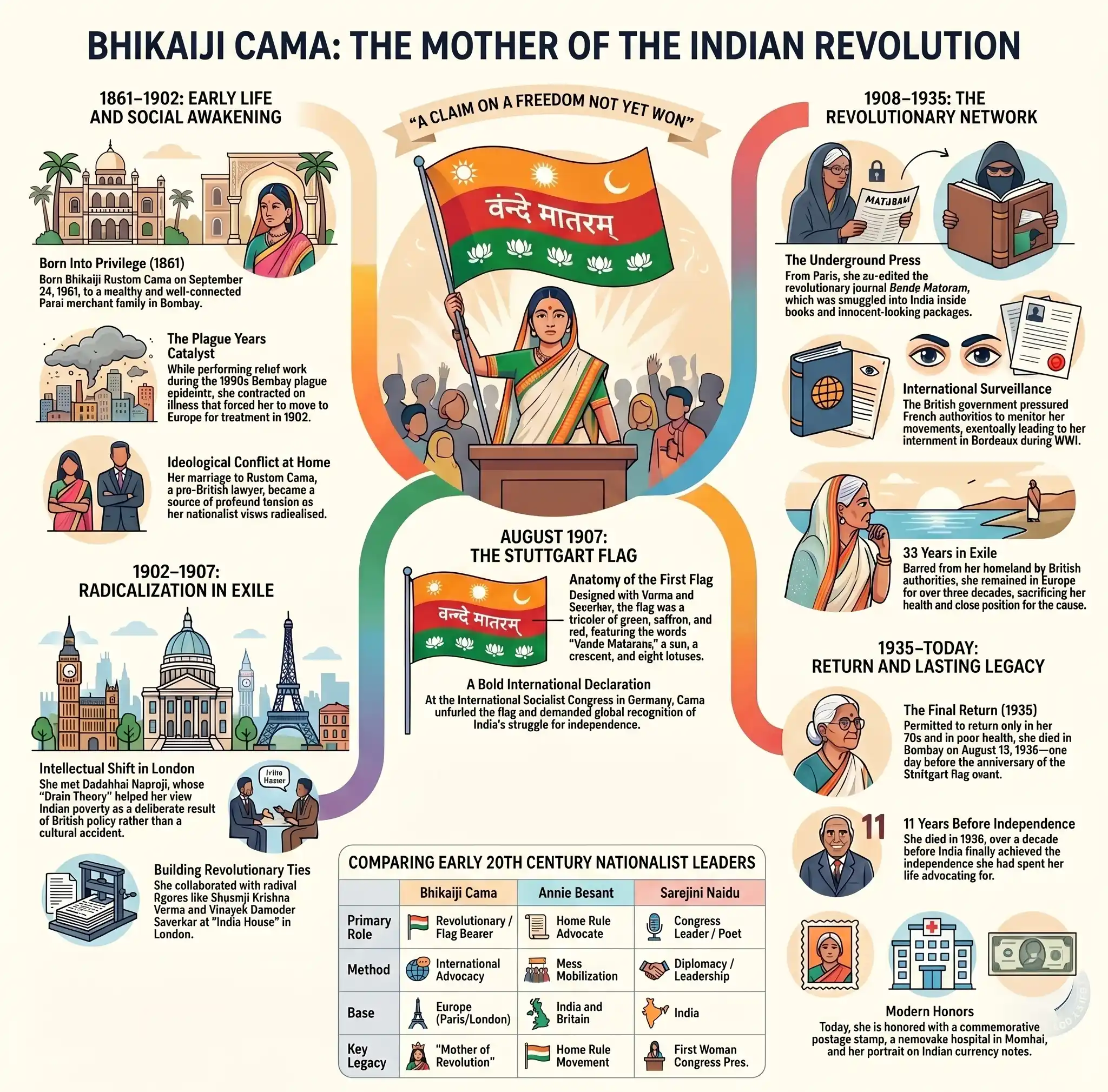
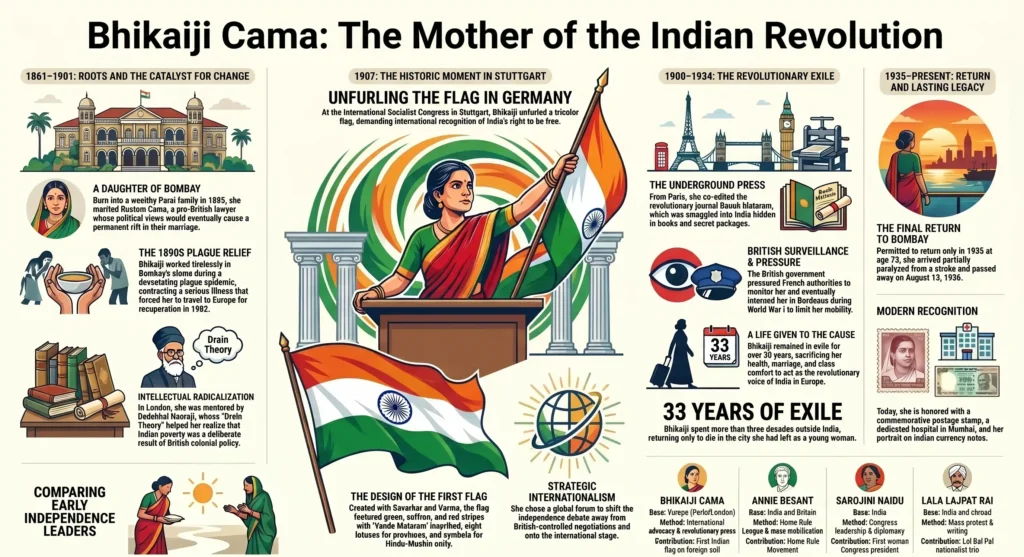
In August 1907, in Stuttgart, Germany, at an International Socialist Congress, a woman stood up before an assembled audience of international delegates and unfurled a flag. The flag was a tricolor of green, saffron and red, with the words “Vande Mataram” stitched across it. She declared it the flag of independent India and asked the world to bear witness to India’s right to be free. She was forty-five years old, in exile from her own country, operating from the margins of European political life, and she was doing something that no Indian had ever done before on foreign soil. She was demanding that the world take India’s freedom seriously. Her name was Bhikaiji Rustom Cama. Her commitment to that moment lasted for thirty-three years more, decades she spent in exile, building networks, editing revolutionary publications, advocating for a country she was not permitted to return to. She did not live to see Indian independence. But she had already made her argument completely.
Strength of Kushal Konwar and the Assam Martyrs of 1942
The Woman Before the Banner: A Bombay Life
Bhikaiji Rustom Cama was born on September 24, 1861, into a wealthy and educated Parsi family in Bombay. Her father, Sorabji Framji Patel, was a prominent merchant, and her family was well connected in the social world of colonial Bombay. She had access to education—a privilege not extended to all women of her time—and she received a good education. In 1885, she married Rustom Cama, a lawyer. On paper, her life looked like the life a woman of her class and community was expected to live: marriage to an educated man, social standing, financial security.
But her husband had pro-British sympathies that would become a source of profound tension between them. For Bhikaiji, watching India under British rule, seeing what colonialism actually meant in the lives of ordinary people, she could not be satisfied with the comfortable position that her class and marriage had given her. In the 1890s, when Bombay was struck by a devastating plague epidemic, she threw herself into relief work in the city’s affected neighborhoods. She worked in the slums and poorer quarters with a directness and physical commitment that was unusual for a woman of her social class. She was not an observer. She was present in the places where people were suffering.
The work cost her her health. She contracted an illness serious enough that her doctors recommended she travel to Europe to recuperate. What began as medical necessity became a political turning point. She left for Europe in 1902. She did not return to India for over thirty years.
Europe as University: The Education She Found
How Ramkinkar Baij Transformed Indian Sculpture Forever
In London, Bhikaiji came into contact with Dadabhai Naoroji, the Indian political economist and the first Indian to be elected to the British Parliament. Naoroji’s systematic analysis of how British colonial policy drained wealth from India—his “drain theory”—gave Bhikaiji an intellectual framework for what she had observed on the streets of Bombay during the plague years. Poverty in India was not an accident. It was not a cultural condition. It was a consequence of deliberate policy, of systematic extraction, of a system designed to benefit Britain at India’s expense.
She also came into contact with Shyamji Krishna Varma, the revolutionary who had established India House in London as a base for Indian nationalist activity. Varma’s approach to independence was more radical than the constitutional approaches of the Indian National Congress, which was advocating for dominion status and gradual reform. And she eventually came into contact with Vinayak Damodar Savarkar, whose revolutionary nationalism was even more militant, even more uncompromising.
These relationships shaped the direction of Bhikaiji’s activism. She was no longer simply a woman interested in social reform. She was becoming a revolutionary, someone who believed that India’s freedom could not be won through negotiation with the British government, that it had to be demanded, asserted, taken. She was learning that the most effective arguments for freedom sometimes required the willingness to stand alone, to be unpopular, to risk everything.
Paris: Building the Revolutionary Network
When Bhikaiji moved to Paris, she became a central figure in an international network of Indian revolutionaries operating from Europe. She did not simply witness this network from the outside. She helped create it. She co-edited a revolutionary publication called “Bande Mataram,” named after the nationalist song, which was printed in Paris and smuggled into India through various channels—hidden in books, wrapped inside innocent-looking packages, passed through networks of sympathetic merchants and sailors. The publication advocated for complete independence rather than the dominion status or gradual reform that the mainstream Congress was pursuing.
The British government was sufficiently concerned about her activities that it pressured the French authorities to monitor and restrict her movements. She was barred from returning to India. Her husband, whose politics remained pro-British, effectively became estranged from her. The marriage that had promised her security and social standing became an obstacle, something she had to accept as lost in service of something larger.
She continued her work regardless. In the dark rooms and modest apartments of Paris, in cafes and meeting halls, she maintained correspondence with revolutionary networks in India. She contributed to publications that were considered seditious by the British government. She used her social connections in European political circles—connections she had access to because of her class and education—to keep the case for Indian freedom in circulation. She was doing the work of a revolutionary from the position of an exile, without the comfort of being in her home country, without the community that comes from being surrounded by others who share your struggle.
The Victory Over Bali and What It Means for the First Day of Chaitra
The Flag at Stuttgart: An Act of Defiance
The flag that Bhikaiji unfurled at the International Socialist Congress in Stuttgart in August 1907 had been designed in collaboration with Shyamji Krishna Varma and Vinayak Damodar Savarkar. It was a tricolor of green, saffron and red, with the words “Vande Mataram” in the center and a crescent and sun symbolizing India’s Hindu and Muslim communities. Eight lotuses were depicted across the top stripe, representing the eight provinces of British India at the time.
This was not the flag that eventually became independent India’s national flag. The design would go through many iterations before the final version was adopted in 1947. But it was the first Indian flag to be carried to an international forum and presented as the symbol of a free nation that did not yet exist in political reality. In that sense, the Stuttgart flag was a declaration made in the future tense, a claim on a freedom that had not yet been won but was being asserted as non-negotiable.
The choice of Stuttgart and the International Socialist Congress was strategically intelligent. Bhikaiji understood that the argument for Indian independence needed an international audience, that confining the struggle to negotiations between Indians and the British government kept the terms of the debate within a framework that Britain controlled. By taking the flag to a forum of international delegates and demanding recognition there, she was attempting to shift the terms of the debate onto ground where Britain had less authority. She was saying: this is not a matter to be settled between Britain and India. This is a matter of international justice, of human rights, of a nation’s right to exist on its own terms.
The moment lasted a few minutes. She walked to the podium with the flag folded under her arm. She unfolded it, held it up before the assembled delegates and announced that what they were looking at was the flag of free India. She asked them to rise. Some did. She delivered a speech demanding India’s independence from British rule and calling on the international community to recognize the injustice of colonial governance. Then she sat down. The consequences of those few minutes lasted considerably longer.
The Long Exile: Building in Silence
After Stuttgart, Bhikaiji continued her work from Paris with a quiet intensity that the historical record captures only partially. She was not a public figure in the way that some of her male counterparts were. She did not tour Europe giving lectures. She worked from the edges, through networks, through publications, through correspondence.
During the First World War, Bhikaiji’s position in France became complicated. The British government renewed pressure on French authorities to restrict her activities, arguing that her revolutionary connections represented a security risk during wartime. She was eventually interned in Bordeaux under light surveillance for part of the war period. The restriction did not silence her, but it significantly limited her mobility. She had already sacrificed her country, her marriage, her health. Now she was sacrificing her freedom of movement.
The years accumulated. One year of exile became five. Five became ten. Ten became twenty. She had left India in 1902, a young woman seeking medical care, and she remained absent because the British government would not permit her return. She was a threat. She was a symbol of resistance. She was a woman who had chosen principle over comfort, and that choice made her dangerous in the eyes of the colonial state.
The Return and the Legacy
Gommateshwara Statue and the Philosophy of Inner Peace
Bhikaiji Cama was finally permitted to return to India in 1935, by which point she was seventy-three years old and in poor health. She had suffered a stroke in 1933 that had left her partially paralyzed. She returned to Bombay, the city she had left thirty-three years earlier as a younger woman, and she found herself unable to do much more than remember.
She died on August 13, 1936, one day before the anniversary of the Stuttgart flag unfurling. The timing was not planned, but it was noted by those who mourned her. The Indian government honored her memory through a commemorative postage stamp and by naming a hospital in Bombay after her. Her portrait appears on Indian currency issued in later decades. These are appropriate honors. They are also considerably less than her full significance deserves.
The story of Bhikaiji Cama is not simply a story about a flag. It is a story about what it looks like when someone decides that the cause of freedom is worth the full cost of personal commitment. She gave up her marriage, her country, her health, and the comfort of her class position to spend thirty-three years telling the world that India had a right to exist on its own terms. She built networks. She edited publications. She maintained her conviction in the face of isolation and restriction and age. She did not live to see independence. Independence came in 1947, eleven years after her death. But she had already done what she came to do. She had raised the flag before the world and said clearly: India is a nation. It has a flag. It will be free.
That clarity, held for three decades without the reward of seeing the outcome, is the measure of her commitment. The flag at Stuttgart was the first sentence of a statement that took forty more years to finish. She wrote it anyway. That is what courage looks like when it has nowhere comfortable to sit down.
The Final Letters of Khudiram Bose and Soul of Young Bengal
If you think you have remembered everything about this topic take this QUIZ
Results


#1. In which German city did Bhikaiji Cama unfurl the flag of independent India in August 1907?
#2. What initial event led Bhikaiji Cama to travel to Europe in 1902?
#3. Whose “drain theory” gave Bhikaiji Cama an intellectual framework regarding how British colonial policy drained wealth from India?
#4. Which revolutionary publication did Bhikaiji Cama co-edit while operating from Paris?
#5. Who collaborated with Bhikaiji Cama to design the tricolor flag unfurled in 1907?
#6. What did the eight lotuses depicted across the top stripe of the 1907 flag represent?
#7. Where was Bhikaiji Cama interned under surveillance during part of the First World War?
#8. In which year was Bhikaiji Cama finally permitted to return to India after her decades of exile?
Who was Bhikaiji Cama and what was her significance in the Indian independence movement?
Bhikaiji Rustom Cama was a Parsi freedom fighter from Bombay who spent over three decades in Europe advocating for Indian independence. She is best known for unfurling what she called the flag of independent India at the International Socialist Congress in Stuttgart in 1907, the first time an Indian flag was presented on foreign soil as the symbol of a free nation. She also co-edited the revolutionary publication Bande Mataram from Paris and built international networks supporting the independence cause.
What was the flag that Bhikaiji Cama unfurled at Stuttgart?
The flag was a tricolor of green, saffron and red, designed in collaboration with Shyamji Krishna Varma and Vinayak Damodar Savarkar. It carried the words Vande Mataram across its center and eight lotuses across the top stripe representing British India’s provinces. It was not the flag eventually adopted by independent India in 1947 but was the first Indian flag presented at an international forum as the symbol of a free nation.
Why did Bhikaiji Cama choose the Stuttgart congress for the flag unfurling?
The International Socialist Congress at Stuttgart in 1907 brought together political delegates from across the world. Bhikaiji chose it because it provided an international audience for the Indian independence argument, shifting the terms of the debate outside the framework of British Indian negotiations where Britain held structural advantage. The presence of international witnesses gave the act of unfurling the flag a resonance that a domestic Indian demonstration could not have achieved.
Why was Bhikaiji Cama barred from returning to India?
The British Indian government considered her revolutionary activities in Europe, including her co-editorship of the Bande Mataram publication and her connections with radical nationalist figures, a threat to colonial order. The government pressured both British and French authorities to restrict her movements and barred her from returning to India. She remained in effective exile for over thirty years before finally being permitted to return in 1935.
How is Bhikaiji Cama remembered in India today?
She is honored through a commemorative postage stamp, a hospital named after her in Mumbai and her portrait on Indian currency. The Indian government and various cultural organizations have marked her contribution to the independence movement, though her name remains less widely known in popular memory than several of her male contemporaries despite the significance of what she accomplished.
Sources & References
Bhikaiji Rustom Cama as a pioneering Parsi freedom fighter and revolutionary who spent 33 years in European exile advocating for Indian independence — Bhikaiji Rustom Cama (1861-1936), born into a wealthy Parsi family in Bombay, became a freedom fighter and revolutionary who spent over three decades in European exile, particularly in Paris and London, advocating for Indian independence while barred from returning to India by the British government, despite leaving for Europe for medical treatment in 1902.
Bhikaiji Cama’s unfurling of the Indian flag at the International Socialist Congress in Stuttgart, Germany in August 1907 and its significance as the first Indian flag presented at an international forum — In August 1907, Bhikaiji Cama unfurled the first Indian flag at the International Socialist Congress in Stuttgart, Germany, a tricolor of green, saffron and red with “Vande Mataram” and eight lotuses representing British India’s provinces, designed in collaboration with Shyamji Krishna Varma and Vinayak Damodar Savarkar, declaring it the symbol of independent India and demanding international recognition of India’s right to freedom.
Bhikaiji Cama’s editorial work on the revolutionary publication Bande Mataram from Paris and her role in international networks of Indian revolutionaries — Bhikaiji Cama co-edited the revolutionary publication Bande Mataram from Paris, which was smuggled into India through underground networks, advocating for complete independence rather than dominion status, while building international networks of Indian revolutionaries including connections to Shyamji Krishna Varma’s India House and Vinayak Damodar Savarkar’s radical nationalist movement.
Bhikaiji Cama’s exile from India lasting 33 years and her internment during World War I due to British pressure on French authorities — Bhikaiji Cama remained barred from returning to India from 1902 to 1935 due to British government pressure on colonial and French authorities, was interned in Bordeaux during part of World War I due to her revolutionary connections, and faced systematic restrictions on her movement throughout her European residence despite continuing her independence advocacy work.
Bhikaiji Cama’s death in 1936 and her legacy as the mother of the Indian revolution honored through Indian currency, postage stamps, and a hospital bearing her name in Mumbai — Bhikaiji Cama died on August 13, 1936, one day before the anniversary of the Stuttgart flag unfurling, after returning to India in 1935, and was honored by the Indian government through commemorative postage stamps, her portrait on Indian currency, and a hospital named after her in Mumbai, though her name remains less widely known in popular memory than many male freedom fighters.