Wednesday, May 20, 2026
20 °c
Columbus
Curious Indian
  • Arts & Culture
  • Festivals of India
  • Indian History
  • Indian Politics
  • Biography
    • Entertainment Personalities
    • Science Personalities
  • Unsolved India
No Result
View All Result
  • Arts & Culture
  • Festivals of India
  • Indian History
  • Indian Politics
  • Biography
    • Entertainment Personalities
    • Science Personalities
  • Unsolved India
No Result
View All Result
Curious Indian
No Result
View All Result
Home Arts & Culture

The Elephanta Trimurti and the Three Faces of an Infinite God

paripurnadatta by paripurnadatta
in Arts & Culture, Indian History, Medieval India, Sculpture
Reading Time: 14 mins read
0 0
A A
Elephanta Trimurti

Elephanta Trimurti

Share on FacebookShare on Twitter

Table of Contents

Toggle
  • The Journey Across Mumbai Harbor to the Forested Mountain
  • The Cave as a Sacred Instrument
  • What the Three Faces Are Actually Saying
  • The Achievement of Balance in Monumental Scale
  • The Political World That Produced the Caves
  • The Remaining Sculptures and What They Add
  • Quick Comparison Table
  • Curious Indian: Fast Facts
  • Conclusion
  • If you think you have remembered everything about this topic take this QUIZ
  • Results
    • #1. Which dynasty is most widely credited by scholars for commissioning the Elephanta Caves?
    • #2. What is the approximate height of the Elephanta Trimurti sculpture?
    • #3. In the spatial organization of the main cave, which direction serves as the axis for the Trimurti sculpture?
    • #4. Which aspect of Shiva does the central face, known as Tatpurusha or Mahadeva, represent?
    • #5. What type of rock was used to carve the Elephanta Caves and its sculptures?
    • #6. In which year was the Elephanta Caves inscribed as a UNESCO World Heritage Site?
    • #7. Which international museum holds 19th-century plaster casts that preserve lost surface details of the Elephanta panels?
    • #8. According to the text, what caused the visible damage to the cave sculptures during the colonial period?
    • What is the Trimurti at Elephanta and what does it represent?
    • When were the Elephanta Caves carved and who built them?
    • Why is Elephanta Island significant beyond its sculptures?
    • What damage have the Elephanta sculptures suffered over the centuries?
    • What other sculptures are in the Elephanta main cave besides the Trimurti?
The Trimurti at Elephanta Caves is among the most powerful works of sacred sculpture anywhere in India. Carved into the basalt of a cave temple on an island in Mumbai harbor, this twenty foot three faced image of Shiva represents his three essential aspects: creator, preserver and destroyer. It was made during a period of extraordinary creative confidence in Indian cave temple architecture, and it achieves something that most monumental sculpture does not. Rather than overwhelming the viewer with scale, it draws them inward into a quality of stillness that feels almost impossible to produce in stone. This piece explores how that balance was achieved, what it means philosophically and why this cave on a small island continues to hold its ground as one of the defining works of Indian art.
DetailInformation
SubjectElephanta Trimurti
LocationElephanta Island, Mumbai, Maharashtra
Period5th to 7th century CE
DynastyKalachuri or early Chalukya
Primary DeityShiva
Height of TrimurtiApproximately 20 feet
MaterialBasalt rock, cave cut
UNESCO StatusWorld Heritage Site since 1987

The Journey Across Mumbai Harbor to the Forested Mountain

Sun Temple wheels of Konark

Elephanta Island sits in Mumbai harbor, about ten kilometers from the Gateway of India. The ferry ride takes roughly an hour. As you approach the island, nothing about its forested hillside suggests what is waiting inside it. There are no towers, no visible carvings from the water, no architectural drama announcing what is there. You walk up a long stairway through trees and vendors and then pass through a low entrance into the cave, and then the monumental face is suddenly in front of you.

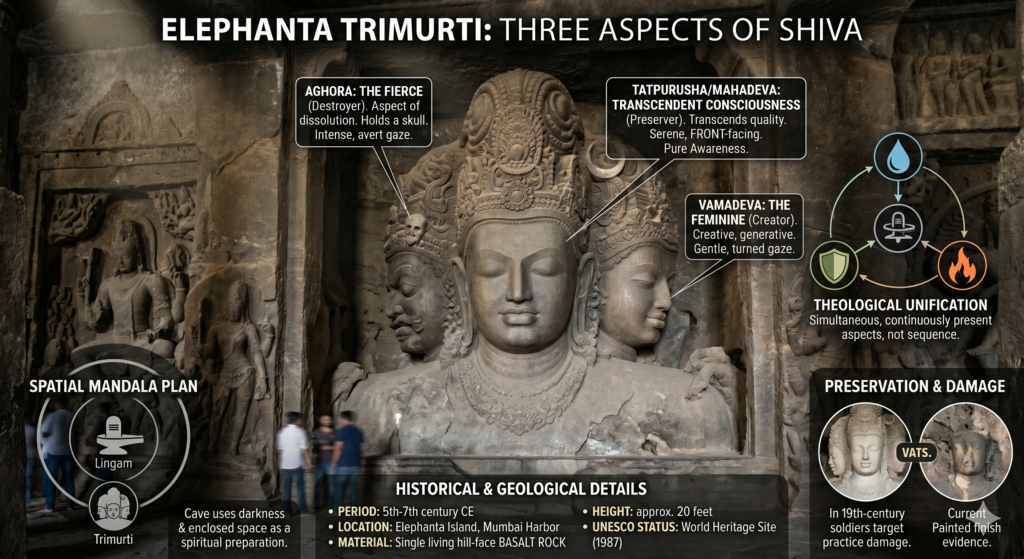
The experience of encountering it for the first time is difficult to describe accurately. The figure is approximately twenty feet tall, emerging from the back wall of the cave southern chamber. Three faces look outward from a single form. The central face is serene beyond any ordinary definition of serenity. The face to the right is feminine and gentle. The face to the left is fierce and turned slightly away, as if deliberately averting its gaze from something the viewer cannot see.

And then the whole composition settles into stillness, and you realize that nothing about it is accidental. This structural mastery of monumental rock carving shares a deep engineering lineage with other massive stone achievements across India, such as the towering Gommateshwara Statue, Shravanabelagola, which required medieval artists to chisel perfect physical proportions from a single living hill face.

The Cave as a Sacred Instrument

The Elephanta cave complex was not cut into the basalt of the island for practical reasons. It was cut to create a specific kind of experience, one that used the qualities of the cave itself, its darkness, its enclosure, its separation from ordinary life above ground, to prepare the visitor for an encounter with the sacred.

READ MORE:  How the Kailasa Temple Was Carved From a Single Mountain

The main cave at Elephanta is oriented so that the entrance allows a controlled amount of natural light to enter. The Elephanta Trimurti is positioned in the cave southern recess, which means it receives light differently at different times of day. In the morning, the light falls more directly on the central face. As the day progresses, the illumination shifts, and different aspects of the composition move in and out of shadow. This is not accidental. The cave architects understood that light in a rock cut interior is a design material, as controllable and as meaningful as stone.

Scholars whose research is documented through the Archaeological Survey of India have noted that the spatial organization of the Elephanta main cave follows a mandala-like plan, with the three faced image at the south, the lingam shrine at the center and subsidiary shrines at the cardinal points. The cave is not a room with a sculpture in it. It is a three dimensional diagram of Shaiva cosmology, and the central carving is its southern axis. This pristine calibration of sacred architecture to chart cosmic layout mirrors the astronomical intelligence built into the Sun Temple wheels of Konark, where every stone spoke and hub served as a precise solar timekeeper.

What the Three Faces Are Actually Saying

The carving is sometimes described as representing Brahma the creator, Vishnu the preserver and Shiva the destroyer combined into a single form. This is partially correct but misses the deeper point. The Elephanta image is not a synthesis of three separate deities. It is a representation of a single deity, Shiva, showing three of his essential aspects or faces simultaneously.

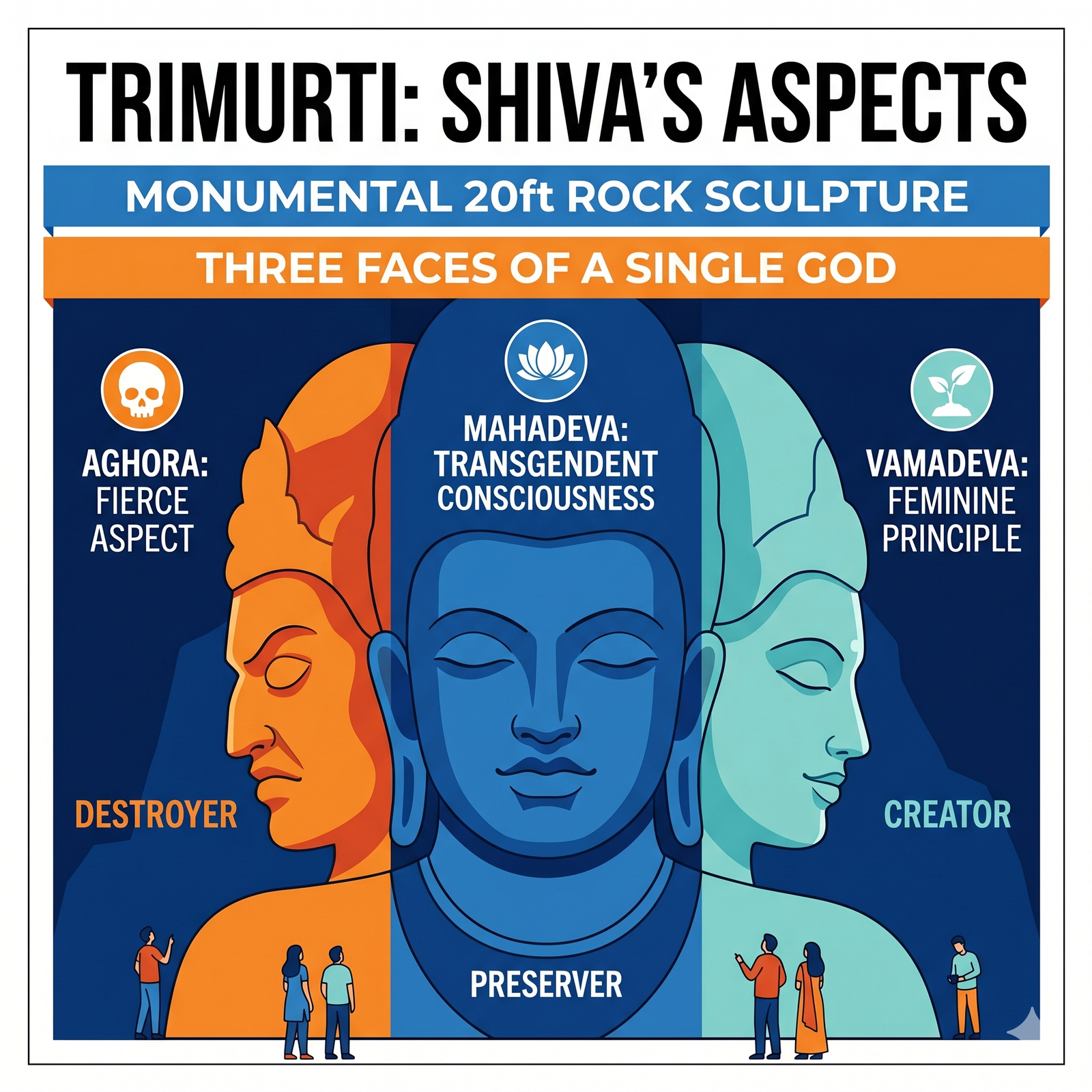
The central face, called Tatpurusha or sometimes Mahadeva, represents Shiva in his transcendent aspect, beyond the qualities of creation and destruction, simply existing as pure consciousness. This face is the largest and most fully frontal of the three. Its expression is what most visitors remember. It is neither happy nor sad, neither alert nor drowsy. It sits in a quality of awareness that has no opposite, that is not in tension with anything.

The Sultanganj Buddha: How Bihar Lost a Copper Giant to Birmingham

The face to the right of the central is called Vamadeva and represents Shiva feminine aspect, associated with creation, gentleness and the generative principle. It is slightly smaller than the central face and turned at a gentle angle. The expression is softer, the features more delicate.

The face to the left is called Aghora, representing Shiva’s fierce and destructive aspect. It is partially turned away from the viewer and wears an expression that art historians have variously described as wrathful, intense and deliberately unsettling. In many representations, this face has a skull incorporated into its headdress and carries associations with death and dissolution.

Together, the three faces say something that Indian philosophy spent centuries developing in language: that creation, preservation and dissolution are not three separate processes happening in sequence. They are three aspects of a single continuous reality, present simultaneously in every moment, held together by a consciousness that is none of them and all of them at once. This balance of cosmic scale with pure geometric equilibrium as a philosophical map of the universe would later serve as a major inspiration for twentieth century modernists.

The Achievement of Balance in Monumental Scale

What makes the central figure technically extraordinary, beyond its philosophical depth, is the balance it achieves across a twenty foot composition made from rock that could not be moved or corrected once the chisel had been applied. The central face had to be large enough to command the space without making the flanking faces feel diminished. The flanking faces had to be distinct enough in character to read as genuinely different aspects without disrupting the unity of the whole. And the entire composition had to work from the specific distance and angle at which a visitor standing in the cave would encounter it.

READ MORE:  The Tashkent Agreement 1966: Peace Treaty or Political Betrayal?

These are not simple problems. They are the kinds of problems that monumental sculptors spend their careers learning to solve, and they are made significantly harder when the medium is basalt in a cave where the available light is limited and variable. The craftsmen who carved the imagery solved all of them simultaneously, producing a composition that reads as unified from a distance and reveals increasing complexity as you move closer.

How the Kailasa Temple Was Carved From a Single Mountain

The surface treatment of the three faces also contributes to the balance. The central face is the most polished and the most smoothly finished. The rightward face shares something of this smooth quality. The leftward face has a slightly rougher, more energetic surface that reinforces its fierce character without breaking the formal unity of the composition. These are extremely subtle distinctions, visible only on close examination, but they are part of what gives the image its unusual quality of feeling simultaneously monumental and intimate.

The detailed conservation records maintained through the Elephanta Island heritage management framework, as part of the broader protections established when UNESCO inscribed the caves as a World Heritage Site in 1987, confirm that the original surface showed evidence of painted finish, meaning the distinctions between the three faces would have been even more pronounced in the sculpture original condition. 

The Political World That Produced the Caves

The Elephanta caves were carved during a period of significant uncertainty about exactly which dynasty was responsible for them. The most widely accepted scholarly position attributes the caves to the Kalachuri dynasty, who controlled much of the western Deccan in the 5th and 6th centuries CE. Some scholars have argued for Chalukya or even Rashtrakuta involvement in later phases. What is clear is that whoever commissioned the caves possessed both the resources and the theological sophistication to conceive and execute a project of this ambition.

The island location in what was then a strategically important harbor suggests that the caves were intended to be seen by people arriving by sea, merchants, travelers and political visitors from across the Indian Ocean world. A cave temple of this scale and quality on an island in a major harbor was a statement of civilizational confidence, saying to anyone who arrived that this was a place where the highest forms of human creative and spiritual achievement were taken seriously. This ancient pattern of building massive sacred sanctuaries in isolated regional environments is a recurring theme across the subcontinent, visible even in remote jungle hills like the ancient Unakoti Rock Cut Sculptures of northern Tripura.

The Remaining Sculptures and What They Add

The Trimurti is the centerpiece of the Elephanta main cave, but the cave contains a further series of large sculptural panels that elaborate on the Shaiva themes established by the central image. These include a panel depicting Shiva and Parvati on Mount Kailash, a Nataraja panel showing Shiva as the cosmic dancer, a panel depicting Andhakasuravadha in which Shiva defeats the demon Andhaka, and a remarkable panel showing the marriage of Shiva and Parvati.

Each of these panels is a significant work of art in its own right. Together they create a narrative and theological environment in which the three faced composition functions as the still center, the point of pure consciousness around which all the activity of Shiva mythological life revolves. The cave becomes, through the arrangement of these panels around the central image, a complete theological statement about the nature of the divine.

The Victoria and Albert Museum in London holds plaster casts of several Elephanta panels made in the 19th century, which provide a record of surface details that have since been lost to weathering and the damage inflicted during the colonial period, when Portuguese soldiers reportedly used the cave sculptures for target practice.

Quick Comparison Table

FeatureElephanta TrimurtiBadami Cave TemplesEllora Cave 16Mahabalipuram Panels
Period5th to 7th century CE6th century CE8th century CE7th to 8th century CE
Primary DeityShivaVishnu and ShivaShivaShiva and Vishnu
StyleMonumental, meditativeNarrative, devotionalElaborate, theatricalNarrative, refined
UNESCO StatusWorld Heritage SiteNot listedWorld Heritage SiteWorld Heritage Site

Curious Indian: Fast Facts

  • The Trimurti at Elephanta is approximately twenty feet tall and carved directly from the basalt of the cave wall, not assembled from separate pieces
  • The three faces represent Shiva transcendent, feminine and fierce aspects simultaneously, not three separate deities.
  • The cave is oriented so that natural light falls differently on the composition at different times of day, a deliberate architectural choice.
  • Portuguese soldiers reportedly used the cave sculptures for target practice during the colonial period, causing damage that is still visible today,
  • UNESCO inscribed the Elephanta Caves as a World Heritage Site in 1987.
  • The main cave follows a mandala-like spatial plan with the Trimurti at the south and a lingam shrine at the center.
  • The Victoria and Albert Museum in London holds 19th century plaster casts of several Elephanta panels, preserving details now lost to weathering.
  • Elephanta Island sits approximately ten kilometers from the Gateway of India in Mumbai harbor and is accessible only by ferry.
READ MORE:  From Jadoo to Javed: The Complete Biography of a Literary Giant

Conclusion

The Elephanta Trimurti has been in that cave for somewhere between fourteen and sixteen centuries. It has survived Portuguese soldiers, colonial neglect, monsoon humidity, the salt air of Mumbai harbor and the footsteps of millions of visitors. It is still doing what it was made to do.

What it was made to do is not simply to depict Shiva. It was made to produce in the person standing before it a specific quality of experience, the recognition that the forces which appear to be in opposition, creation and destruction, stillness and energy, the gentle and the fierce, are not actually opposed. They are aspects of a single reality, held together by a consciousness that contains all of them without being destabilized by any of them.

That is a philosophical proposition. But in the Trimurti it is not argued in words. It is demonstrated in the relationship between three stone faces, in the balance of a twenty foot composition, in the quality of an expression that has been sitting in the same cave for fifteen centuries and has yet to tip in any direction.

That is what makes it a masterpiece. Not the scale. Not antiquity. The balance.

If you think you have remembered everything about this topic take this QUIZ


Results

Share your score!
Tweet your score!
Tweet your score!
Share to other
QUIZ START

#1. Which dynasty is most widely credited by scholars for commissioning the Elephanta Caves?

Previous
Next

#2. What is the approximate height of the Elephanta Trimurti sculpture?

Previous
Next

#3. In the spatial organization of the main cave, which direction serves as the axis for the Trimurti sculpture?

Previous
Next

#4. Which aspect of Shiva does the central face, known as Tatpurusha or Mahadeva, represent?

Previous
Next

#5. What type of rock was used to carve the Elephanta Caves and its sculptures?

Previous
Next

#6. In which year was the Elephanta Caves inscribed as a UNESCO World Heritage Site?

Previous
Next

#7. Which international museum holds 19th-century plaster casts that preserve lost surface details of the Elephanta panels?

Previous
Next

#8. According to the text, what caused the visible damage to the cave sculptures during the colonial period?

Previous
Finish

What is the Trimurti at Elephanta and what does it represent?

The Trimurti is a twenty foot three faced sculptural image of Shiva carved from the basalt wall of the main cave at Elephanta Island. It represents three aspects of Shiva simultaneously: the central face shows his transcendent consciousness, the right face shows his gentle and feminine creative aspect and the left face shows his fierce and destructive aspect. Together they present Shiva as a deity who contains all fundamental forces of existence within a single unified form.

When were the Elephanta Caves carved and who built them?

The caves are generally dated to between the 5th and 7th centuries CE. The most widely accepted scholarly attribution is to the Kalachuri dynasty, who controlled the western Deccan during this period, though some scholars have argued for Chalukya or later involvement in certain phases of the cave construction. The precise patronage remains a subject of ongoing academic debate.

Why is Elephanta Island significant beyond its sculptures?

Elephanta Island sits in Mumbai harbor at a location that was strategically important for maritime trade across the Indian Ocean world. A cave temple of this scale and ambition at this location was a deliberate statement of civilizational confidence by whoever commissioned it, designed to be seen by merchants, travelers and political visitors arriving by sea. The island isolation also gives the caves a quality of remove from ordinary life that reinforces the experience of entering the sacred space.

What damage have the Elephanta sculptures suffered over the centuries?

The most significant documented damage was inflicted by Portuguese soldiers during the colonial period, who reportedly used the cave sculptural panels for target practice. This accounts for the damage visible on several figures throughout the cave. Further deterioration has occurred due to the humid coastal environment, salt air and the heavy tourist traffic the caves have received since becoming accessible from Mumbai.

What other sculptures are in the Elephanta main cave besides the Trimurti?

The main cave contains several large sculptural panels arranged around the central Trimurti. These include a panel of Shiva and Parvati on Mount Kailash, a Nataraja panel showing Shiva as the cosmic dancer, a panel depicting Shiva defeating the demon Andhaka and a panel showing the marriage of Shiva and Parvati. Together these panels create a complete theological narrative around the still center established by the Trimurti.

Tags: Ancient Indian astronomyEastern Ganga dynastyIndian cosmic geometryIndian sundialKhondalite stoneKonark Sun TempleNarasimhadeva IOdisha heritageSun Temple wheelsUNESCO World Heritage India
ShareTweetPin
paripurnadatta

paripurnadatta

Related Posts

Khudiram Bose
Biography

The Final Letters of Khudiram Bose and Soul of Young Bengal

May 19, 2026
Bhikaiji Cama
Biography

How Madam Bhikaiji Cama Unfurled India’s Flag in Germany

May 19, 2026
Matangini Hazra
Biography

Matangini Hazra: The Widow Who Walked Into Gunfire

May 19, 2026
No Result
View All Result

Stay Updated

  • Trending
  • Latest
Life of Mahavira: From Prince Vardhamana to Great Conqueror

Life of Mahavira: From Prince Vardhamana to Great Conqueror

April 11, 2026
Life of Buddha: The Journey to Enlightenment

Life of Buddha: The Journey to Enlightenment

April 11, 2026
Christmas in India

Christmas in India: A Festive Blend of Faith, Flavors, and Tradition

April 11, 2026
From Shimla to Stardom: The Complete Biography of Anupam Kher

From Shimla to Stardom: The Complete Biography of Anupam Kher

April 11, 2026
Khudiram Bose

The Final Letters of Khudiram Bose and Soul of Young Bengal

May 19, 2026
Bhikaiji Cama

How Madam Bhikaiji Cama Unfurled India’s Flag in Germany

May 19, 2026
Matangini Hazra

Matangini Hazra: The Widow Who Walked Into Gunfire

May 19, 2026
Gommateshwara statue

Gommateshwara Statue and the Philosophy of Inner Peace

May 19, 2026

Widget Title

Facebook Twitter Youtube RSS
Curious Indian Logo

Explore the soul of Bharat with Curious Indian. A definitive guide to Indian history, arts, culture, biographies, and the events that defined our future.

Follow us on social media:

Recent News

  • The Final Letters of Khudiram Bose and Soul of Young Bengal
  • How Madam Bhikaiji Cama Unfurled India’s Flag in Germany
  • Matangini Hazra: The Widow Who Walked Into Gunfire

Category

  • Ancient Civilizations & The Vedic Age
  • Architecture
  • Artists & Cultural Icons
  • Arts & Culture
  • Battles of India
  • Biography
  • Business & Industrialists
  • Colonial India
  • Cultural Insights
  • Dance & Music
  • Entertainment Personalities
  • Festivals of India
  • Freedom Fighters
  • Freedom Movement
  • Historical Events & Turning Points
  • Indian History
  • Indian Politics
  • Major Festivals
  • Medieval India
  • North East India
  • Paintings & Visual Arts
  • Political Leaders
  • Post-Independence India
  • Regional Culture
  • Religious & Spiritual Figures
  • Science Personalities
  • Scientific Discoveries
  • Sculpture
  • Social Issues
  • SOCIETY & MYSTERIES
  • Strange & Unknown Stories
  • Textiles & Handicrafts
  • Uncategorized
  • Unsolved India
  • Unsung Heroes

© 2026 Curious Indian- Everything about India

Welcome Back!

Login to your account below

Forgotten Password?

Retrieve your password

Please enter your username or email address to reset your password.

Log In

Add New Playlist

No Result
View All Result
  • Arts & Culture
  • Festivals of India
  • Indian History
  • Indian Politics
  • Biography
    • Entertainment Personalities
    • Science Personalities

© 2026 Curious Indian- Everything about India

This website uses cookies. By continuing to use this website you are giving consent to cookies being used. Visit our Privacy and Cookie Policy.
Are you sure want to unlock this post?
Unlock left : 0
Are you sure want to cancel subscription?
×