Wednesday, May 20, 2026
20 °c
Columbus
Curious Indian
  • Arts & Culture
  • Festivals of India
  • Indian History
  • Indian Politics
  • Biography
    • Entertainment Personalities
    • Science Personalities
  • Unsolved India
No Result
View All Result
  • Arts & Culture
  • Festivals of India
  • Indian History
  • Indian Politics
  • Biography
    • Entertainment Personalities
    • Science Personalities
  • Unsolved India
No Result
View All Result
Curious Indian
No Result
View All Result
Home Indian History Ancient Civilizations & The Vedic Age

Sarnath Buddha Sculpture: Where Mathematics Meets Divine

paripurnadatta by paripurnadatta
in Ancient Civilizations & The Vedic Age, Arts & Culture, Indian History, Sculpture
Reading Time: 11 mins read
0 0
A A
Sarnath Buddha sculpture

Sarnath Buddha sculpture

Share on FacebookShare on Twitter

Table of Contents

Toggle
  • The Sacred Proportions of the Sarnath Buddha Sculpture
  • The World the Gupta Sculptors Inherited
  • What the Proportions Actually Describe
  • The Mudra and What It Commemorates
  • The UNESCO Buddhist Circuit and Global Recognition
  • Quick Comparison Table
  • Curious Indian: Fast Facts
  • Conclusion
  • If you think you have remembered everything about this topic take this QUIZ
  • Results
    • #1. In which century CE was the Sarnath Buddha sculpture carved during the Gupta period?
    • #2. What specific material was used by the Gupta sculptors to carve the Sarnath Buddha?
    • #3. Which mudra or hand gesture is depicted in the Sarnath Buddha sculpture?
    • #4. What feature unique to the Sarnath school of Gupta sculpture gives the robe its water-like, transparent appearance?
    • #5. Which sacred Buddhist pilgrimage site is historically associated with the first sermon commemorated by this sculpture?
    • #6. According to the text, what figures are carved on the base of the sculpture along with a central wheel flanked by deer?
    • #7. In which year was the Sarnath Archaeological Museum, which houses the sculpture, established?
    • #8. According to the comparison table, which style of Buddha sculpture is characterized by heavy Greco-Roman drapes and Hellenistic, naturalistic facial expressions?
    • Where is the Sarnath Buddha sculpture currently housed?
    • What does the Dharmachakra Pravartana mudra mean?
    • What makes the Sarnath Buddha different from other Buddha sculptures?
    • What is the Gupta school of sculpture?
    • Why is Sarnath significant in Buddhist history?
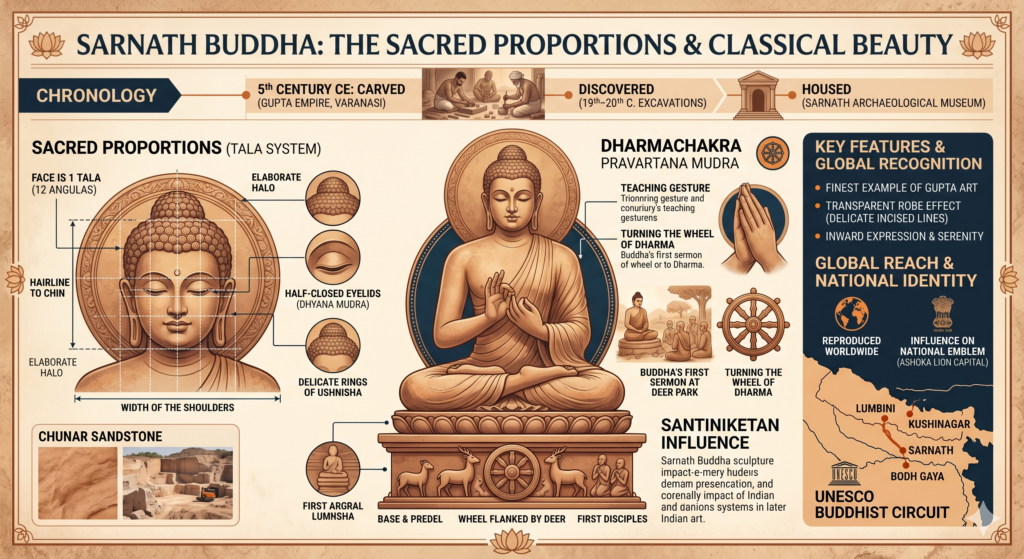
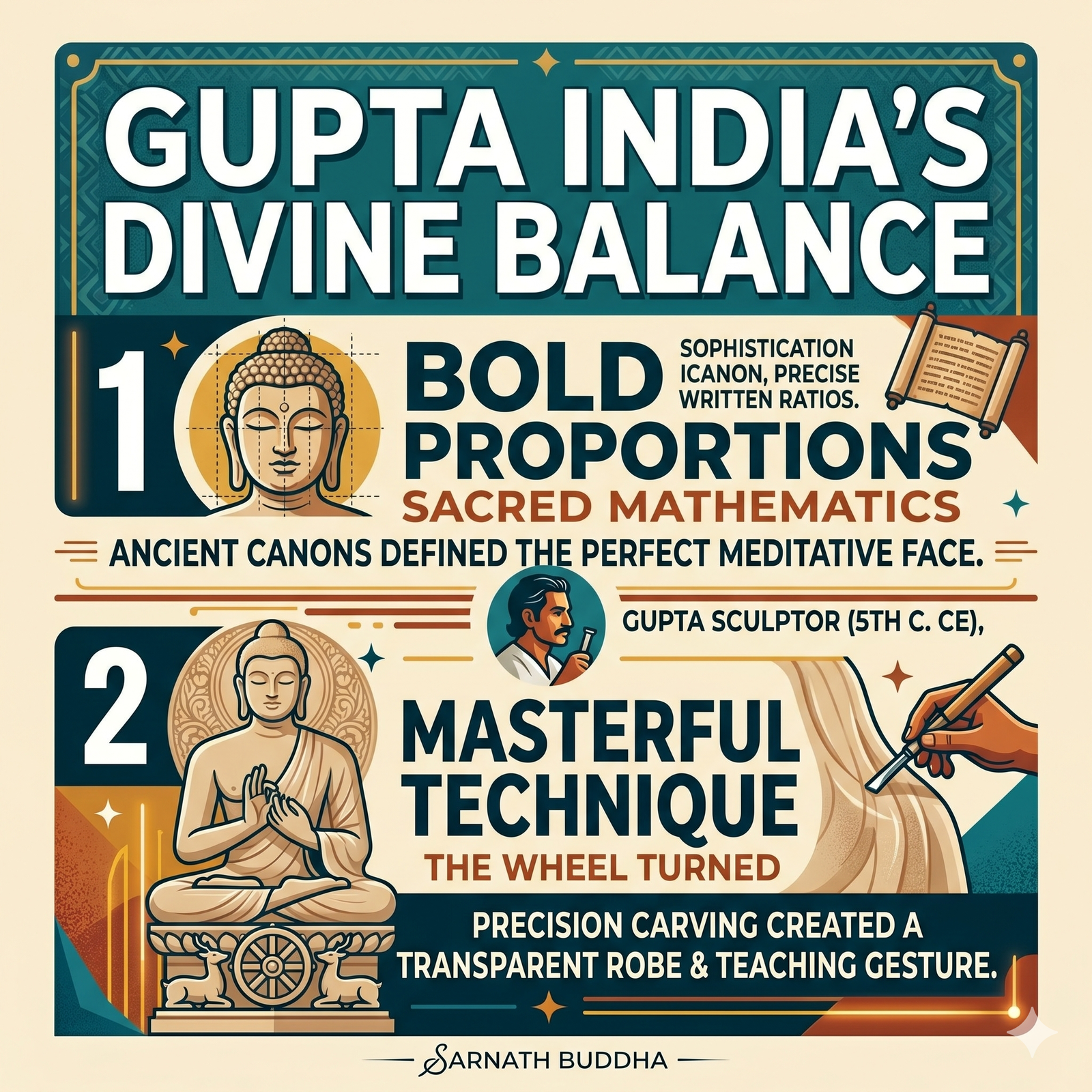
The Sarnath Buddha sculpture, carved during the Gupta period in the 5th century CE, is widely regarded as the finest example of classical Indian sculpture. Housed today in the Sarnath Archaeological Museum, it depicts the Buddha in the Dharmachakra Pravartana mudra, the gesture of the first sermon. Its proportions follow a sophisticated canon drawn from ancient Indian texts on aesthetics and iconography. This piece explores what those proportions mean, how they were achieved, and why this single sculpture continues to define how the world imagines the face of the Buddha.
DetailInformation
SubjectSarnath Buddha Sculpture
LocationSarnath, Uttar Pradesh, India
Period5th century CE (Gupta Empire)
MaterialChunar sandstone
HeightApproximately 1.6 meters
Current LocationSarnath Archaeological Museum
StyleGupta school of art
Deity DepictedGautama Buddha
MudraDharmachakra Pravartana (Wheel of Law gesture)
UNESCO StatusPart of Buddhist Circuit, nominated heritage consideration
SignificanceConsidered the finest example of Gupta sculptural art
Sarnath Buddha sculpture

The Sacred Proportions of the Sarnath Buddha Sculpture

There is a room in the Sarnath Archaeological Museum where the light falls in a particular way onto a pale sandstone figure seated in meditation. The figure is approximately 1.6 meters tall. It is over fifteen hundred years old. And yet most people who stand in front of it report the same experience. They go quiet. Not from reverence alone, but from something harder to name, a feeling that the figure is somehow more perfectly itself than anything around it.

READ MORE:  Jivaka: The King of Physicians Who Healed the Buddha

That quality did not happen by accident. It was calculated.

The World the Gupta Sculptors Inherited

The Gupta Empire, which flourished across northern India between the 4th and 6th centuries CE, is often called India’s Golden Age. It was a period of extraordinary productivity in mathematics, astronomy, literature and the arts. The sculptors working at Sarnath during this period inherited centuries of Buddhist iconographic tradition but also something more specific: a set of written canons governing how the ideal human form should be measured and rendered.

These texts, rooted in the Shilpa Shastras, the ancient Indian treatises on art and architecture, prescribed precise ratios for every part of the body. The distance from the hairline to the chin. The width of the shoulders relative to the height of the torso. The curve of the eyelids. The length of the fingers. None of these were left to personal preference. They were understood as sacred mathematics, a system by which the infinite could be made visible within the finite boundaries of carved stone.

What the Proportions Actually Describe

The Sarnath Buddha follows these proportions with a fidelity that art historians have verified through careful measurement. The face alone is a study in calculated balance. The eyes are cast slightly downward, not fully closed and not fully open, holding the figure in a state between inward awareness and outward presence. This half-closed position was specifically prescribed in iconographic texts to convey the meditative state of dhyana without disconnecting the figure entirely from the viewer.

The ushnisha, the cranial protrusion at the top of the head indicating wisdom and spiritual attainment, rises in a smooth, unadorned curve that contrasts deliberately with the elaborate halo behind the figure. The halo itself is carved with concentric rings of lotus petals and floral scrollwork, providing a decorated frame that makes the simplicity of the face feel even more concentrated.

Unakoti Tripura: Jungle Sanctuary With a Million Stone Faces

The robe that covers the figure is perhaps the most remarkable achievement of the Sarnath sculptors. It appears almost transparent. You can see the contours of the body beneath it as if the fabric were made of water. The folds are indicated by the most delicate incised lines, creating the impression of cloth without interrupting the smooth surface underneath. This technique, unique to the Sarnath school of Gupta sculpture, required the artisans to work at a level of precision that left almost no room for error in a medium as unforgiving as stone.

Scholars affiliated with the Archaeological Survey of India have documented that this transparent robe effect was achieved through a combination of surface polishing and extremely shallow relief carving, a technique that was developed specifically at Sarnath and never fully replicated elsewhere.

The Mudra and What It Commemorates

The Buddha’s hands are held in the Dharmachakra Pravartana mudra, a gesture that represents the turning of the wheel of dharma. This is not a generic meditation pose. It is a specific reference to a specific moment: the first sermon the Buddha delivered at the Deer Park in Sarnath after attaining enlightenment, the moment when he shared what he had discovered with the world for the first time.

READ MORE:  Chapters of the Smita Patil Life Story

Choosing this mudra for the Sarnath sculpture was therefore both geographically and spiritually precise. The statue commemorates the very act that took place in the location where it was made. The right hand is raised with fingers arranged in the teaching gesture while the left hand rests in the lap, its position mirroring and completing the gesture of the right. Below, on the base of the sculpture, smaller figures are carved representing the Buddha’s first disciples, along with a wheel at the center flanked by deer, a direct reference to the Deer Park setting of the first sermon.

This layering of meaning, the mudra, the location, the base imagery, the proportions all pointing to the same moment, is what gives the Sarnath Buddha its unusual density of intention. It is not simply a beautiful figure. It is a precise argument in stone.

The UNESCO Buddhist Circuit and Global Recognition

Sarnath is one of the four most sacred sites in Buddhism, the others being Bodh Gaya, Kushinagar and Lumbini. The site draws pilgrims and scholars from across the world, and the sculpture housed in its museum has become one of the most reproduced images in the history of Indian art. As documented through the UNESCO World Heritage framework governing the broader Buddhist circuit, Sarnath’s significance extends beyond any single religious tradition. It represents a moment in human history when one person’s experience of consciousness was translated into a teaching that would eventually reach hundreds of millions of people across Asia and the world.

The face of the Sarnath Buddha has traveled far beyond the museum room where the original sits. It appears on the official emblem of the Government of India, drawn from the Ashoka Lion Capital also found at Sarnath, connecting this single site to the deepest roots of Indian national identity.

Quick Comparison Table

FeatureSarnath BuddhaMathura BuddhaGandhara BuddhaAmaravati Buddha
Period5th century CE2nd century CE1st to 3rd century CE2nd to 3rd century CE
MaterialChunar sandstoneRed sandstoneSchist/stuccoLimestone
StyleGupta schoolMathura schoolGreco-BuddhistAmaravati school
Facial ExpressionDeeply serene, inwardStrong, assertiveHellenistic, naturalisticGentle, devotional
Robe TreatmentTransparent, clingingBold foldsHeavy Greco-Roman drapeMinimal, flat
Cultural InfluencePure Indian classicalIndian classicalGreek and RomanSouth Indian regional
Current LocationSarnath Museum, UPGovernment Museum, MathuraVarious international museumsBritish Museum, London

Curious Indian: Fast Facts

  • The Sarnath Buddha was carved from Chunar sandstone, a pale fine-grained stone quarried near Varanasi that was prized by Gupta sculptors for its workability.
  • The transparent robe effect on the sculpture was unique to the Sarnath school and was never fully replicated by sculptors working in other regions.
  • The Dharmachakra Pravartana mudra specifically commemorates the Buddha’s first sermon, delivered at the Deer Park in Sarnath.
  • The ushnisha or cranial protrusion on the figure is deliberately unadorned, creating a visual contrast with the elaborately carved halo behind it.
  • The Ashoka Lion Capital, also found at Sarnath, forms the basis of the national emblem of India.
  • Sarnath is one of four sacred Buddhist pilgrimage sites, along with Bodh Gaya, Kushinagar and Lumbini.
  • The sculpture dates to the 5th century CE, placing it at the height of the Gupta Empire’s cultural and artistic output.
  • The Sarnath Archaeological Museum was established in 1910 and is one of the oldest site museums in India.
READ MORE:  Where Is The Lost Wealth Of Mir Osman Ali Khan

Conclusion

The Sarnath Buddha is a sculpture about precision in the service of transcendence. Its makers understood that to represent the infinite, they could not afford to be approximate. Every ratio, every surface, every gesture was chosen from a tradition that treated beauty not as decoration but as a form of truth.

What is most striking today is how fully that intention survived. Fifteen hundred years of history, invasion, neglect and rediscovery later, the figure still produces in its viewers the response its creators designed it to produce. The stillness is intact. The proportions hold. The face continues to sit in that exact position between inward and outward, between here and somewhere else entirely.

The Gupta sculptors who carved this figure never signed their work. We do not know their names. What we have instead is the object itself, and the fact that it is still working exactly as intended. That is a different kind of signature, and in some ways a more permanent one.

If you think you have remembered everything about this topic take this QUIZ


Results

Share your score!
Tweet your score!
Tweet your score!
Share to other
QUIZ START

#1. In which century CE was the Sarnath Buddha sculpture carved during the Gupta period?

Previous
Next

#2. What specific material was used by the Gupta sculptors to carve the Sarnath Buddha?

Previous
Next

#3. Which mudra or hand gesture is depicted in the Sarnath Buddha sculpture?

Previous
Next

#4. What feature unique to the Sarnath school of Gupta sculpture gives the robe its water-like, transparent appearance?

Previous
Next

#5. Which sacred Buddhist pilgrimage site is historically associated with the first sermon commemorated by this sculpture?

Previous
Next

#6. According to the text, what figures are carved on the base of the sculpture along with a central wheel flanked by deer?

Previous
Next

#7. In which year was the Sarnath Archaeological Museum, which houses the sculpture, established?

Previous
Next

#8. According to the comparison table, which style of Buddha sculpture is characterized by heavy Greco-Roman drapes and Hellenistic, naturalistic facial expressions?

Previous
Finish

Where is the Sarnath Buddha sculpture currently housed?

The original sculpture is housed in the Sarnath Archaeological Museum in Sarnath, Uttar Pradesh. The museum was established in 1910 and sits very close to the archaeological site where the sculpture was originally discovered.

What does the Dharmachakra Pravartana mudra mean?

It is the gesture of the turning of the wheel of dharma, representing the moment the Buddha delivered his first sermon at the Deer Park in Sarnath. It is one of the most symbolically specific mudras in Buddhist iconography and directly connects the sculpture to its geographic location.

What makes the Sarnath Buddha different from other Buddha sculptures?

The Sarnath Buddha is distinctive for its transparent robe treatment, the extreme serenity of its facial expression and its strict adherence to the proportional canons of the Shilpa Shastras. The Gupta school’s technique of shallow surface carving to suggest fabric without interrupting the body’s smooth contours was unique to Sarnath and was not replicated elsewhere.

What is the Gupta school of sculpture?

The Gupta school refers to the style of sculpture that developed during the Gupta Empire in northern India between the 4th and 6th centuries CE. It is characterized by idealized human forms, refined surface treatment and a synthesis of spiritual symbolism with technical mastery. The Sarnath Buddha is considered its finest surviving example.

Why is Sarnath significant in Buddhist history?

Sarnath is the site where the Buddha delivered his first sermon after attaining enlightenment at Bodh Gaya. It is one of the four holiest sites in Buddhism and has been a place of pilgrimage and scholarship for over two thousand years. The Ashoka pillar erected at Sarnath by Emperor Ashoka in the 3rd century BCE marked it as a site of imperial and spiritual importance long before the Gupta period.

Tags: Buddhist heritage IndiaBuddhist sculpture IndiaChunar sandstoneDharmachakra mudraGupta Empire artSarnath Archaeological MuseumSarnath BuddhaShilpa Shastras
ShareTweetPin
paripurnadatta

paripurnadatta

Related Posts

Khudiram Bose
Biography

The Final Letters of Khudiram Bose and Soul of Young Bengal

May 19, 2026
Bhikaiji Cama
Biography

How Madam Bhikaiji Cama Unfurled India’s Flag in Germany

May 19, 2026
Matangini Hazra
Biography

Matangini Hazra: The Widow Who Walked Into Gunfire

May 19, 2026
No Result
View All Result

Stay Updated

  • Trending
  • Latest
Life of Mahavira: From Prince Vardhamana to Great Conqueror

Life of Mahavira: From Prince Vardhamana to Great Conqueror

April 11, 2026
Life of Buddha: The Journey to Enlightenment

Life of Buddha: The Journey to Enlightenment

April 11, 2026
Christmas in India

Christmas in India: A Festive Blend of Faith, Flavors, and Tradition

April 11, 2026
From Shimla to Stardom: The Complete Biography of Anupam Kher

From Shimla to Stardom: The Complete Biography of Anupam Kher

April 11, 2026
Khudiram Bose

The Final Letters of Khudiram Bose and Soul of Young Bengal

May 19, 2026
Bhikaiji Cama

How Madam Bhikaiji Cama Unfurled India’s Flag in Germany

May 19, 2026
Matangini Hazra

Matangini Hazra: The Widow Who Walked Into Gunfire

May 19, 2026
Gommateshwara statue

Gommateshwara Statue and the Philosophy of Inner Peace

May 19, 2026

Widget Title

Facebook Twitter Youtube RSS
Curious Indian Logo

Explore the soul of Bharat with Curious Indian. A definitive guide to Indian history, arts, culture, biographies, and the events that defined our future.

Follow us on social media:

Recent News

  • The Final Letters of Khudiram Bose and Soul of Young Bengal
  • How Madam Bhikaiji Cama Unfurled India’s Flag in Germany
  • Matangini Hazra: The Widow Who Walked Into Gunfire

Category

  • Ancient Civilizations & The Vedic Age
  • Architecture
  • Artists & Cultural Icons
  • Arts & Culture
  • Battles of India
  • Biography
  • Business & Industrialists
  • Colonial India
  • Cultural Insights
  • Dance & Music
  • Entertainment Personalities
  • Festivals of India
  • Freedom Fighters
  • Freedom Movement
  • Historical Events & Turning Points
  • Indian History
  • Indian Politics
  • Major Festivals
  • Medieval India
  • North East India
  • Paintings & Visual Arts
  • Political Leaders
  • Post-Independence India
  • Regional Culture
  • Religious & Spiritual Figures
  • Science Personalities
  • Scientific Discoveries
  • Sculpture
  • Social Issues
  • SOCIETY & MYSTERIES
  • Strange & Unknown Stories
  • Textiles & Handicrafts
  • Uncategorized
  • Unsolved India
  • Unsung Heroes

© 2026 Curious Indian- Everything about India

Welcome Back!

Login to your account below

Forgotten Password?

Retrieve your password

Please enter your username or email address to reset your password.

Log In

Add New Playlist

No Result
View All Result
  • Arts & Culture
  • Festivals of India
  • Indian History
  • Indian Politics
  • Biography
    • Entertainment Personalities
    • Science Personalities

© 2026 Curious Indian- Everything about India

This website uses cookies. By continuing to use this website you are giving consent to cookies being used. Visit our Privacy and Cookie Policy.
Are you sure want to unlock this post?
Unlock left : 0
Are you sure want to cancel subscription?
×