
Hampi: a team of scientists who check nuclear reactors for hidden cracks brought their instruments to the Vitthala temple, to find out why its stone pillars ring
The instruments the team brought to Hampi were not made for temples.
They came from the Indira Gandhi Centre for Atomic Research at Kalpakkam, in Tamil Nadu. The scientists there worked on nondestructive testing: finding out what is inside a solid object without breaking it open. One of their methods, called impact echo, sends a small shock into a structure and listens to how it comes back. They had used it to check the concrete containment of a nuclear reactor.
Now, with the Archaeological Survey’s permission and a grant from the Indian National Science Academy, they pointed the same methods at the stone pillars of the Vitthala temple.
How Verghese Kurien Turned a Small Village Struggle Into Amul Revolution
The great stage
Unakoti Tripura: Jungle Sanctuary With a Million Stone Faces
The Vitthala temple stands on the south bank of the Tungabhadra, in the ruins of Vijayanagara, the capital that was sacked in 1565. It goes back at least to the middle of the fifteenth century, and it is the grandest temple on the site.
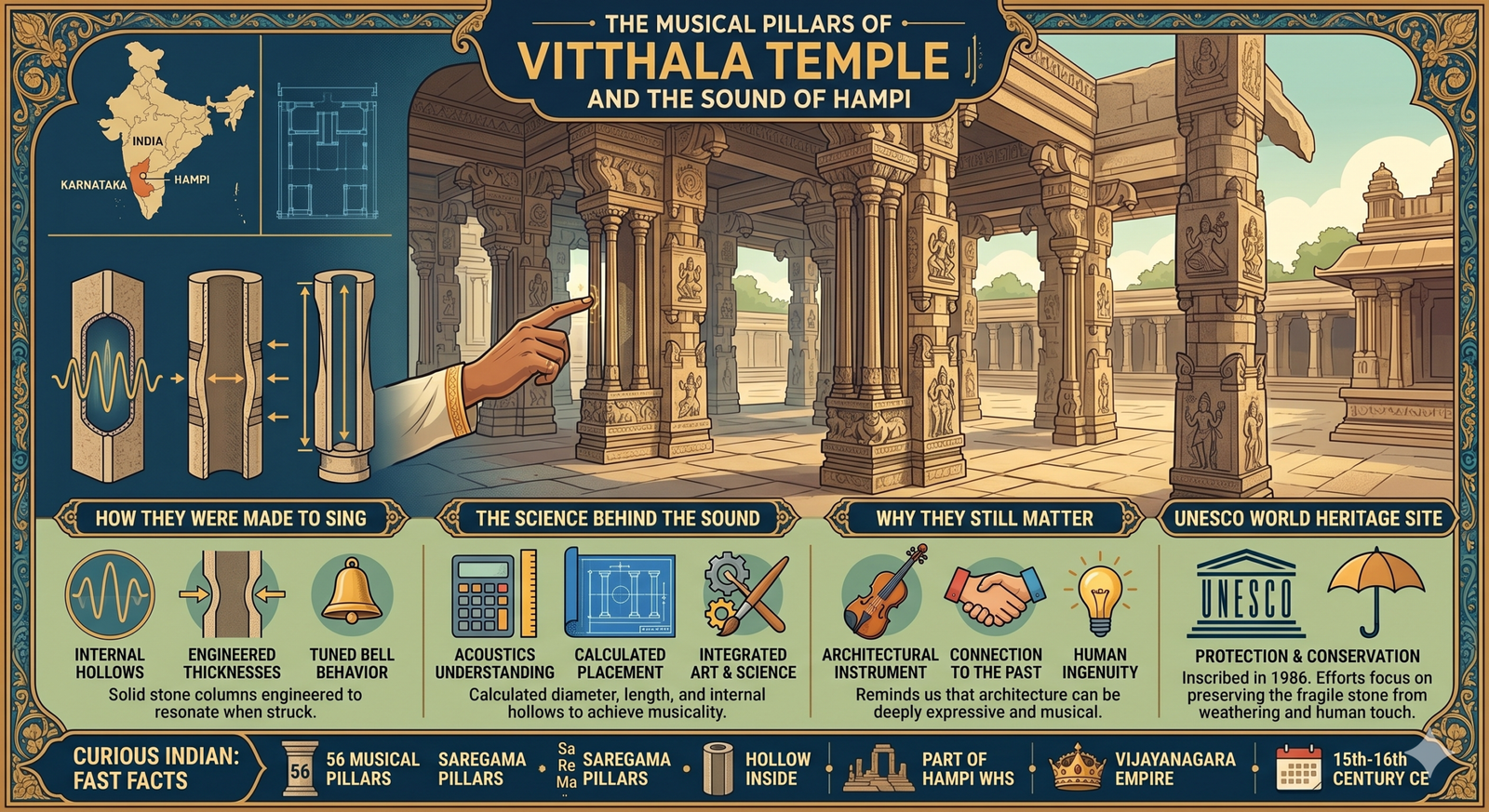
In front of the shrine stands the mahamandapa, the great stage, an open hall held up by massive granite piers. Each pier is really a cluster: a thick central shaft surrounded by slimmer columns, all cut from the same stone. The slim columns are not there to hold anything up. Tap one gently with a thumb and it rings.
For centuries visitors had done exactly that. Guides named the piers after the instruments they were said to sound like: the seven notes of the scale, the jal tarang, the mridangam, the tabla, the damaru, the ghatam, the veena, the conch and the temple bell. So many people struck them, so often, that the pillars began to wear. Today the ASI does not allow visitors to touch them.
The instruments the team brought to Hampi were not made for temples.
Listening
The Kalpakkam team, with Anish Kumar as lead author, chose the eleven best-known pillars. There were 87 musical columns among them.
They measured each column’s length and its width at top and bottom, to half a millimetre. They sent ultrasonic pulses straight through the stone from one side to the other, and timed how long the pulses took to arrive. They polished two broken fragments and looked at the surface under a microscope. Then they struck the middle of each column with a thumb and recorded the sound on a laptop.
The first question was the one everyone asks at Hampi: are the columns hollow? The ultrasound said no. Every musical column was a solid shaft of stone, and the microscope showed ordinary granite.
Why solid stone sings
Sarnath Buddha Sculpture: Where Mathematics Meets Divine
A slim column of granite, fixed at the top and the bottom and struck in the middle, flexes very slightly, the way a xylophone bar flexes under a mallet. It vibrates at a frequency set by three things: how long it is, how thick it is, and how fast sound travels through the stone.
The scientists worked out what frequency each column ought to produce from its measurements, and then compared that with what they had recorded. The two matched closely. The music of the Vitthala pillars was exactly what the physics of their shape predicted.
That meant the notes had been built in. Longer, thinner columns sounded lower, shorter and thicker ones higher, and within a single pier the columns usually rose in pitch one after another, so that striking them in sequence played something like a scale. A few columns were rectangular rather than round, and sounded a different note depending on which face was struck. The sculptors had tuned the stone by cutting it.
Nobody knows how the craftsmen judged the length and thickness of each column before they cut it.
The bell and the dead pillar
The scientists also measured how long each sound lasted. The pier known as the bell rang longest, about half a second, with a slow fade and a slightly clashing overtone. Those are the marks of the sound of a real bell.
One pier gave them almost nothing: a short dull knock that died in less than a tenth of a second. Its stone had been damaged, probably by fire. The ultrasound travelled noticeably slower through the damaged columns than through the sound ones, the same sign of hidden cracking the team would have looked for in a reactor wall. Of the 54 main piers they could count in the hall, four had lost all their musical columns.
Quiet now
Their paper appeared in the Journal of the Acoustical Society of America in 2008. It was, the authors noted, the first scientific study anyone had made of the pillars.
It did not solve every mystery. Nobody knows who the craftsmen were, or how they judged the length and thickness of each column before they cut it. They left no notes. They had no instruments to measure frequency. They had their ears, their chisels and the granite of Hampi.
The pillars are silent now, most of the time, behind a rope. But the notes are still in the stone, fixed there by the shape the sculptors gave it five hundred years ago.
Bold Gamble Dhirubhai Ambani Took at Aden Trading Port
The Powerful Feminist Anthems Hidden in the Songs of Lalon Fakir
If you think you have remembered everything about this topic take this QUIZ
How many musical pillars are there in the Vitthala temple?
The Vitthala temple complex contains several halls with pillars, but the most famous musical pillars are located in the main pillared mantapas. Traditionally it is said there are about 56 pillars that can produce musical tones when tapped.
Do the musical pillars still produce sound today?
Some pillars still produce clear musical notes, while others have deteriorated due to age, weathering and frequent touching by visitors. Conservation authorities advise visitors to tap gently to preserve the pillars.
Were the pillars really used in temple music performances?
There is no definitive historical record that these pillars were regularly used as musical instruments during rituals. However, they were likely demonstrated to royal guests or used as an acoustic curiosity that showcased the empire’s artistic and scientific achievements.
Can visitors hear the music themselves?
Yes, visitors can try tapping the pillars with their fingers to hear the tones. It is a popular activity at Hampi and one of the most memorable experiences of the site.
Why is Hampi a UNESCO World Heritage Site?
Hampi was inscribed because it is an outstanding example of a prosperous medieval trading city, with a rich architecture including temples, forts, markets and water structures that illustrate the glory of the Vijayanagara Empire.
Sources & References
Anish Kumar, T. Jayakumar, C. Babu Rao, Govind K. Sharma, K. V. Rajkumar, Baldev Raj and P. Arundhati, “Nondestructive characterization of musical pillars of Mahamandapam of Vitthala Temple at Hampi, India,” Journal of the Acoustical Society of America 124(2): 911–917 (2008), DOI 10.1121/1.2945170 — methods, the 11 pillars and 87 columns, solid granite, flexural resonance, the bell pillar, the damaged pillar, the 54 main piers.
D. Devakunjari, Hampi, 4th ed. (Archaeological Survey of India, 1998) — dating of the temple and the plan of the mahamandapa, as cited in the paper above.
The Tribune, “The Temple with Musical Pillars” (2020) — tapping now prohibited because of damage.
M. G. Prasad, “Musical Pillars and Singing Rocks” — overview of musical pillars in South Indian temples.