Wednesday, May 20, 2026
20 °c
Columbus
Curious Indian
  • Arts & Culture
  • Festivals of India
  • Indian History
  • Indian Politics
  • Biography
    • Entertainment Personalities
    • Science Personalities
  • Unsolved India
No Result
View All Result
  • Arts & Culture
  • Festivals of India
  • Indian History
  • Indian Politics
  • Biography
    • Entertainment Personalities
    • Science Personalities
  • Unsolved India
No Result
View All Result
Curious Indian
No Result
View All Result
Home Indian History Ancient Civilizations & The Vedic Age

Gommateshwara Statue and the Philosophy of Inner Peace

paripurnadatta by paripurnadatta
in Ancient Civilizations & The Vedic Age, Arts & Culture, Indian History, Sculpture
Reading Time: 13 mins read
0 0
A A
Gommateshwara statue

Gommateshwara statue

Share on FacebookShare on Twitter

Table of Contents

Toggle
  • Gommateshwara Statue and the Philosophy of Inner Peace
  • The Man Behind the Stone
  • How Chavundaraya Built a Mountain Monument
  • What the Symbolism Is Actually Saying
  • The Mahamastakabhisheka: When a Million People Watch a Statue Get a Bath
  • Shravanabelagola in the Larger History of Karnataka
  • Why This Statue Still Matters
  • Quick Comparison Table
  • Curious Indian: Fast Facts
  • Conclusion
  • If you think you have remembered everything about this topic take this QUIZ
  • Results
    • #1. Who was the Ganga dynasty commander and minister responsible for commissioning the Gommateshwara statue?
    • #2. On which hill is the 57-foot tall monolithic statue of Bahubali located?
    • #3. According to the text, why are vines and anthills carved onto the legs and feet of the statue?
    • #4. How often is the Mahamastakabhisheka, the great head-anointing ceremony, performed at Shravanabelagola?
    • #5. Which famous Indian emperor is said to have abdicated his throne and spent his final years in meditation at Shravanabelagola?
    • #6. What is the translation of the town name “Shravanabelagola” in Old Kannada?
    • #7. In the Digambara tradition of Jainism, what does the nakedness of the Bahubali statue symbolize?
    • #8. How many stone steps must visitors climb to reach the Gommateshwara statue on the hilltop?
    • How old is the Gommateshwara statue at Shravanabelagola?
    • Who is Gommateshwara and why is he depicted as a naked figure?
    • What is the Mahamastakabhisheka and how often does it happen?
    • Is the Gommateshwara statue actually carved from a single piece of rock?
    • Can anyone visit Shravanabelagola, or is it restricted to Jain pilgrims?
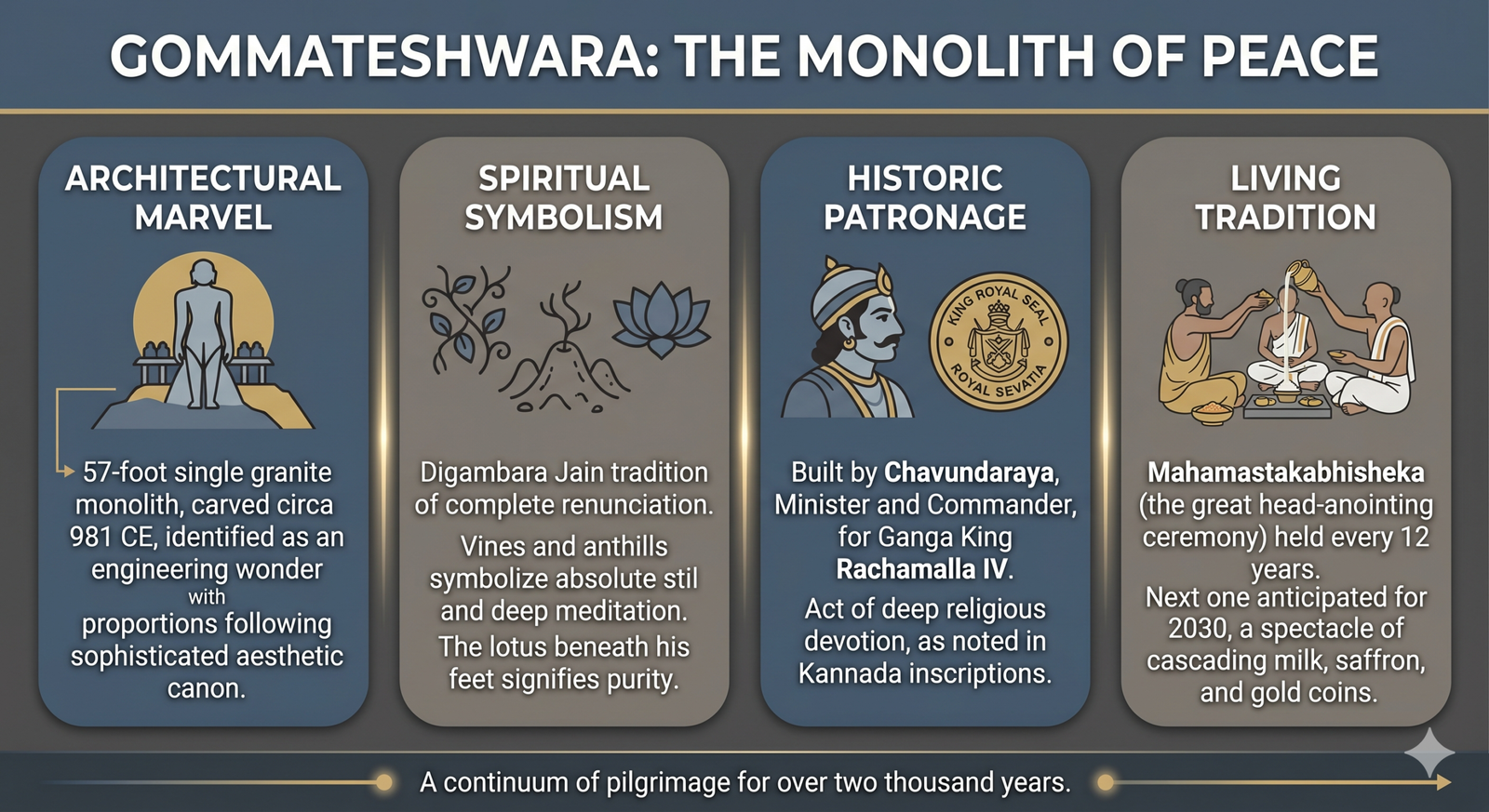
Rising 57 feet above the town of Shravanabelagola in Karnataka, the Gommateshwara statue is one of the most remarkable monolithic sculptures ever created. Built in the 10th century by a Ganga dynasty commander named Chavundaraya, it depicts Bahubali, the Jain figure who surrendered a kingdom to pursue spiritual liberation. More than an architectural wonder, this statue embodies a philosophy of non-violence, renunciation, and peace that has drawn scholars, pilgrims, and curious travelers for centuries. This piece explores the human story behind the stone, the symbolism encoded in every carved detail, and why this ancient statue continues to hold deep meaning in the modern world.
DetailInformation
SubjectGommateshwara Statue, Shravanabelagola
LocationVindhyagiri Hill, Shravanabelagola, Karnataka, India
Height57 feet (17.37 meters)
Built ByChavundaraya, a minister and commander
Commissioned ForGanga King Rachamalla IV
Period10th century CE (circa 981 CE)
ReligionJainism
Deity DepictedBahubali (also called Gommateshwara)
MaterialSingle granite monolith
UNESCO StatusNominated for World Heritage consideration
Major FestivalMahamastakabhisheka (held every 12 years)
Last Mahamastakabhisheka2018
Gommateshwara statue

Gommateshwara Statue and the Philosophy of Inner Peace

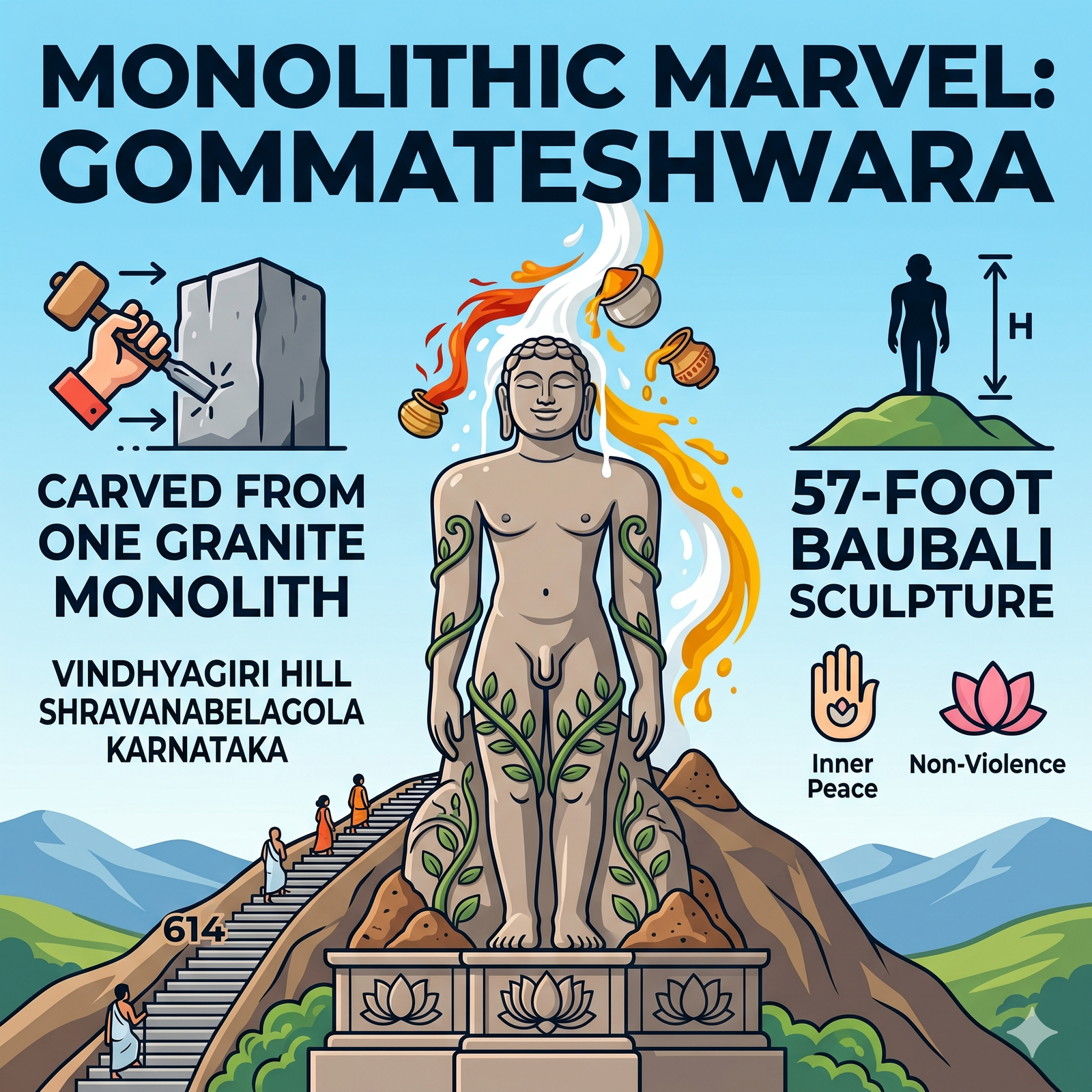
The first time most people see the Gommateshwara statue, they stop walking. Not because they are tired from the 614 stone steps that lead up Vindhyagiri Hill. They stop because nothing quite prepares you for the sight of a 57-foot man carved from a single piece of granite, standing completely still, completely naked, and completely at peace.

That image is not accidental. Every detail of this statue was designed to tell a specific story about a specific kind of courage. Not the courage of a warrior who wins wars, but the courage of a man who walks away from one.

The Man Behind the Stone

Bahubali was a prince. According to Jain tradition, he was the son of Rishabhadeva, the first Tirthankara, the first great teacher of Jain philosophy. When his father renounced the world to pursue liberation, his kingdom was divided among his sons. Bahubali and his brother Bharata could not agree on who deserved more. Rather than drag their armies into a bloody war, the two brothers agreed to settle the matter through personal combat.

READ MORE:  Later Vedic Period 1000-600 BCE: The Age of Iron and Kingdoms

Bahubali won every contest. He defeated his brother completely. But in the moment of victory, standing over a fallen Bharata, something shifted inside him. He looked at his hands. He looked at the crowd. He asked himself what exactly he had won. Power over land. Dominance over a sibling. None of it felt like anything worth holding.

He walked away. Not to his palace. Into the forest. He stood in deep meditation for an entire year, so still that vines grew up his legs and anthills formed at his feet. Birds nested in his hair. And at the end of that year, he attained kevala jnana, complete and perfect knowledge. Liberation.

That is the figure carved into Vindhyagiri Hill. The vines climbed his calves. The anthills rising at his feet. The absolute calm on a face that has let go of everything.

How Chavundaraya Built a Mountain Monument

The man responsible for this statue was not a king. He was Chavundaraya, a minister and military commander serving under the Ganga dynasty ruler Rachamalla IV in 10th century Karnataka. Chavundaraya was also a devoted Jain, and according to historical accounts preserved in Kannada inscriptions at the site, he commissioned the statue around 981 CE as an act of deep religious devotion.

The engineering involved is staggering even by modern standards. Artisans did not assemble this figure from multiple pieces of rock. They identified a single granite outcrop on Vindhyagiri Hill and carved the entire 57-foot figure directly from it. The statue weighs hundreds of tons and has survived over a thousand years of monsoons, earthquakes, and the political upheavals of multiple dynasties. No mortar. No reinforcement. Just stone, skill, and an extraordinary understanding of structural integrity.

Scholars studying the site, including those affiliated with the Archaeological Survey of India, have noted that the proportions of the figure follow a sophisticated aesthetic canon. The face alone is over six feet in height. The chest spans nearly nine feet across. Yet standing at the base and looking up, the figure appears perfectly balanced, almost gentle in its scale. That optical precision was intentional, the work of craftsmen who understood how the human eye processes scale from below.

What the Symbolism Is Actually Saying

Every element of the Gommateshwara statue carries philosophical weight. The nakedness is not incidental. In Jain practice, the Digambara tradition holds that complete renunciation includes the renunciation of clothing, of all physical attachment. Bahubali stands unclothed because he has released everything the material world offered him, including the clothes off his back.

How Ramkinkar Baij Transformed Indian Sculpture Forever

The vines and anthills carved around his legs are a record of time. They communicate that this man stood in one place long enough for nature to reclaim him. He was not fighting the forest. He became part of it. That image of human stillness merging with the natural world is central to Jain ethics, which teaches ahimsa, or non-violence, not just toward other people but toward every living creature.

The lotus carvings beneath his feet and the serene expression on his face complete the picture. He is not straining. He is not in pain. He has simply arrived somewhere the rest of us are still walking toward.

The Mahamastakabhisheka: When a Million People Watch a Statue Get a Bath

Every twelve years, Shravanabelagola becomes one of the most crowded places in India. The Mahamastakabhisheka, the great head-anointing ceremony, draws hundreds of thousands of pilgrims, scholars, politicians, and curious visitors from across the world. From specially constructed scaffolding built above the statue’s head, priests pour thousands of liters of milk, sugarcane juice, saffron paste, turmeric, vermillion, and gold coins over the statue in a cascading ritual anointing.

READ MORE:  Life of Mahavira: From Prince Vardhamana to Great Conqueror

The 2018 Mahamastakabhisheka was attended by over one million people. Television cameras broadcast it live. The Karnataka state government deployed thousands of security personnel. And still, the overwhelming mood that visitors and journalists described was not chaos. It was quiet. A kind of collective breath held in reverence.

That reaction points to something the statue does that is difficult to explain in purely architectural terms. It creates stillness in the people who come to it. Whether you are Jain or not, whether you have any religious belief at all, standing at the base of Gommateshwara and looking up produces a specific sensation. Something in the scale and the silence of the figure asks you to be quiet inside yourself for a moment.

Shravanabelagola in the Larger History of Karnataka

The town of Shravanabelagola itself is mentioned in inscriptions dating back to the 3rd century BCE. Jain tradition holds that Chandragupta Maurya, the founder of the Maurya Empire and grandfather of Ashoka, came here after abdicating his throne. He reportedly spent his final years in meditation at this very hill, following his guru Bhadrabahu. If that account is historically accurate, it means this small Karnataka town has been a site of royal renunciation for over two thousand years.

The Archaeological Survey of India maintains the site and has documented over 800 inscriptions at Shravanabelagola in Sanskrit, Kannada, Tamil, and Marathi, making it one of the most epigraphically rich sites in South India. These inscriptions record donations, royal visits, battles, and philosophical debates spanning more than a millennium.

Scholars at institutions including the University of Mysore have argued that Shravanabelagola represents a rare continuity in Indian religious history, a place where the same spiritual tradition has been practiced, recorded, and physically maintained without significant interruption for over two thousand years.

Why This Statue Still Matters

India builds temples constantly. It restores old ones and consecrates new ones at a pace that makes it easy to become numb to the sheer density of sacred architecture in this country. So the question is fair: why does this particular statue still carry weight?

Part of the answer is age and scale. There is simply nothing else quite like it. The Gommateshwara statue remains one of the largest monolithic statues in the world, and certainly one of the oldest still in active religious use.

But the deeper answer has to do with what the statue represents. Bahubali did not win peace by defeating an enemy. He won it by defeating the part of himself that needed to win. In a world that is loud about victory, achievement, and dominance, a thousand-year-old statue of a man who walked away from all of it still has something urgent to say.

Peace, the statue seems to insist, is not something that happens around you. It is something you build inside yourself, one renunciation at a time.

Quick Comparison Table

FeatureGommateshwara StatueStatue of UnityChrist the RedeemerSpring Temple Buddha
LocationKarnataka, IndiaGujarat, IndiaRio de Janeiro, BrazilHenan, China
Height57 feet (monolith)597 feet98 feet420 feet
MaterialSingle granite rockBronze and steelSoapstone and concreteSteel and copper
AgeCirca 981 CE2018 CE1931 CE2008 CE
Religious ContextJainismSecular/PoliticalChristianityBuddhism
UNESCO RecognitionNominatedNot listedWorld Heritage SiteNot listed
Active RitualsYes (every 12 years)NoYes (annual)Yes

Curious Indian: Fast Facts

  • The Gommateshwara statue was carved from a single granite rock, with no joints, no assembly, and no added material.
  • Shravanabelagola translates roughly to “monk of the white pond” in Old Kannada.
  • The statue’s face is over six feet tall and has been described by art historians as one of the most serene carved faces in world sculpture.
  • Chandragupta Maurya, who built one of India’s greatest empires, is said to have ended his life in fasting meditation at this very hill.
  • The Mahamastakabhisheka ritual uses milk, coconut water, sugarcane juice, saffron, turmeric, gold coins, and precious gemstones in its anointing cascade.
  • The vines carved onto Bahubali’s legs are named in Jain texts as symbols of his total absorption in meditation.
  • Over 800 stone inscriptions have been found at Shravanabelagola, written in four different languages.
  • The site has been a place of pilgrimage for an unbroken period of over two thousand years.
  • Chavundaraya, the man who built the statue, was also a celebrated Kannada poet and author of the text Chavundaraya Purana.
READ MORE:  The Cosmic Geometry Behind the Sun Temple Wheels of Konark

Conclusion

The Gommateshwara statue does not need to announce itself. It simply stands. On a granite hill above a small Karnataka town, it has outlasted empires, outlasted the rulers who commissioned it, and outlasted the very debates that once surrounded Jain philosophy in medieval India. What remains is the figure itself, naked, still, rooted, and looking at nothing in particular.

Bahubali’s story is not a comfortable one. He won a fight and then decided winning was not the point. He gave up a kingdom not because it was taken from him but because he chose something harder than power. That kind of renunciation is not celebrated much in modern life. We tend to honor those who accumulate, who climb, who take more than they came in with. Bahubali turned that logic around completely.

Vitthala Temple Musical Pillars When Stone Becomes Music

The artisans who carved him into that hilltop understood what they were doing. They gave him vines for his legs and birds for his hair. They gave him a face that does not look troubled by anything. They gave him a body that stands in complete stillness for no audience and no reward. And they built all of that out of a single piece of the earth itself.

Over a thousand years later, that choice still works. People still climb 614 steps to stand at his feet. They still go quiet when they arrive. Whatever the Gommateshwara statue is saying, it is clearly still worth hearing.

If you think you have remembered everything about this topic take this QUIZ


Results

Share your score!
Tweet your score!
Tweet your score!
Share to other

#1. Who was the Ganga dynasty commander and minister responsible for commissioning the Gommateshwara statue?

Previous
Next

#2. On which hill is the 57-foot tall monolithic statue of Bahubali located?

Previous
Next

#3. According to the text, why are vines and anthills carved onto the legs and feet of the statue?

Previous
Next

#4. How often is the Mahamastakabhisheka, the great head-anointing ceremony, performed at Shravanabelagola?

Previous
Next

#5. Which famous Indian emperor is said to have abdicated his throne and spent his final years in meditation at Shravanabelagola?

Previous
Next

#6. What is the translation of the town name “Shravanabelagola” in Old Kannada?

Previous
Next

#7. In the Digambara tradition of Jainism, what does the nakedness of the Bahubali statue symbolize?

Previous
Next

#8. How many stone steps must visitors climb to reach the Gommateshwara statue on the hilltop?

Previous
Finish

How old is the Gommateshwara statue at Shravanabelagola?

The statue was built around 981 CE during the reign of Ganga dynasty ruler Rachamalla IV. It was commissioned by his minister and commander Chavundaraya. This makes the statue approximately 1,043 years old, placing it firmly in the early medieval period of South Indian history.

Who is Gommateshwara and why is he depicted as a naked figure?

Gommateshwara is another name for Bahubali, the son of Rishabhadeva, the first Tirthankara in Jain tradition. He is depicted without clothing because the Digambara sect of Jainism holds that complete spiritual renunciation includes the abandonment of all physical possessions, including clothing. The nakedness is a deliberate symbol of total liberation from worldly attachment.

What is the Mahamastakabhisheka and how often does it happen?

The Mahamastakabhisheka is a grand ritual anointing ceremony in which the Gommateshwara statue is bathed with milk, saffron, turmeric, sugarcane juice, gold coins, and precious gems. It takes place once every twelve years and is one of the largest religious gatherings in India. The most recent ceremony was held in 2018 and drew over one million participants.

Is the Gommateshwara statue actually carved from a single piece of rock?

Yes. The statue is a monolith, meaning it was carved entirely from a single granite outcrop on Vindhyagiri Hill. No separate pieces were attached, and no mortar or binding material was used in its construction. This makes it one of the most remarkable feats of ancient stone carving anywhere in the world.

Can anyone visit Shravanabelagola, or is it restricted to Jain pilgrims?

Shravanabelagola is open to all visitors regardless of religion. However, there are some conduct guidelines at the site, including removing footwear before ascending Vindhyagiri Hill. The Archaeological Survey of India maintains the location as a protected monument, and it welcomes tourists, historians, and pilgrims alike throughout the year.

Tags: Bahubali statueGommateshwaraIndian sculpture historyJainismMahamastakabhishekaShravanabelagolaVindhyagiri Hill
ShareTweetPin
paripurnadatta

paripurnadatta

Related Posts

Khudiram Bose
Biography

The Final Letters of Khudiram Bose and Soul of Young Bengal

May 19, 2026
Bhikaiji Cama
Biography

How Madam Bhikaiji Cama Unfurled India’s Flag in Germany

May 19, 2026
Matangini Hazra
Biography

Matangini Hazra: The Widow Who Walked Into Gunfire

May 19, 2026
No Result
View All Result

Stay Updated

  • Trending
  • Latest
Life of Mahavira: From Prince Vardhamana to Great Conqueror

Life of Mahavira: From Prince Vardhamana to Great Conqueror

April 11, 2026
Life of Buddha: The Journey to Enlightenment

Life of Buddha: The Journey to Enlightenment

April 11, 2026
Christmas in India

Christmas in India: A Festive Blend of Faith, Flavors, and Tradition

April 11, 2026
From Shimla to Stardom: The Complete Biography of Anupam Kher

From Shimla to Stardom: The Complete Biography of Anupam Kher

April 11, 2026
Khudiram Bose

The Final Letters of Khudiram Bose and Soul of Young Bengal

May 19, 2026
Bhikaiji Cama

How Madam Bhikaiji Cama Unfurled India’s Flag in Germany

May 19, 2026
Matangini Hazra

Matangini Hazra: The Widow Who Walked Into Gunfire

May 19, 2026
Gommateshwara statue

Gommateshwara Statue and the Philosophy of Inner Peace

May 19, 2026

Widget Title

Facebook Twitter Youtube RSS
Curious Indian Logo

Explore the soul of Bharat with Curious Indian. A definitive guide to Indian history, arts, culture, biographies, and the events that defined our future.

Follow us on social media:

Recent News

  • The Final Letters of Khudiram Bose and Soul of Young Bengal
  • How Madam Bhikaiji Cama Unfurled India’s Flag in Germany
  • Matangini Hazra: The Widow Who Walked Into Gunfire

Category

  • Ancient Civilizations & The Vedic Age
  • Architecture
  • Artists & Cultural Icons
  • Arts & Culture
  • Battles of India
  • Biography
  • Business & Industrialists
  • Colonial India
  • Cultural Insights
  • Dance & Music
  • Entertainment Personalities
  • Festivals of India
  • Freedom Fighters
  • Freedom Movement
  • Historical Events & Turning Points
  • Indian History
  • Indian Politics
  • Major Festivals
  • Medieval India
  • North East India
  • Paintings & Visual Arts
  • Political Leaders
  • Post-Independence India
  • Regional Culture
  • Religious & Spiritual Figures
  • Science Personalities
  • Scientific Discoveries
  • Sculpture
  • Social Issues
  • SOCIETY & MYSTERIES
  • Strange & Unknown Stories
  • Textiles & Handicrafts
  • Uncategorized
  • Unsolved India
  • Unsung Heroes

© 2026 Curious Indian- Everything about India

Welcome Back!

Login to your account below

Forgotten Password?

Retrieve your password

Please enter your username or email address to reset your password.

Log In

Add New Playlist

No Result
View All Result
  • Arts & Culture
  • Festivals of India
  • Indian History
  • Indian Politics
  • Biography
    • Entertainment Personalities
    • Science Personalities

© 2026 Curious Indian- Everything about India

This website uses cookies. By continuing to use this website you are giving consent to cookies being used. Visit our Privacy and Cookie Policy.
Are you sure want to unlock this post?
Unlock left : 0
Are you sure want to cancel subscription?
×