Nokrek, Garo Hills: on the highest mountain of the Garo country grows a small, sour, scarlet orange the Garos call memang narang, the orange of the spirits. The first people on the mountain, the story goes, were told about it in a dream
Long ago, the Garos say, when men and gods still lived side by side, a leader named Abong Noga and his wife, Silme Do’ka, came up into the hills and settled on Nokrek, the highest point of the Garo country.
They had people with them, the story says, about a thousand, who cleared patches of the forest and planted their crops the old way, cutting and burning and moving on. And they had animals.
One year all of Abong Noga’s animals fell sick. Nothing he did would heal them. Then, in a dream, the gods told him what to do: take the small wild oranges that grew in the forest, crush them, and give them to the animals.
He did. The animals recovered. And the fruit was given the name it still carries in the Garo hills: memang narang.
In a dream, the gods told him: crush the small wild oranges from the forest, and give them to the animals.
The orange of the spirits
Memang means the spirits of the dead. Memang narang is the orange of the spirits, or, as some translate it, the fruit of ghosts.
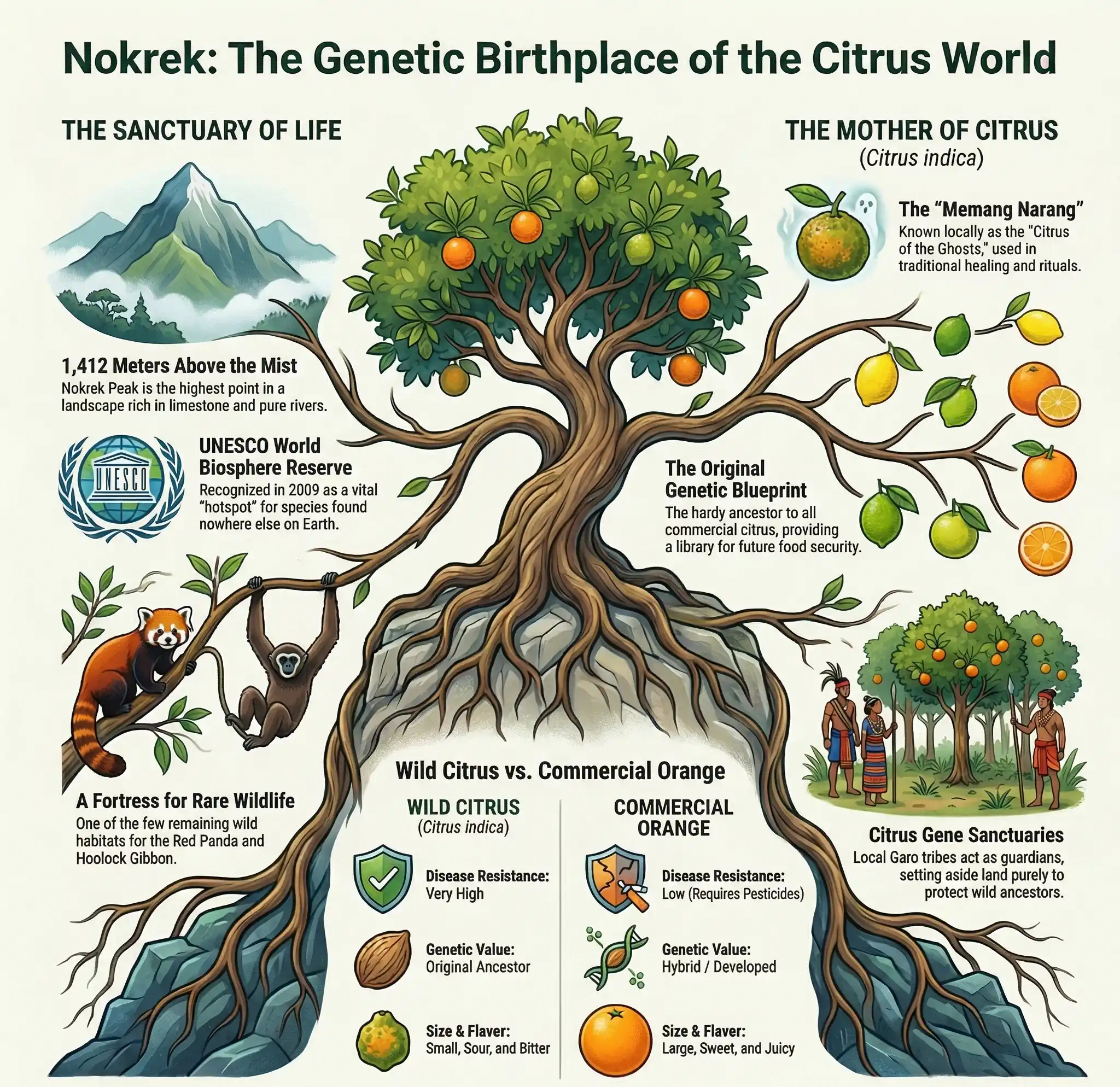
It is not much to look at. It is small, very sour, and not juicy at all. When fully ripe it turns a deep orange-red, almost scarlet, and it has a pleasant, sharp smell. Nobody eats it for pleasure.
What it is eaten for is healing. In the Garo villages around Nokrek, the fruit is crushed with its peel inside a bamboo tube and the sour juice is mixed into food, for people, cattle, pigs and even birds, against fevers, colds, stomach troubles, and as an antidote to poison. Because it can only be picked once a year, families dry it over the fireplace or on a bamboo stick above the fire, to last until the next harvest.
And it has a place in death. The Garos use it in their funeral rites, which is how, many say, it came by its name. One account says the dead were once laid out among the fruits, to keep away the ghosts.
Because it can only be picked once a year, families dry it over the fire, to last until the next harvest.
Great Forest Uprising 1917: When Kuki Tribes Said No to British Empire
Rani Gaidinliu: Zeliangrong Uprising’s Youngest, Boldest Voice
November
The trees like shade and cool, damp ground under the taller forest. They grow naturally in only a small area, in and around the Nokrek range.
And they have one strange habit. Even when the fruit is ripe, it does not drop. It stays on the branch. So every year, in November, the villagers climb up and pick the scarlet oranges straight from the trees.
The villages look after their memang trees carefully. Wild Indian oranges grow in a few other corners of the north-east too, but researchers found that not every community near them had taken the fruit into its life the way the Garos and the Khasis have: tending it, drying it, healing with it, keeping it close at the time of death.
The scientists
In the twentieth century, botanists came to Nokrek and found the same tree. They gave it a Latin name, Citrus indica, the Indian wild orange, and they became very interested in it.
Many of the oranges, lemons and limes on the world’s tables are the result of long histories of crossing and cultivation. A wild citrus growing on its own in the forest, untouched by orchards, is a precious thing to anyone who wants to understand where those fruits came from, or to breed new ones that can resist disease. Some have called memang narang one of the most primitive citrus in the world.
To protect it, India set up a National Citrus Gene Sanctuary on Nokrek, covering about forty-seven square kilometres. In 2009 UNESCO recognised the wider Nokrek area as a Biosphere Reserve, the only one in Meghalaya. In 2015 memang narang itself received a Geographical Indication tag.
Deendayal Upadhyaya Murder Mystery: Questions That Were Never Answered
The mountain
Nokrek holds far more than oranges. Elephants move through its forests, hoolock gibbons call from its trees, and nearly all the important rivers of the Garo hills begin on its slopes, among them the Simsang, which flows down past Williamnagar and on into Bangladesh.
But the fruit is the thread that ties it together. It reached the world of science as Citrus indica, a wild gene pool to be conserved. It was known on Nokrek long before that as the thing Abong Noga’s gods told him about in a dream: a small, sour, scarlet orange that heals the sick, stays with the dead, and does not fall, even when it is ripe, until someone who knows it climbs up and picks it.
Protecting The Rare Hoolock Gibbon India
The Threat Of Deepor Beel Urban Encroachment
If you think you have remembered everything about this topic take this QUIZ
Results


#1. In which mountain range is the Nokrek Biosphere Reserve located?
#2. What is the scientific name of the “Mother of Citrus” found in the reserve?
#3. What does the local Garo name “Memang Narang” translate to?
#4. In which year was Nokrek recognized as a UNESCO World Biosphere Reserve?
#5. Which rare animal, known for spending its days in bamboo thickets, is a key species in Nokrek?
#6. According to the text, which river finds its beginnings in the hills of the reserve?
#7. Why is Citrus indica specifically valuable to scientists today?
#8. What unique soil characteristic in Nokrek is believed to help citrus fruits thrive?
Can tourists visit the Nokrek Biosphere Reserve?
Yes, but you often need permission from the forest department, and it is best to hire a local guide to navigate the dense forest trails.
When is the best time to visit Nokrek?
The months between October and May are ideal, as the weather is pleasant and the trails are less slippery than during the monsoon.
Where is the Citrus Gene Sanctuary located?
The sanctuary is integrated within the core and buffer zones of the Nokrek Biosphere Reserve to protect the wild citrus in its natural habitat.
Are there tigers in Nokrek?
While tigers are not the primary focus of Nokrek, the dense forests provide a habitat for various leopards and other smaller wild cats.
How do I reach Nokrek?
The nearest major town is Tura in Meghalaya. From there, you can take a local taxi to reach the base of the reserve.
Sources & References
Slow Food Foundation, Ark of Taste, “Memang Narang” (2018) — the legend of Abong Noga and Silme Do’ka, the fruit’s uses and preparation, and its November harvest.
West Garo Hills District Administration, “Places of Interest” — the meaning of the name, the National Citrus Gene Sanctuary and the rivers that rise on Nokrek.
Digital GI, “Memong Narang” — the Geographical Indication awarded in 2015 and the fruit’s place in Garo funeral rites.
Incredible India, Ministry of Tourism, “Nokrek Biosphere Reserve” — the reserve’s wildlife and its UNESCO status.