Asal Uttar, September 1965: a tailor’s son from Ghazipur, a recoilless gun bolted to a jeep, and the Patton tanks coming down the road to Cheema
In the first week of September 1965 the tanks of Pakistan’s 1st Armoured Division came across the Punjab border and took Khem Karan, a few kilometres inside India. They were American M48 Pattons, the most modern tanks Pakistan had. Beyond Khem Karan lay the road north, and beyond that Amritsar and the Grand Trunk Road.
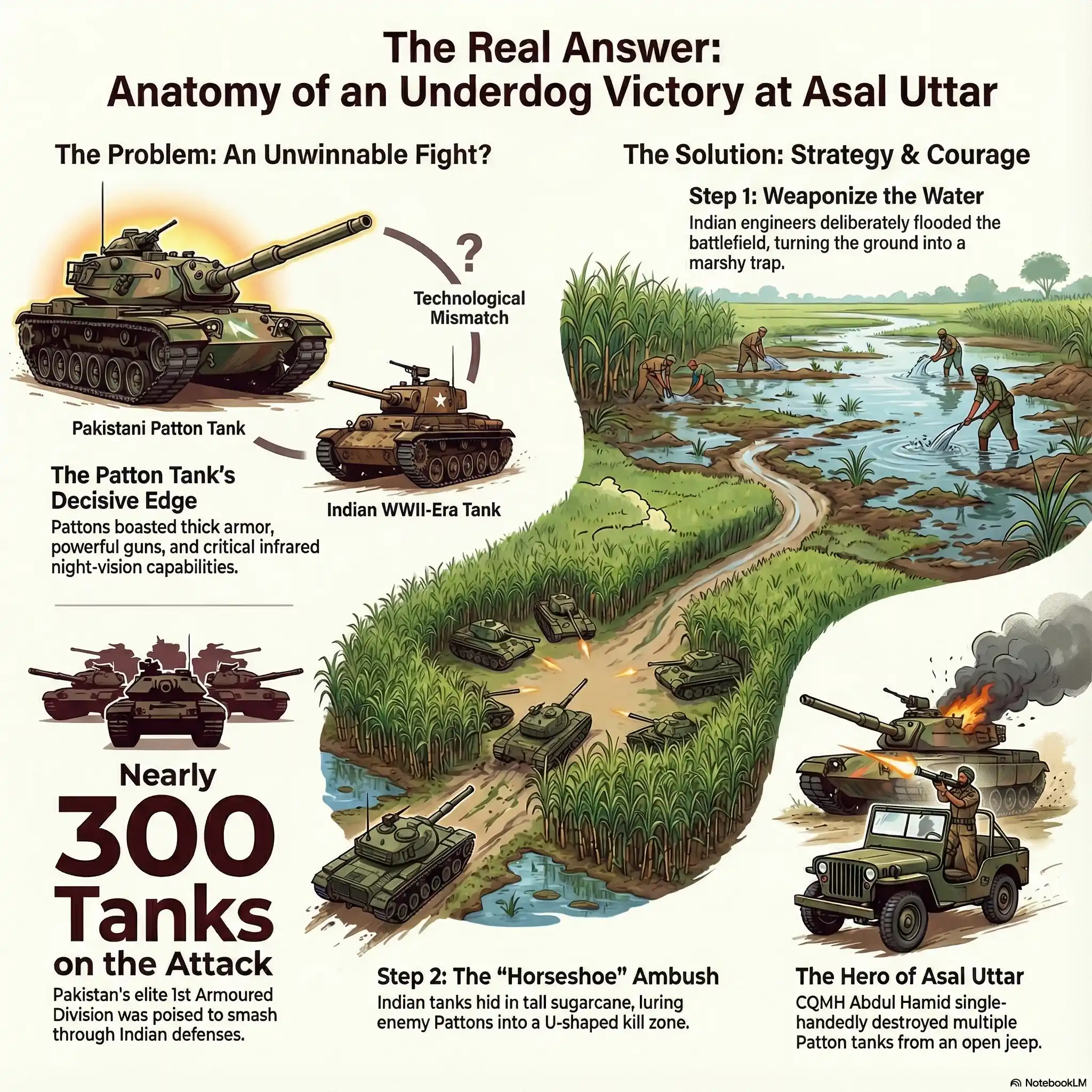
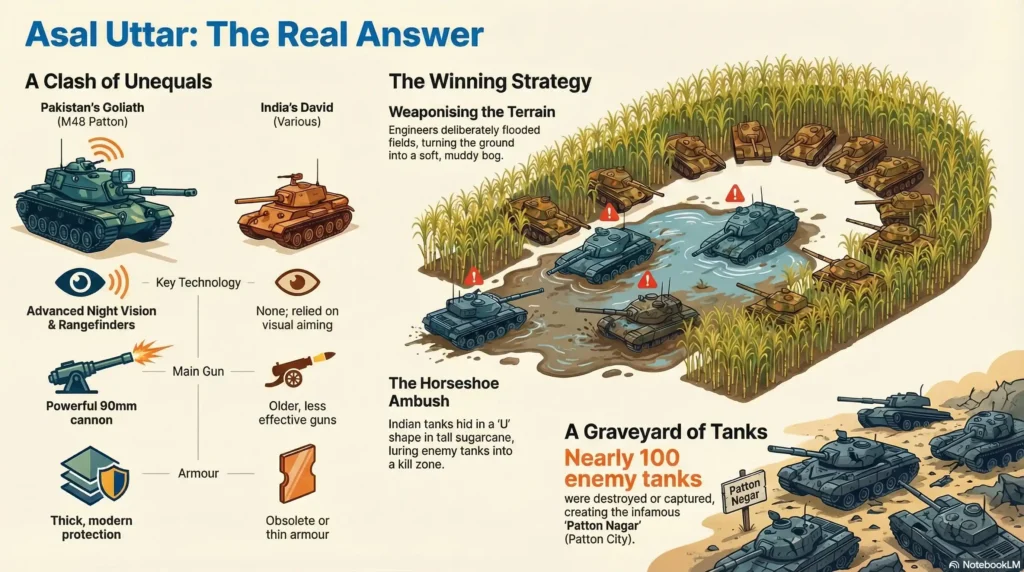
On 8 September Lieutenant General Harbaksh Singh, commanding the army in the west, had the 4th Battalion of the Grenadiers ordered to dig in at the village of Asal Uttar, across that road. They had very little time. They laid anti-tank mines along the approaches, and the fields around the village were flooded overnight until the ground was soft mud. The cane and cotton stood tall enough to hide a man, or a jeep.
The Grenadiers were infantry. They were waiting for tanks.
The man with the gun
Company Quartermaster Havildar Abdul Hamid was thirty-two. He came from Dhamupur in the Ghazipur district of Uttar Pradesh, one of eight in his family. He had left school after the eighth class and worked in his father’s tailoring shop before he joined the army at twenty. He had served with the battalion in the war against China three years earlier.
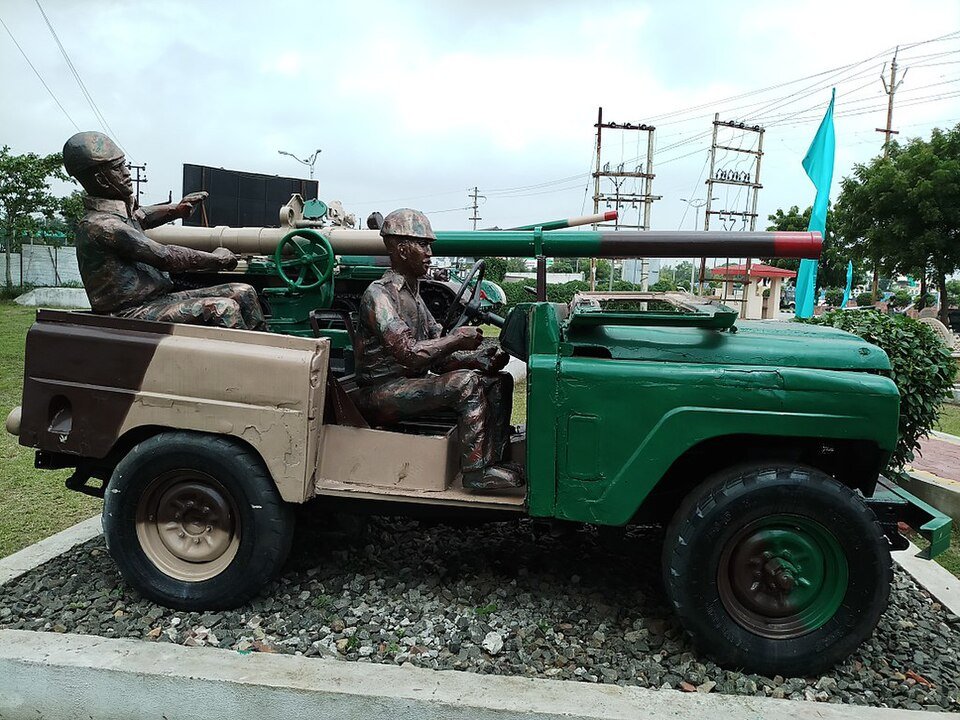
Now he commanded a recoilless gun detachment. The gun was a 106-millimetre anti-tank weapon mounted on a jeep. It could kill a tank, but the jeep had no armour at all. A crew that fired it gave away where they were, and a tank that saw them could kill them just as easily.
The way to use it was to hide, wait until the tank was close, fire, and move before anyone could fire back.
For two days the tanks came at Asal Uttar and the villages around it, feeling for a way through. Hamid and his jeep were already in action. The accounts of those first days are the ones that disagree most. What is written down officially begins on the third morning.
10 September, 0800
The attack came at eight in the morning on 10 September, against the Grenadiers’ positions ahead of the village of Cheema on the Bhikkiwind road. Heavy artillery fire came first. Then a regiment of Patton tanks, and infantry following close behind them. By nine o’clock the tanks had broken into the forward positions.
Hamid took his jeep out to the flank under the shelling. He found a position in the cane where he could see the tanks and they could not yet see him. He knocked out the leading tank. Then he moved, fast, to a new position, and sent a second tank up in flames.
By then the other tanks had found him. They turned their machine guns and high-explosive rounds on the jeep. He did not pull back. He kept firing at the next tank.
A high-explosive shell hit him while he was doing it. He died of his wounds.
He was killed firing at the third tank, not running from it.
The count
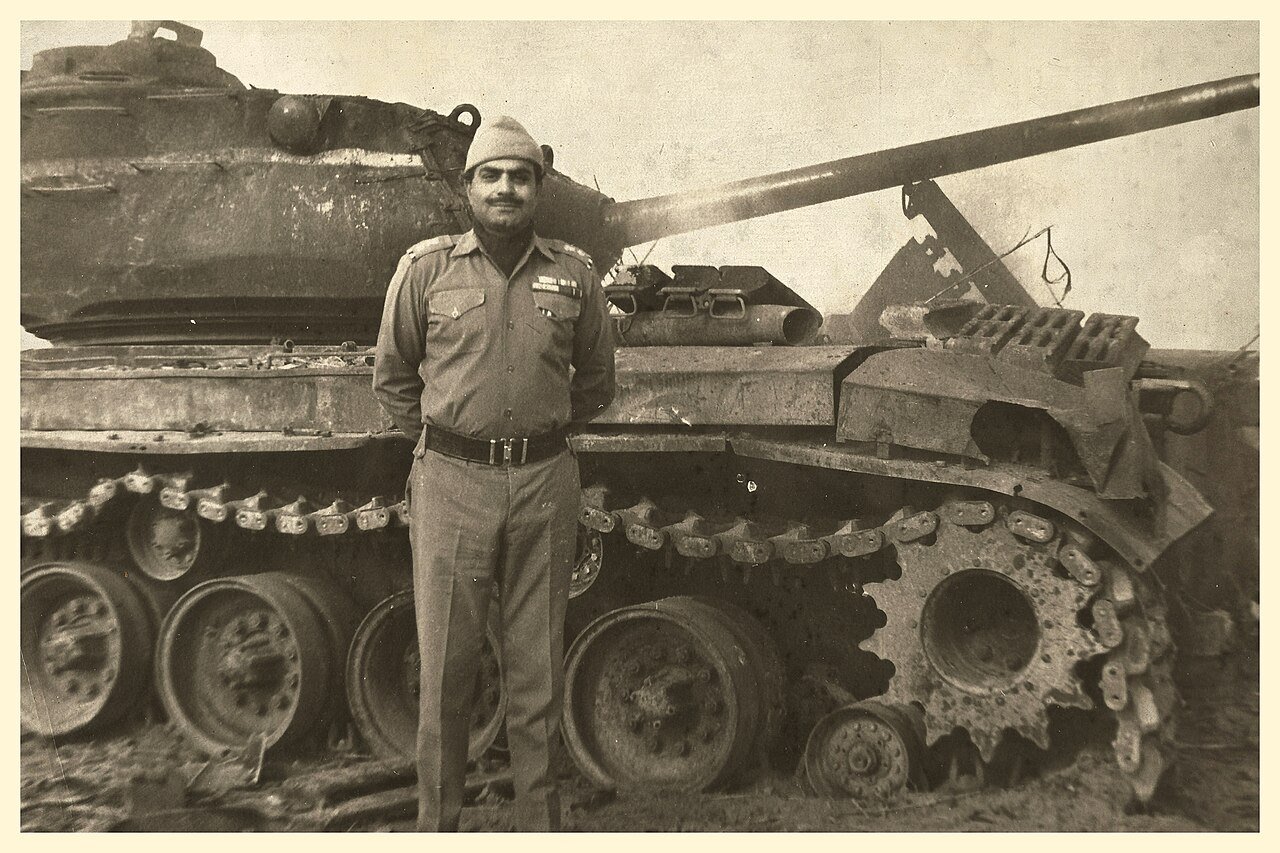
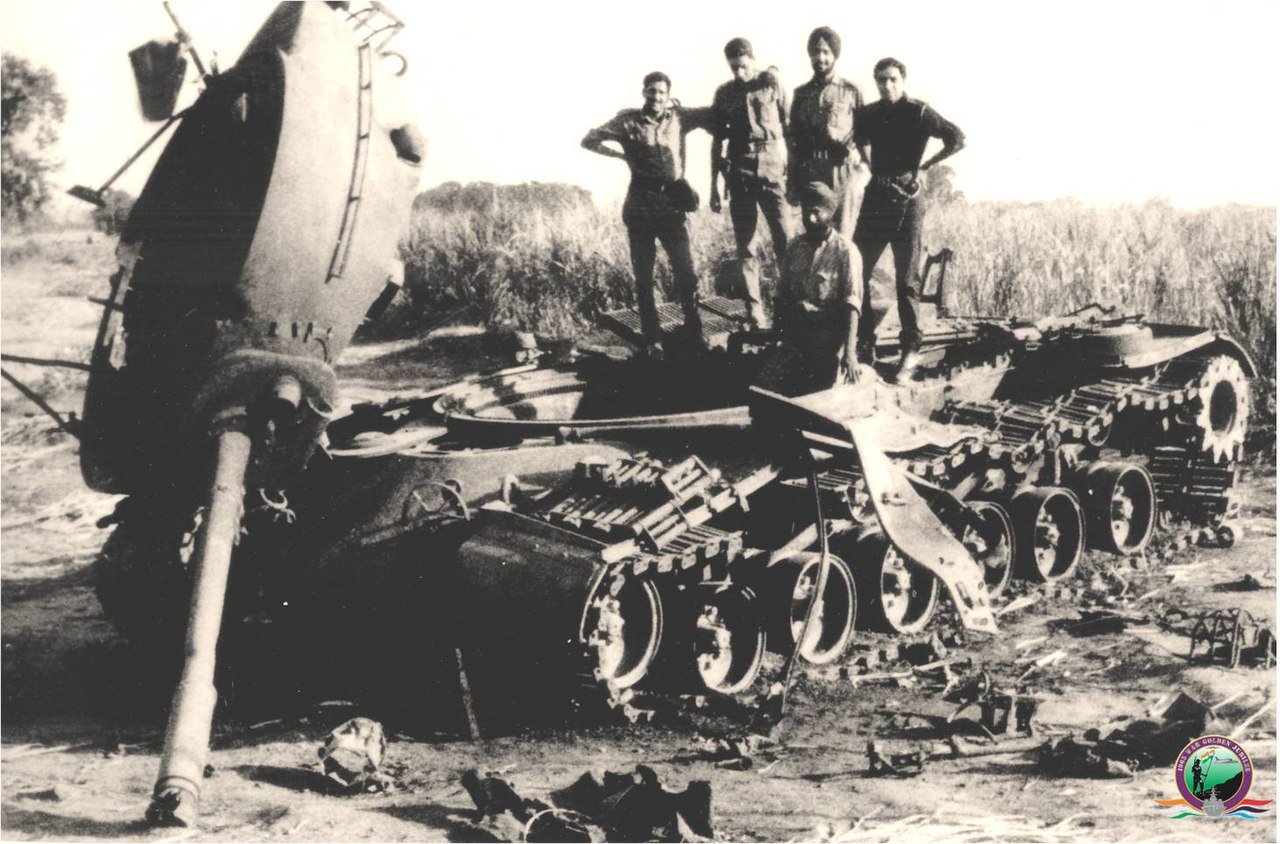
Around him, the Grenadiers held. The citation for his Param Vir Chakra says his example put fight into the men around him and helped beat back the tank assault. In the flooded fields and the cane, Pakistani tanks bogged down, burned, or were left where they stuck.
How many tanks Hamid himself destroyed is still argued over. The citation for his Param Vir Chakra counts two, both on the morning of 10 September. Battalion and regimental accounts say seven over two days. A government video has said three, an army video eight, and other retellings as many as eleven.
The citation needed only two. Two tanks, from an open jeep, with a regiment of armour looking for him, was enough for the highest award the country gives.
Cheema
The battle at Asal Uttar ended Pakistan’s drive towards Amritsar. The armoured division that had crossed the border to break through the Punjab did not get past the villages around Khem Karan.
Abdul Hamid was buried on the edge of Cheema, beside the road he had been defending. He had learnt his first trade sitting still at his father’s work, and at Cheema his last one asked the same thing of him: to wait in the cane, keep still, and fire only when the tank was close.
If you think you have remembered everything about this topic take this QUIZ
Results


#1. What was the core element of the Indian Army’s “Honey Trap” strategy at the Battle of Asal Uttar?
#2. Which type of vehicle did CQMH Abdul Hamid use to destroy multiple Patton tanks?
#3. What nickname was given to the area near Bhikkiwind following the battle?
#4. According to the analysis, what was a primary reason for the failure of the technologically advanced Pakistani armoured division?
#5. Despite being an older model, what advantage did the Indian Centurion tanks possess over the M48 Pattons in this battle?
#6. The initial confrontation at Asal Uttar is described as ‘asymmetric warfare’. What does this imply?
#7. What specific tactic did CQMH Abdul Hamid employ to maximise his effectiveness and survivability?
#8. The Indian strategy involved luring the Pakistani armour into what specific shape of ambush?
What is the significance of the Battle of Asal Uttar?
The Battle of Asal Uttar is significant because it halted the Pakistani armored offensive in 1965, preventing them from capturing Punjab. It is considered one of the greatest defensive victories in Indian military history and the largest tank battle in Asia.
Why were the M48 Patton tanks called “Tommy Cookers”?
Indian engineers breached the banks of the Rohi Nallah stream, directing water into the fields where the enemy was expected to advance. The water turned the soil into soft mud, causing the heavy Pakistani tanks to get stuck (bogged down), making them easy targets.
How did the flooding strategy work?
Indian engineers breached the banks of the Rohi Nallah stream, directing water into the fields where the enemy was expected to advance. The water turned the soil into soft mud, causing the heavy Pakistani tanks to get stuck (bogged down), making them easy targets.
Who was CQMH Abdul Hamid?
CQMH Abdul Hamid was a soldier in the 4 Grenadiers regiment. He is a national hero for destroying multiple enemy tanks with a jeep-mounted Recoilless Gun during the battle. He was posthumously awarded the Param Vir Chakra.
What happened to the captured tanks?
Many of the captured Patton tanks were displayed at a site nicknamed “Patton Nagar” near Bhikhiwind to show the public the scale of the victory. Today, many of these tanks stand as war trophies at various military cantonments and museums across India.
What tanks did India use in this battle?
The Indian forces used a mix of World War II-era M4 Shermans, French AMX-13 light tanks, and British Centurion Mk 7 tanks. Despite being older than the Pakistani Pattons, the Centurions proved highly effective due to their superior guns and the skill of the Indian crews.
Sources & References
ThePrint, Snehesh Alex Philip, “India remembers 1965 PVC winner Abdul Hamid, and here’s how many Pattons he really smashed” (10 September 2019) — the full Param Vir Chakra citation and the competing tank counts.
ThePrint, Suchet Vir Singh, “Abdul Hamid’s bravery in destroying Pakistani tanks at Asal Uttar ensured his legacy” (1 July 2022) — his family and early life, the Grenadiers’ deployment, the mines and flooded fields, and his grave near Cheema.
The Tribune, “Army marks Asal Uttar Day” — the recoilless gun action and the battle’s place in the 1965 war.
Author


Exploring the Soul of Bharat through History, Science, Culture, and its Diversity
Our Mission
Curious Indian is a definitive knowledge portal dedicated to chronicling the events, personalities, and cultural shifts that defined the Indian subcontinent. From the ancient Vedic Period to the complexities of 21st-century politics, our goal is to provide deep-dive analysis that inspires.
Editorial Standards & E-E-A-T
Every article published under our brand undergoes a rigorous fact-checking process. We prioritize primary historical records, academic citations, and credible archives to ensure our readers receive accurate, high-authority information.
Historical Integrity Directly sourcing from ASI archives and academic journals.Topical Authority Comprehensive clustering of Indian Science, Biographies, and Wars.Managed by Paripurna Datta and TEAM | Dedicated to the Knowledge of India.