Charaka may be a title and Sushruta a legend. Vagbhata tells you his grandfather, his father, his teacher and his river, and even that has not been enough to hold him together
At the end of the Ashtanga Sangraha the author stops and introduces himself.
There was a great physician called Vagbhata, he says, who was my grandfather, and I carry his name. From him came Simhagupta, and from Simhagupta came me. I was born in the Sindhu country. I learned this science from my teacher Avalokita, and a good deal more of it from my father.
Four generations of a family, a teacher, a river. It takes three lines.
Rakesh Roshan Biography: The Mastermind Behind the ‘K’ Phenomenon
Nothing like it appears in either of the other two great medical books. The men who wrote those left no address.
What the others left
Beyond the Shadow: The Remarkable Transformation of Pran
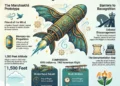
The Charaka Samhita presents itself as the teaching of Atreya, written down by Agnivesha, redacted by Charaka and completed centuries later by Dridhabala. Charaka may have been a man or a title or a line of editors.
The Sushruta Samhita carries the name of a surgeon about whom the text says nothing, in a version compiled and revised long after whoever he was had died.
Medical writing in Sanskrit does not usually have authors in the sense we mean. It has lineages, and the individual dissolves into the lineage on purpose. Then a man from the Indus valley writes down his grandfather’s name.
A Buddhist in a Vedic frame
Avalokita is a Buddhist name, and both of Vagbhata’s works open with praise of the Buddha, addressed as the unprecedented teacher. He was, on the evidence of his own opening verses, a Buddhist.
The same books show respect for brahmins and for cattle, refer to Hindu deities, and trace the origin of Ayurveda to Brahma. This is not confusion. The north-west in his period was a place where both traditions were in the room, and a physician writing a textbook for everyone had no interest in picking a fight he did not need.
What he actually made
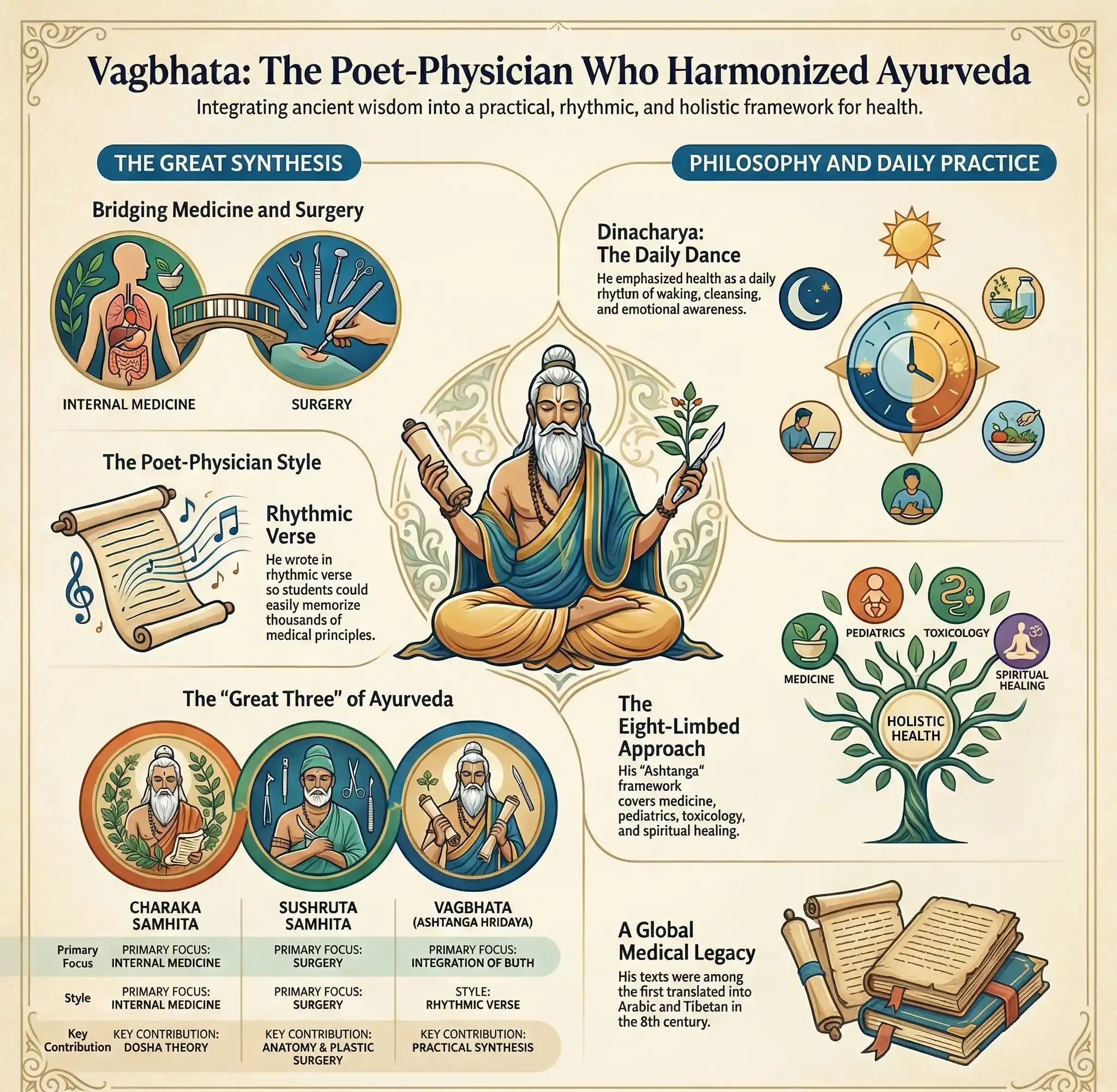
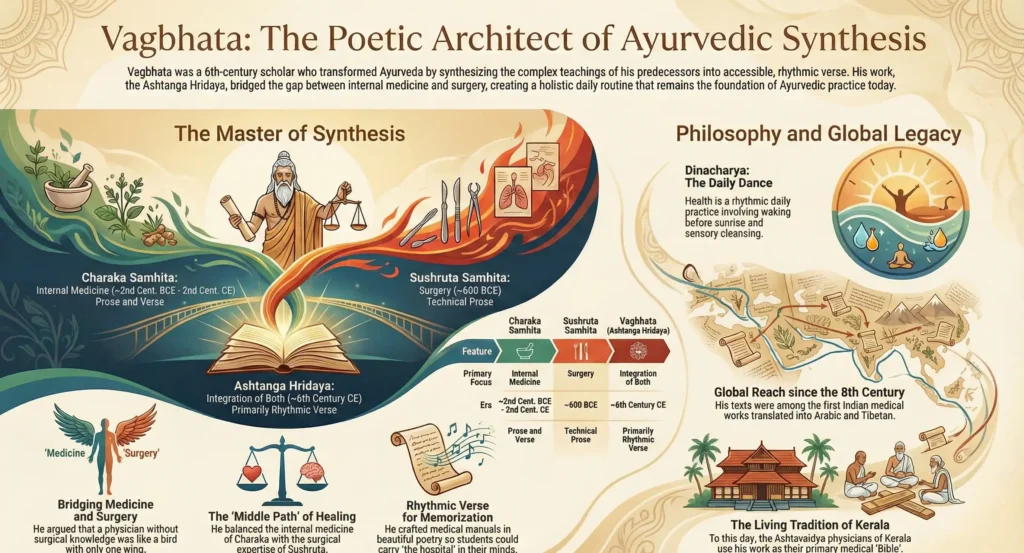
The Ashtanga Hridaya, the Heart of the Eight Branches, runs to six sections, a hundred and twenty chapters and around seven thousand verses. It takes Charaka’s internal medicine and Sushruta’s surgery and rebuilds them as a single ordered course.
Almost nothing in it is new, and that was the design. Charaka argues with opponents and digresses. Sushruta is writing for a surgeon with instruments in his hand. Vagbhata was writing for a student who has to hold the whole of medicine in his head and be examined on it.
So it is in verse, tightly organised, compressed and memorable, and it went on to be copied, translated and commented upon more than either of the books it was built from.
The instinct behind it shows in the small decisions. He drops the long doctrinal disputes. He keeps what a practitioner will use. He arranges by what a physician meets first rather than by what is most prestigious to know, and he says himself that he has taken the essence from the older works rather than pretending to have found it alone.
Where it went
S. P. Balasubrahmanyam Biography: 5 Decades of Musical Supremacy
It was translated into Tibetan and into Arabic, and it stands behind the medical tradition of Tibet. Copies travelled far enough that European libraries acquired manuscripts of it.
In Kerala it became something closer to a living thing. The Ashtavaidya families taught from it, memorised it and wrote commentary after commentary on it in Sanskrit and Malayalam, a local literature stacked up around a text written near the Indus more than a thousand kilometres and a thousand years away.
He built a book to be carried in the head. It has been carried in heads, continuously, for about fourteen hundred years.
And then the signature comes apart
Here is the difficulty. Those lineage verses are at the end of the Ashtanga Sangraha, not the Ashtanga Hridaya, and the best modern scholarship, principally Meulenbeld’s survey of the whole medical literature, argues that the two works cannot be the product of one author.
The colophons disagree across manuscripts. The tradition itself eventually began speaking of an elder Vagbhata and a younger one, assigning a book to each. The Ashtanga Hridaya refers back to an earlier work of the same name, which is either modesty or a second person.
None of this touches the book. It was still the text that taught the subject to more people than either of its sources, whoever assembled it.
A popular claim that he was Kashmiri turns out to rest on a misreading of a German scholar’s remark and should be dropped wherever it appears.
The one physician in the tradition who told us who he was may turn out to have been two people, and we still do not know which of them wrote the book that won.
If you think you have remembered everything about this topic take this QUIZ
Results


#1. What was Vagbhata’s primary motivation for writing the ‘Ashtanga Hridaya’ in rhythmic verse?
#2. Vagbhata is credited with bridging a major gap in ancient Indian medicine. Which two fields did he successfully integrate?
#3. What does the term ‘Dinacharya’ refer to in Vagbhata’s teachings?
#4. According to the ‘Comparison of the Great Three’ table, what is the primary style of the ‘Ashtanga Hridaya’?
#5. Which specific region in India holds Vagbhata’s work in such high regard that it forms the basis of the ‘Ashtavaidya’ tradition?
#6. Vagbhata is often called the ‘Sage of the Middle Path’. Why?
#7. Which historical evidence suggests a Buddhist influence on Vagbhata’s work?
#8. What is the meaning of the title ‘Ashtanga Hridaya’?
Evolution of Jyothika Saravanan as a Modern Cinematic Powerhouse
Who exactly was Vagbhata in Indian history?
Vagbhata was one of the most influential writers and scientists in the history of Ayurveda, living around the 6th century CE. He is best known for authoring the Ashtanga Hridaya, a foundational text that simplified and integrated the medical knowledge of ancient India.
What is the main difference between Vagbhata and Charaka?
While Charaka focused almost exclusively on internal medicine and herbs, Vagbhata integrated the surgical techniques of Sushruta with internal medicine, providing a more balanced and concise guide for practitioners.
Why is the Ashtanga Hridaya so important?
It is considered the most practical and best-organized text of Ayurveda. Because it was written in verse, it allowed the knowledge of healing to be passed down orally and accurately through generations.
Did Vagbhata believe in spiritual healing?
Yes, his “eight-limbed” approach included Bhuta Vidya, which addressed the psychological and spiritual aspects of health, acknowledging that the mind and soul play a critical role in physical well-being.
Is Vagbhata’s advice still applicable in the modern world?
Absolutely. His teachings on Dinacharya (daily routine) and Ritucharya (seasonal routine) are the basis for many modern wellness practices, emphasizing prevention and lifestyle over reactive treatment.
Sources & References
G. Jan Meulenbeld, A History of Indian Medical Literature (Egbert Forsten, 1999-2002) — the authorship problem, the relationship between the two works and the dating.
Vagbhata, Ashtanga Hridayam, translated by K.R. Srikantha Murthy (Krishnadas Academy) — the lineage verses, the structure of the six sections and the opening praise of the Buddha.
Dominik Wujastyk, The Roots of Ayurveda (Penguin Classics) — Vagbhata’s place among the three great compendia and the character of his synthesis.
National Center for Biotechnology Information (PubMed Central) — the Ashtanga Hridaya tradition in Kerala and the commentaries written around it.
Author


Exploring the Soul of Bharat through History, Science, Culture, and its Diversity
Our Mission
Curious Indian is a definitive knowledge portal dedicated to chronicling the events, personalities, and cultural shifts that defined the Indian subcontinent. From the ancient Vedic Period to the complexities of 21st-century politics, our goal is to provide deep-dive analysis that inspires.
Editorial Standards & E-E-A-T
Every article published under our brand undergoes a rigorous fact-checking process. We prioritize primary historical records, academic citations, and credible archives to ensure our readers receive accurate, high-authority information.
Historical Integrity Directly sourcing from ASI archives and academic journals.Topical Authority Comprehensive clustering of Indian Science, Biographies, and Wars.Managed by Paripurna Datta and TEAM | Dedicated to the Knowledge of India.