Dignaga argued that a word does not tell you what a thing is, only what it is not. Indian philosophy spent the next thousand years arguing with him
What does the word cow mean?
The answer everyone in fifth-century India would have given is that it picks out cow-ness, a real property shared by every cow and by nothing else, present in each animal and somehow the same in all of them.
Dignaga was a Buddhist, and Buddhists do not get to have that. A philosophy built on the claim that nothing carries a fixed enduring essence cannot then install a permanent cow-ness inside every cow to make language work.
So he took the other route. A word does not gather things together. It cuts everything else away.
This is the theory called apoha, which means exclusion. Cow does not name a shared essence. It excludes everything that is not a cow, and what is left standing after the exclusion is what you were talking about.
The meaning of a word, on this account, is a boundary rather than a thing. It is a negative operation that produces a usable positive result, which is why the standard formulation sounds like a riddle: a cow is a not-non-cow.
It solves his problem exactly. Language keeps working, distinctions keep holding, conversation proceeds, and nothing permanent has to exist anywhere for any of it to happen.
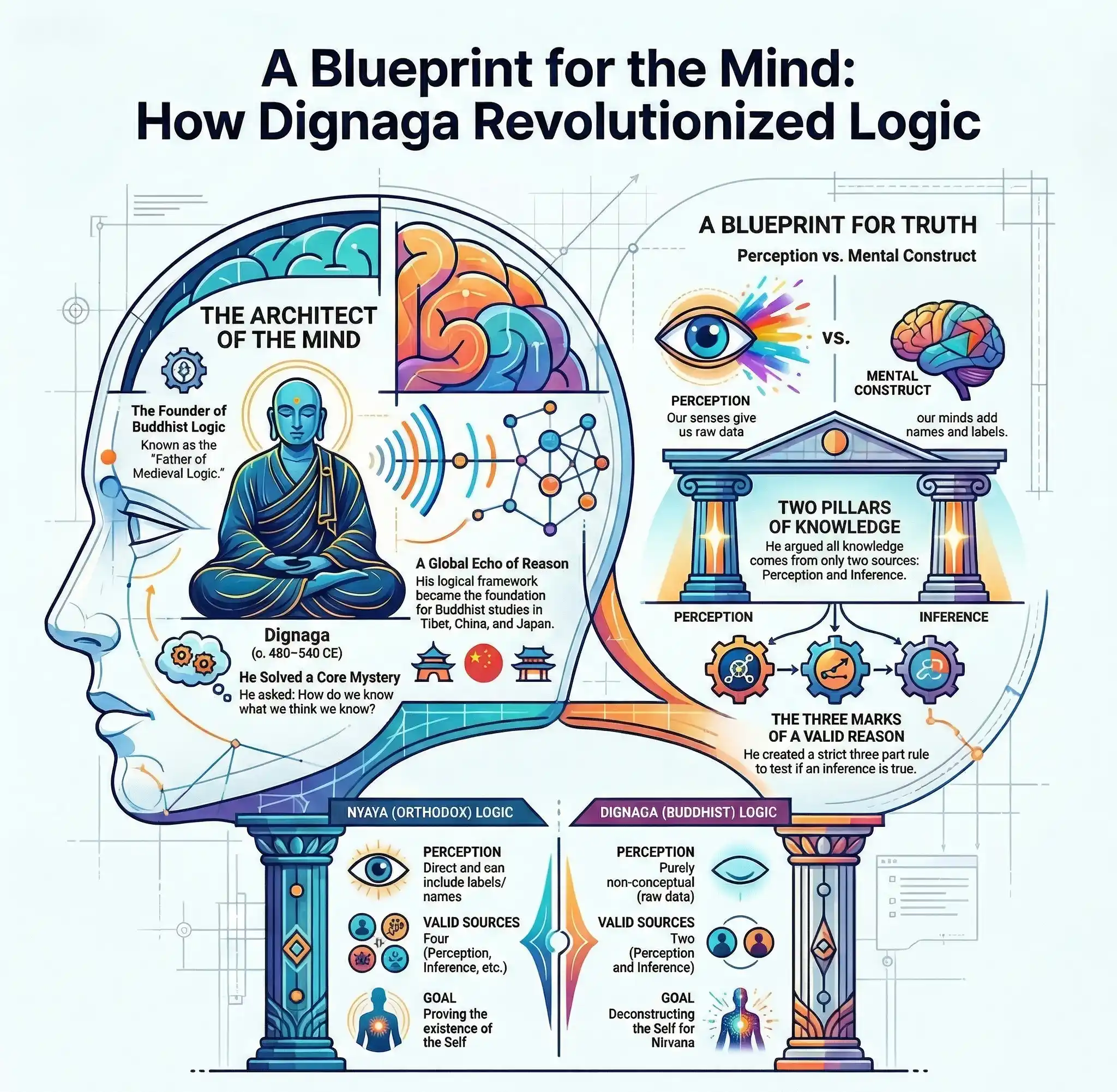
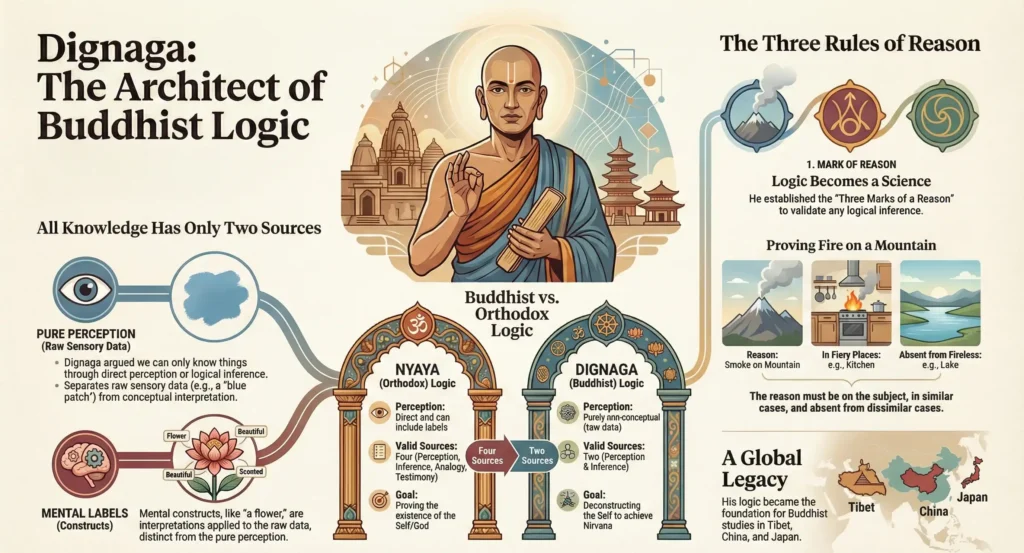
He was equally ruthless with the rest of the apparatus. The accepted list of reliable ways to get knowledge ran to four: perception, inference, comparison and reliable testimony. He cut it to two.
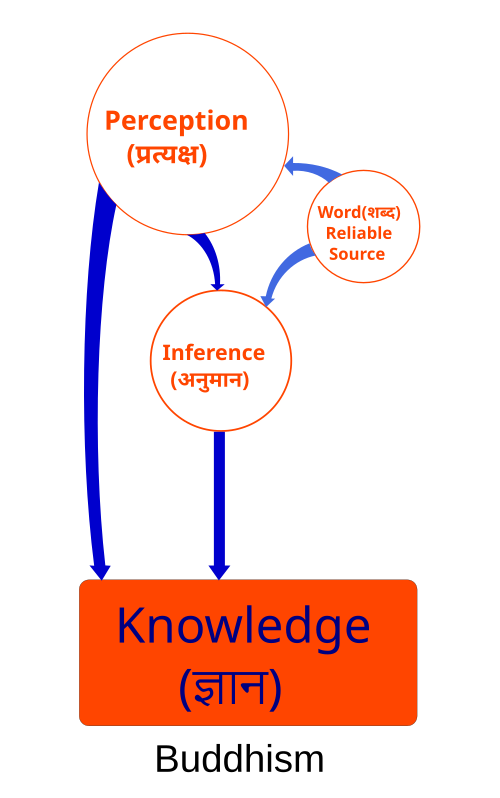
Perception and inference, and nothing else, because the other two collapse into inference once examined.
His perception is stricter than the ordinary sense of the word. It is bare, wordless contact with a particular, free of any conceptual construction. The instant you think that is a cow, you have left perception behind and started inferring. Naming is not seeing.
Between the thing in front of you and the word you reach for, he opened a gap that Indian philosophy has never quite closed.
The wheel
His other contribution is a piece of machinery. The Hetucakra, the wheel of reasons, is a three-by-three arrangement of the nine possible ways a proposed reason can behave: present, absent, or partly present in the cases where the property holds, crossed against the same three options for the cases where it does not.
Of the nine cells, two yield valid inferences and the rest do not. It is a matrix for testing arguments mechanically rather than by feel, and there is nothing like it earlier in the Indian record.
Underneath it sit his three conditions for a good reason: it must be present in the case being argued about, present in at least one case where the conclusion is known to hold, and absent from every case where it does not. Smoke qualifies for fire. Most things people argue from do not.
The Pramanasamuccaya, where all of this is set out, does not survive in Sanskrit. Not a single complete copy.
What exists is two Tibetan translations, neither of them good, and a large body of passages quoted by the philosophers who set out to refute him. Scholars have reconstructed much of his Sanskrit by working backwards from the words his opponents put in his mouth in order to attack them.
The men who wanted him wrong are the reason we still have him.
Who he was
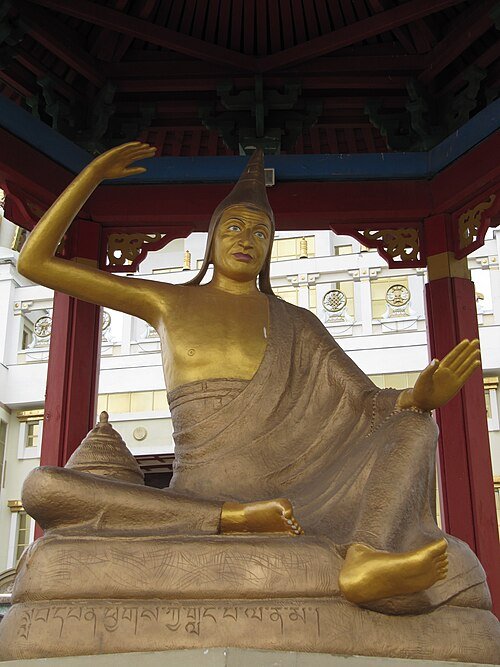
He was born near Kanchipuram in the far south, probably around 480, and died around 540. He began with one Buddhist school, left it over a disagreement about the self, and the tradition makes him a student of Vasubandhu.
He argued in public for a living, in a culture where philosophical debate had audiences, stakes and consequences for patronage, which is part of why he built a device for checking reasons rather than a set of opinions.
What happened after
Everything. Every major school that came after had to answer him. The Mimamsakas attacked apoha, the Naiyayikas defended their four means of knowledge against his two, and the arguments they generated shaped Indian philosophy down to the modern period.
Inside his own tradition, Dharmakirti reworked him in the seventh century so thoroughly that Dignaga is often read through Dharmakirti’s corrections. Outside it, modern philosophers have noticed that meaning by contrast, rather than by reference to shared essences, is an idea that came round again in Europe about fourteen hundred years later.
He asked what a word does. The answer he gave was strange enough that people are still testing it.
If you think you have remembered everything about this topic take this QUIZ
Results
QUIZ START
#1. What radical distinction did Dignaga make regarding human perception that changed Buddhist epistemology?
Previous
Next
#2. Dignaga is famous for establishing the ‘Trairupya’. What does this term refer to?
Previous
Next
#3. Dignaga is famous for establishing the ‘Trairupya’. What does this term refer to?
Previous
Next
#4. In the comparison of logic schools, how many valid sources of knowledge (Pramanas) did Dignaga recognize?
Previous
Next
#5. What is the name of Dignaga’s masterpiece, often called the ‘Compendium of Valid Cognition’?
Previous
Next
#6. Where is Dignaga said to have spent much of his time composing his most complex works?
Previous
Next
#7. According to Dignaga, why are mental constructs (like names and categories) considered ‘unreal’ in a strict sense?
Previous
Next
#8. Which great master served as Dignaga’s primary teacher during his Buddhist studies?
Previous
Next
#9. What is the ultimate goal of using logic according to Dignaga’s Buddhist perspective?
Previous
Finish
What is the “Focus Keyword” in Dignaga’s work?
In his philosophy, the focus is on Pramana, or the “means of valid cognition.” It is the study of how we can be certain that our knowledge is accurate.
Why did Dignaga only accept two sources of knowledge?
He believed that everything we know either comes directly from the senses (Perception) or is a result of thinking about those sensations (Inference). He felt other sources like “Testimony” were just forms of inference.
Is Buddhist logic different from Western logic?
While they share many similarities, Dignaga Buddhist Logic is unique because it is deeply tied to psychology and the goal of spiritual liberation, whereas Western logic is often purely mathematical or linguistic.
What is Dignaga’s most famous book?
His most famous and influential work is the Pramana-samuccaya, a massive compendium that synthesized all his radical ideas on logic and perception.
How did he influence modern thought?
Dignaga’s distinction between “things-in-themselves” and our mental representations of them predates similar ideas by Western philosophers like Immanuel Kant by over a thousand years.
Sources & References
Stanford Encyclopedia of Philosophy (“Dignaga”) — his dates, his two means of knowledge and the apoha theory of meaning.
Masaaki Hattori, Dignaga, On Perception (Harvard Oriental Series, 1968) — the translation of the first chapter of the Pramanasamuccaya and the state of the surviving text.
Richard P. Hayes, Dignaga on the Interpretation of Signs (Kluwer, 1988) — the theory of exclusion and the reconstruction of the Sanskrit from hostile quotations. Encyclopaedia Britannica (“Dignaga”) — his life, his place in Buddhist thought and his influence on later Indian logic.
Exploring the Soul of Bharat through History, Science, Culture, and its Diversity
Our Mission
Curious Indian is a definitive knowledge portal dedicated to chronicling the events, personalities, and cultural shifts that defined the Indian subcontinent. From the ancient Vedic Period to the complexities of 21st-century politics, our goal is to provide deep-dive analysis that inspires.
Editorial Standards & E-E-A-T
Every article published under our brand undergoes a rigorous fact-checking process. We prioritize primary historical records, academic citations, and credible archives to ensure our readers receive accurate, high-authority information.
Historical IntegrityDirectly sourcing from ASI archives and academic journals.
Topical AuthorityComprehensive clustering of Indian Science, Biographies, and Wars.
Managed by Paripurna Datta and TEAM | Dedicated to the Knowledge of India.