The most revealing chapter of the Charaka Samhita is not about medicines at all
If you find yourself in a hostile debate with a weaker opponent, the Charaka Samhita advises you to speak in terms he will struggle to follow, to tell him plainly that his position has failed, and to suggest he go away and study for another year.
It further advises that before the assembly has even gathered you should get the jury on your side, and steer the chosen subject towards ground you know and he does not. Once an opponent has been beaten in public he stays beaten, and you should decline to debate him again.
This is a medical textbook.
That advice is in there because a physician’s living depended on winning in public. Medicine was an open trade, argued in front of an audience that could choose someone else.
The same chapter
Vimana Sthana 8 is where all of this sits, and it also contains the oath.
The initiate swears before fire, before his teacher and before assembled physicians. He is to speak the truth and eat no meat. He is to work day and night for the relief of his patients, and not to abandon or injure a patient even for the sake of his own life. He is not to enter a house without announcing himself and being led in, and what he sees inside a patient’s house he is not to repeat elsewhere.
Not to abandon the patient even for the sake of your own life. It was written down as a condition of entry to the profession.
The debate rules are not an embarrassment to be skipped over, either. The same passage distinguishes the friendly discussion, held with a peer to arrive at the truth, from the hostile one, held to win, and it is candid about which techniques belong to which. A profession that had to argue for its place wrote down how the arguing was done.
Dr. A.P.J. Abdul Kalam: (1931-2015)
10 Remarkable Facts About Meghnad Saha Life and Achievements
Before the medicines
The chapter begins even further back, with a question no modern textbook asks. A man who thinks he is suited to medicine should first choose a treatise, and the text tells him how to judge one: composed by someone of standing, accepted by the learned, free of padding and repetition, clear enough that its meaning does not have to be guessed at.
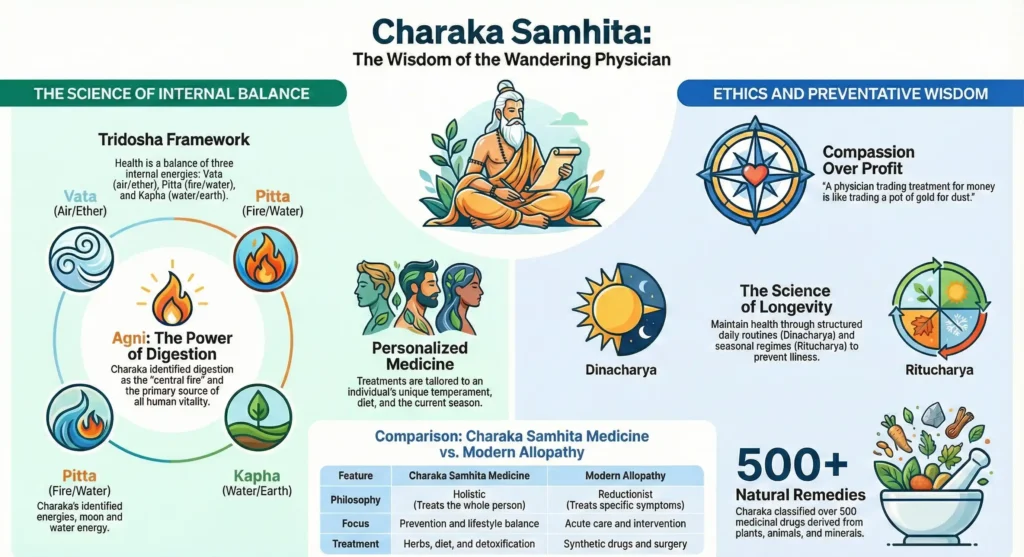
Then how to find a teacher, and how a teacher should size up a student before accepting him. Then the ten things to be assessed in a patient before any treatment begins, among them the constitution he was born with, the state he is in now, his strength, his digestion, his age and his mind, alongside the severity of the disease and the season.
The instruction is that you do not treat a disease. You treat this person, who has it.
Who Charaka was
The book is not the work of one man and does not claim to be. It presents itself as the teaching of Atreya, set down by his pupil Agnivesha, and then redacted by Charaka. Seventeen chapters of the therapeutics section and two entire sections were added later still, by Dridhabala, several centuries after that.
The dates run from a few hundred years before the common era to a few hundred years after, and one tradition places Charaka as a physician at the court of Kanishka in the second century. Charaka may have been a man, or a title, or a line of editors.
What survives is a hundred and twenty chapters in eight sections, and it is still the set text in Ayurvedic colleges in India, which makes it one of the longest-serving textbooks anywhere.
7 Secrets of Padmanabhaswamy Temple Treasure
What the book is for
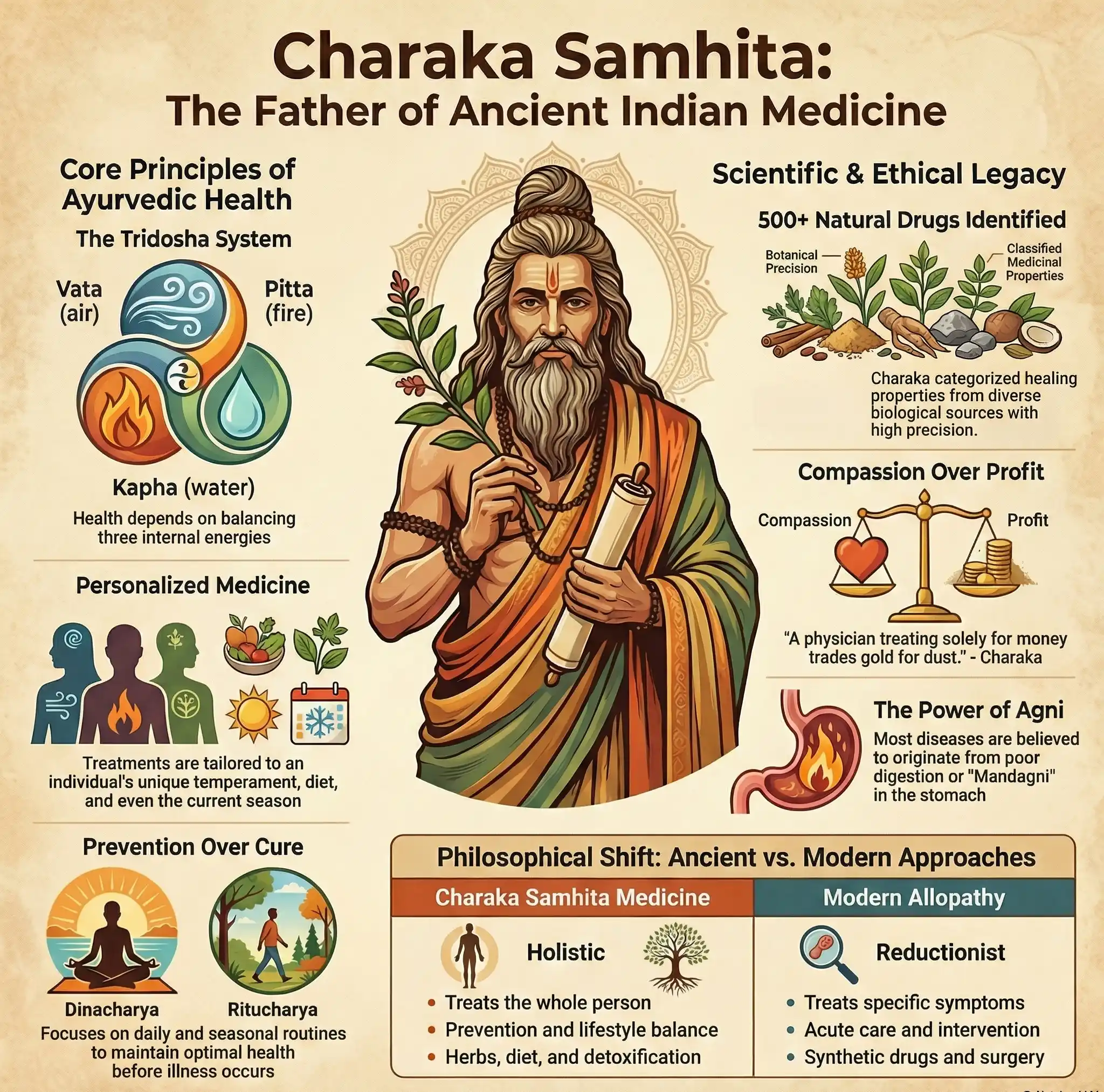
The bulk of it is internal medicine rather than surgery, which is where it differs from the Sushruta Samhita. Diet, regimen, the seasons, digestion, fevers, poisons, the management of long illness, and a great deal on prevention, on the principle that keeping a healthy man healthy ranks with curing a sick one.
It also insists that disease has causes that can be found. The physician, the drug, the attendant and the patient are named as the four supports of treatment, and the patient is one of them, which is a way of saying that a person who will not cooperate cannot be cured by anyone.
By the eighth century it had been rendered into Persian and then Arabic, and physicians in the Islamic world, al-Razi among them, were reading and citing it.
A book that spends its most famous chapter on how to think, how to argue and how to behave, and only then on what to prescribe.
6 Unfoldings in the Subrahmanyan Chandrasekhar Biography
If you think you have remembered everything about this topic take this QUIZ
Results


#1. What does the name “Charaka” literally translate to?
#2. According to Charaka Samhita Medicine, every individual is born with a unique combination of which three energies (Tridosha)?
#3. What did Charaka believe was the primary source of all vitality, often citing its malfunction as the root of disease?
#4. How did Charaka describe a physician who treats patients primarily for the sake of money?
#5. Charaka organized the Charaka Samhita into eight distinct sections known as:
#6. Which statement best reflects Charaka’s view on the medicinal properties of the natural world?
#7. Charaka is credited with providing surprisingly accurate descriptions of which biological process long before ultrasound technology?
#8. Unlike modern reductionist medicine, what was the primary focus of Charaka’s medical philosophy?
Who is considered the Father of Indian Medicine?
Charaka is widely regarded as the Father of Indian Medicine due to his compilation of the Charaka Samhita, the foundational text of internal medicine.
What is the main focus of Charaka Samhita Medicine?
Its main focus is Kayachikitsa (internal medicine), emphasizing the balance of the three Doshas—Vata, Pitta, and Kapha—to maintain health.
Did Charaka perform surgery?
While Charaka focused on internal medicine and herbs, his contemporary, Sushruta, is known as the Father of Surgery. Both are pillars of Ayurveda.
Is Charaka’s wisdom still relevant today?
Absolutely. Concepts like gut health, personalized nutrition, and the mind-body connection in modern wellness are all rooted in his ancient teachings.
Read More: https://curiousindian.in/sushruta-6th-century-bc/
Sources & References
Encyclopaedia Britannica (“Charaka Samhita”) — the structure of the text, its redaction by Charaka and Dridhabala, and the range of dates proposed for it.
Charaka Samhita, Vimana Sthana, chapter 8, in the Jamnagar edition (Shree Gulabkunverba Ayurvedic Society) — the oath, the rules for debate and the ten points of patient assessment.
National Institute of Indian Medical Heritage, Hyderabad — the Sanskrit text of the oath.
Kenneth G. Zysk, Asceticism and Healing in Ancient India (Oxford University Press) — the setting in which the Ayurvedic profession developed and the transmission of these texts.
Author


Exploring the Soul of Bharat through History, Science, Culture, and its Diversity
Our Mission
Curious Indian is a definitive knowledge portal dedicated to chronicling the events, personalities, and cultural shifts that defined the Indian subcontinent. From the ancient Vedic Period to the complexities of 21st-century politics, our goal is to provide deep-dive analysis that inspires.
Editorial Standards & E-E-A-T
Every article published under our brand undergoes a rigorous fact-checking process. We prioritize primary historical records, academic citations, and credible archives to ensure our readers receive accurate, high-authority information.
Historical Integrity Directly sourcing from ASI archives and academic journals.Topical Authority Comprehensive clustering of Indian Science, Biographies, and Wars.Managed by Paripurna Datta and TEAM | Dedicated to the Knowledge of India.