Smita Patil never set out to be an actress, made about eighty films in eleven years, and died of something India still calls fate
In the early 1970s the Bombay station of Doordarshan had only just begun transmitting, and a college student was reading the Marathi bulletin.
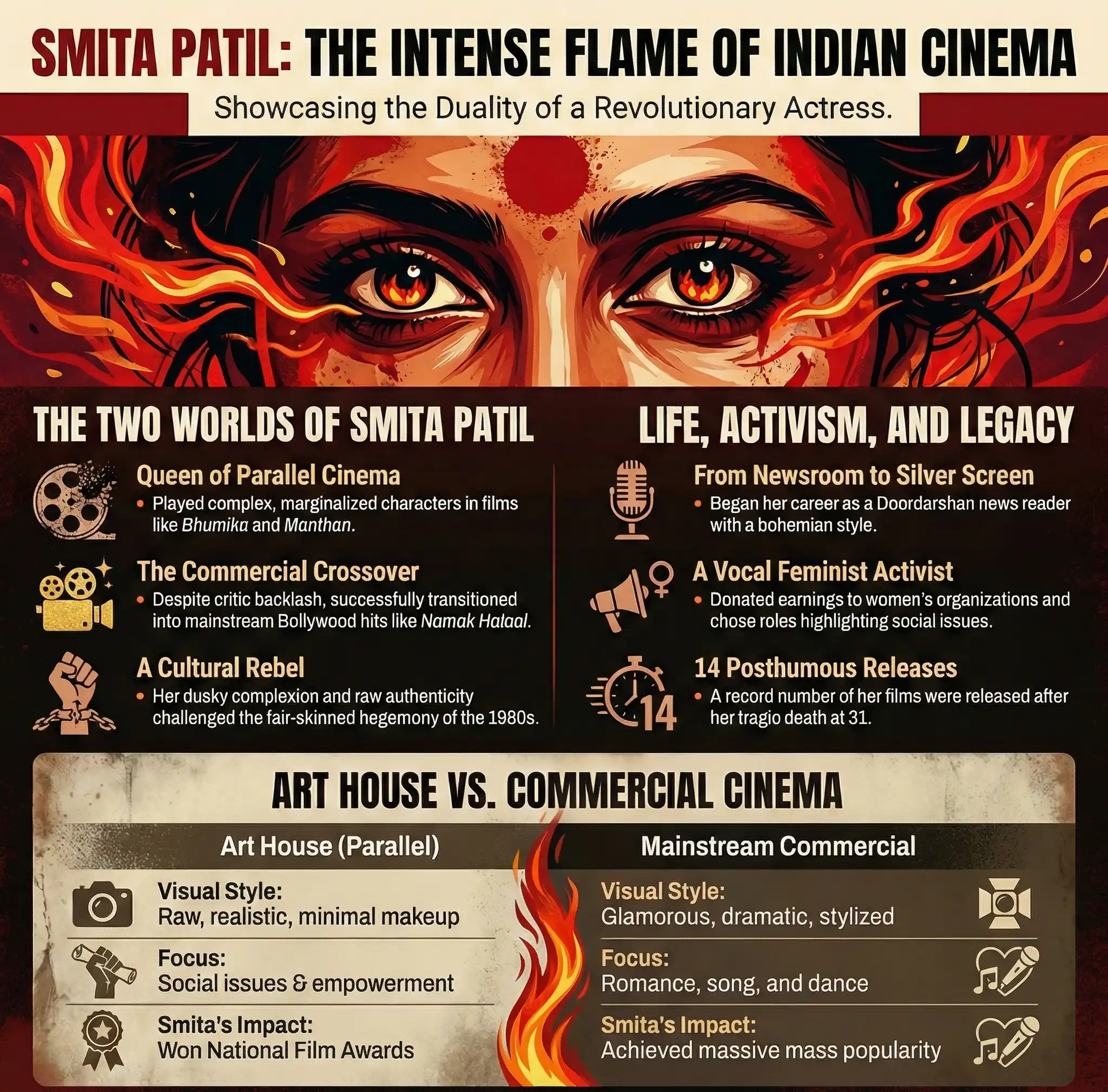
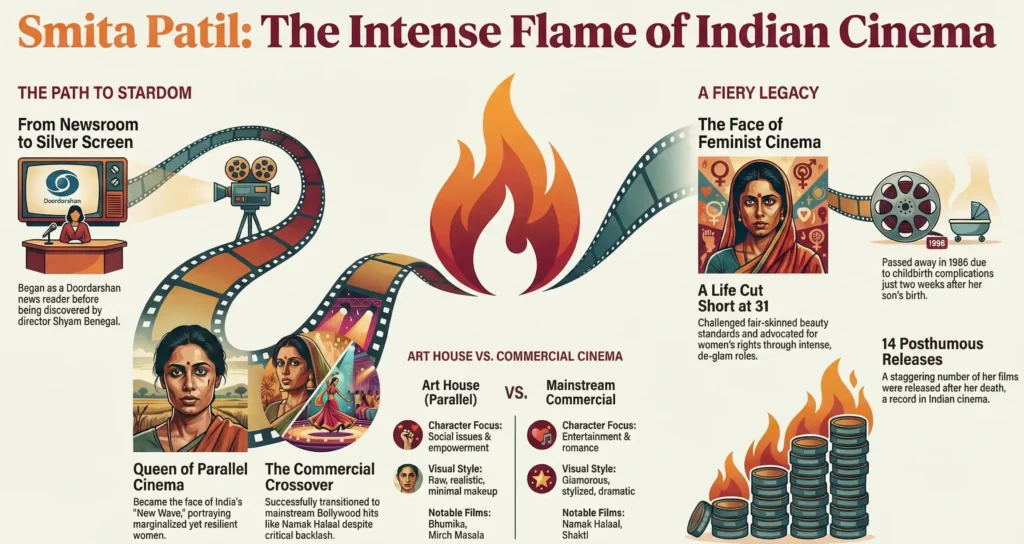
She wore handloom saris on air. By several accounts she arrived at the studio in jeans and pulled the sari on over them a few minutes before going live, which tells you roughly how seriously she was taking the presentation side of it.
She was not an aspiring actress. She had not trained for it, had no family in films, and was not waiting to be discovered by anybody.
Shyam Benegal found her, and the accounts of how differ.
Some say he saw her reading the news, some say he saw her photographs, and some say it was a diploma short from the film institute at Pune. What is agreed is that he cast her in Charandas Chor in 1975, which was a children’s film, and that within a year she was in Nishant and Manthan.
Her father was a Maharashtra politician and her mother a social worker, so she had grown up around public argument rather than around film sets. The parallel cinema movement was arriving at exactly that moment and it needed faces that did not look like the ones already in circulation. She was dark skinned in an industry that was not, and had been mocked for it as a girl.
What she could do
Bhumika, in 1977, won her the National Film Award for Best Actress at the age of twenty-two.
It is based on the life of the Marathi actress Hansa Wadkar and it asks her to play a woman across decades, in and out of several disastrous arrangements with men. Chakra, a few years later, brought the second National Award and the Filmfare. Satyajit Ray cast her in Sadgati in 1981.
Benegal has said she was reluctant to take some of what Bhumika required of her, and that it was her mother who talked her into it. Amol Palekar, who acted opposite her in Bhumika, has said he never saw another Indian actor who could carry that many things across a face without speaking. That is the whole account of her technique and it does not need extending.
She was a working feminist, and not in the decorative sense.
She was a member of the Women’s Centre in Bombay and put her name behind films that examined what was actually happening to women in Indian households, which in the early 1980s was not a crowded field and was not a safe one either. Arth, Bazaar, Mandi, Mirch Masala.
The comparisons with Shabana Azmi were constant and mostly manufactured, the press having decided that two serious actresses in the same decade had to be competing for one chair. She also took mainstream films, because the parallel ones paid badly, and the two halves of her filmography do not sit comfortably together. She was aware of that and said so.
Eleven years
She made somewhere above eighty films, in Hindi, Marathi, Gujarati, Malayalam and Kannada.
That is not a career, it is a sprint. The Padma Shri came in 1985, when she was twenty-nine. More than ten of her films had still not been released when she died, which is why Mirch Masala, one of her best things, reached cinemas in 1987 without her.
She was working at that rate for just over a decade and then it stopped. Nobody was managing that career for her, and there was no machinery in place telling her to take a year off.
13 December 1986
She died two weeks after her son was born, of complications following childbirth. She was thirty-one.
This is almost always written up as destiny, or a flame that burned too fast, or fate being cruel to the gifted. It was none of those things. It was the most ordinary way for a woman of her age to die in India, then and to a considerable extent now, and the country records tens of thousands of such deaths
If you think you have remembered everything about this topic take this QUIZ
Results
QUIZ START
#1. Before entering the film industry, what was Smita Patil’s profession?
Previous
Next
#2. For which film did Smita Patil win the National Film Award for Best Actress, portraying the life of Hansa Wadkar?
Previous
Next
#3. In the film Mirch Masala, Smita Patil’s iconic scene involves her holding what?
Previous
Next
#4. Smita Patil faced criticism for her shift to commercial cinema, particularly for the song “Aaj Rapat Jaye” in which film?
Previous
Next
#5. Smita Patil passed away at the young age of 31 due to:
Previous
Next
#6. Which actor did Smita Patil marry, a relationship that attracted intense media scrutiny?
Previous
Next
#7. Smita Patil reportedly had a premonition about which actor’s near-fatal accident on the sets of Coolie?
Previous
Next
#8. A record number of Smita Patil’s films were released after her death. How many?
Previous
Finish
What was the cause of Smita Patil’s death?
Smita Patil passed away due to severe childbirth complications (puerperal sepsis) just two weeks after giving birth to her son, Prateik Babbar.
How many National Awards did Smita Patil win?
She won two National Film Awards: Best Actress for Bhumika (1977) and Best Actress for Chakra (1981).
Was Smita Patil a news reader?
Yes, before her film career took off, Smita Patil worked as a news reader for Doordarshan in Mumbai in the early 1970s.
Who is Smita Patil’s husband?
Smita Patil was married to actor and politician Raj Babbar.
Which was Smita Patil’s last film?
While Galiyon Ka Badshah (1989) was one of her last releases, Mirch Masala (1987) is often considered her definitive final masterpiece released shortly after her death.
Sources & References
Encyclopaedia Britannica (“Smita Patil”) — her career, her films and her place in the parallel cinema movement.
Directorate of Film Festivals, Government of India — her National Film Awards for Bhumika and Chakra.
Ministry of Home Affairs, Government of India — the Padma Shri of 1985.
Office of the Registrar General of India, Sample Registration System — maternal mortality figures for India.
Exploring the Soul of Bharat through History, Science, Culture, and its Diversity
Our Mission
Curious Indian is a definitive knowledge portal dedicated to chronicling the events, personalities, and cultural shifts that defined the Indian subcontinent. From the ancient Vedic Period to the complexities of 21st-century politics, our goal is to provide deep-dive analysis that inspires.
Editorial Standards & E-E-A-T
Every article published under our brand undergoes a rigorous fact-checking process. We prioritize primary historical records, academic citations, and credible archives to ensure our readers receive accurate, high-authority information.
Historical IntegrityDirectly sourcing from ASI archives and academic journals.
Topical AuthorityComprehensive clustering of Indian Science, Biographies, and Wars.
Managed by Paripurna Datta and TEAM | Dedicated to the Knowledge of India.