The Indian National Congress (INC) was founded on December 28, 1885, marking the beginning of the nationalist movement in India that played a crucial role in the country's struggle for independence from British rule.
How a loyal debating club grew into India’s freedom movement
In December 1885, in a college hall in Bombay, seventy-two men in Western suits held a very polite meeting.
They made careful speeches, in excellent English, about the reforms they hoped a fair-minded British government might grant them. They asked for small things: a few more Indians in the councils, and examinations for the civil service held in India rather than only in far-off London. And then they ended their gathering by singing, with apparent sincerity, “God Save the Queen.”
Sixty-two years later, the organisation those men had founded stood at the centre of the ceremony that lowered the British flag over India for the last time.
This is the story of the Indian National Congress, and of how a loyal little club of lawyers grew, step by patient step, into the movement that ended the greatest empire on earth. It may even be, as the old story goes, that the British helped set it up to keep India quiet. If so, it was one of the greatest miscalculations they ever made.
A very British beginning
The man most responsible for bringing the Congress into being was not an Indian at all. He was a retired British civil servant named Allan Octavian Hume, a career official who, in his spare time, happened to be one of the greatest birdwatchers of his age.
Hume gathered educated Indians from across the country for a first meeting, planned for Poona but shifted to Bombay when cholera broke out. On 28 December 1885, seventy-two delegates assembled, and a Calcutta barrister named Womesh Chandra Bonnerjee took the chair as the first president.
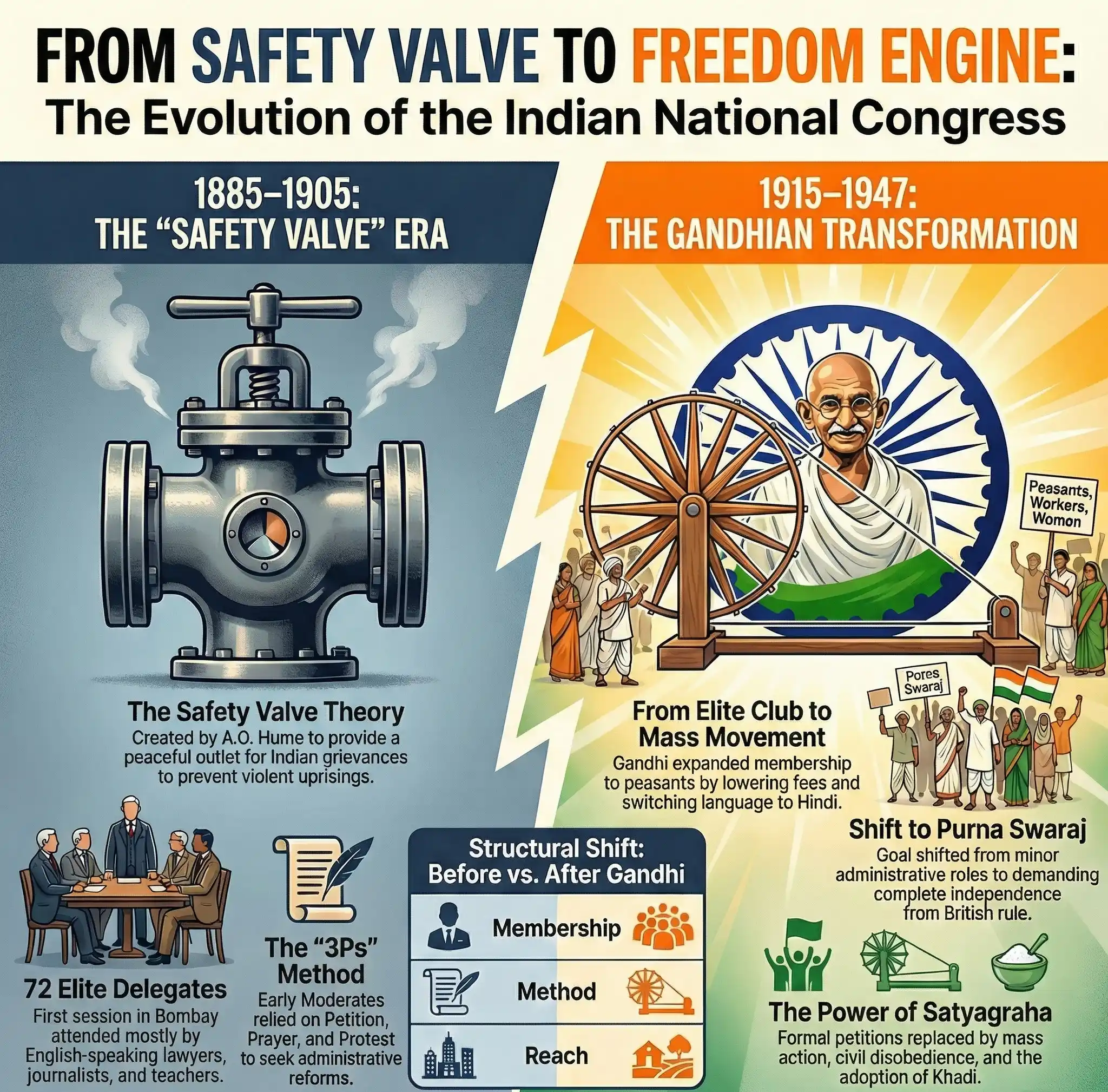
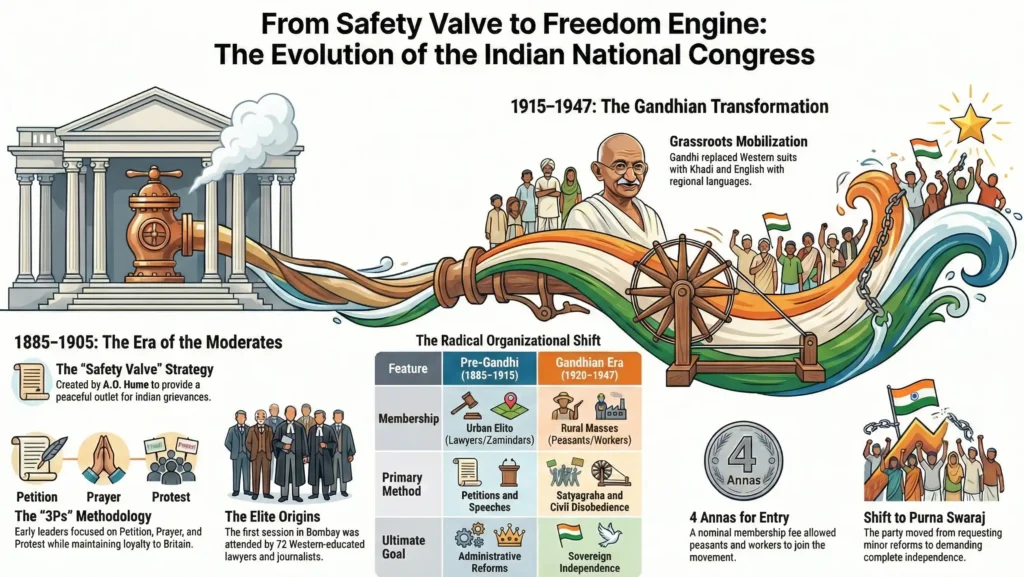
There is a famous theory about why a British officer would want to help found an Indian political body. The idea, often called the safety valve theory, is that Hume had seen alarming reports of unrest among the Indian poor and wanted to give educated Indians a calm, legal way to let off steam, so that the country would never again explode as it had in 1857.
Historians still argue about how true that story really is. But whether or not the Congress was ever meant to be a safety valve, one thing is certain: it was born gentle, loyal and moderate, with no thought at all of driving the British out.
For its first twenty years, the Congress was led by men history calls the Moderates, and their faith in British fair play was almost touching.
Leaders like Dadabhai Naoroji, Pherozeshah Mehta and Gopal Krishna Gokhale were lawyers and scholars who genuinely admired much about Britain. They did not want to overthrow the empire. They wanted to be treated as equal partners inside it. Their chosen weapons were what one might call the three Ps: petition, prayer and protest. They wrote, they argued, they appealed to the British conscience, and they waited.
The early Congress did not ask Britain to leave. It asked Britain to live up to its own promises, and it made that request in flawless English and in well-cut suits.
It sounds timid, and in a way it was. But the Moderates did something more important than they knew. Dadabhai Naoroji, the man they called the Grand Old Man of India, worked out and popularised what became known as the Drain Theory, a careful economic argument showing that British rule was steadily draining India’s wealth away to Britain. He proved, in Britain’s own language of ledgers and figures, that the empire was making India poor. The polite men in suits had built the intellectual case against the Raj.
Political begging
The politeness could not last, and a younger generation soon lost patience with it.
By the early 1900s a group of fierier leaders had risen, remembered together as Lal-Bal-Pal: Lala Lajpat Rai, Bal Gangadhar Tilak and Bipin Chandra Pal. They looked at decades of petitions that had won only crumbs, and they were disgusted. They had a scornful name for the Moderate method. They called it political mendicancy, which is a polite way of saying begging.
To the younger men, asking politely was not politics at all. Freedom, they insisted, is taken, not requested.
These radicals wanted Swaraj, self-rule, and they meant to fight for it through mass action, not memoranda. The clash between the two visions grew so bitter that in 1907, at the Congress session in Surat, the meeting collapsed into open chaos, with furniture thrown and the party breaking in two. It would take nearly a decade to stitch the halves back together. But the direction of travel was now clear. The Congress was growing teeth.
The final transformation came with one man, and it changed everything.
When Mohandas Gandhi took charge of the Congress after the First World War, it was still, for all its new fire, a party of the educated elite, of lawyers and landowners who met once a year to pass resolutions. Gandhi tore that model up. He reached past the drawing rooms and the courtrooms, all the way down to the village.
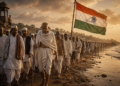
He changed the very texture of the party. He shifted its language from English to the tongues ordinary people actually spoke. He swapped the Western suits for simple homespun khadi. And, cleverest of all, he set the membership fee at just four annas, a few small coins.
With that one tiny fee, a poor farmer could belong to the same party as a Bombay barrister. A club of gentlemen quietly became a movement of the masses.
Now the Congress was not a yearly gathering but a living presence in the countryside, in the fields and the small towns, fighting for the peasant and the worker every day. And its goal had hardened, from polite requests for reform into a demand for Purna Swaraj, complete and total independence.
From God Save the Queen to the tricolour
Look at the two ends of that journey, and it is almost hard to believe they belong to the same story.
The Congress began in 1885 as a body so loyal that it closed its meetings by singing the anthem of the British Queen. It ended in 1947 as the movement that raised the Indian tricolour over a free nation, while Jawaharlal Nehru spoke of a tryst with destiny.
There is a lesson buried in that arc, and it is a simple one. You cannot give people a room in which to speak and expect them to stay small. If the British really did create the Congress as a safety valve, a place for Indians to blow off a little harmless steam, then they had misunderstood something basic about human beings. Give a people a place to find their voice, and the voice does not stay quiet. It grows. It asks for more. In time, it stops asking altogether.
The Congress did not begin by demanding freedom. It began by asking, ever so politely, for fairness. Then it demanded a share of power. Then it demanded power itself. Generation by generation, a debating club of seventy-two men in suits discovered that it was, in fact, a country. And the empire that had once waved it away as a microscopic minority lived to watch it win.
If you think you have remembered everything about this topic take this QUIZ
Results
QUIZ START
#1. Who was the retired British civil servant credited with founding the INC?
Previous
Next
#2. Who presided over the very first session of the Congress in Bombay?
Previous
Next
#3. How many delegates attended the first session of the Congress?
Previous
Next
#4. The “Safety Valve Theory” suggests that the Congress was founded to:
Previous
Next
#5. Which famous economic theory did Dadabhai Naoroji propose to prove Britain was bleeding India white?
Previous
Next
#6. In which year did the Congress split into Moderates and Extremists at the Surat Session?
Previous
Next
#7. Who was the first woman to become the President of the Indian National Congress in 1917?
Previous
Finish
Who founded the Indian National Congress?
It was founded by Allan Octavian Hume (A.O. Hume), a retired British civil servant.
When and where was the first session held?
The first session was held on December 28, 1885, at Gokuldas Tejpal Sanskrit College in Bombay.
Who was the first President of the INC?
Womesh Chandra Bonnerjee was the first President.
What is the “Safety Valve” theory?
It is the theory that the British founded the Congress to provide a safe, peaceful outlet for Indian grievances to avoid a violent rebellion like the 1857 Mutiny.
When did the Congress demand Complete Independence?
The Congress officially demanded Purna Swaraj (Complete Independence) at the Lahore Session in 1929 under Jawaharlal Nehru’s presidency.
Sources & References
Encyclopaedia Britannica (“Indian National Congress”) — the founding in 1885, the first session, and the party’s early growth.
The Open University, Making Britain (Allan Octavian Hume) — the retired British civil servant who helped found the Congress.
Encyclopaedia Britannica (“Dadabhai Naoroji”) — the Grand Old Man of India and his economic Drain Theory.
Encyclopaedia Britannica (“Bal Gangadhar Tilak”) — the radical challenge to the Moderates and the Surat split of 1907.
Exploring the Soul of Bharat through History, Science, Culture, and its Diversity
Our Mission
Curious Indian is a definitive knowledge portal dedicated to chronicling the events, personalities, and cultural shifts that defined the Indian subcontinent. From the ancient Vedic Period to the complexities of 21st-century politics, our goal is to provide deep-dive analysis that inspires.
Editorial Standards & E-E-A-T
Every article published under our brand undergoes a rigorous fact-checking process. We prioritize primary historical records, academic citations, and credible archives to ensure our readers receive accurate, high-authority information.
Historical IntegrityDirectly sourcing from ASI archives and academic journals.
Topical AuthorityComprehensive clustering of Indian Science, Biographies, and Wars.
Managed by Paripurna Datta and TEAM | Dedicated to the Knowledge of India.