How Babur’s cannons founded the Mughal Empire
On the morning of 21 April 1526, two armies faced each other on a dusty plain near a town called Panipat, some ninety kilometres north of Delhi.
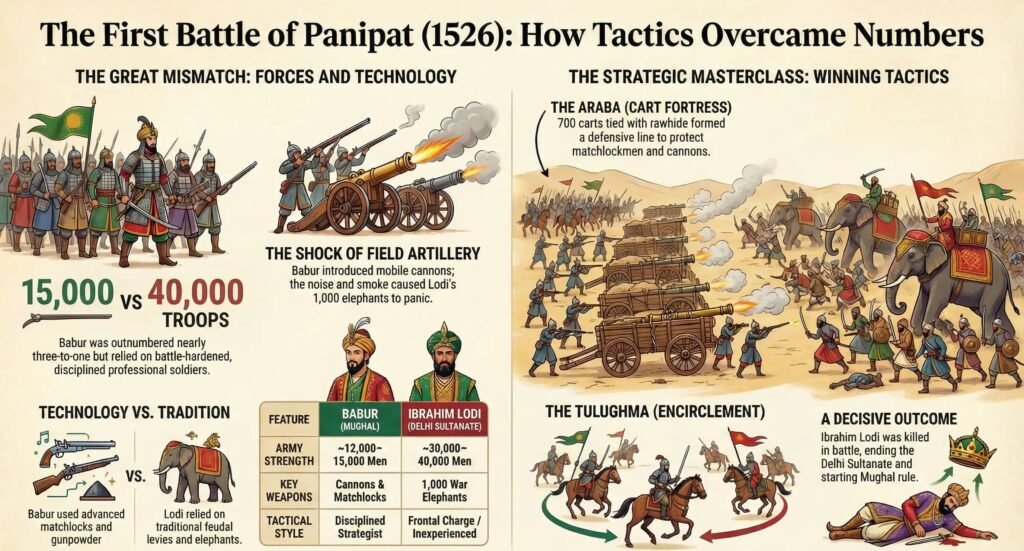
One army was huge. It had perhaps forty thousand men and a thousand war elephants, and it belonged to Ibrahim Lodi, the Sultan of Delhi.
The other was small. Maybe fifteen thousand men, tired after a long march down from the mountains. It belonged to an outsider named Babur.
By the end of the day, the small army had won, the Sultan was dead, and a new empire had been born — one that would rule much of India for the next three hundred years.
How does the smaller side win a fight like that? The answer is one of the great lessons in history, and it starts with a man who had already lost almost everything.
A prince with no kingdom
Babur was not born to rule India. He was born far away, in Central Asia, and he came from famous blood — a descendant of both Genghis Khan and Timur, two of the most feared conquerors who ever lived.
But a great name does not keep you on a throne. As a young man, Babur lost his own small kingdom of Fergana. He captured the beautiful city of Samarkand, then lost that too. For years he was a warrior-prince with soldiers but no country to call his own.
So he looked south, toward the rich, warm plains of Hindustan.
His chance came from an unlikely place: Ibrahim Lodi’s own people. The Sultan was proud and harsh, and he had made enemies among his own nobles. Some of them — including the governor of Punjab — quietly invited Babur to come and pull Lodi down.
Babur did not need asking twice. He marched from Kabul, crossed the Indus, took Punjab, and pushed on toward Delhi.
Second Battle of Panipat 1556: The Arrow That Changed History
The wall of carts
Babur knew the plain truth: he was badly outnumbered. So he decided he would not fight fair. He would fight clever.
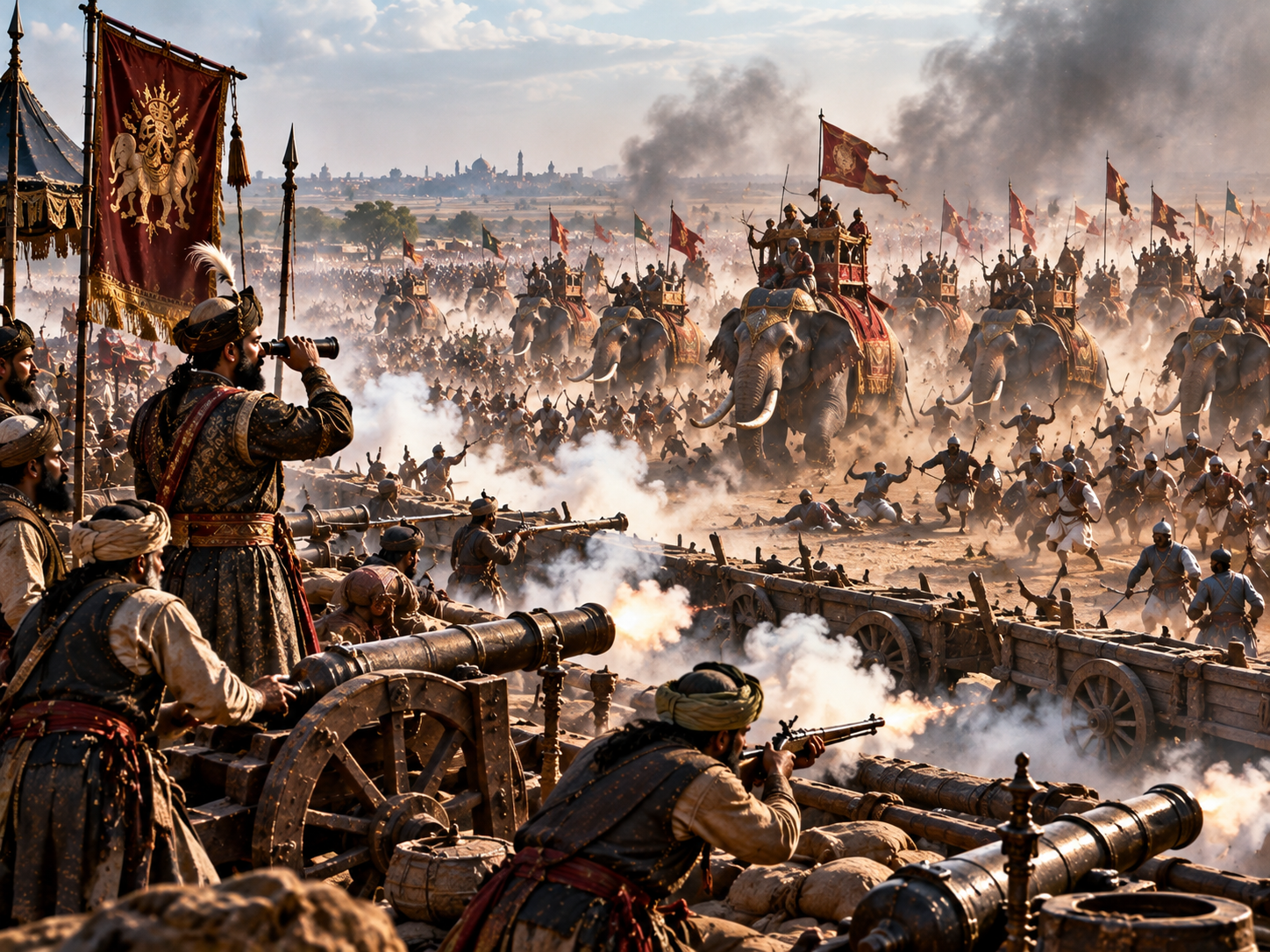
Before the battle, he built himself a fortress out of nothing but the things his army already had. He took around seven hundred bullock carts and lashed them together in a long line with rawhide ropes.
Seven hundred carts, roped end to end, made a wall the enemy could not simply ride through. And in the gaps between them, Babur hid his secret weapon.
That secret weapon was gunpowder. Babur had cannons and matchlock guns, handled by two skilled gunners named Ustad Ali and Mustafa. In the plains of North India in 1526, this kind of field artillery was almost unheard of. Most of Lodi’s men had never seen a cannon fired in anger.
Babur had one more trick, an old Central Asian tactic called the Tulughma. He split his army into left, right and centre, then set aside fast, mobile groups on the wings. Their job was to swing wide around the enemy and strike from the sides and the back.
The carts would hold the enemy in front. The wings would wrap around behind. It was a trap, and Lodi was about to walk straight into it.
Third Battle of Panipat 1761: The Day the Maratha Dream Died
The morning the elephants turned
Ibrahim Lodi looked across the field, saw a much smaller army, and did the confident thing. He attacked head-on.
His great mass of soldiers and his thousand elephants rolled forward, expecting to crush Babur’s line by sheer weight.
Then Babur’s cannons opened fire.
For most of Lodi’s men, and all of his elephants, it was the first time they had ever heard that sound. The roar and the smoke were terrifying — and the elephants broke.
The animals meant to smash Babur’s army panicked, spun around, and went stampeding backwards through Lodi’s own soldiers, crushing the men they were supposed to protect.
Lodi’s greatest strength had just become his worst enemy. And it was about to get much worse.
Nowhere to run
With Lodi’s front in chaos, Babur gave the signal for the Tulughma. His mobile wings galloped wide and closed in from the sides and the rear, pouring arrows into the packed, panicking mass.
Now Lodi’s army was caught in a box.
They could not push forward — the wall of carts and the cannons blocked the way. They could not fall back — Babur’s horsemen had sealed the escape. Tens of thousands of men were trapped in a shrinking space, with nowhere to go.
What followed was less a battle than a killing. By midday, it was effectively over.
Ibrahim Lodi could have run. Many rulers in his place did exactly that. He did not. He stayed and fought until he was cut down, and his body was later found in a heap of the soldiers who had died around him.
With him died the Delhi Sultanate, the line of kings who had ruled from Delhi for more than three hundred years.
Third Battle of Panipat 1761: The Day the Maratha Dream Died
Why the smaller army won
It is worth stopping to ask why. How did fifteen thousand men beat forty thousand?
It was not luck. It came down to a few clear things.
The first was technology. Babur had cannons, and Lodi had no real answer to them. A wall of brave men and elephants, however large, could not stand in front of gunpowder.
The second was discipline. Babur’s soldiers were hardened veterans who obeyed one clear plan. Lodi’s army was a loose gathering of feudal lords and their men, thrown together, with far less unity.
A smaller army that moves as one will often beat a bigger one that moves as a crowd.
The third was leadership. Babur was patient, cunning, and thought several moves ahead. Ibrahim Lodi was personally brave, but as a general he was rash. He trusted his numbers, ignored the trap, and led his men straight into it.
One morning, three hundred years
It is strange to think how much turned on a single spring morning.
Babur marched on to Delhi and Agra and took the throne. The dynasty he founded, the Mughals, would rule much of the subcontinent for roughly three centuries. Their emperors would build the Taj Mahal and reshape India’s art, food, language and cities in ways still visible everywhere today.
There is a small, glittering footnote too. In the loot after the battle, Babur’s son Humayun was handed a spectacular diamond taken from the family of a raja who had died fighting for Lodi. Its name was the Koh-i-Noor — the same stone that would pass from hand to hand for centuries, all the way to a crown in London.
Panipat itself would see two more great battles, in 1556 and 1761, each deciding the fate of India. That was no accident. The flat plain sat right on the road an invader had to take to reach Delhi, so again and again the fate of the capital was settled there.
But the first of those battles was the one that changed everything. On that April morning, a man who had lost his own kingdom used smoke, noise and a wall of carts to win a whole subcontinent — and the elephants meant to save an empire helped end one instead.
Battle of Talikota 1565: The Fall of the Vijayanagara Empire
If you think you have remembered everything about this topic take this QUIZ
Results


#1. Which two historical figures was Babur descended from, linking him to the great Mongol and Timurid lineages?
#2. Which specific Afghan nobles are credited with inviting Babur to Hindustan to overthrow Ibrahim Lodi?
#3. In the context of the battle, what did the ‘Araba’ defensive strategy primarily involve?
#4. The ‘Tulughma’ tactic was instrumental in Babur’s victory. How did this manoeuvre function on the battlefield?
#5. Who were the primary commanders responsible for Babur’s superior artillery fire during the battle?
#6. Why did Ibrahim Lodi’s 1,000 war elephants ultimately become a disadvantage for his own army?
#7. True or False: Ibrahim Lodi fled the battlefield when he realised the battle was lost, mirroring the actions of many other contemporary rulers.
#8. After the victory, Babur’s son Humayun acquired a famous diamond from the family of the Raja of Gwalior. What was its name?
When was the First Battle of Panipat fought?
It was fought on April 21, 1526.
Who won the First Battle of Panipat?
Babur defeated Ibrahim Lodi to win the battle.
What was the Tulughma tactic?
It was a military tactic used by Babur involving dividing the army into flanking units to encircle the enemy from the sides and rear.
What was the main reason for Babur’s victory?
The use of artillery (cannons) and disciplined cavalry tactics against Lodi’s elephants and disorganized infantry.
Who was the last Sultan of Delhi?
Ibrahim Lodi was the last Sultan, who died in this battle.
Sources & References
- Babur’s memoir, the Baburnama (University of Washington Silk Road archive) — his descent from Genghis Khan and Timur, the loss of Fergana and Samarkand, the march from Kabul across the Indus, and his firsthand account of the battle and its tactics.
- Encyclopaedia Britannica (“Babur”) — his life, the invitation from disaffected nobles, and the founding of the Mughal Empire after the victory.
- Panipat district administration (panipat.gov.in) — the date of 21 April 1526, the location near Panipat in Haryana, and the town’s position on the approach to Delhi.
- Know India, National Portal of India (Mughal era) — the long span of Mughal rule that followed and its cultural and political weight.
Author


Exploring the Soul of Bharat through History, Science, Culture, and its Diversity
Our Mission
Curious Indian is a definitive knowledge portal dedicated to chronicling the events, personalities, and cultural shifts that defined the Indian subcontinent. From the ancient Vedic Period to the complexities of 21st-century politics, our goal is to provide deep-dive analysis that inspires.
Editorial Standards & E-E-A-T
Every article published under our brand undergoes a rigorous fact-checking process. We prioritize primary historical records, academic citations, and credible archives to ensure our readers receive accurate, high-authority information.
Historical Integrity Directly sourcing from ASI archives and academic journals.Topical Authority Comprehensive clustering of Indian Science, Biographies, and Wars.Managed by Paripurna Datta and TEAM | Dedicated to the Knowledge of India.