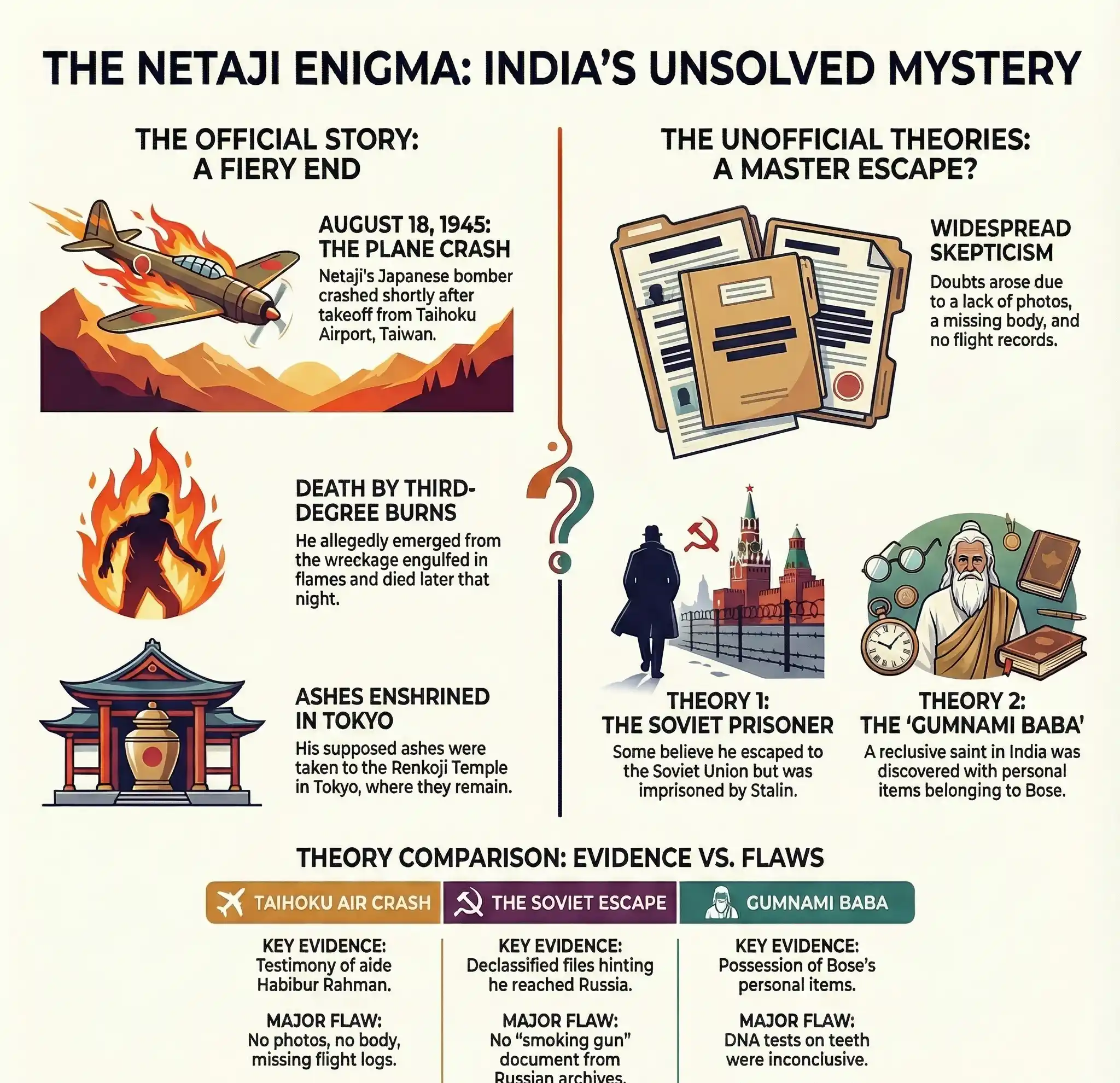
The disappearance of Subhas Chandra Bose on August 18, 1945, remains India’s most debated historical mystery. While the official version states he died in a plane crash in Taiwan, numerous inconsistencies—including missing flight records, the lack of photographic evidence, and the suspicious Gumnami Baba sightings—have led many to believe he survived. Investigative bodies like the Mukherjee Commission have officially challenged the crash theory, suggesting instead that Netaji may have escaped to the Soviet Union or returned to India as a secret ascetic, leaving behind a legacy that refuses to be buried.| Key Detail | Information |
| Subject | Netaji Subhas Chandra Bose |
| Official Death Date | August 18, 1945 (Disputed) |
| Official Location | Taihoku Airport, Japanese Taiwan |
| Primary Theory | Taihoku Air Crash |
| Controversial Alternative | Gumnami Baba (Bhagwanji) |
| Key Inquiry | Justice Mukherjee Commission (1999–2005) |
The Netaji Subhas Chandra Bose disappearance remains the most haunting riddle in independent India’s history. If you walk through the streets of Kolkata today, or visit any small town in Odisha, you will find a sentiment that refuses to fade even after eight decades. It is a whisper, a hope, and for many, a firm belief: “Netaji is alive.”
In the pantheon of Indian heroes, Subhas Chandra Bose stands as a giant. He was the defiant warrior who looked the British Empire in the eye and said, “Give me blood, and I will give you freedom.” But unlike other leaders whose lives ended with a clear full stop—a date of death recorded in history books—Netaji’s story ended with a question mark.
Did he really die in a plane crash in Taiwan on August 18, 1945? Or was it the greatest escape act in military history?
Welcome to the first chapter of Unsolved India, where we peel back the layers of India’s most enduring mystery.
Dr. A.P.J. Abdul Kalam: (1931-2015)Dr. A.P.J. Abdul Kalam: (1931-2015)
The Fateful Afternoon: August 18, 1945
To understand the mystery, we must first look at the official story. The date was August 18, 1945. World War II had just ended with Japan’s surrender. The Indian National Army (INA), which Netaji had built with blood and sweat, was facing an uncertain future.
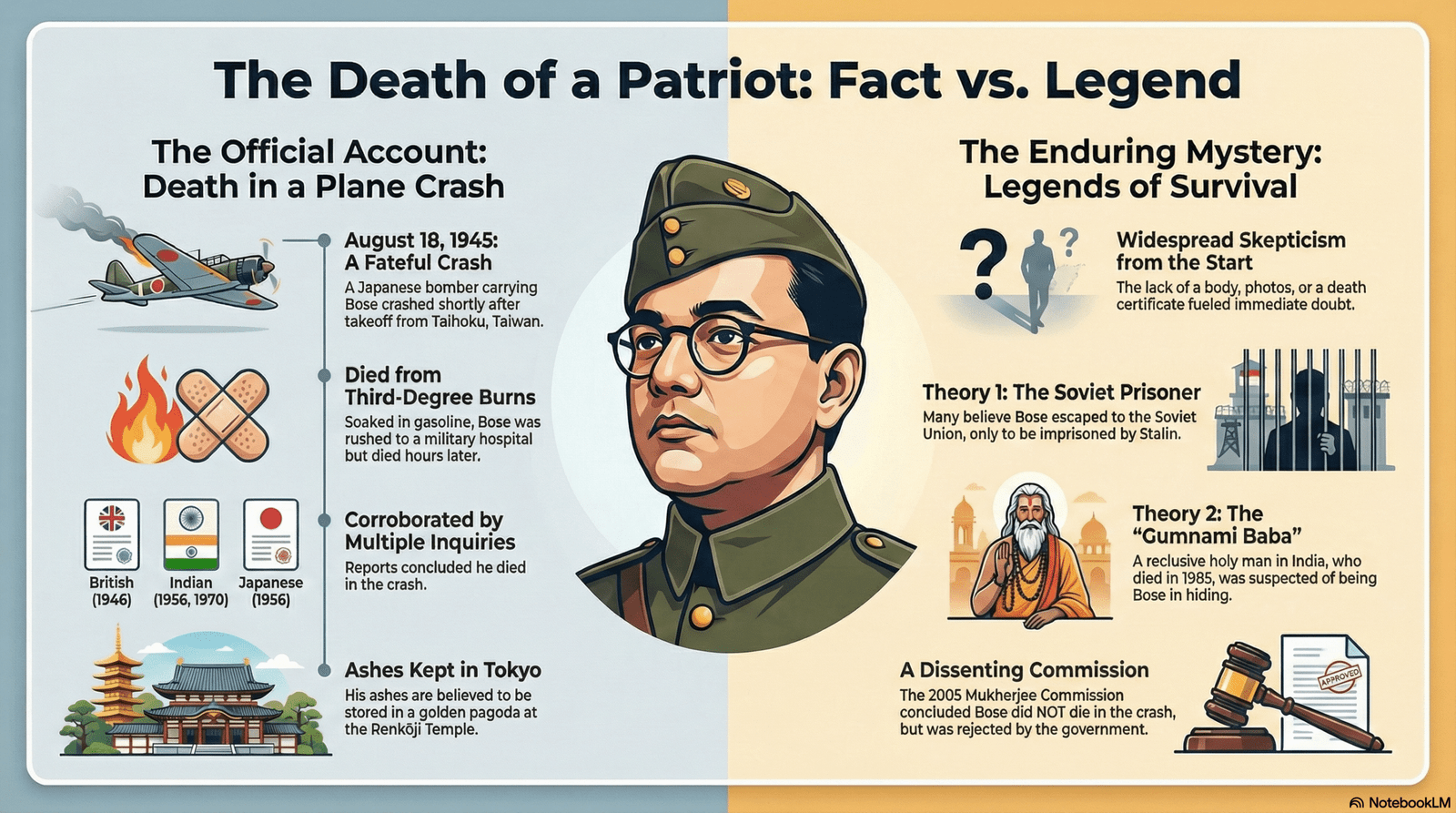
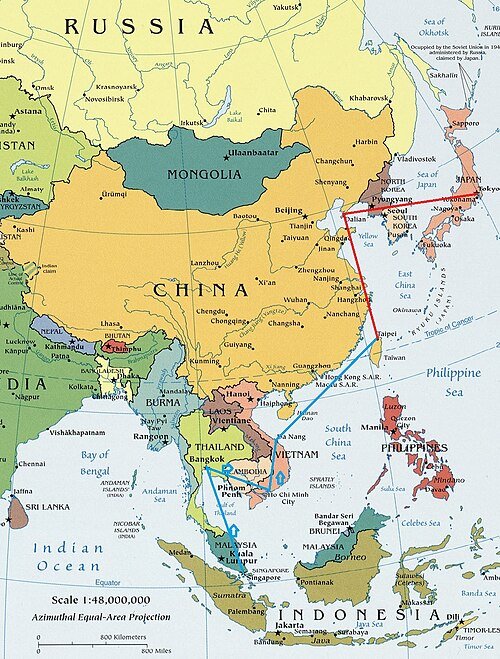
According to historical records and the testimony of his aide, Habibur Rahman, Netaji boarded a heavy Japanese bomber, a Mitsubishi Ki-21, at Taihoku Airport (modern-day Taipei). His destination? Dairen, Manchuria. His plan was to reach the Soviet Union to continue the fight for India’s independence against the British.
The plane, overloaded and heavy, taxied down the runway. Just moments after takeoff, a loud explosion ripped through the air. The port engine had failed. The plane crashed violently into the ground and snapped into two.
Survivors claimed that Netaji emerged from the wreckage, his cotton uniform soaked in gasoline and engulfed in flames. He was rushed to the Nanmon Military Hospital. Legend says that even in his final moments, enduring third-degree burns, his only concern was for his country. He reportedly told Habibur Rahman:
“I feel that I shall die very soon. I have fought for India’s freedom until the last. Go and tell my countrymen to continue the fight. India will be free, and before long.”
According to the Japanese doctor, Dr. Taneyoshi Yoshimi, Netaji Subhas Chandra Bose passed away that night. He was cremated in Taipei, and his ashes were later taken to the Renkoji Temple in Tokyo, where they remain to this day.
Case closed? Not quite.
Why the Nation Refused to Believe
Almost immediately, cracks appeared in this narrative surrounding the Netaji Subhas Chandra Bose disappearance. In 1945, the British intelligence community itself was skeptical. Lord Wavell, the then Viceroy of India, noted in his diary, “I suspect it is all a cover-up.”
Why the doubt?
No Body, No Photo: In a culture where death rituals are sacred, no photograph was ever taken of Netaji’s body after he died. The only photo released was of his face wrapped entirely in bandages—unidentifiable.
The Timing: The crash happened mere days after Japan surrendered. It was the perfect cover for a man who needed to disappear to avoid being captured by the Allied forces as a “war criminal.”
The Discrepancies: The flight records at Taihoku Airport for that day were strangely missing. Later, reports surfaced that no plane crash had occurred in that region on that specific date.
For millions of Indians, the “crash” was a masterful decoy—a smokescreen created by Bose and the Japanese intelligence to help him slip into Russia.
8 Defining Chapters in the Vikram Sarabhai Biography
Theory 1: The Russian Prisoner
If he didn’t die in Taiwan, where did he go? The strongest theory for decades was the Soviet Connection.
Netaji believed that the enemy of his enemy was his friend. With Germany and Japan defeated, he saw the Soviet Union as the only power capable of standing up to the British. Declassified files suggest that Indian diplomats in Moscow and Tehran had heard rumors of Bose being alive in Russia post-1945.
Some researchers believe that Bose did reach Russia but was detained by Joseph Stalin. Was he held in a Siberian Gulag? Did he spend his final years looking at the snow, dreaming of a free Bengal? This theory suggests a tragic end—that the Lion of India died not in battle, but in cold captivity, betrayed by the geopolitical games of the Cold War.
Theory 2: The Mystery of Gumnami Baba
This is perhaps the most fascinating and spinal-chilling aspect of the Netaji mystery. It brings the story back home, to the dusty lanes of Uttar Pradesh.
For years, a reclusive ascetic lived in Faizabad (now Ayodhya). He was known simply as Gumnami Baba (The Nameless Saint) or “Bhagwanji.” He lived in the shadows, never letting anyone see his face, speaking to visitors from behind a curtain.
But he was no ordinary sadhu.
He spoke fluent English, German, and Bengali.
He discussed high-level military strategy and international politics.
He had a commanding voice that listeners swore was identical to the one they heard on the radio calling out “Dilli Chalo!”
When Gumnami Baba passed away in 1985, his belongings were examined. The inventory left the investigators stunned. Among the piles of books and religious items were:
Round-rimmed spectacles (identical to Netaji’s).
A Rolex watch (Netaji was known to wear one).
Binoculars of German make.
Original family photographs of the Bose family.
Letters from senior INA veterans who had visited him in secret.
Handwriting experts later compared Gumnami Baba’s letters with Netaji’s writings. Several experts confirmed a match, though others disagreed.
Was Netaji hiding in plain sight in independent India? If it was him, why did he not come out? Some say he was a spiritual recluse; others believe he remained in hiding because his appearance would have caused international chaos, labeling India as a nation harboring a “war criminal.”
The Justice Mukherjee Commission Bombshell
The Indian government formed three commissions to investigate the death. The first two (Shah Nawaz and Khosla Commissions) agreed with the plane crash theory. But the third one changed everything.
In 1999, the Justice Mukherjee Commission was formed. After seven years of rigorous investigation, traveling to Japan, Russia, and Taiwan, Justice Mukherjee concluded in 2006:
Netaji Subhas Chandra Bose did NOT die in the plane crash.
The ashes in the Renkoji Temple are not his.
There is no record of a plane crash at Taihoku on that date.
However, the government at the time rejected these findings, leaving the mystery officially “unsolved.”
The Purulia Arms Drop Mystery 1995: When the Sky Rained Guns
The Legacy of the Unknown
So, what really happened?
Did the Phoenix rise from the ashes of the plane crash only to be caged in Russia? Or did he return to the motherland he freed, living the life of a monk, watching his country grow from behind a curtain?
The truth lies buried in classified files that may never see the light of day. But perhaps, in the grand scheme of things, the how of his death matters less than the why of his life.
Netaji Subhas Chandra Bose was a man who could not be contained by borders, by empires, or even by death. He vanished like a ghost, leaving behind a spirit that refuses to be extinguished. Every year, on January 23rd, when the conch shells blow in Bengal, we don’t just celebrate a birth; we celebrate a hope.
The mystery remains. And as long as it does, Netaji lives on.
Comparison Table: Theories of Disappearance
| Theory | Key Evidence | Major Flaw |
| Taihoku Air Crash | Testimony of Habibur Rahman & Dr. Yoshimi | No photos, no body, missing flight logs. |
| The Soviet Escape | Secret files suggesting he reached Manchuria | No “smoking gun” document from Russian archives. |
| Gumnami Baba | Possession of personal Bose family items | DNA tests on teeth were reportedly inconclusive. |
| Siberian Gulag | Intelligence reports of “The Bose” in Russia | Relies heavily on oral accounts and leaked files. |


Curious India: Fast Facts
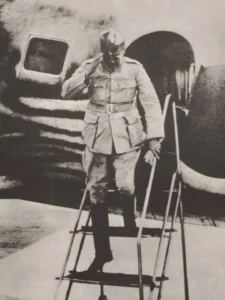
The Last Photograph: The last known clear photo of Netaji was taken on August 17, 1945, at Saigon airport.
The DNA Test: The ashes at Renkoji Temple have never been DNA tested, despite repeated requests from parts of the Bose family.
Declassification: In 2016, the Indian government declassified 100 files related to Netaji, but many critical intelligence files remain destroyed or missing.
1971 Nagarwala Case: India’s Great Bank Heist Mystery
If you think you have rememberd everything about this topic take this QUIZ
Results


#1. Who was the high-ranking INA officer traveling with Bose on the plane, who survived with severe burns and later testified about the event? ? Hint
This individual was Bose’s chief-of-staff and was the only other INA member for whom a seat could be arranged on the crowded flight.
#2. According to the official account detailed in the source material, where did the plane carrying Subhas Chandra Bose crash on August 18, 1945? ? Hint
The crash occurred at a scheduled refueling stop during the flight to Japanese-occupied China.
#3. What was the controversial primary conclusion presented by the Justice Mukherjee Commission in its 2005 report? ? Hint
This commission’s findings, which were rejected by the Indian government, departed significantly from the previous two official inquiries.
#4. Among the possessions of the mysterious ascetic Gumnami Baba, which discovery particularly fueled speculation that he was Subhas Chandra Bose? ? Hint
Think about the personal items that would be very difficult for a stranger to obtain.
#5. According to the source material, where are the ashes believed to be Subhas Chandra Bose’s currently preserved? ? Hint
After Bose’s cremation in Taihoku, his remains were transported to the capital of the country that had been his wartime ally.
#6. What was a key reason why many people, including British Viceroy Lord Wavell, initially doubted the news of Bose’s death in 1945? ? Hint
Consider what kind of physical evidence is typically expected to confirm a person’s death.
#7. The Figgess Report (1946) and the Shah Nawaz Committee (1956) were two of the earliest official inquiries into Bose’s fate. What was their shared conclusion? ? Hint
The findings of the first two major inquiries were consistent with each other and the initial reports.
#8. A 1956 Japanese government report, declassified in 2016, provided a technical explanation for the plane crash. What did it identify as the cause? ? Hint
The report pointed to a specific, catastrophic mechanical failure that occurred moments after the plane left the ground.
This article is part of our exclusive series Unsolved India. Stay tuned for more chapters where we will explore more unsolved mysteries of India.
Is there any proof that Netaji Subhas Chandra Bose died in 1945?
No conclusive proof exists. While the Japanese government and two Indian commissions (Shah Nawaz and Khosla) stated he died in a plane crash in Taihoku, the Justice Mukherjee Commission (2006) concluded that the crash story was fabricated and that Netaji did not die in 1945.
Who was Gumnami Baba?
Gumnami Baba was a mysterious ascetic who lived in Faizabad (Uttar Pradesh) until 1985. After his death, his belongings were found to include personal family photos of the Bose family, a Rolex watch, and German binoculars, leading many to believe he was Netaji Subhas Chandra Bose in hiding.
Why was the Justice Mukherjee Commission report rejected?
The Justice Mukherjee Commission concluded that Netaji did not die in the 1945 plane crash and that the ashes in Renkoji Temple were not his. However, the Indian government at the time rejected these findings without providing a detailed explanation, leaving the mystery officially unresolved.
Are the ashes in Renkoji Temple really Netaji’s?
The Justice Mukherjee Commission concluded that the ashes kept at Renkoji Temple in Tokyo belong to a Japanese soldier, not Netaji. However, no DNA test has ever been conducted to scientifically prove or disprove this claim.
What happened to the files related to Netaji’s death?
In 2016, the Indian government declassified over 100 files related to Netaji. However, several critical intelligence files from 1945–1950 are reported to be destroyed or missing, which has fueled further conspiracy theories about his disappearance.