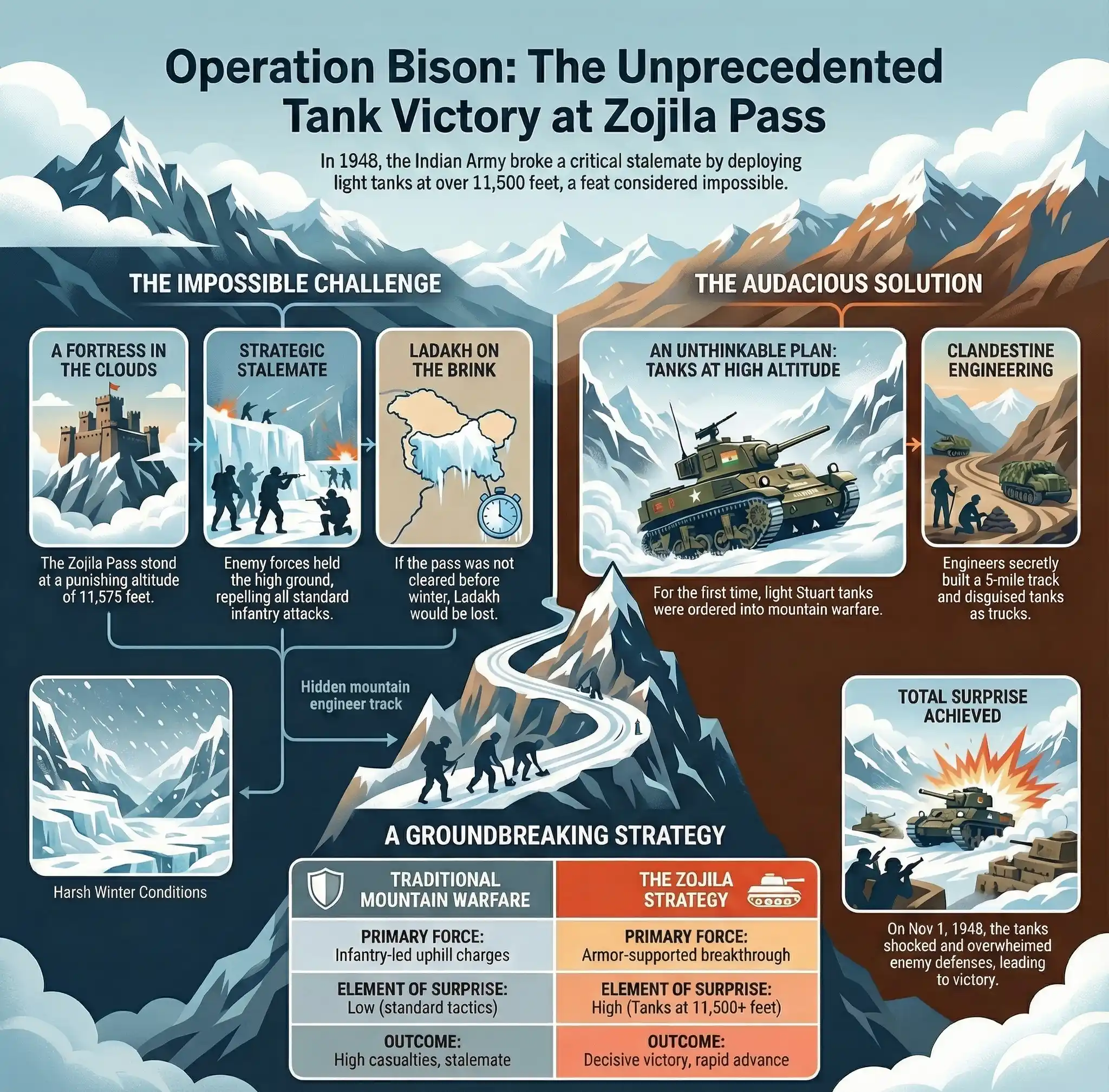
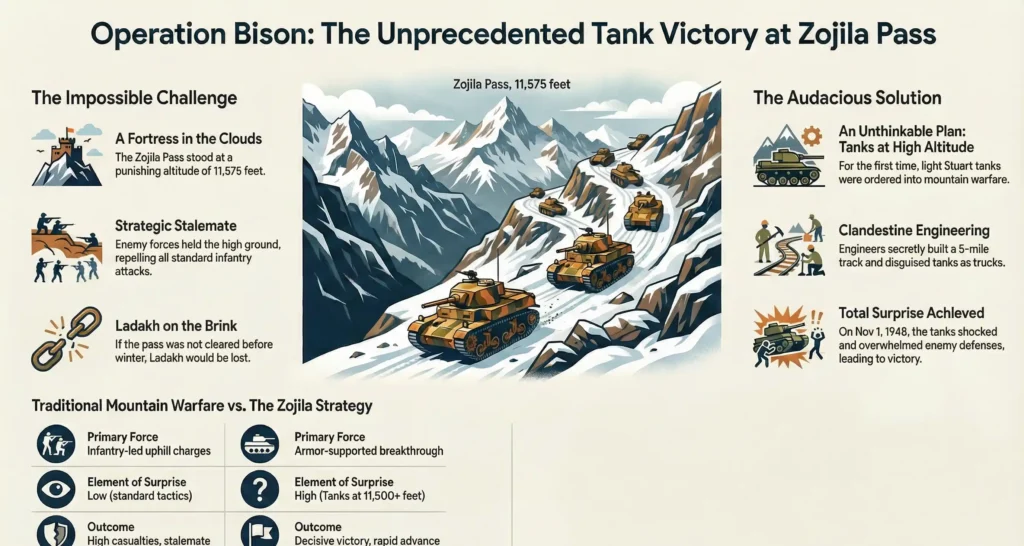
The Battle of Zojila was a pivotal conflict in the 1948 Indo-Pakistani War where the Indian Army successfully used light tanks at an altitude of 11,575 feet. This strategic masterstroke, part of Operation Bison, broke the enemy's hold on the Zojila Pass. By deploying the 7th Light Cavalry’s Stuart tanks, India was able to bypass the deadly stalemates of infantry warfare in high-altitude terrain, leading to the liberation of Dras, Kargil, and the securing of Leh.| Key Detail | Information |
| Operation Name | Operation Bison |
| Historical Event | Battle of Zojila (1948) |
| Primary Location | Zojila Pass, Jammu & Kashmir |
| Key Military Asset | 7th Light Cavalry (Stuart Tanks) |
| Altitude | 11,575 Feet (3,528 Meters) |
| Outcome | Decisive Indian Victory; Liberation of Ladakh |
The winter of 1948 was not just cold; it was a race against time and geography that threatened to sever Ladakh from the rest of India forever. The Battle of Zojila 1948 remains etched in military history as one of the most audacious gambles ever taken on a battlefield. At the heart of this story is the Zojila Pass, a narrow, treacherous gateway situated at an altitude of over 11,500 feet. For months, Pakistani raiders had entrenched themselves in the surrounding peaks, effectively cutting off the road to Leh. If the pass remained closed, Ladakh would fall. The Indian Army knew that a standard infantry assault against fortified mountain positions would lead to a massacre. They needed a miracle, and that miracle came in the form of steel tracks and sheer human will.
8 Defining Chapters in the Vikram Sarabhai Biography
The Gateway to the Clouds
Zojila is often described as the “Pass of Blizzards,” and in 1948, it became the focal point of India’s sovereignty. The terrain was unforgiving—steep cliffs, sub-zero temperatures, and oxygen-depleted air that made every step an ordeal. The enemy held the high ground at Mukand and Gumri, looking down upon any potential Indian advance. Earlier attempts to clear the pass using infantry and cavalry had been repelled by heavy machine-gun fire and the brutal climate. The situation was dire. General K.M. Cariappa and Lt. Gen. S.M. Shrinagesh realized that to break the stalemate, they had to do something the world had never seen: bring tanks to a high-altitude mountain pass.
The Impossible Engineering of Operation Bison
When the order was given to move the 7th Light Cavalry’s Stuart tanks to Zojila, many experts thought it was madness. Operation Bison was born out of this desperation. There were no roads capable of carrying heavy armor, and the bridges along the Srinagar-Ganderbal route were not built for the weight of 12-ton tanks. To keep the mission a secret, the Indian Army’s engineers worked under the cover of darkness. They dismantled the turrets of the tanks to reduce weight and disguised the hulls as trucks. This was a masterclass in Operation Bison history, showing that the Indian Army was as much a force of engineering genius as it was of combat prowess.
1971 Nagarwala Case: India’s Great Bank Heist Mystery
Building a Path Where None Existed
The Madras Sappers played a pivotal role in this saga. In just a matter of weeks, they carved a five-mile track through solid rock and shale, often working while being sniped at from above. This track, known as the “Humbug” track, was the lifeline that allowed the Stuart tanks in Zojila to reach the assembly point. The sight of these metal giants crawling up the narrow, winding paths was something the enemy never anticipated. The psychological advantage was shifting, even before the first shell was fired.
November 1: The Day the Mountains Shook
The final assault was scheduled for November 1, 1948. Typically, tanks are useless in heavy snow and steep gradients, but the Indian crews were determined. As the morning mist cleared, the Pakistani raiders were stunned to see the barrels of Stuart tanks emerging from the clouds. They initially refused to believe they were tanks, dismissing them as “armored trucks” or some kind of mountain-climbing contraption. When the 37mm guns began to roar, reality set in. The armor provided the Indian infantry with the cover they desperately needed to charge the enemy bunkers. The high-altitude warfare India practiced that day rewrote the manuals of mountain combat.
The Human Spirit Behind the Steel
Behind every tank and every gun was a story of personal sacrifice. Drivers operated with frostbitten fingers, and mechanics worked in the open air where the metal was so cold it would tear skin upon contact. The Indian Army 1948 victory was not just about superior technology; it was about the bond between the soldiers. Men from different backgrounds—the tankers from the south and the infantry from the north—stood together on that frozen ridge, united by a single purpose: the defense of their motherland.
Dr. A.P.J. Abdul Kalam: (1931-2015)
Battle Comparison: Tactics vs. Environment
| Feature | Traditional Mountain Warfare | The Zojila Strategy |
| Primary Force | Infantry-led uphill charges | Armor-supported breakthrough |
| Logistics | Mule-based supply lines | Engineer-built “Humbug” tracks |
| Element of Surprise | Low (standard mountain paths) | High (Tanks at 11,500+ feet) |
| Weather Impact | Can halt all operations | Tanks utilized despite heavy snow |
| Outcome | High casualties, slow progress | Decisive victory, rapid advance |
The Liberation of Leh
With Zojila cleared, the road to Leh was finally open. The Indian forces pushed forward with renewed vigor, liberating Dras and eventually Kargil. The success of the Battle of Zojila 1948 ensured that the cultural and spiritual heritage of Ladakh remained a part of India. Had the tanks not reached the pass, the map of India would look very different today. It remains a shining example of how unconventional thinking and bravery can overcome even the most insurmountable odds.
Curious Indian: Fast Facts
- A World Record: The deployment of Stuart tanks at Zojila remains one of the highest altitude tank battles in world military history.
- The Big Secret: To hide the tanks from enemy spies, they were moved at night with their turrets removed and covered in tarpaulins to look like common transport trucks.
- The Madras Sappers: These engineers built a road through the mountains in less than a month—a task that would normally take years.
- The Enemy’s Disbelief: Pakistani soldiers reportedly thought the tanks were “monsters” or “shaitans” (devils) because they didn’t believe machines could climb such heights.
- Thermal Challenges: Engines often froze, and crews had to light fires under the tanks just to get the oil flowing enough to start them.
Conclusion
The Battle of Zojila 1948 is more than just a date in a history book; it is a story of what happens when the human spirit refuses to accept the word “impossible.” By bringing tanks to the clouds, the Indian Army didn’t just win a battle—they saved a region and defined the grit of a new nation. Today, as travelers traverse the Zojila Pass, the echoes of the Stuart tanks’ engines still seem to resonate through the cold mountain air, reminding us of the heroes who stood tall when the stakes were highest.
The Purulia Arms Drop Mystery 1995: When the Sky Rained Guns
If you think you have remembered everything about this topic take this QUIZ
Results


#1. What was the primary strategic objective of ‘Operation Bison’ in 1948?
#2. How did the Indian Army successfully transport Stuart tanks to the Zojila Pass without alerting enemy spies?
#3. Which engineering unit was responsible for carving the five-mile ‘Humbug’ track through solid rock in just a few weeks?
#4. What was the initial reaction of the Pakistani raiders when they saw the Stuart tanks on November 1, 1948?
#5. At what altitude (approximately) was the Battle of Zojila fought?
#6. What major mechanical challenge did the tank crews face due to the extreme cold?
#7. According to the battle comparison table, what was a key difference between traditional mountain warfare and the Zojila strategy?
#8. Which regiment’s light tanks were used during the Battle of Zojila?
Why was the Battle of Zojila so important?
Zojila is the only link between the Kashmir Valley and Ladakh. If India had lost the pass, Ladakh would have likely been annexed by Pakistan in 1948.
Which tanks were used in the battle?
The Indian Army used M5 Stuart Light Tanks, which were prized for their mobility despite the extreme terrain.
Who led the tank operation?
The operation was carried out by the 7th Light Cavalry under the overall command of Lt. Gen. K.M. Cariappa and tactical leadership on the ground.
How did they get the tanks up the mountain?
They were dismantled, moved under secrecy, and driven over a temporary track carved into the mountainside by Indian Army engineers.