The Jaswant Singh Rawat 1962 war legend recounts the incredible story of a soldier who held off the Chinese army for three days during the Battle of Nuranang. With the help of two local girls, he created a tactical illusion that delayed the invasion and saved countless Indian lives. Today, he is revered as a "living saint" at the Jaswant Garh memorial, where the Indian Army continues to serve him as if he were still alive, proving that true heroes never really retire.| Category | Details |
| Name | Rifleman Jaswant Singh Rawat |
| Unit | 4th Battalion, Garhwal Rifles |
| Conflict | Indo-China War 1962 |
| Location | Nuranang, Arunachal Pradesh |
| Award | Maha Vir Chakra (Posthumous) |
| Legacy | “The Living Soldier” who never retired |
The Guardian of the Snowy Passes
The Jaswant Singh Rawat 1962 war legend begins in the biting cold of the Nuranang Valley, a place where the wind howls like a wounded beast through the mountain passes. It was November 1962, and the Sino-Indian war was at its most brutal peak. While the world watched the broader movements of divisions and armies, a solitary post in the North-East Frontier Agency (now Arunachal Pradesh) was about to witness a human experience so profound that it would blur the lines between history and divinity. Jaswant Singh Rawat, a young soldier of the 4 Garhwal Rifles, was not just a rifleman; he was a sentinel who refused to blink.
The air was thin, oxygen was a luxury, and the enemy was advancing with overwhelming numbers. Most units had been ordered to retreat due to lack of supplies and the sheer weight of the Chinese assault. But Jaswant, along with two other soldiers, decided to hold a position that commanded a strategic view of the valley. This decision was the spark that ignited the Jaswant Singh Rawat 1962 war legend, a story that is told today with moist eyes by every traveler crossing the Sela Pass.
1971 Nagarwala Case: India’s Great Bank Heist Mystery
The 72-Hour Stand: A Solo Defiance
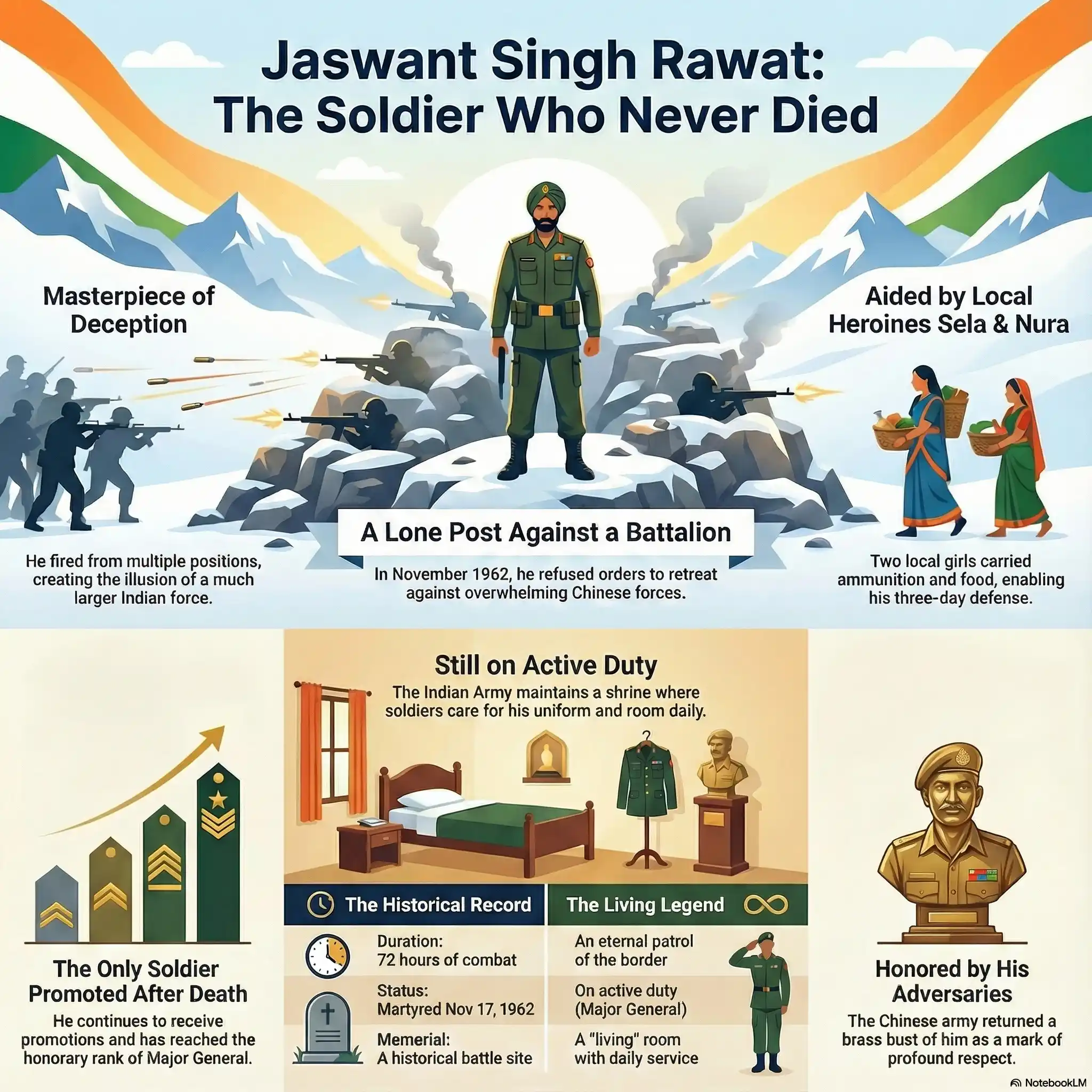
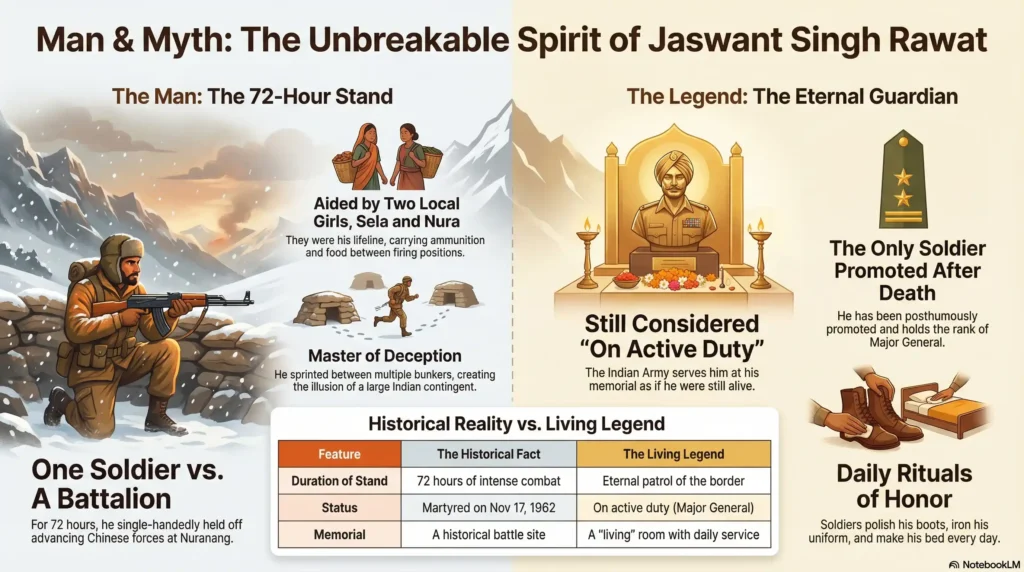
To understand the tactical depth of the Jaswant Singh Rawat 1962 war legend, one must look at the cleverness of his defense. After his two companions were martyred, Jaswant found himself alone against an entire battalion. But he was not truly alone. He was joined by two local Monpa girls, Sela and Nura, who stayed behind to help their “brother” defend their land. Together, they orchestrated a masterpiece of military deception.
Jaswant set up multiple firing positions along the ridge. He would fire from one bunker, then sprint through the snow to another, and fire again. This gave the Chinese forces the illusion that they were facing a massive Indian contingent. Sela and Nura acted as his lifelines, carrying ammunition and food between the bunkers. For 72 hours—three days of non-stop combat—this small team held off hundreds of soldiers. This is 4 Garhwal Rifles bravery in its most raw and relatable form. It wasn’t just about bullets; it was about a man who loved his country so much that he refused to let it fall, even when he was the last one standing.

The Tragedy of Sela and Nura
Every hero’s story has a tragic heartbeat, and the Sela and Nura story is the soul of this legend. As the Chinese realized they were being fooled, they captured a local villager who revealed Jaswant’s true strength. In the final, massive assault, Sela was killed in a grenade blast, and Nura was captured. Facing imminent capture and refusing to surrender, Jaswant Singh Rawat reportedly used his last bullet to end his life.
The Chinese were so moved by his courage that they cut off his head and took it back to China as a trophy. However, after the ceasefire, they returned a brass bust of the hero, acknowledging that they had never faced a soldier of such caliber. Today, the Sela Pass and the town of Nura bear the names of the two girls who stood by him, ensuring that the Jaswant Singh Rawat 1962 war legend remains a story of collective sacrifice and unbreakable bonds.
The Purulia Arms Drop Mystery 1995: When the Sky Rained Guns
The Living Legend of Jaswant Garh
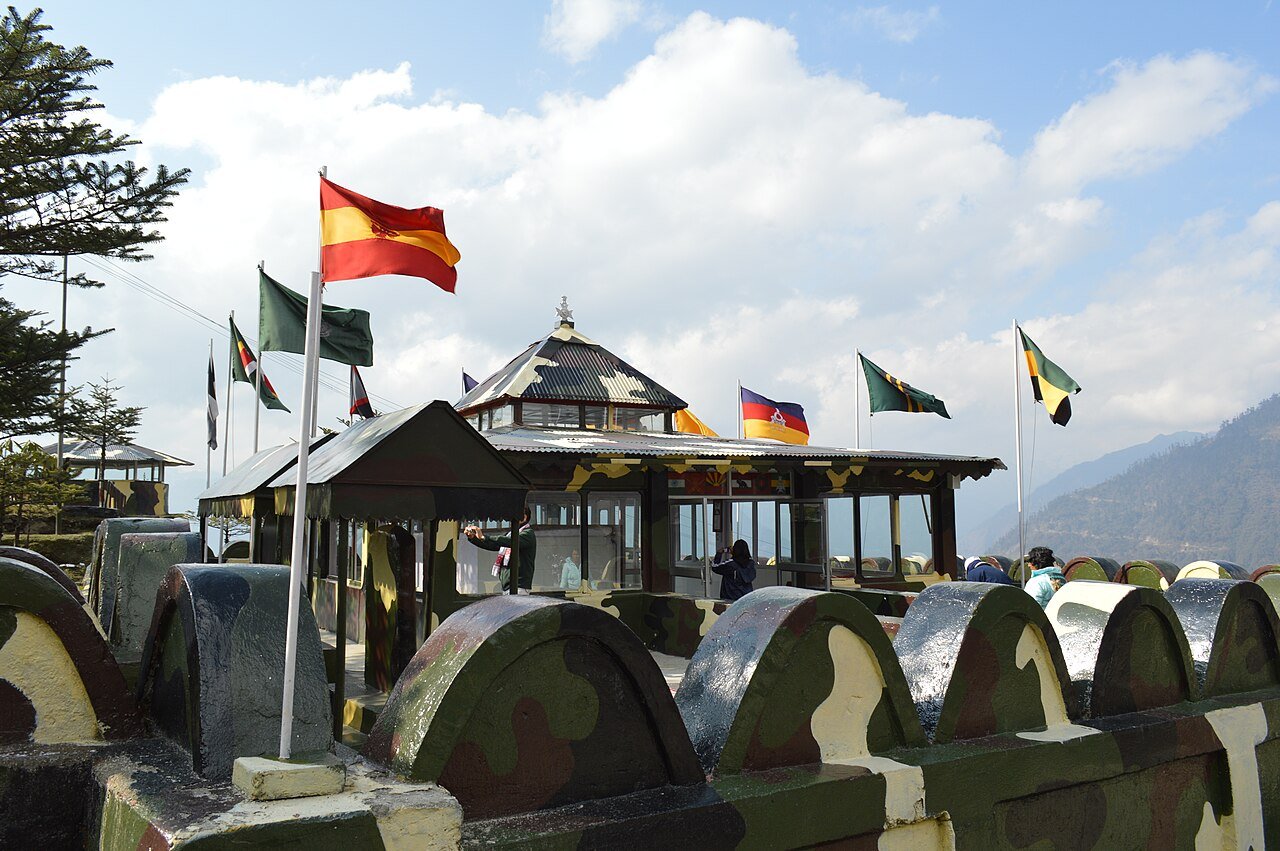
The most fascinating part of the Jaswant Singh Rawat 1962 war legend is what happened after his death. The Indian Army does not treat him as a martyr who is gone; they treat him as a soldier who is still on duty. A memorial called the Jaswant Garh memorial stands at the very spot where he fought his last battle. It is not a silent monument; it is a functioning army post.
Jaswant Singh Rawat continues to receive promotions. He was promoted to Major General (honorary) recently. Every morning, soldiers at the memorial polish his boots, iron his uniform, and lay out his breakfast. It is said that the bed is often found wrinkled in the morning, as if someone had slept in it. Soldiers on duty at the border report seeing a lone figure patrolling the ridges at night, occasionally slapping a sentry who has fallen asleep on his watch. Whether it is a collective psychological phenomenon or a genuine spiritual presence, the Jaswant Singh Rawat 1962 war legend keeps the morale of the Indian Army high in the harshest conditions on earth.
Curious Indian: Fast Facts
- Eternal Promotion: Jaswant Singh is the only Indian soldier to be promoted continuously after his death.
- The Living Bed: Army personnel still make his bed every night and report that the sheets are often disturbed by morning.
- The Brass Bust: The Chinese army gifted a brass bust of Jaswant Singh to India as a mark of respect for his bravery.
- Maha Vir Chakra: He was posthumously awarded the Maha Vir Chakra, India’s second-highest military honor.
- The Sela Connection: The famous Sela Pass is named after the girl who helped him during the Battle of Nuranang mystery.
Quick Comparison: The Facts vs. The Legend
| Feature | Historical Record | The Living Legend |
| Duration of Stand | 72 hours of combat | Eternal patrol of the border |
| Support | Sela and Nura (Local girls) | Spirit guides for modern soldiers |
| Status | Martyred Nov 17, 1962 | On active duty (Major General rank) |
| Memorial | Historical Site | A “living” room with ironed clothes |
Conclusion
The Jaswant Singh Rawat 1962 war legend is a bridge between our glorious past and a resilient future. It teaches us that courage is not the absence of fear, but the decision that something else is more important than fear. As we visit the heights of Arunachal Pradesh, the winds of Nuranang still whisper his name. For any “Curious Indian,” this story is a reminder that as long as we remember our heroes, they never truly leave us. He remains the silent guardian, the watchful protector, and the eternal Major General of the Himalayas.
8 Defining Chapters in the Vikram Sarabhai Biography
If you think you have remembered everything about this topic take this QUIZ
Results


#1. What primary military deception did Jaswant Singh Rawat employ to hold back the Chinese forces at Nuranang?
#2. According to the legend, who provided essential support to Jaswant Singh Rawat during his 72-hour stand?
#3. What unique honour does the Indian Army bestow upon Jaswant Singh Rawat to this day at his memorial?
#4. What gesture of respect did the Chinese army make towards Jaswant Singh Rawat after the conflict ended?
#5. The famous Sela Pass in Arunachal Pradesh is named in memory of:
#6. To which regiment of the Indian Army did Rifleman Jaswant Singh Rawat belong?
#7. What was the reported fate of Sela and Nura during the final Chinese assault?
#8. Which high military honour was posthumously conferred upon Jaswant Singh Rawat for his actions?
Is Jaswant Singh Rawat still considered “on duty”?
Yes, the Indian Army treats him as a serving officer. He receives regular promotions, and soldiers iron his clothes and make his bed daily at the Jaswant Garh memorial.
What was the role of Sela and Nura?
Sela and Nura were local Monpa girls who helped Jaswant by providing food and ammunition and helping him move between firing positions to fool the enemy.
What happened at the Battle of Nuranang?
Jaswant Singh Rawat successfully held off a Chinese battalion for 72 hours, destroying nearly 300 enemy soldiers before his position was finally compromised.
Can I visit Jaswant Garh?
Yes, the memorial is a popular stop for travelers on the way to Tawang in Arunachal Pradesh. It offers free tea and snacks to all visitors as a tradition.