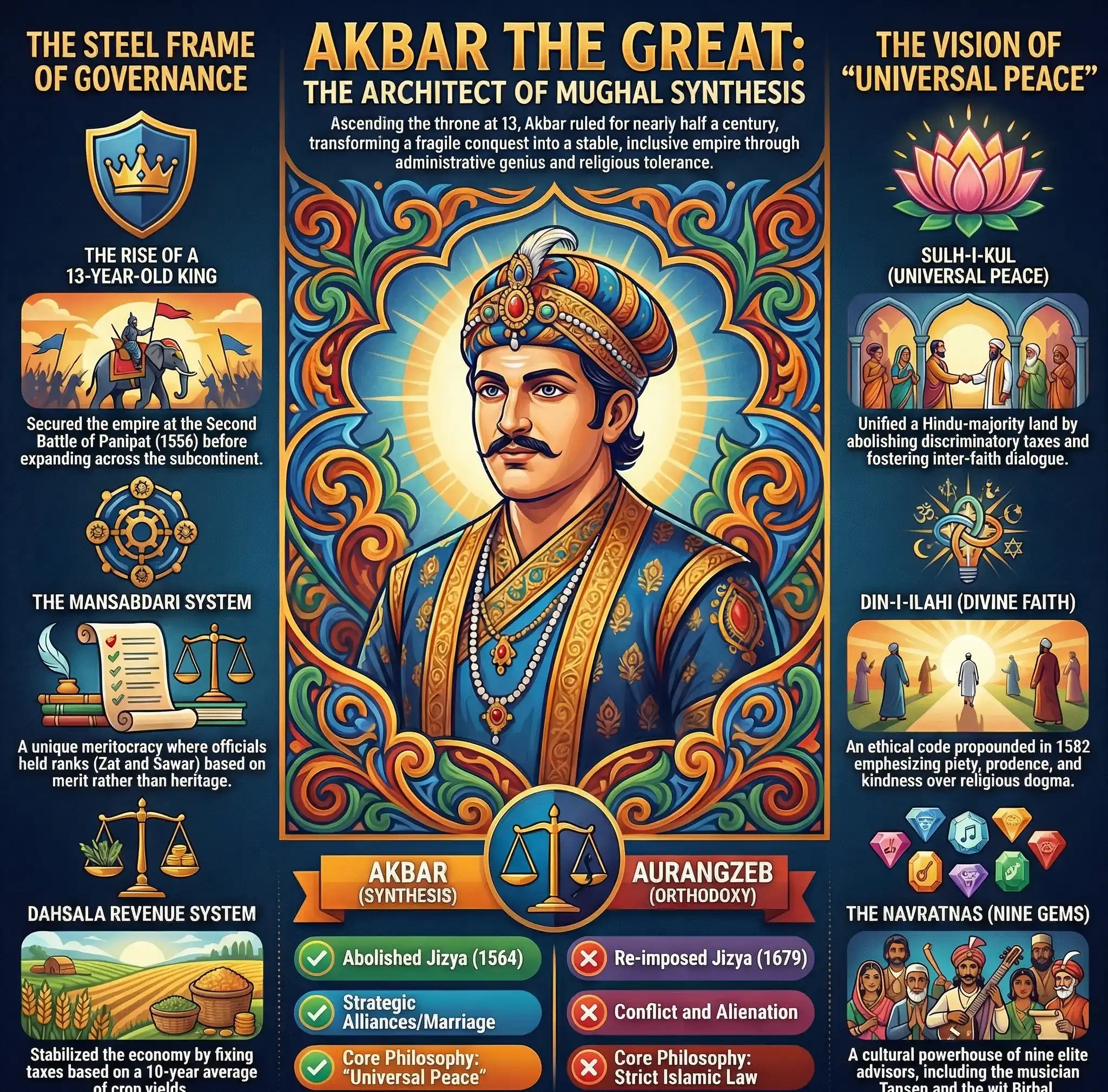
The Reign of Akbar spans nearly half a century, from 1556 to 1605. Ascending the throne at the tender age of 13 after the sudden death of his father Humayun, Akbar faced immediate threats from Hemu and Afghan rebels. His victory at the Second Battle of Panipat (1556) secured his position. Over the next five decades, he expanded the Mughal Empire to cover most of the Indian subcontinent. But his true legacy lies in his administrative brilliance—the Mansabdari system—and his revolutionary religious policy of Sulh-i-kul (Universal Peace). He abolished the discriminatory Jizya tax, engaged in inter-faith dialogues at the Ibadat Khana, and even proposed a new syncretic way of life called Din-i-Ilahi. Under his rule, art, culture, and economy flourished, marking the zenith of Indo-Islamic civilization.| Feature | Details |
| Reign Dates | 1556 – 1605 |
| Coronation Age | 13 Years Old (at Kalanaur) |
| Regent | Bairam Khan |
| Key Victory | Second Battle of Panipat (1556) |
| Religious Policy | Sulh-i-kul (Universal Peace) |
| New Faith | Din-i-Ilahi (Divine Faith) |
| Capital Cities | Agra, Fatehpur Sikri, Lahore |
| Administrative System | Mansabdari System |
| Revenue Minister | Raja Todar Mal (Dahsala System) |
The Boy King and the Regent
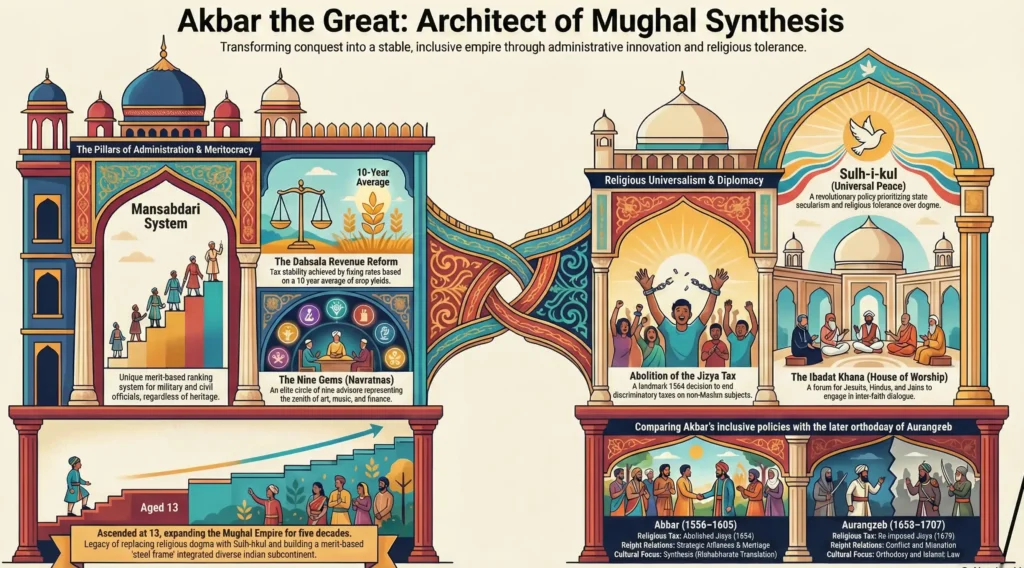
When Humayun tumbled down his library stairs and died in 1556, the Mughal Empire was fragile. Akbar was crowned on a masonry platform in Kalanaur, Punjab. He was a boy king surrounded by wolves. The Hindu general Hemu (Hemchandra Vikramaditya) had captured Delhi and Agra.
It was Akbar’s regent, Bairam Khan, who saved the empire. At the Second Battle of Panipat (1556), a lucky arrow struck Hemu in the eye, turning a certain defeat into a decisive Mughal victory. Akbar was now the undisputed ruler of Hindustan.
Nadir Shah’s Invasion of Delhi 1739: The Massacre That Emptied India
Conquest by Sword and Marriage
Akbar realized that to rule a Hindu-majority land, he couldn’t rely solely on foreign nobles (Uzbeks/Persians). He needed the Rajputs.
- Matrimonial Alliances: In a masterstroke of diplomacy, he married Harkha Bai (often called Jodha Bai), the daughter of Raja Bharmal of Amber (Jaipur). Unlike previous conquerors, he allowed her to practice Hinduism inside the Mughal harem.
- Military Campaigns: He conquered Gujarat (1573), Bengal (1576), and Kashmir (1586). However, the valiant Maharana Pratap of Mewar refused to bow. The Battle of Haldighati (1576) between Akbar’s general Man Singh and Maharana Pratap remains a legendary saga of Rajput resistance.
The Steel Frame: Mansabdari System
Akbar didn’t just conquer; he organized. He introduced the Mansabdari System, a unique blend of civil and military administration.
- Ranks: Every official was given a rank (Mansab) consisting of Zat (personal status) and Sawar (cavalry command).
- Meritocracy: It wasn’t hereditary. A Hindu could rise to the highest rank (like Raja Man Singh) based on merit.
- Land Revenue: His finance minister, Raja Todar Mal, introduced the Dahsala System (Bandobast system), fixing taxes based on a 10-year average of crop yields, which brought stability to the peasant and the treasury.
The Quest for Truth: Din-i-Ilahi
Akbar was deeply spiritual but allergic to dogma. He built the Ibadat Khana (House of Worship) in Fatehpur Sikri, where he invited Jesuits from Goa, Zoroastrians, Hindus, and Jains to debate with Muslim Ulema.
Disillusioned by the bickering of religious clerics, he propounded Din-i-Ilahi (Divine Faith) in 1582. It wasn’t a new religion but an ethical code emphasizing piety, prudence, abstinence, and kindness. Only a handful of courtiers, including Birbal, accepted it. It died with Akbar, but it proved his commitment to secularism.
Battle of Plassey 1757: The Betrayal That Changed India’s Destiny
The Nine Gems (Navratnas)
Akbar’s court was a cultural powerhouse, adorned by the Navratnas (Nine Gems):
- Birbal: The witty advisor and close friend.
- Tansen: The legendary musician whose voice could light lamps (Deepak Raga) or bring rain (Megh Malhar).
- Abul Fazl: The historian who wrote the Akbarnama and Ain-i-Akbari.
- Faizi: The poet laureate.
- Raja Man Singh: The brilliant general.
- Raja Todar Mal: The finance wizard.
- Mullah Do Pyaza: The advisor known for his wit.
- Fakir Aziao-Din: The mystic advisor.
- Abdul Rahim Khan-i-Khanan: The poet and son of Bairam Khan.
Reign of Aurangzeb 1658-1707: The Zenith and Decline of the Mughals
Quick Comparison Table: Akbar vs. Aurangzeb
| Feature | Akbar (1556–1605) | Aurangzeb (1658–1707) |
| Religious Tax | Abolished Jizya (1564) | Re-imposed Jizya (1679) |
| Temple Policy | Allowed construction / Grants | Destroyed specific temples |
| Rajput Relations | Strategic Alliances / Marriage | Conflict / Alienation |
| Cultural Focus | Synthesis (Translation of Mahabharata) | Orthodoxy / Islamic Law |
| Capital | Fatehpur Sikri / Agra | Delhi / Aurangabad (Camp) |
| Legacy | “The Great” (Inclusive) | “Alamgir” (Polarizing) |
Curious Indian: Fast Facts
- Illiterate Genius: Akbar is perhaps the only major emperor in history who was illiterate (likely due to dyslexia), yet he had books read to him daily and possessed encyclopedic knowledge.
- Fatehpur Sikri: He built an entire new capital city, Fatehpur Sikri, to honor the Sufi saint Salim Chishti, who predicted the birth of his son Jahangir. He abandoned it 15 years later due to water shortage.
- Vegetarianism: In his later years, Akbar largely gave up meat, stating, “It is not right that a man should make his stomach the grave of animals.”
- The “Allah-u-Akbar” Seal: He introduced a greeting Allah-u-Akbar, which was controversial because it could mean “God is Great” or “Akbar is God,” reflecting his flirtation with divinity.
Conclusion
The Reign of Akbar was a rare moment in history where power bowed to wisdom. He realized early on that a foreign dynasty could not rule India by the sword alone; it had to become Indian. By marrying local princesses, respecting local customs, and appointing local talent, he transformed the Mughal Empire from a Central Asian warlord state into an Indian entity. He proved that the strongest cement for an empire is not mortar, but tolerance.
Reign of Shah Jahan: The Golden Age of Mughal Architecture
If you think you have remembered everything about this topic take this QUIZ
Results


#1. At what age did Akbar ascend the throne after the sudden death of his father Humayun?
#2. Who was the regent and guardian who led the Mughal forces to victory at the Second Battle of Panipat?
#3. Which discriminatory tax on non-Muslims did Akbar abolish in 1564?
#4. What was the name of the new capital city built by Akbar to honor the Sufi saint Salim Chishti?
#5. The “Mansabdari System” introduced by Akbar was a unique administrative system based on:
#6. Who was the Finance Minister (Diwan) responsible for introducing the Dahsala revenue system?
#7. What was the name of the syncretic ethical code or “Divine Faith” propounded by Akbar in 1582?
#8. Which legendary musician, one of the Navratnas, was believed to be able to light lamps with his voice?
When did Akbar ascend the throne?
He became emperor in 1556 at the age of 13.
What was the Second Battle of Panipat?
It was a battle fought in 1556 between the forces of Akbar (led by Bairam Khan) and the Hindu king Hemu. Akbar’s victory secured Mughal rule in India.
What was the Mansabdari System?
It was an administrative system introduced by Akbar where every official was given a rank (Mansab) determining their status and the number of troops they had to maintain.
Who was Akbar’s famous Finance Minister?
Raja Todar Mal was his finance minister, famous for introducing the Dahsala revenue system.
Did Akbar start a new religion?
He started a syncretic spiritual movement called Din-i-Ilahi (Divine Faith), which blended elements of Islam, Hinduism, Zoroastrianism, and Christianity, but it was not a formal religion with a scripture.