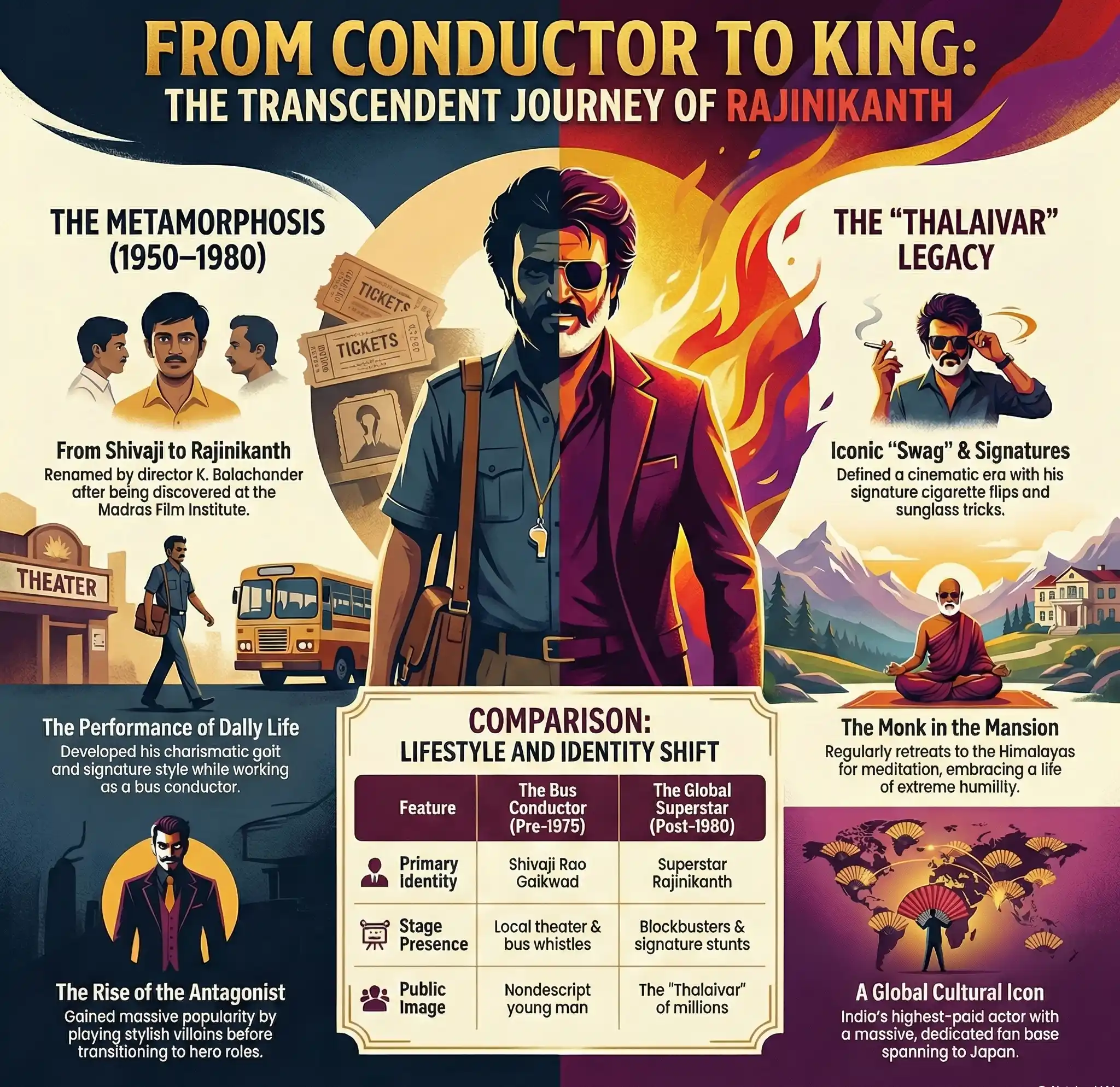
The journey of Shivaji Rao Gaikwad, famously known as Rajinikanth, is one of the most remarkable "rags-to-riches" stories in the history of global cinema. Born into a modest family in Bangalore, he worked several odd jobs, including serving as a bus conductor, before his passion for acting led him to the Madras Film Institute. Discovered by director K. Balachander, he transformed from a menacing villain into the "Superstar" of Indian cinema, a title he has held for decades. Beyond the gravity-defying stunts and iconic dialogues, his life is defined by a profound spiritual connection to the Himalayas and a reputation for extreme humility, making him a living legend whose influence extends far beyond the borders of Tamil Nadu.8 Fascinating Facts in the Homi Jehangir Bhabha Biography
| Attribute | Details |
| Birth Name | Shivaji Rao Gaikwad |
| Date of Birth | December 12, 1950 |
| Place of Birth | Bangalore, Mysore State (now Karnataka) |
| First Movie | Apoorva Raagangal (1975) |
| Spiritual Guru | Mahavatar Babaji |
| Highest Award | Dadasaheb Phalke Award (2019) |
| Famous Signature | Flipping cigarettes and sunglasses |
The Beginning of an Era: The Rajinikanth Life Story
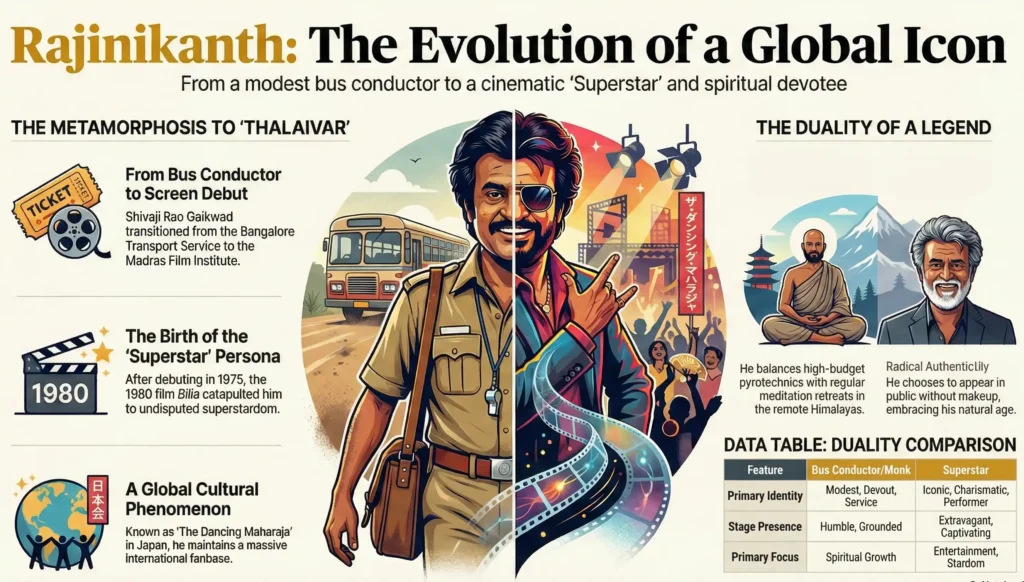
The Rajinikanth life story did not begin in the glitz of a film studio, but in the dusty streets of Bangalore, where a young boy named Shivaji Rao Gaikwad faced the harsh realities of a middle-class upbringing. The youngest of four siblings, Shivaji lost his mother at the tender age of nine, a loss that would deeply shape his emotional landscape and eventually lead him toward a path of spiritual seeking. His father, a police constable, struggled to provide, and Shivaji spent his youth doing whatever it took to survive—working as a carpenter, a coolie, and eventually finding a stable job as a bus conductor for the Bangalore Transport Service.
Even in those early days, the seeds of a superstar were visible. Passengers on his bus didn’t just pay for their tickets; they paid for the show. Shivaji had a way of whistling, a way of issuing tickets with a flick of the wrist, and a charismatic gait that made people wait specifically for his bus. He was already a performer in the theater of daily life, and it was his close friend, Raj Bahadur, who saw the fire in him. Bahadur encouraged Shivaji to enroll in the Madras Film Institute, even providing financial support when his family was hesitant. It was a leap of faith that would change the course of Indian history forever.
6 Unfoldings in the Subrahmanyan Chandrasekhar Biography
The Metamorphosis: From Shivaji to Rajinikanth
When Shivaji Rao Gaikwad arrived in Chennai, he was a man with a dream but no map. His breakthrough came when the legendary director K. Balachander noticed him during a performance at the institute. Balachander didn’t see just an actor; he saw a unique energy. He gave Shivaji a new name—Rajinikanth—taken from a character in his earlier film Major Chandrakanth. His debut in Apoorva Raagangal (1975) was modest, appearing in a small role as a man opening a gate, but the impact was seismic.
In the late 1970s, the Rajinikanth life story took a sharp turn into the territory of the antagonist. He played the villain with such panache and “swag” that audiences began to root for him over the heroes. His collaboration with the prodigious Kamal Haasan in films like 16 Vayathinile and Moondru Mudichu established him as a formidable presence. However, it was the 1980 film Billa—a remake of Amitabh Bachchan’s Don—that officially catapulted him to superstardom. He had found his niche: the stylish, larger-than-life hero who stood for the common man.
The Spiritual Mystery: The Monk in the Mansion
Perhaps the most intriguing chapter of the Rajinikanth life story is the stark contrast between his on-screen persona and his private life. While his films are filled with pyrotechnics and mass hysteria, the man behind the myth is a devoted spiritualist. For decades, Rajinikanth has made regular pilgrimages to the Himalayas, often disappearing into the mountains to meditate in the caves of Mahavatar Babaji.
This duality is what fascinates his fans the most. He is a man who can command the opening of a temple in his name, yet he chooses to appear in public without wigs or makeup, embracing his age and natural appearance with a transparency rarely seen in the film industry. His devotion to the teachings of Autobiography of a Yogi and his frequent retreats to the Swami Dayananda Ashram in Rishikesh serve as a grounding force, allowing him to navigate the intoxicating heights of fame with a monk-like detachment. He has often said that while Shivaji Rao Gaikwad lives in the world, Rajinikanth is merely a role he plays for his fans.
A Global Phenomenon and the “Thalaivar” Status
By the 1990s, Rajinikanth had transitioned from being a mere actor to a “Thalaivar” (Leader). His films like Baasha, Padayappa, and Annamalai broke every conceivable box office record. His influence was so great that even his political whispers could sway elections in Tamil Nadu. The world took notice, especially Japan, where his film Muthu turned him into a cultural icon known as “The Dancing Maharaja.”
The Rajinikanth life story is also one of immense philanthropy, though much of it happens away from the cameras. From donating to disaster relief funds to supporting the education of thousands of children, he treats his wealth as a responsibility rather than a luxury. Even as he crossed into his 70s, films like Jailer proved that the “Superstar” tag is not just a title but a permanent state of being. He remains the highest-paid actor in India, not because of his demands, but because the audience’s demand for him is inexhaustible.
8 Remarkable Secrets in the Jagadish Chandra Bose Biography
Quick Comparison: The Transition of an Icon
| Feature | The Bus Conductor (Pre-1975) | The Global Superstar (Post-1980) |
| Primary Identity | Shivaji Rao Gaikwad | Superstar Rajinikanth |
| Lifestyle | Working-class struggle, simple jobs | High-net-worth individual, global icon |
| Stage Presence | Local theater and BTS bus whistles | Blockbuster movies and signature stunts |
| Focus | Survival and finding a break | Spiritual growth and cinema excellence |
| Public Image | Nondescript young man | The “Thalaivar” of millions |
Curious Indian: Fast Facts
- The Name Change: He was named Shivaji after the great Maratha warrior Chhatrapati Shivaji Maharaj.
- The First Ticket: Even today, the first ticket of any new bus route launched by the Bangalore Transport Service is often sent to him as a mark of respect.
- Japanese Fandom: He is the only Indian actor to have a massive, dedicated fan base in Japan that travels to India for his film releases.
- Non-Smoker in Real Life: Despite his famous cigarette-flipping tricks on screen, he has frequently advised his fans against the habit in recent years.
- CBSE Lessons: His life journey, specifically his rise from a bus conductor, is part of the school syllabus in many parts of India to inspire children.
Conclusion
The Rajinikanth life story is a testament to the fact that destiny is not just about where you start, but about the courage to follow a path that others cannot see. He remains an enigma—a man who wears the crown of superstardom with the heart of a seeker. Whether he is flipping a cigarette on a 70mm screen or meditating in the silent folds of the Himalayas, he embodies the spirit of resilience. For every “Curious Indian,” Rajinikanth is more than just an actor; he is proof that with enough style, heart, and faith, a bus conductor can indeed become a king.
10 Remarkable Facts About Meghnad Saha Life and Achievements
If you think you have remembered everything about this topic take this QUIZ
Results


#1. What is Rajinikanth’s birth name?
#2. Before joining the film industry, what job did Rajinikanth hold in Bangalore?
#3. Which legendary director discovered Rajinikanth and gave him his screen name?
#4. In which film did Rajinikanth make his debut in 1975?
#5. Which Rajinikanth film turned him into a cultural icon in Japan known as “The Dancing Maharaja”?
#6. Who is Rajinikanth’s spiritual guru, whose caves he visits in the Himalayas?
#7. Which 1980 film, a remake of Amitabh Bachchan’s Don, officially catapulted him to superstardom?
#8. Which prestigious award was conferred upon Rajinikanth in 2019?
What is Rajinikanth’s real name?
His real name is Shivaji Rao Gaikwad. He was born into a Marathi-speaking family in Bangalore.
How did the Rajinikanth life story begin in films?
He was discovered by director K. Balachander at the Madras Film Institute and made his debut in the 1975 film Apoorva Raagangal.
Is Rajinikanth active in politics?
While he frequently voiced his opinions and planned to enter politics in 2017, he eventually decided to step back from formal politics due to health reasons in late 2020.
Why is he called “Thalaivar”?
“Thalaivar” means leader or boss in Tamil. It is a title bestowed upon him by his fans to signify his unparalleled status in the industry.
Read More: https://curiousindian.in/kamal-haasan-november-1954-present/