The Purulia arms drop mystery is one of the most bizarre and terrifying breaches of national security in the history of independent India. Unlike political assassinations that happen behind closed doors, this crime happened in the open sky, witnessed by hundreds of villagers.
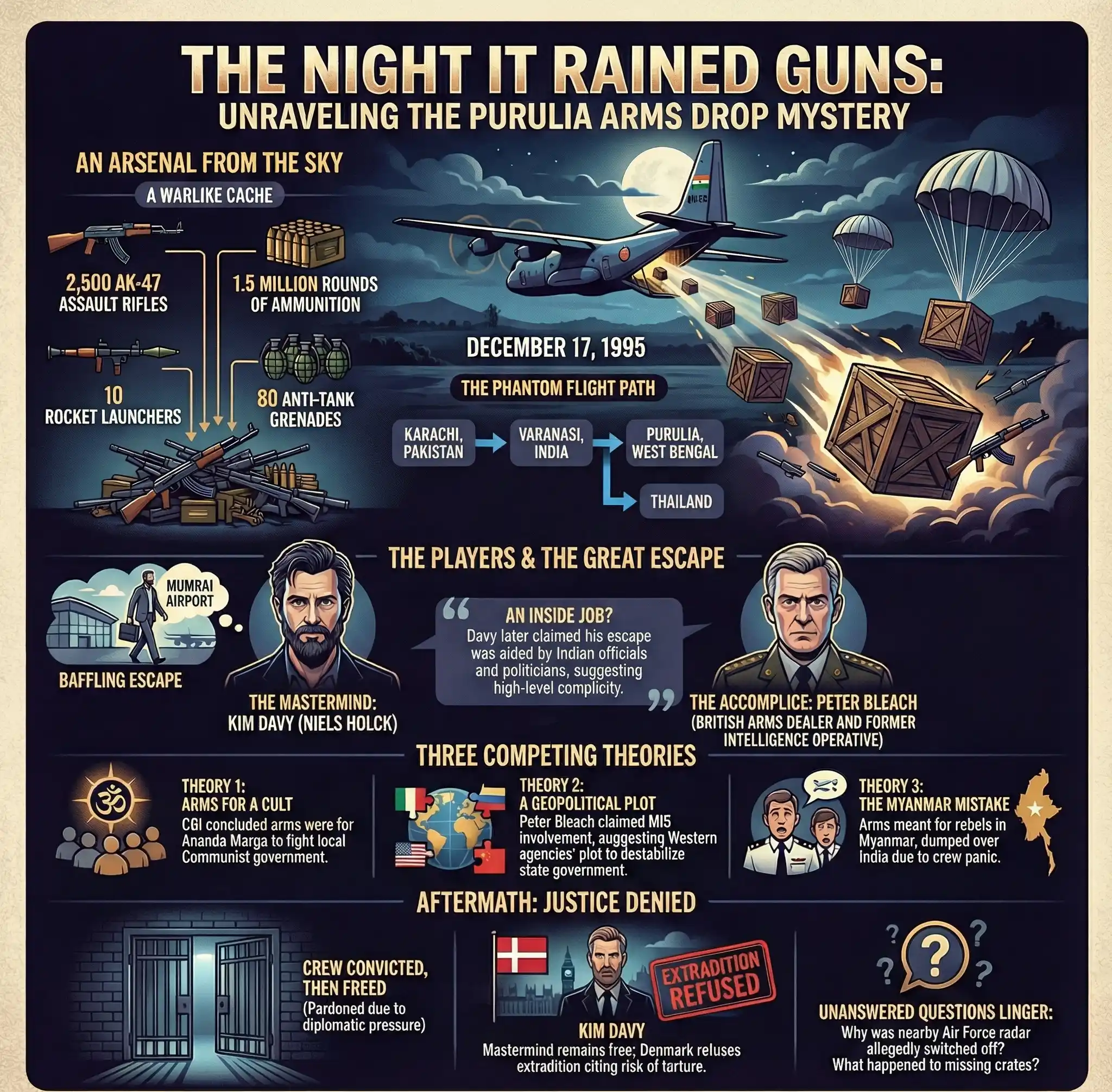
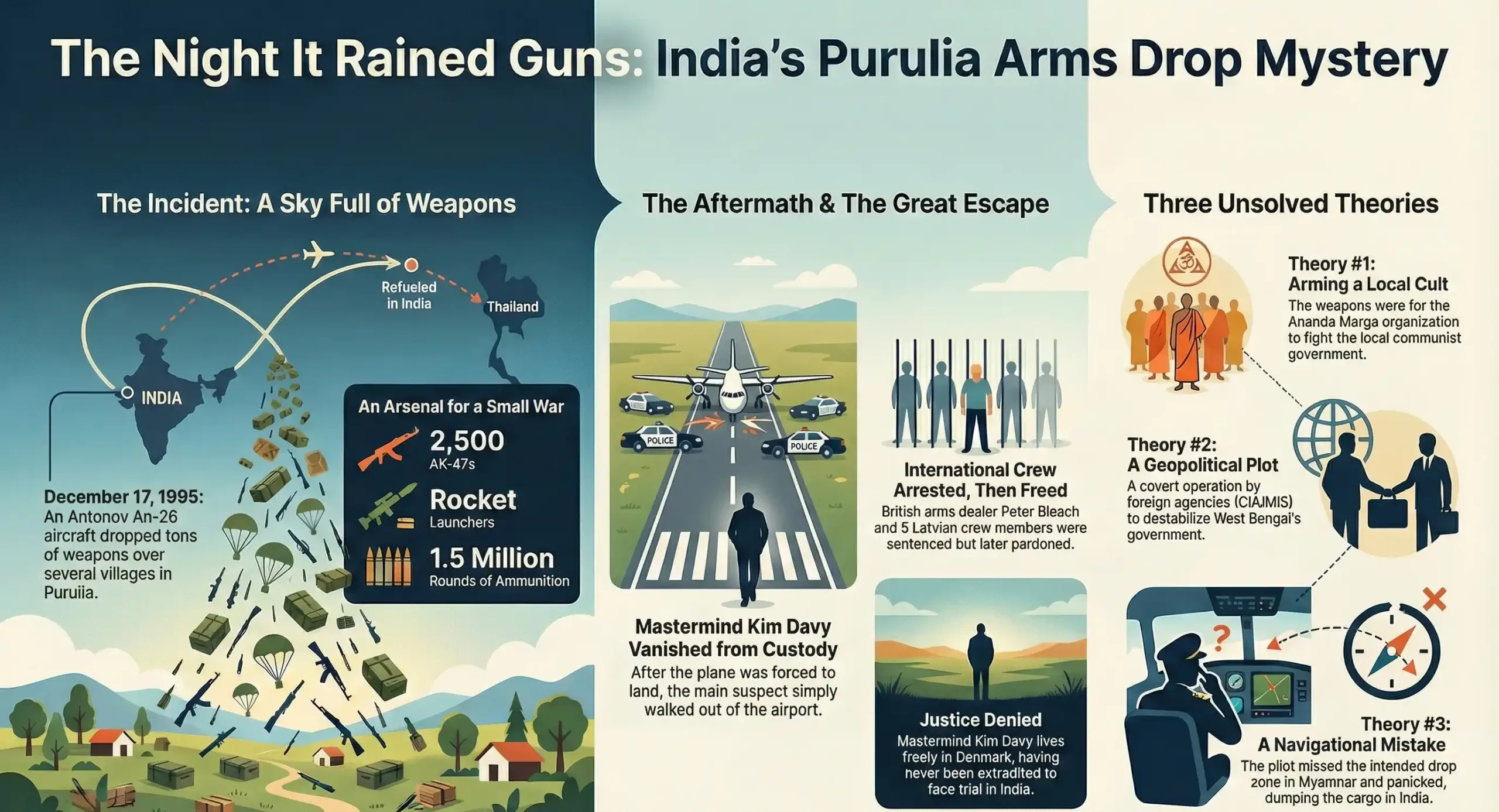
On the night of December 17, 1995, the residents of Jhalda, Khatanga, and Belamu villages in West Bengal’s Purulia district woke up to a strange sound—a low-humming aircraft circling in the dark. Moments later, heavy wooden crates rained down from the heavens, crashing into fields and huts.
When the villagers opened the boxes, they didn’t find food or aid. They found war.
2,500 AK-47 Assault Rifles
10 Rocket Launchers
80 Anti-Tank Grenades
1.5 Million Rounds of Ammunition.
It was enough firepower to start a small war. Who sent them? Who were they for? And most importantly, how did the mastermind behind it simply walk away?
Welcome to the Unsolved India, where we analyze the night it rained guns.
The Flight of the Phantom: Antonov An-26
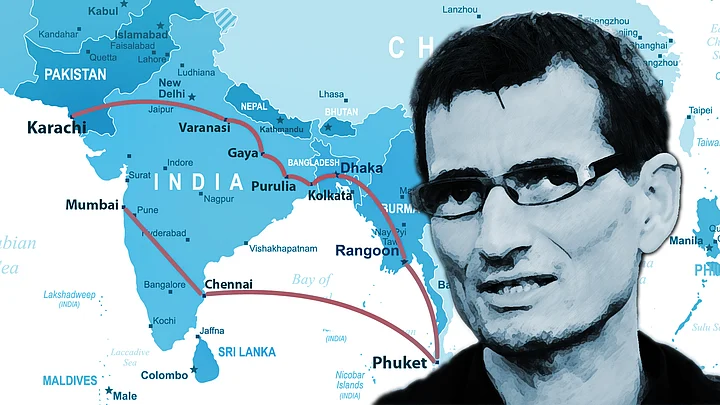
The aircraft responsible was an Antonov An-26, a Soviet-era cargo plane registered in Latvia. Its flight path was a masterclass in deception. It took off from Karachi (Pakistan), stopped in Varanasi for fuel (in India!), and then flew towards Kolkata.
But over Purulia, it went off radar. The rear hatch opened, and pallets of weapons were parachuted down.
The plane then continued to Thailand. Incredibly, days later, the same plane entered Indian airspace again on its return journey. This time, an Indian Air Force MiG-21 intercepted it and forced it to land in Mumbai.
The crew was arrested:
Peter Bleach: A British arms dealer and former intelligence operative.
Five Latvian Crew Members.
Kim Davy: The alleged Danish mastermind.
The Great Escape of Kim Davy
Here is where the Purulia arms drop mystery turns into a spy thriller. After the plane landed in Mumbai, surrounded by Indian security forces, Kim Davy (real name Niels Holck) managed to slip away.
Did he run? No. He reportedly simply walked out of the airport.
He traveled to Nepal and then back to Denmark, where he lives freely today.
Davy later claimed he was aided by Indian officials and politicians, including a local MP, to escape.
How does the prime suspect of an international arms drop walk out of a high-security airport without help from the inside?
Theory 1: The Ananda Marga Connection
The Central Bureau of Investigation (CBI) concluded that the weapons were intended for the Ananda Marga, a socio-spiritual organization based in Purulia.
Motive: The Ananda Marga had a long history of violent conflict with the ruling Communist Party of India (Marxist) – CPI(M) government in West Bengal.
Evidence: Kim Davy himself admitted that the arms were for the Ananda Marga to defend themselves against “communist oppression”.
However, critics argue that 2,500 AK-47s and anti-tank grenades are excessive for “self-defense.” This was an arsenal meant for an insurrection.
Theory 2: The CIA/MI5 Plot to Destabilize Bengal
A darker theory suggests that the Ananda Marga were just pawns in a geopolitical game.
Peter Bleach’s Testimony: Bleach, the British arms dealer, claimed he was actually an informant for MI5 (British Intelligence). He stated that he had informed British authorities about the drop months in advance.
The RAW Tip-off: Reports suggest that MI5 did inform India’s Research and Analysis Wing (RAW) about the impending drop. Yet, the plane was allowed to land, refuel, and fly freely.
Was this a controlled operation by Western agencies (CIA/MI5) to destabilize the communist government in West Bengal, which had gone wrong? Kim Davy has publicly claimed that the Indian central government (Congress at the time) was aware of the plan to destabilize the state’s Left Front government.
Theory 3: The Myanmar Mistake
A third theory proposes that the pilot simply missed his target. The weapons were allegedly meant for the Kachin Independent Army in Myanmar, fighting the military junta. Due to a navigational error or fear of interception, the crew panicked and dumped the cargo over Purulia.
However, the specific maps found on the plane and Davy’s confession regarding Ananda Marga make this less likely.
Conclusion: Justice Denied
The aftermath of the Purulia arms drop is a story of diplomatic failure.
Peter Bleach and the Latvian crew were sentenced to life imprisonment but were released a few years later due to pressure from the British and Russian governments (Bleach was pardoned in 2004).
Kim Davy lives in Denmark. Despite repeated extradition requests by India, Danish courts have refused to send him back, citing “risk of torture” in Indian prisons.
Today, the rusty guns of Purulia sit in police lockers, and the mystery remains: Was it a spiritual cult, a foreign government, or a massive intelligence failure that allowed it to rain guns on Indian soil?
🕵️ Unsolved India: Fast Facts
The Radar Switch-Off: It is alleged that the radar at Kalaikunda Air Force base (nearby) was mysteriously switched off or not operational during the exact time of the drop.
The “Secret” Pardon: Peter Bleach was released after intense lobbying by the UK government, fueling rumors that he was indeed a protected intelligence asset.
The Missing Cargo: While most weapons were recovered, reports suggest that several crates were carried away by locals before the police arrived. Some of these weapons reportedly found their way to Naxalites in the region.
If you think you have rememberd everything about this topic take this QUIZ
Results


#1. What was the official conclusion of India’s Central Bureau of Investigation (CBI) regarding the intended recipients of the weapons dropped over Purulia?
#2. According to the source material, what happened to Kim Davy (Niels Holck), the alleged mastermind, immediately after the plane was forced to land in Mumbai?
#3. The geopolitical theory surrounding the arms drop suggests the involvement of Western intelligence agencies like the CIA or MI5. What evidence from the text supports this theory?
#4. What was particularly unusual about the flight of the Antonov An-26 aircraft before it was eventually intercepted?
#5. What was the ultimate legal outcome for Peter Bleach and the Latvian crew members involved in the arms drop?
#6. The ‘Myanmar Mistake’ theory is considered less probable for what primary reason, according to the source material?
#7. Which of the following items was NOT listed as part of the arsenal dropped over the Purulia district?
#8. According to a ‘Fast Fact’ in the text, what suspicious circumstance at a nearby air force base coincided with the time of the arms drop?
Frequently Asked Questions (FAQs)
Q: Who was Kim Davy? A: Kim Davy is the alias of Niels Holck, a Danish national. He admitted to being the mastermind behind the arms drop, claiming he wanted to help the Ananda Marga sect fight the communist government of West Bengal. He currently lives in Denmark.
Q: Was Peter Bleach a spy? A: Peter Bleach was a British arms dealer who claimed he was working as an informant for British Intelligence (MI5) to expose the arms deal. He argues that he kept the British authorities informed, who in turn alerted Indian agencies, yet the drop was allowed to happen.
Q: Why did Denmark refuse to extradite Kim Davy? A: The Danish High Court rejected India’s extradition request, citing that Davy might face “torture or inhumane treatment” in Indian prisons, which would violate the European Convention on Human Rights.
Q: What happened to the weapons? A: The majority of the weapons were seized by the West Bengal police and the CBI. However, it is widely believed that some weapons were looted by villagers or local insurgents before authorities could secure the vast drop zone.
Q: Was the Indian Government involved? A: Kim Davy has alleged that elements within the Indian central government (Congress) sanctioned the drop to destabilize the rival Communist (CPI-M) government in West Bengal. However, the CBI has denied these claims.
This article is part of our exclusive series Unsolved India. Read the previous chapter: The Syama Prasad Mookerjee Death Mystery.