Naseeruddin Shah is not merely an actor; he is an institution in himself. Born into an aristocratic family in Barabanki, his journey was anything but a royal procession. Facing academic failures and a strained relationship with a father who demanded he become a doctor, Shah rebelled to follow his passion for the stage. From the corridors of the National School of Drama to winning the prestigious Volpi Cup in Venice, his life has been a relentless pursuit of artistic truth. This article explores his transformation from a struggling student to the pioneer of India's parallel cinema movement, highlighting his triumphs, his controversies, and his enduring legacy.| Attribute | Details |
| Full Name | Naseeruddin Shah |
| Date of Birth | July 20, 1950 |
| Birthplace | Barabanki, Uttar Pradesh, India |
| Education | Aligarh Muslim University, National School of Drama (NSD) |
| Key Awards | 3 National Film Awards, 3 Filmfare Awards, Padma Shri, Padma Bhushan, Volpi Cup |
| Spouse | Ratna Pathak Shah (m. 1982), Manara Sikri (deceased) |
| Famous Roles | Nishant, Masoom, Aakrosh, A Wednesday, Sarfarosh |
| Profession | Actor, Director, Teacher |
The Unlikely Hero of Barabanki
In the quiet, dusty town of Barabanki, Uttar Pradesh, a boy was born into the lineage of Jan-Fishan Khan, a 19th-century Afghan warlord. While his ancestry boasted tales of valor and battlefields, young Naseeruddin Shah fought his wars in classrooms and against societal expectations. It is often assumed that legends are born with a clear path to destiny, but Shah’s early life was a chaotic mix of confusion and rebellion.
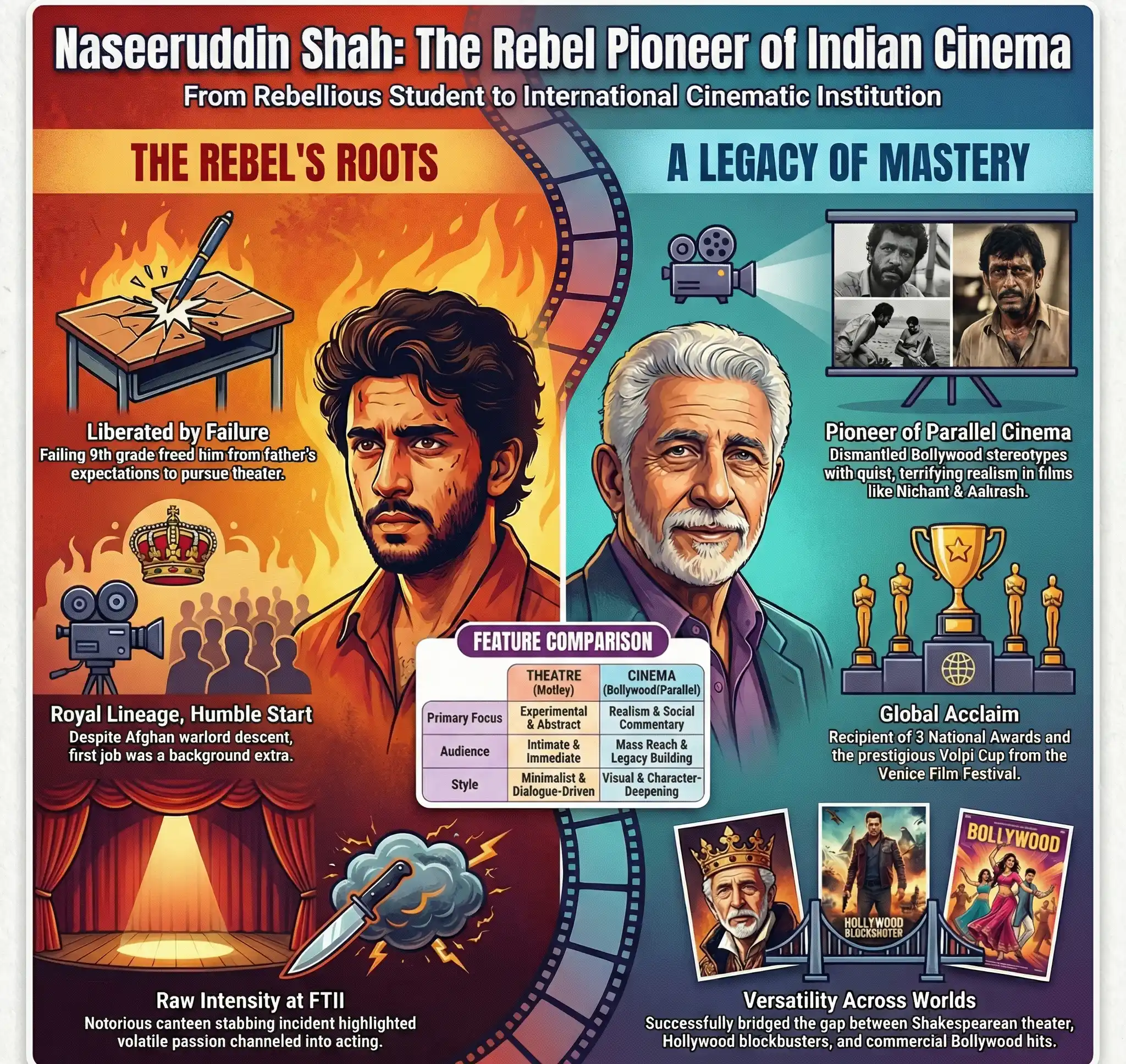
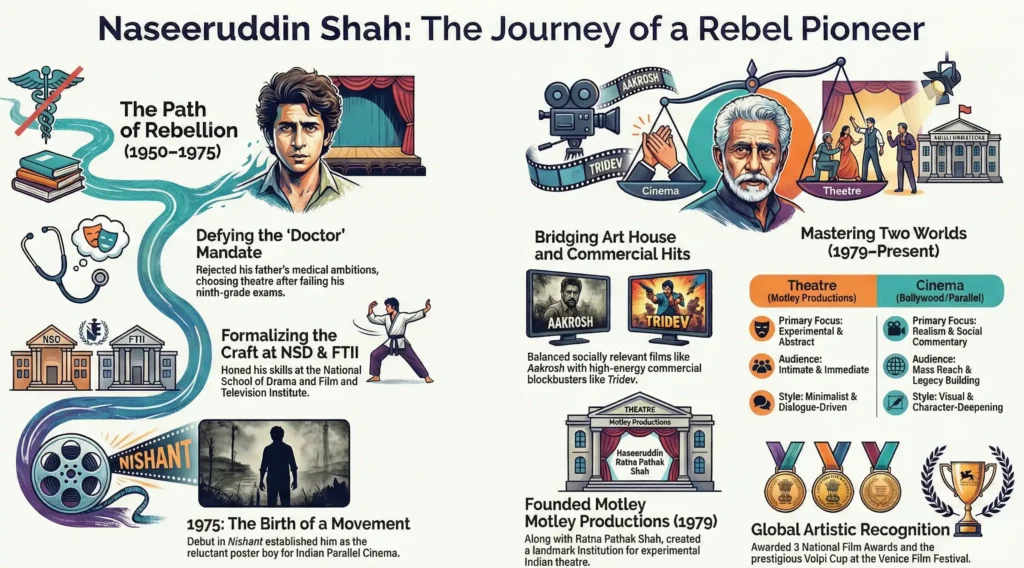
The Naseeruddin Shah biography begins not with applause, but with silence—the silence of a disappointed father. His father, a strict disciplinarian, envisioned a life of medicine and stability for his son. However, the young Nawab had other plans. At St. Anselm’s in Ajmer and later at St. Joseph’s College in Nainital, Shah found himself mesmerized not by biology textbooks, but by the magic of storytelling. The defining moment of his early rebellion occurred when he failed his ninth-grade examinations. It was a crushing blow to his family’s pride, yet it was this very failure that liberated him. Freed from the burden of academic perfection, he drifted closer to the world of theatre.
10 Remarkable Facts About Meghnad Saha Life and Achievements
His first brush with the stage came at age 14, playing Shylock in The Merchant of Venice. Standing under the crude stage lights, he realized that the stage was the only place where he felt truly awake. This epiphany led him to Aligarh Muslim University and eventually to the hallowed halls of the National School of Drama (NSD) in Delhi. It was here that the raw, unpolished gem began to find its shine, learning that acting was not just about pretending, but about revealing the most uncomfortable truths of humanity.
The Rebel at FTII and the Stabbing Incident
Life at the Film and Television Institute of India (FTII) in Pune was the crucible that forged Shah’s resilience. It was a time of intense artistic discovery, but also of volatile temperaments. The industry was not welcoming to actors who looked “too ordinary.” Shah did not possess the conventional good looks of the Bollywood heroes of the 1970s. He was intense, scrawny, and possessed a gaze that could unsettle anyone.
One of the most shocking yet lesser-known episodes of this period involved a violent altercation. In a moment of heated passion—a trait that would later define his screen persona—Shah was involved in a stabbing incident at the college canteen with a fellow actor. It was a stark reminder of the intense pressure and rivalry that brewed behind the scenes. This incident, often whispered about in industry circles, highlighted the raw, unfiltered emotion that Shah carried within him. Rather than letting this destroy him, he channeled this intensity into his craft. He learned to control the fire, using it to fuel performances that would soon scorch the screen.
Pioneering the Parallel Cinema Movement
The mid-1970s in India saw the rise of a new wave, and Naseeruddin Shah became its reluctant poster boy. His debut in Shyam Benegal’s Nishant (1975) was a revelation. He did not play the hero; he played a character. This distinction was crucial. In an era dominated by melodramatic superstars, Shah brought a quiet, terrifying realism to the screen.
His work in films like Aakrosh, Sparsh, and Manthan dismantled the stereotype of the Indian leading man. In Sparsh, his portrayal of a visually impaired principal was so convincing that audiences often forgot he could see. He didn’t just act; he inhabited the souls of the marginalized. This period cemented his status as a titan of Parallel Cinema, a movement that prioritized social relevance over box-office receipts. He became the voice of the common man—the angry, the oppressed, and the misunderstood.
7 Incredible Facts in the Satyendra Nath Bose Biography
Bridging the Gap: Commercial Success and Versatility
While the critics worshipped him, the masses needed convincing. Shah proved his versatility by stepping into the chaotic world of commercial Bollywood. He surprised everyone with Tridev, dancing to “Oye Oye” with the same commitment he gave to Shakespeare. Films like Mohra and Vishwatma introduced him to a wider audience, proving that he could play the villain or the hero with equal ease.
However, his heart remained tethered to the unconventional. His comedic timing in Jaane Bhi Do Yaaro remains a masterclass in satire. The scene where he speaks to a dead body is cited by film schools across the world as a pinnacle of black comedy. This ability to oscillate between the profound tragedy of Masoom and the slapstick absurdity of Chamatkar is what makes the Naseeruddin Shah early life and career so unique. He refused to be boxed in, constantly challenging the industry’s perception of what he could do.
Love, Loss, and the Anchor of Family
Behind the intensity of the actor lies a complex personal life. His first marriage to Manara Sikri, who was 16 years his senior, was a defiant act of love that eventually ended in separation. Despite the heartbreak, he remained a devoted father to their daughter, Heeba.
Fate, however, had a second act written for him. He found his soulmate in Ratna Pathak, a formidable actress in her own right and the daughter of the legendary Dina Pathak. Their union was a meeting of minds. Together, they founded Motley Productions in 1979, with their inaugural play Waiting for Godot becoming a landmark in Indian theatre. Ratna became his anchor, providing the stability he needed to navigate the turbulent waters of stardom. Their partnership is often cited as a benchmark for creative couples, grounded in mutual respect and a shared love for the arts.
8 Fascinating Facts in the Homi Jehangir Bhabha Biography
The Legacy of an Honest Artist
Today, Naseeruddin Shah stands as a guardian of the arts. He is not just a relic of the past but an active, vocal participant in the present. Whether he is conducting workshops for aspiring actors or voicing his opinions on the socio-political climate, he remains fearlessly honest.
His memoir, And Then One Day, offers a glimpse into the mind of a man who is constantly searching. He has won three National Awards and the prestigious Volpi Cup at the Venice Film Festival—a rare honor for an Indian. Yet, if you ask him, his greatest achievement is not the trophies on his shelf, but the students he has taught and the truth he has spoken. Naseeruddin Shah teaches us that success is not about fitting in; it is about having the courage to stand out, even if it means failing ninth grade or fighting the entire world to follow your dream.
Quick Comparison: Theatre vs. Cinema
| Feature | Theatre (Motley Productions) | Cinema (Bollywood/Parallel) |
| Primary Focus | Experimental, Abstract (e.g., Waiting for Godot) | Realism & Social Commentary |
| Audience Connection | Intimate, Immediate Feedback | Mass Reach, Legacy Building |
| Key Partners | Benjamin Gilani, Tom Alter, Ratna Pathak | Shyam Benegal, Om Puri, Smita Patil |
| Style | Minimalist, Dialogue-Driven | Visual, Character-Deepening |
Curious Indian: Fast Facts
- The Royal Connection: Naseeruddin is a direct descendant of the 19th-century Afghan warlord Jan-Fishan Khan.
- The First Paycheck: He acted as an extra in the film Aman (1967) just to see Rajendra Kumar, standing in a crowd for hours.
- The Hollywood Stint: He played Captain Nemo in the international blockbuster The League of Extraordinary Gentlemen (2003).
- The missed role: He was considered for the role of Gandhi in Richard Attenborough’s classic but lost it to Ben Kingsley.
- The Author: His autobiography, And Then One Day, is considered one of the most candid celebrity memoirs in India.
Conclusion
Naseeruddin Shah’s life serves as a beacon for anyone who has ever felt like an outsider. From the disapproval of his father to the rejection of the mainstream film industry, he used every brick thrown at him to build a foundation of artistic integrity. His story is not just about acting; it is about the stubborn refusal to compromise on one’s identity. As he continues to grace both the stage and the screen, Shah remains a reminder that true artistry is timeless, and the most powerful role one can play is that of their authentic self.
6 Unfoldings in the Subrahmanyan Chandrasekhar Biography
If you think you have remembered everything about this topic take this QUIZ
Results


#1. Naseeruddin Shah is a direct descendant of which 19th-century Afghan warlord?
#2. At the age of 14, which character did Naseeruddin Shah play in his first stage performance?
#3. Which film marked Naseeruddin Shah’s debut in 1975?
#4. Which prestigious international award did Naseeruddin Shah win at the Venice Film Festival?
#5. What is the name of the theatre group founded by Naseeruddin Shah and Ratna Pathak Shah in 1979?
#6. Naseeruddin Shah played the role of Captain Nemo in which international blockbuster film?
#7. What is the title of Naseeruddin Shah’s candid autobiography?
#8. Naseeruddin Shah was considered for the lead role in which classic film but lost it to Ben Kingsley?
What is Naseeruddin Shah most famous for?
He is most famous for pioneering the Parallel Cinema movement in India with films like Nishant and Aakrosh, as well as for his versatile roles in commercial hits like Tridev and A Wednesday.
Who is Naseeruddin Shah’s wife?
Naseeruddin Shah is married to the acclaimed actress Ratna Pathak Shah. They got married in 1982. He was previously married to Manara Sikri.
Did Naseeruddin Shah win any international awards?
Yes, he won the Volpi Cup for Best Actor at the Venice Film Festival in 1984 for his performance in the film Paar.
What is the controversy involving Naseeruddin Shah at FTII?
During his student days at FTII, Shah was involved in a serious altercation involving the stabbing of a fellow student in the canteen, an event he has candidly discussed in his memoir as a moment of youthful rage.
Which theatre group did Naseeruddin Shah found?
He founded Motley Productions in 1979 along with fellow actors Tom Alter and Benjamin Gilani. Their first play was Samuel Beckett’s Waiting for Godot.
Read More: https://curiousindian.in/salman-khan-a-legendary-force-in-bollywood-december-1965-present/