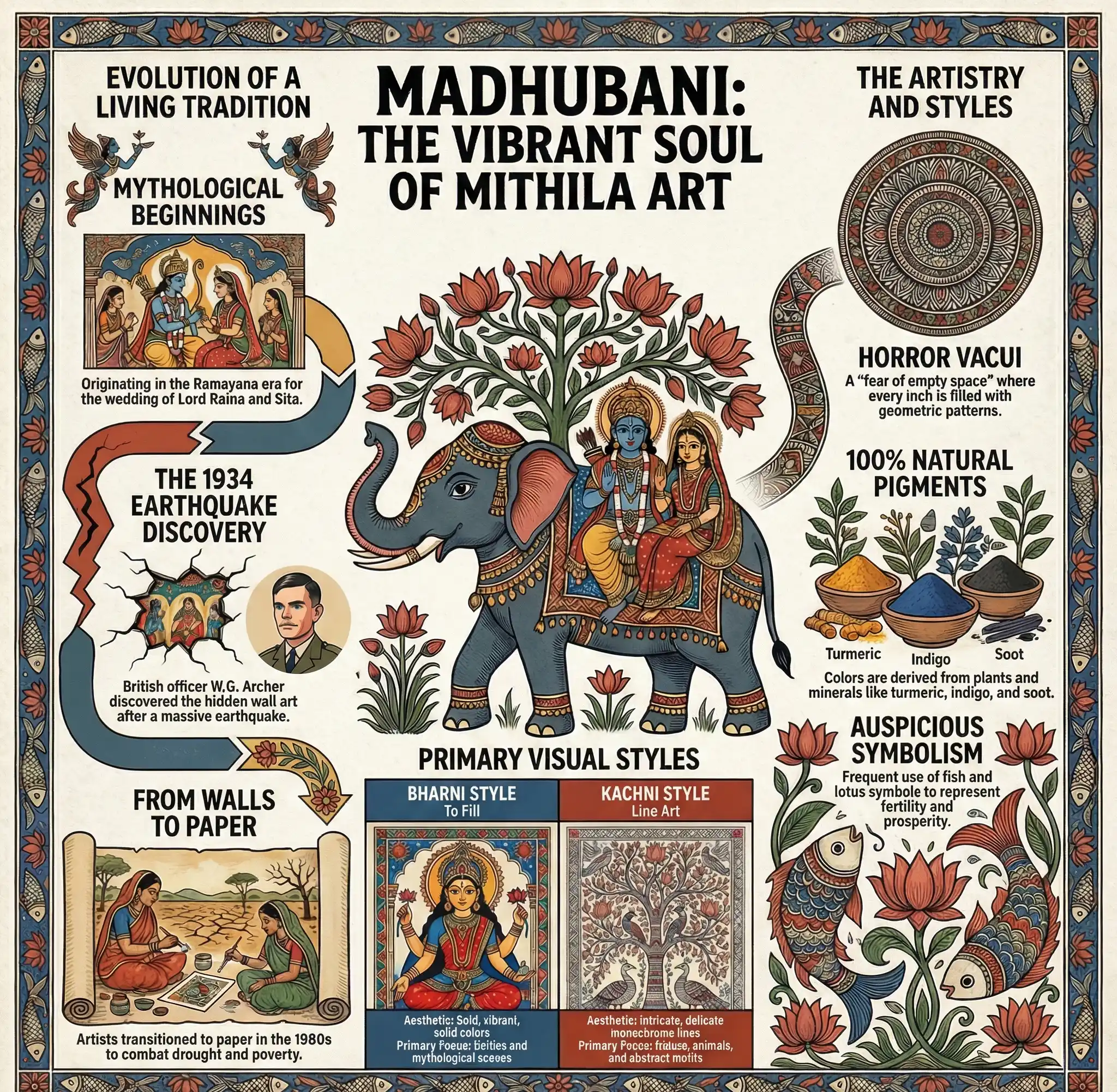
Madhubani painting, also known as Mithila art, is a traditional Indian folk art form originating from the Mithila region of Bihar (India) and adjoining parts of Nepal. Characterized by eye-catching geometrical patterns, vibrant natural colors, and a distinct lack of empty space, it was historically painted on the freshly plastered mud walls and floors of huts by women. While its mythological roots are traced back to the Ramayana, the art was brought to global attention after a massive earthquake in 1934 exposed the hidden wall paintings to a British colonial officer. In the 1960s, to combat drought and poverty, artists transitioned from walls to handmade paper, transforming a domestic ritual into a tool for women's economic empowerment. Today, it features five distinct styles: Bharni, Kachni, Tantrik, Godna, and Kohbar.| Feature | Details |
| Origin | Mithila Region (Bihar, India & Nepal) |
| Also Known As | Mithila Art |
| Legendary Origin | King Janaka for Sita’s Wedding (Ramayana) |
| Key Themes | Hindu Deities, Nature, Royal Courts, Weddings |
| Key Styles | Bharni, Kachni, Tantrik, Godna, Kohbar |
| Materials Used | Twigs, Fingers, Nib-pens, Matchsticks |
| Key Pigments | Soot (Black), Turmeric (Yellow), Indigo (Blue) |
| Famous Artists | Sita Devi, Ganga Devi, Mahasundari Devi |
| Global Recognition | Geographical Indication (GI) Tag |
The Origins: A Wedding in the Ramayana
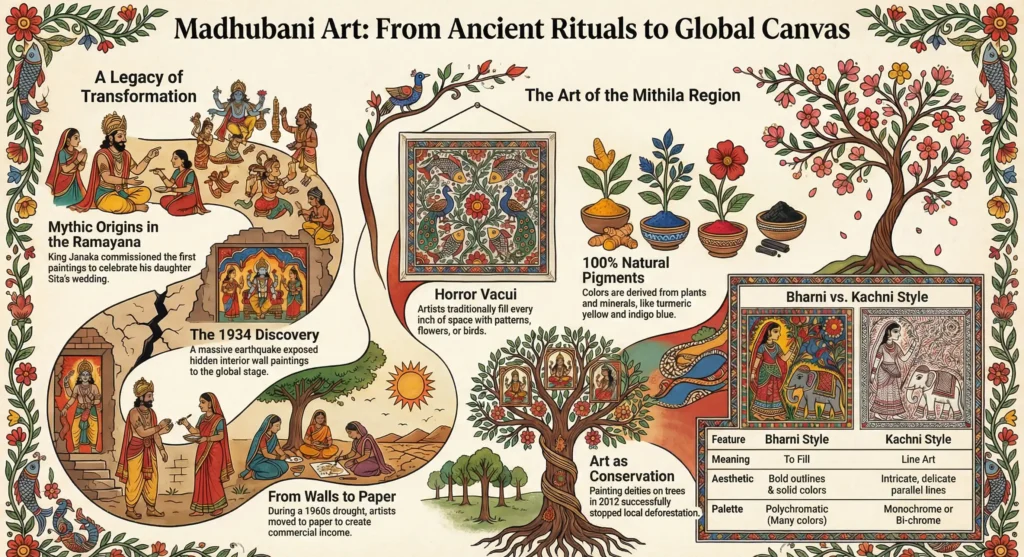
The roots of Madhubani painting delve deep into Hindu mythology. According to local lore, the art form originated during the era of the Ramayana. King Janaka, the ruler of the Mithila kingdom, commissioned local artists and women to paint the walls and floors of the city to celebrate the marriage of his daughter, Sita, to Lord Rama.
For centuries, the tradition was passed down from mothers to daughters. It was a domestic ritual, painted on mud walls (Bhitti Chitra) and courtyard floors (Aripana) during festivals, religious events, and weddings to invoke divine blessings.
Contemporary Indian Sculpture: 20th and 21st Century Innovations
From Mud Walls to Canvas: The Discovery
For generations, Madhubani remained a hidden, localized practice. Its journey to the global stage was sparked by two natural disasters.
- The 1934 Earthquake: A devastating earthquake struck Bihar in 1934. When British colonial officer William G. Archer inspected the damage in the Madhubani district, he saw the vibrantly painted interior walls of the collapsed houses. He was stunned by their resemblance to the works of modern Western artists like Picasso and Miró, taking photographs and writing about them.
- The 1960s Drought: In the late 1960s, a severe drought hit Bihar, devastating the agricultural economy. The All India Handicrafts Board, led by Pupul Jayakar, visited the region and encouraged the local women to transfer their wall paintings onto handmade paper and canvas for commercial sale. This pivotal shift not only saved the region from starvation but also economically empowered the women of Mithila.
Durga Puja: Celebrating the Divine Feminine in Bengal
The Five Styles of Madhubani
Historically, the styles of Madhubani painting were divided along caste lines, though these boundaries have blurred significantly today.
- Bharni: Meaning “to fill,” this style is characterized by bold black outlines completely filled with vibrant, solid colors. It was traditionally practiced by Brahmin women and focuses heavily on depicting gods and goddesses.
- Kachni: Meaning “line art,” this style relies on intricate, delicate, and closely drawn parallel lines. It uses a muted palette (often just monochrome black and vermilion) and was traditionally practiced by Kayastha women.
- Tantrik: Focused solely on religious and mythological motifs, depicting deities with specific tantric symbols for prayer and meditation.
- Godna: Inspired by traditional tattoos, this style was pioneered by Dalit women. It features concentric circles of flowers, fields, and animals.
- Kohbar: This is the quintessential wedding art. Painted in the nuptial chamber (Kohbar Ghar), it is loaded with symbols of fertility and prosperity, such as the lotus plant, bamboo grove, fish, birds, and snakes.
Techniques and Natural Colors
Madhubani paintings are famous for their Horror Vacui (fear of empty space). Once the main figures are drawn, the artists fill every inch of the remaining canvas with geometric patterns, flowers, or birds.
- Tools: Traditionally, no modern brushes were used. Artists used their fingers, twigs, matchsticks, and nib-pens.
- Dyes: The colors are 100% natural, derived from plants and minerals, mixed with cow dung and mud for the base.
- Black: Soot/Lampblack mixed with cow dung.
- Yellow: Turmeric or extract of marigold flowers.
- Blue: Indigo.
- Red: Kusum flower juice or red sandalwood.
- White: Rice powder paste.
Indian Textiles: From Lustrous Silk Sarees to Hand-Block Prints
Quick Comparison Table: Bharni vs. Kachni Style
| Feature | Bharni Style | Kachni Style |
| Meaning | “To Fill” | “Line Art” |
| Aesthetic | Bright, solid colors | Intricate, delicate line work |
| Color Palette | Polychromatic (Many bright colors) | Monochrome or bi-chrome (Red/Black) |
| Historical Origin | Brahmin Community | Kayastha Community |
| Primary Subjects | Gods, Goddesses (Krishna, Durga) | Nature, Animals, Abstract motifs |
Curious Indian: Fast Facts
- Saving Trees with Art: In 2012, an environmental NGO in Bihar came up with a brilliant idea to stop rampant deforestation. Local artists painted Madhubani depictions of Hindu deities on the trunks of highway trees. Fearing divine retribution, the locals stopped cutting the trees down!
- The Mithila Museum in Japan: Madhubani art has a massive following in Japan. The Mithila Museum, located in a converted schoolhouse in Tokamachi, Japan, houses over 15,000 exquisite Madhubani paintings.
- The Fish Symbol: In Mithila culture, the fish is a highly auspicious symbol representing fertility, good luck, and prosperity, which is why it appears so frequently in their art.
- GI Tag: Madhubani painting was awarded the Geographical Indication (GI) tag in 2007, ensuring that only authentic art from this region can be sold under the name.
Conclusion
Madhubani painting is a testament to the resilience and creativity of Indian women. What started as a temporary prayer plastered on a mud wall has transformed into a globally recognized art form that sustains thousands of families. It is a living tradition that bridges the gap between the mythological past and the modern present, proving that art is not just about aesthetics—it is a tool for survival, empowerment, and cultural preservation.
The Gupta Empire: When India Led the World in Science and Culture
If you think you have remembered everything about this topic take this QUIZ
Results


#1. According to local mythology, Madhubani art originated when King Janaka commissioned artists to paint the city for whose wedding?
#2. What natural disaster in 1934 first exposed the hidden Madhubani wall paintings to the outside world?
#3. In the late 1960s, why were local women encouraged to transfer their paintings from walls to handmade paper for commercial sale?
#4. Which style of Madhubani painting relies heavily on intricate, delicate, and closely drawn parallel lines, often using a monochrome palette?
#5. Which quintessential Madhubani wedding art style is painted in the nuptial chamber and loaded with symbols of fertility?
#6. The famous Madhubani aesthetic of filling every inch of the canvas with patterns and leaving no empty space is known as what?
#7. According to the text, what natural source is traditionally used to create the black pigment in Madhubani paintings?
#8. In 2012, how did an environmental NGO brilliantly use Madhubani art to stop rampant deforestation in Bihar?
Where did Madhubani painting originate?
It originated in the Mithila region of Bihar, India, and adjoining areas of Nepal.
What is the legend behind Madhubani art?
Legend says King Janaka commissioned the first Madhubani paintings to decorate the kingdom for the wedding of his daughter, Sita, to Lord Rama.
What materials are used for Madhubani painting?
Artists use natural dyes derived from plants, soot, and minerals. Traditional tools include twigs, fingers, matchsticks, and nib-pens instead of synthetic brushes.
Why are there no empty spaces in Madhubani paintings?
The art form employs a technique often called horror vacui (fear of empty space). Any gaps are immediately filled with geometric shapes, flowers, or birds to make the painting look complete and vibrant.
What is “Kohbar” in Madhubani art?
Kohbar is a specific style of Madhubani painting created in the nuptial chamber during weddings. It features heavy symbolism related to fertility and prosperity, such as fish and lotuses.