The story of Madhava of Sangamagrama is one of the most fascinating chapters in the history of global mathematics. Living in a small village in Kerala during the 14th century, Madhava founded the Kerala School of Astronomy and Mathematics. He is credited with being the first to step into the world of "infinite processes," discovering the power series for trigonometric functions and an incredibly accurate value for Pi. While Western history books often credit Isaac Newton or Gottfried Wilhelm Leibniz with the invention of calculus, the Madhava of Sangamagrama history proves that these advanced concepts were being practiced on the banks of the Bharatapuzha River hundreds of years earlier.| Feature | Details |
| Name | Madhava of Sangamagrama |
| Era | 1340 – 1425 AD |
| Origin | Irinjalakuda, Kerala, India |
| School | Kerala School of Astronomy and Mathematics |
| Major Contribution | Infinite Series for Sine, Cosine, and Pi |
The Genius from a Small Kerala Village
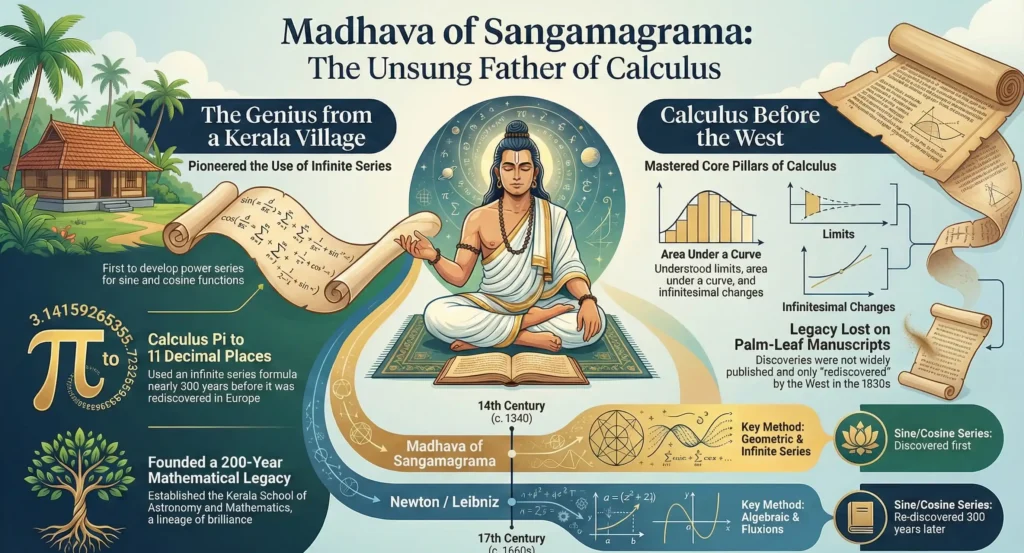
The Madhava of Sangamagrama history doesn’t begin in a grand university or a royal palace, but in the lush, green landscapes of Irinjalakuda, a small town near Thrissur. In the 14th century, while Europe was slowly emerging from the Middle Ages, Madhava was looking at the stars and the curves of circles with a level of precision that was unheard of. He didn’t just see shapes; he saw infinite possibilities.
Madhava was a “Bakula,” a title suggesting he belonged to a family associated with the local temple. But his true temple was the cosmos. He founded what we now call the Kerala School of Astronomy and Mathematics. This wasn’t just a school; it was a lineage of brilliance that lasted for over two centuries. What makes his story a mystery is that none of his original mathematical treatises have survived the test of time. We only know of his genius through the writings of his successors, like Nilakantha Somayaji, who spoke of Madhava with the kind of reverence one reserves for a deity of knowledge.
Dr. A.P.J. Abdul Kalam: (1931-2015)
The Man Who Measured the Infinite
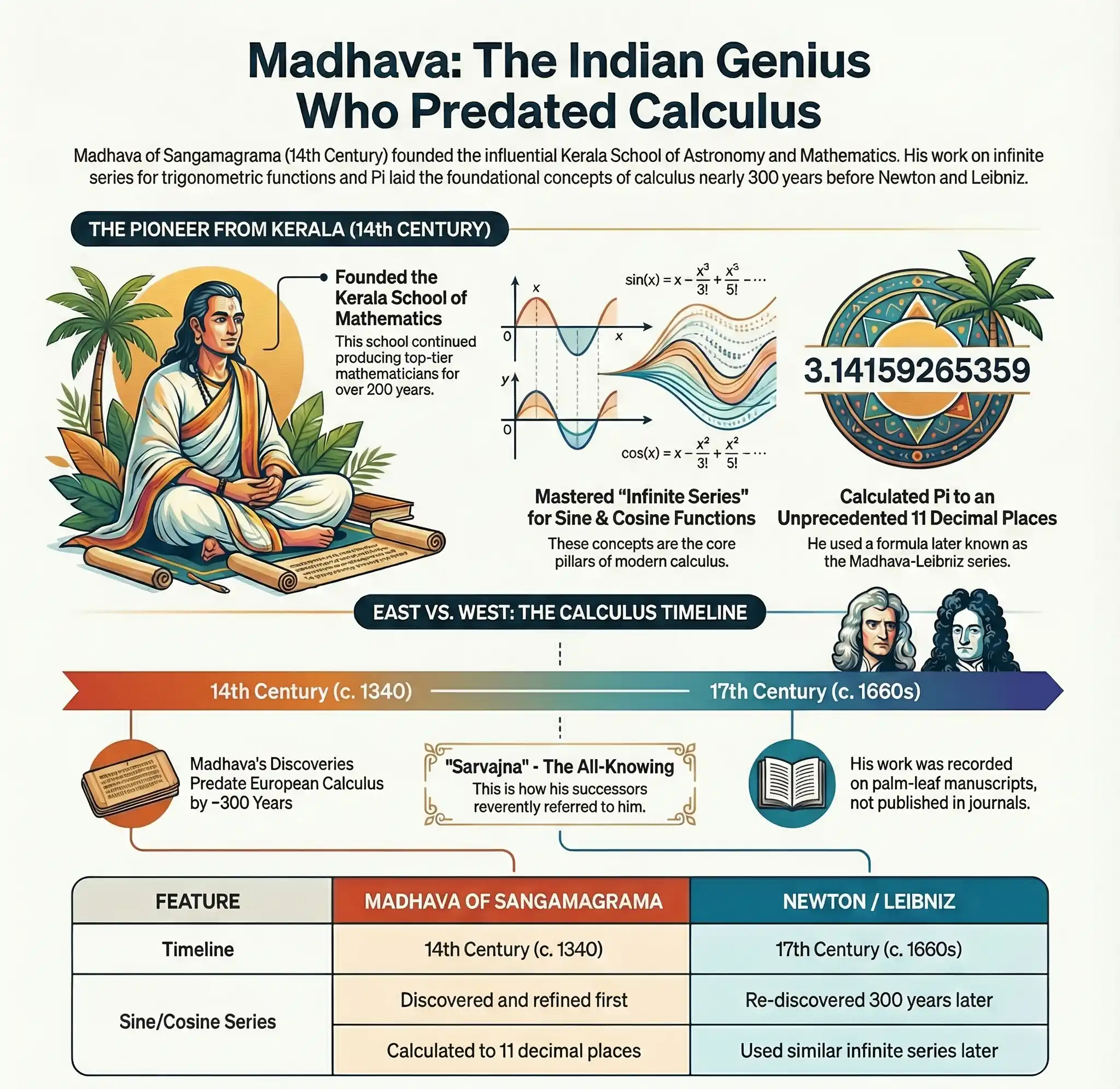
Imagine trying to calculate the circumference of a circle without a modern calculator. Most ancient civilizations used rough approximations for Pi ($\pi$). However, Madhava was not satisfied with “good enough.” He developed a formula that we now know as the Madhava-Leibniz series. The irony is that while it carries a European name, it was written in Sanskrit verses in Kerala nearly 300 years before Leibniz was born.
His work on the infinite series for Pi was so advanced that he calculated the value of $\pi$ to 11 decimal places. To put this into perspective, he described the ratio as the result of an infinite addition and subtraction of fractions. He saw that the more terms you added, the closer you got to the “truth” of the circle. This concept of a limit is the very heartbeat of modern calculus. When we look at the Madhava of Sangamagrama history, we aren’t just looking at math; we are looking at the birth of modern analytical thinking.
Calculus Before the West
For centuries, the world was told that calculus was the brainchild of the 17th-century scientific revolution in Europe. But the Madhava of Sangamagrama history challenges this narrative. Madhava had already mastered the power series expansions for sine and cosine functions. He understood how to find the area under a curve and how to handle infinitesimal changes—the core pillars of calculus.
The beauty of Madhava’s work lay in its poetic form. He wrote his mathematical proofs in the form of Sanskrit slokas. For him, there was no separation between the beauty of language and the logic of numbers. He treated the movement of planets not as chaotic events, but as predictable patterns that could be captured through infinite sums. This personal and spiritual connection to numbers allowed him to push the boundaries of what was thought possible in the medieval world.
1971 Nagarwala Case: India’s Great Bank Heist Mystery
A Legacy Preserved in Palm Leaves
One might wonder, if he was so brilliant, why isn’t he as famous as Einstein or Pythagoras? The answer lies in the way knowledge was shared in ancient India. It was a tradition of “Guru-Shishya” (Teacher-Student). His discoveries were recorded on palm-leaf manuscripts, many of which were lost to humidity, insects, or simply the passage of time.
However, the Indian scientist biography of Madhava survived because his students were so inspired by him that they quoted his “karikas” (verses) in their own books. They referred to him as Sarvajna, the “all-knowing.” It was only in the 1830s that a British administrator named Charles Whish “discovered” these manuscripts and brought them to the attention of the Western world, admitting that the Kerala school had anticipated the core of European calculus.
Comparison: Madhava vs. Modern Calculus Founders
| Feature | Madhava of Sangamagrama | Newton / Leibniz |
| Timeline | 14th Century (1340s) | 17th Century (1660s-70s) |
| Primary Method | Geometric & Infinite Series | Algebraic & Fluxions |
| Medium | Sanskrit Palm-Leaf Manuscripts | Published Books/Journals |
| Sine/Cosine Series | Discovered & refined first. | Re-discovered 300 years later. |
| Concept of Pi | Accurate to 11 decimal places. | Used similar series later. |
The Spirit of the Curious Indian
Madhava’s life is a reminder of the power of observation. He didn’t have telescopes or computers; he had a clear sky, a sharp mind, and a relentless curiosity. He spent his nights tracking the moon’s positions to refine his astronomical tables. He was an explorer of the invisible, a man who dared to calculate the infinite from a small porch in a Kerala village.
This Madhava of Sangamagrama history is more than just a set of formulas. It is a story of human potential. It tells us that great ideas are not restricted by geography or era. They belong to those who are curious enough to look closer. Madhava’s work continues to influence how we understand the world today, from the GPS in our phones to the way we build skyscrapers.
8 Defining Chapters in the Vikram Sarabhai Biography
Curious Indian: Fast Facts
- The Pi Pioneer: Madhava’s series for $\pi$ is: $\pi = 4(1 – 1/3 + 1/5 – 1/7 + \dots)$.
- The Bakula Tree: His name is often associated with the Bakula (Spanish Cherry) tree, which was said to be abundant in his village.
- Astronomy Master: He calculated the positions of the moon so accurately that his tables were used by sailors for centuries.
- A Scientific School: His school in Kerala continued to produce top-tier mathematicians for over 200 years after his death.
- Poetic Math: Most of his mathematical constants were encoded in “Katapayadi” notation, a system where letters of the alphabet represent numbers.
Conclusion
The Madhava of Sangamagrama history is a vital piece of the puzzle in the story of human progress. He was a man who saw the infinite within the finite, a mathematician who found poetry in numbers. By reclaiming his place in history, we don’t just honor a great Indian; we honor the truth of scientific evolution. Madhava reminds us that the quest for knowledge is a universal journey, and sometimes, the biggest breakthroughs come from the quietest corners of the world.
The Purulia Arms Drop Mystery 1995: When the Sky Rained Guns
If you think you have remembered everything about this topic take this QUIZ
Results


#1. Which influential school of thought did Madhava of Sangamagrama found in the 14th century?
#2. To how many decimal places did Madhava successfully calculate the value of Pi ($pi$)?
#3. What mathematical concept, later credited to Leibniz in Europe, was actually described in Sanskrit verses by Madhava 300 years earlier?
#4. Why have none of Madhava’s original mathematical treatises survived to the present day?
#5. What does the term ‘Katapayadi’ refer to in the context of Madhava’s work?
#6. According to the comparison table, what was the primary medium Madhava used to record his discoveries?
#7. Madhava’s successors referred to him as ‘Sarvajna’. What does this title mean?
#8. Which 19th-century British administrator brought the Kerala School’s discoveries to the attention of the Western world?
Who is the Father of Calculus?
While Isaac Newton and Leibniz are traditionally called the fathers of calculus, the Madhava of Sangamagrama history shows that he developed the foundation of power series and calculus concepts 300 years earlier.
What is the Kerala School of Astronomy and Mathematics?
It was a school of mathematicians founded by Madhava in Kerala, India, which thrived between the 14th and 16th centuries, producing groundbreaking work in infinite series and trigonometry.
Did Madhava influence European mathematics?
There is a significant historical debate. Some scholars believe that Jesuit missionaries in Kerala may have transmitted Madhava’s findings to Europe, but there is no direct “smoking gun” evidence yet.
What is Madhava’s most famous formula?
His most famous formula is the infinite series for Pi ($\pi$), which allows for the calculation of the circle’s circumference with extreme precision.
Why are Madhava’s original books missing?
In ancient India, knowledge was often passed down orally or on perishable palm leaves. While his primary works are lost, his discoveries were meticulously preserved in the commentaries of his students.
Read More: https://curiousindian.in/mahavira/