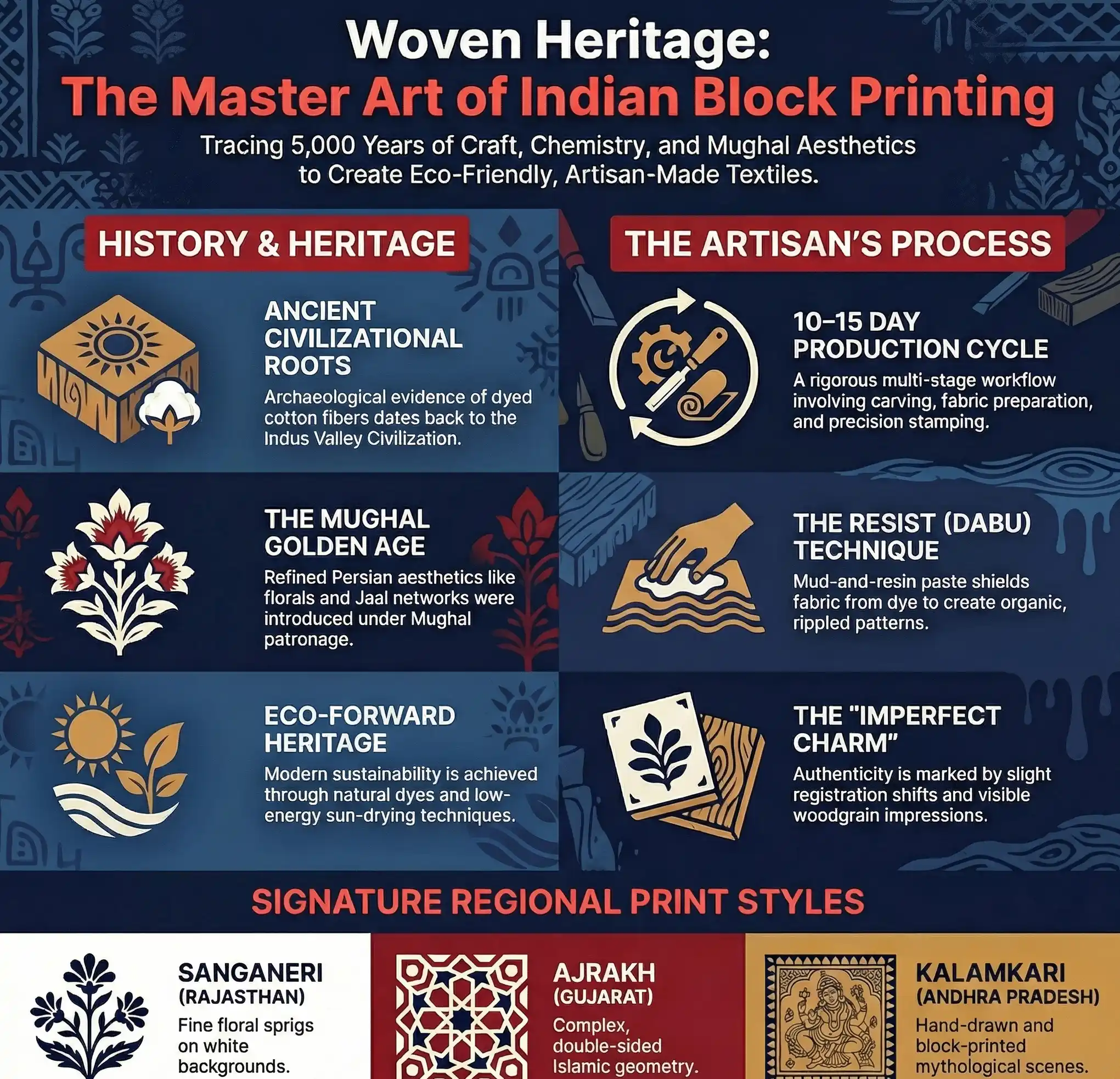
Indian textiles are a living archive of the subcontinent's trade routes, ritual aesthetics, and regional identities. The mastery of Indian artisans over dyeing, weaving, and printing dates back to the Indus Valley Civilization, which yielded early evidence of mordant-dyed cotton. This craft reached new heights of sophistication under Mughal patronage, establishing major hubs in Rajasthan and Gujarat. Today, the tradition thrives through complex techniques like direct, resist, and discharge block printing. Styles such as Bagru, Sanganeri, Dabu, Ajrakh, and Kalamkari showcase India's incredible print diversity. Despite colonial disruptions, the craft has experienced a robust revival, with eco-conscious consumers and designers embracing the "imperfect charm" of hand-printed fabrics and the elegant drape of printed Tussar silk sarees.| Feature | Details |
| Oldest Evidence | Indus Valley Civilization (Dyed cotton fibers, spindles) |
| Golden Age of Motifs | Mughal Empire (Florals, Jaals, Paisleys) |
| Key Printing Styles | Direct, Resist (Dabu), Discharge |
| Famous Print Regions | Rajasthan (Bagru, Sanganer), Gujarat (Ajrakh), Andhra Pradesh (Kalamkari) |
| Key Materials | Carved Wooden Blocks (Teak, Sycamore), Natural Dyes, Tussar Silk, Cotton |
| Time to Produce | 10–15 days for a typical hand-block printed batch |
| Eco-Friendly Aspect | Use of natural/organic dyes, sun-drying, low water usage |
Civilizational Roots to Mughal Flourish
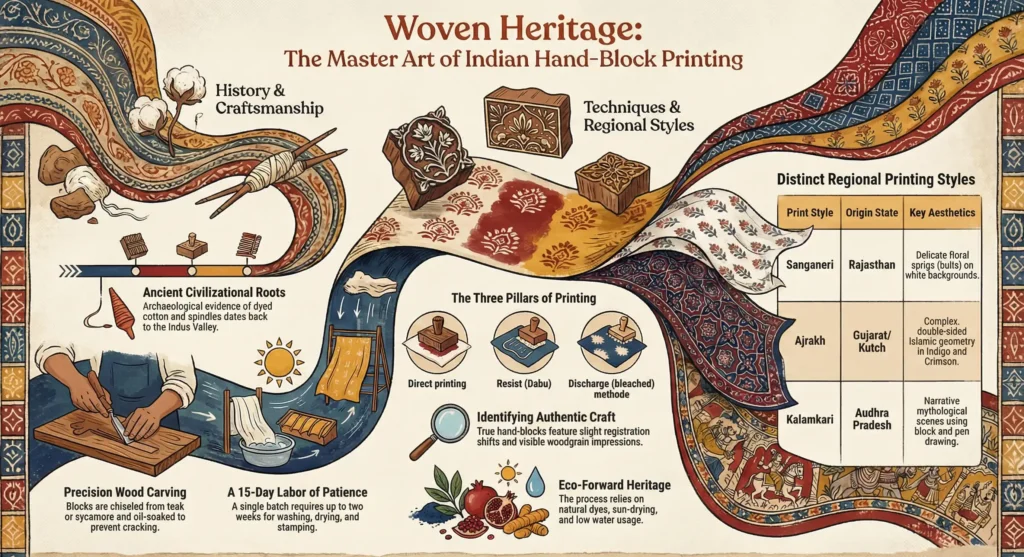
The story of Indian textiles begins in antiquity. Archaeological excavations in the Indus Valley have unearthed cotton fibers dyed with madder, alongside ancient needles and spindles, proving that Indians mastered the complex chemistry of mordanting (fixing dyes to fabric) thousands of years ago. Fast forward to the medieval period, and the craft received immense momentum under Mughal patronage. The Mughals introduced refined Persian aesthetics—intricate floral bouquets, butis, and complex trellis (Jaal) networks. Hubs in Rajasthan and Gujarat became the epicenters of this art, producing block-printed fabrics that were exported globally, shaping international taste.
Reign of Akbar 1556-1605: The Golden Age of the Mughal Empire
The Craft of Hand-Block Printing
Hand-block printing is a labor of intense patience and precision. A typical batch takes 10 to 15 days to complete, reflecting a rigorous, multi-stage workflow:
- Block Carving: Master carvers chisel intricate designs into blocks of teak, sycamore, or pear wood. These blocks are then soaked in oil for 10-15 days to prevent cracking and ensure durability. 2. Preparation: The fabric is desized, washed, sun-dried, and pinned tightly to long printing tables.
- The Ink Kitchen: Pigments are mixed with binders in cushioned trays to ensure the wooden block picks up an even layer of color.
- The Stamping: The artisan stamps the block onto the fabric. Register and rhythm are crucial here. Each color requires a dedicated block, and the artisan must align them perfectly by eye, waiting for layers to dry before overprinting.
The Three Pillars of Printing Techniques
Artisans employ three primary methods to create patterns:
- Direct Printing: The simplest method. The fabric is bleached, dyed a base color, and then stamped with carved blocks dipped in sequential colors.
- Resist Printing: Specific areas of the fabric are shielded with a paste made of clay and resin (like the Dabu technique). When the fabric is dyed, the shielded areas resist the color. Once washed, the protected patterns are revealed, often leaving beautiful, organic ripple effects in the background.
- Discharge Printing: A chemical paste is stamped onto pre-dyed cloth to bleach or “discharge” the color from specific zones. These zones can then be over-dyed, allowing light, sharp motifs to stand out brilliantly against dark backgrounds.
Colonial Architecture in India: Indo-Saracenic & Art Deco
Regional Lineages and Signature Styles
While Rajasthan and Gujarat are the historical cores, block printing thrives across India, with each region boasting a signature style:
- Bagru (Rajasthan): Known for earthy tones and mordant/resist techniques.
- Sanganeri (Rajasthan): Famous for fine, delicate floral bootis on white backgrounds.
- Ajrakh (Gujarat/Rajasthan): Complex, double-sided geometric patterns requiring multiple stages of resist printing and dyeing, heavily featuring indigo and madder red.
- Kalamkari (Andhra Pradesh): A stunning mix of block-printing and freehand pen (kalam) drawing, often featuring narrative mythological scenes.
Silk Sarees: The Elegance of Printed Tussar
While cotton is the daily staple, silk elevates the craft to festive elegance. Tussar silk (wild silk) is particularly prized for block printing. It has a rich, textured hand-feel and a warm, golden sheen that absorbs natural dyes beautifully. Because of silk’s delicate nature, layered printing on Tussar demands careful post-print steaming, washing, and pressing to lock in the hues and stabilize the fabric, ensuring the saree remains vibrant for generations.
The Indus Valley Civilization: The First Urban Society
Quick Comparison Table: Major Block Print Styles
| Print Style | Origin State | Key Aesthetics & Motifs | Dominant Colors |
| Sanganeri | Rajasthan | Delicate floral sprigs (butis) on white/off-white | Pastels, bright reds, yellows |
| Bagru | Rajasthan | Bold, earthy, geometric, and floral | Indigo, Black, Madder Red |
| Ajrakh | Gujarat/Kutch | Complex, double-sided Islamic geometry | Deep Indigo, Crimson Red |
| Dabu | Rajasthan | Mud-resist printing, cracked vein textures | Indigo, earthy tones |
| Kalamkari | Andhra Pradesh | Block & pen drawn, mythological/floral narratives | Earthy reds, mustard, black |
Curious Indian: Fast Facts
- The Imperfect Charm: How do you spot a genuine hand-block print? Look for slight imperfections! Micro-shifts in registration, tiny dye overlaps, and visible woodgrain impressions are the hallmarks of authentic human labor, distinguishing it from flawless machine-printed knockoffs.
- Colonial Disruption: The craft nearly died during British rule. Heavy taxes on Indian textiles and the flooding of the market with cheap, mill-made fabrics from Manchester forced many artisans to abandon their villages for urban mills.
- Eco-Forward Heritage: Traditional block printing is inherently sustainable. It relies on natural/organic dyes, low-energy sun-drying, and long-lived wooden blocks, aligning perfectly with modern eco-conscious fashion goals.
Conclusion
From the ancient dye vats of the Harappan civilization to the bustling modern ateliers of Rajasthan, Indian textiles prove that technique and storytelling can share the same warp and weft. Hand-block printing is not just about decorating cloth; it is a rhythm of breath and pressure, of wood meeting fabric. When you wear a hand-printed Tussar silk saree, you are not just wearing a garment—you are draping yourself in centuries of unbroken, beautifully imperfect human heritage.
Contemporary Indian Sculpture: Exploring 20th and 21st Century Innovations
If you think you have remembered everything about this topic take this QUIZ
Results


#1. Before adopting the hybrid Indo-Saracenic style, which architectural styles did the British initially use to project imperial authority?
#2. Which iconic Mumbai building is cited as the ultimate example of High Victorian Gothic architecture, designed by F.W. Stevens?
#3. In the term “Indo-Saracenic,” what does the word “Saracenic” refer to?
#4. Which Indian city is noted for having the second-largest collection of Art Deco buildings in the world (after Miami)?
#5. Which of the following is a key feature of the Art Deco architectural movement?
#6. How was the Art Deco style “tropicalized” or adapted specifically for the Indian climate?
#7. When building New Delhi, architects Edwin Lutyens and Herbert Baker created a disciplined blend of European Classicism with subtle Indian elements known as what?
#8. In 2018, which specific ensemble of buildings in Mumbai was inscribed as a UNESCO World Heritage Site?
What is hand-block printing?
It is a centuries-old technique where artisans stamp fabric with intricately carved wooden blocks dipped in dye to create repeating patterns.
What is the difference between Direct, Resist, and Discharge printing?
Direct printing stamps color straight onto the fabric. Resist printing uses a clay paste to block dye from certain areas. Discharge printing uses chemicals to remove existing dye to create a pattern.
How can you tell if a fabric is truly hand-block printed?
Look for slight irregularities—tiny color overlaps, slight shifts in pattern alignment, or the faint texture of the woodblock. These “imperfections” are the signature of the human hand.
What is Tussar silk?
Tussar is a type of wild silk produced in India. It is highly valued for its rich texture, natural golden sheen, and its ability to beautifully hold block-printed dyes.
What are “Ajrakh” and “Kalamkari”?
Ajrakh is a complex, geometric block-print style from Gujarat/Rajasthan. Kalamkari is an art form from Andhra Pradesh that combines block printing with freehand pen drawing, often depicting mythological scenes.