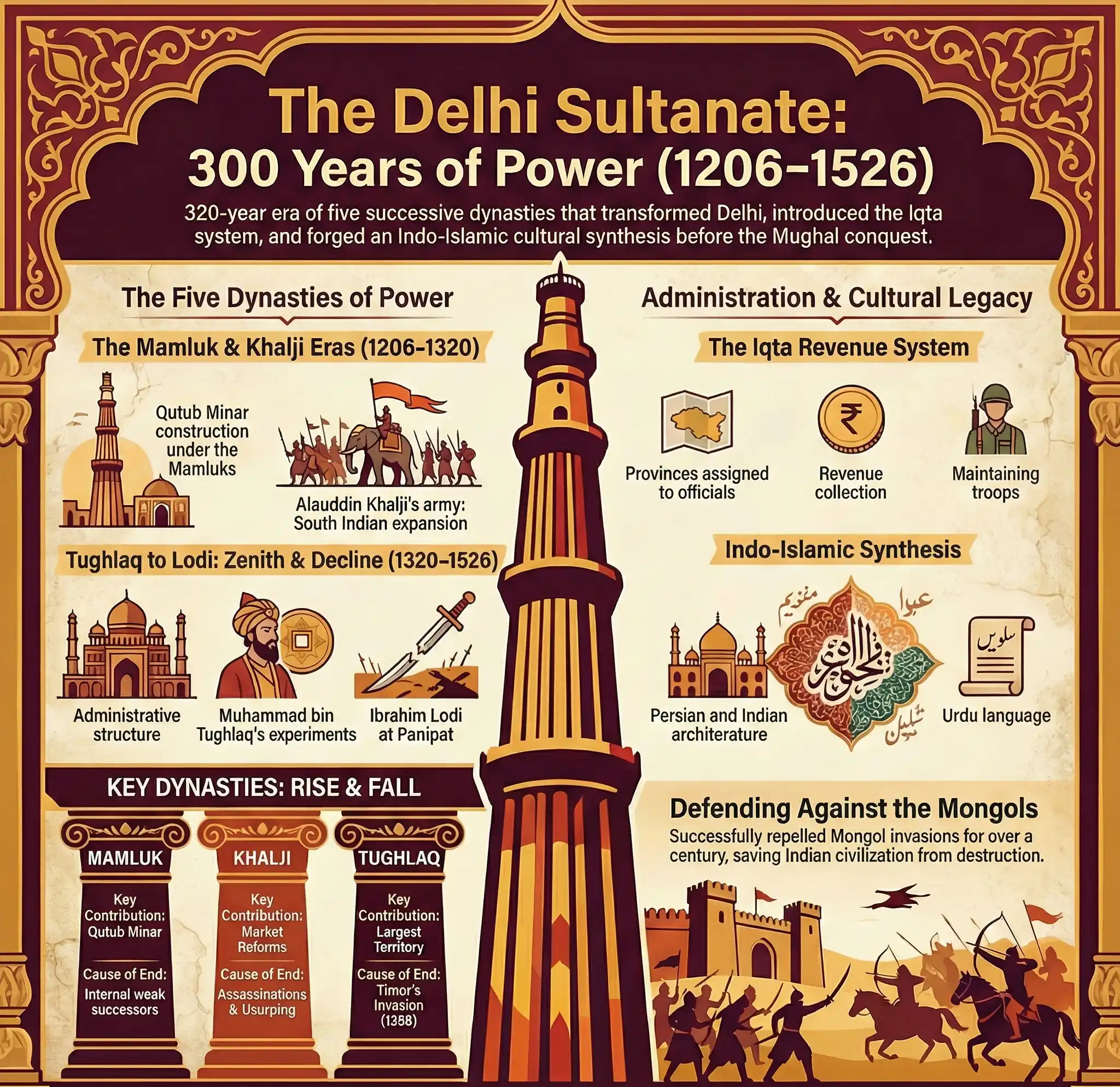
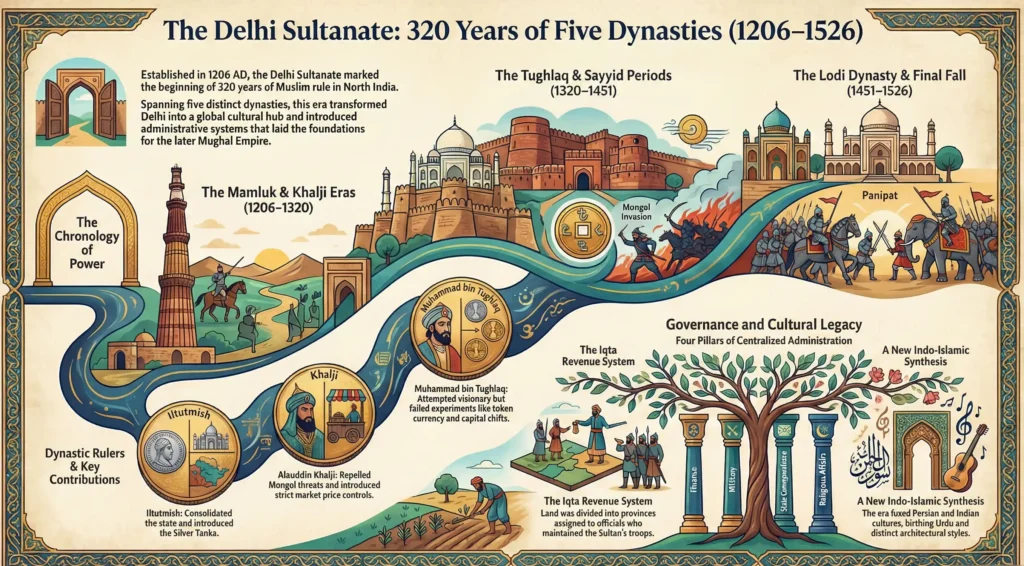
The Delhi Sultanate was established in 1206 AD by Qutb-ud-din Aibak after the death of his master, Muhammad Ghori. It marked the beginning of Muslim rule in North India, which lasted for 320 years until 1526. The Sultanate was ruled by five distinct dynasties: the Mamluk (Slave) Dynasty, Khalji Dynasty, Tughlaq Dynasty, Sayyid Dynasty, and Lodi Dynasty. The capital was primarily Delhi, which transformed into a cosmopolitan hub of culture, architecture, and trade. The Sultanate era introduced the Iqta system of land revenue, Indo-Islamic architecture (like the Qutub Minar), and saw the defense of India against the Mongols. It ended with the defeat of Ibrahim Lodi by Babur at the First Battle of Panipat in 1526.| Feature | Details |
| Establishment Date | 1206 AD |
| Founder | Qutb-ud-din Aibak |
| Total Duration | 320 Years (1206 – 1526) |
| Number of Dynasties | 5 (Mamluk, Khalji, Tughlaq, Sayyid, Lodi) |
| Capital | Delhi (Shifted briefly to Daulatabad & Agra) |
| Official Language | Persian |
| Key Monument | Qutub Minar (Symbol of Victory) |
| End Event | First Battle of Panipat (1526) |
The Founder: Qutb-ud-din Aibak (The Slave King)
After the Second Battle of Tarain (1192), Muhammad Ghori returned to Khorasan, leaving his Indian territories in the hands of his trusted slave-general, Qutb-ud-din Aibak. When Ghori was assassinated in 1206, Aibak declared himself independent and founded the Mamluk Dynasty (Mamluk means “owned” or slave).
- Lakh Baksh: He was known as “Lakh Baksh” (Giver of Lakhs) for his generosity.
- Qutub Minar: He started the construction of the Qutub Minar in Delhi to celebrate the victory of Islam, though he died before completing it.
- Death: He died in 1210 while playing Chaugan (Polo) in Lahore when he fell from his horse.
Timur’s Invasion of Delhi 1398: The Massacre That Shook India
The Five Dynasties
The Delhi Sultanate is the collective term for the five dynasties that ruled sequentially.
- Mamluk (Slave) Dynasty (1206–1290):
- Founders of the Sultanate.
- Iltutmish (1211–1236): The real consolidator who introduced the Iqta system and the silver Tanka.
- Razia Sultan (1236–1240): The first and only female ruler of Delhi.
- Balban (1266–1287): Known for his “Blood and Iron” policy and introducing the Persian custom of Sijda (prostration).
- Khalji Dynasty (1290–1320):
- Founded by Jalaluddin Khalji.
- Alauddin Khalji (1296–1316): The most powerful Sultan who repelled the Mongols, introduced market reforms, and expanded the empire to South India.
- Tughlaq Dynasty (1320–1414):
- Founded by Ghiyas-ud-din Tughlaq.
- Muhammad bin Tughlaq (1325–1351): Known for his ambitious but failed experiments (Token Currency, Capital Shift).
- Firoz Shah Tughlaq (1351–1388): A builder of canals and cities, but known for his religious intolerance.
- Sayyid Dynasty (1414–1451):
- Founded by Khizr Khan, a former governor of Timur. They ruled as vassals of the Timurids. This was the shortest-ruling dynasty with little expansion.
- Lodi Dynasty (1451–1526):
- The first Afghan dynasty (others were Turks).
- Bahlul Lodi: Founder.
- Sikandar Lodi: Moved the capital from Delhi to Agra in 1504.
- Ibrahim Lodi: The last Sultan, defeated by Babur in 1526.
Reign of Muhammad bin Tughluq: The Visionary Failure of Medieval India
The Administrative System
The Sultanate introduced a centralized administration heavily influenced by Persian traditions.
- The Sultan: The absolute head of state, commander-in-chief, and chief judge.
- Iqta System: The land was divided into Iqtas (provinces), assigned to officials (Iqtadars) who collected revenue and maintained troops for the Sultan.
- The Four Departments:
- Diwan-i-Wizarat (Finance)
- Diwan-i-Arz (Military)
- Diwan-i-Insha (Correspondence)
- Diwan-i-Risalat (Religious Affairs)
Quick Comparison Table: The Five Dynasties
| Dynasty | Rule Period | Key Ruler | Major Contribution | End Cause |
| Mamluk | 1206–1290 | Balban | Foundation, Qutub Minar | Internal weak successors |
| Khalji | 1290–1320 | Alauddin | Market Reforms, South Expansion | Assassinations/Usurping |
| Tughlaq | 1320–1414 | Md. bin Tughlaq | Largest Territory, Canals | Timur’s Invasion (1398) |
| Sayyid | 1414–1451 | Khizr Khan | Vassals of Timurids | Voluntarily gave up throne |
| Lodi | 1451–1526 | Sikandar Lodi | Agra Capital, Afghan Rule | Babur’s Invasion (1526) |
Curious Indian: Fast Facts
- The First Mosque: The Quwwat-ul-Islam mosque near Qutub Minar was the first mosque built in Delhi, constructed using stones from destroyed Hindu and Jain temples.
- The “Forty”: Iltutmish created a corps of forty loyal Turkish slaves (Turkan-i-Chahalgani) to help him rule. Ironically, they became kingmakers and eventually destroyed his dynasty.
- Prices: During Alauddin Khalji’s reign, a horse could be bought for 100-120 Tankas, and a slave girl for 5-12 Tankas, thanks to his strict price controls.
- Mongol Threat: The Sultanate successfully defended India against the Mongols for over a century, saving Indian civilization from the total destruction seen in Persia and China.
Conclusion
The Establishment of the Delhi Sultanate reshaped the cultural and political landscape of India. It integrated India into the wider Islamic world, leading to a synthesis of culture—Indo-Islamic art, Urdu language, and new musical forms. While often marked by bloodshed and intolerance, it also laid the administrative foundations that the Mughal Empire would later perfect.
Reign of Alauddin Khalji 1296-1316: The Iron Fist of Delhi
If you think you have remembered everything about this topic take this QUIZ
Results


#1. Who founded the Delhi Sultanate in 1206 AD and was known as “Lakh Baksh”?
#2. How did Qutb-ud-din Aibak die in 1210 AD?
#3. Which was the first and only female ruler of the Delhi Sultanate?
#4. Which dynasty of the Delhi Sultanate was the first to be of Afghan origin?
#5. Who introduced the “Blood and Iron” policy and the Persian custom of Sijda (prostration)?
#6. The “Iqta System” introduced during the Sultanate period was related to:
#7. Which Sultan shifted the capital from Delhi to Agra in 1504?
#8. The Delhi Sultanate ended in 1526 with the defeat of Ibrahim Lodi in which battle?
Who established the Delhi Sultanate?
Qutb-ud-din Aibak established the Delhi Sultanate in 1206 AD.
Which was the first dynasty of the Delhi Sultanate?
The Mamluk (Slave) Dynasty was the first.
How many dynasties ruled the Delhi Sultanate?
Five dynasties ruled: Mamluk, Khalji, Tughlaq, Sayyid, and Lodi.
Who was the only female ruler of the Delhi Sultanate?
Razia Sultan (daughter of Iltutmish) was the only female ruler.
When did the Delhi Sultanate end?
It ended in 1526 AD after the First Battle of Panipat.