| Feature | Details |
| Architectural Style | Dravidian (South Indian Temple Architecture) |
| Key Origins | Pallava Dynasty (600–900 CE) |
| Major Dynasties | Pallavas, Cholas, Pandyas, Vijayanagara, Nayaks |
| Primary Material | Granite, Sandstone, Soapstone |
| Famous Examples | Brihadeeswarar Temple (Thanjavur), Meenakshi Temple (Madurai), Hampi |
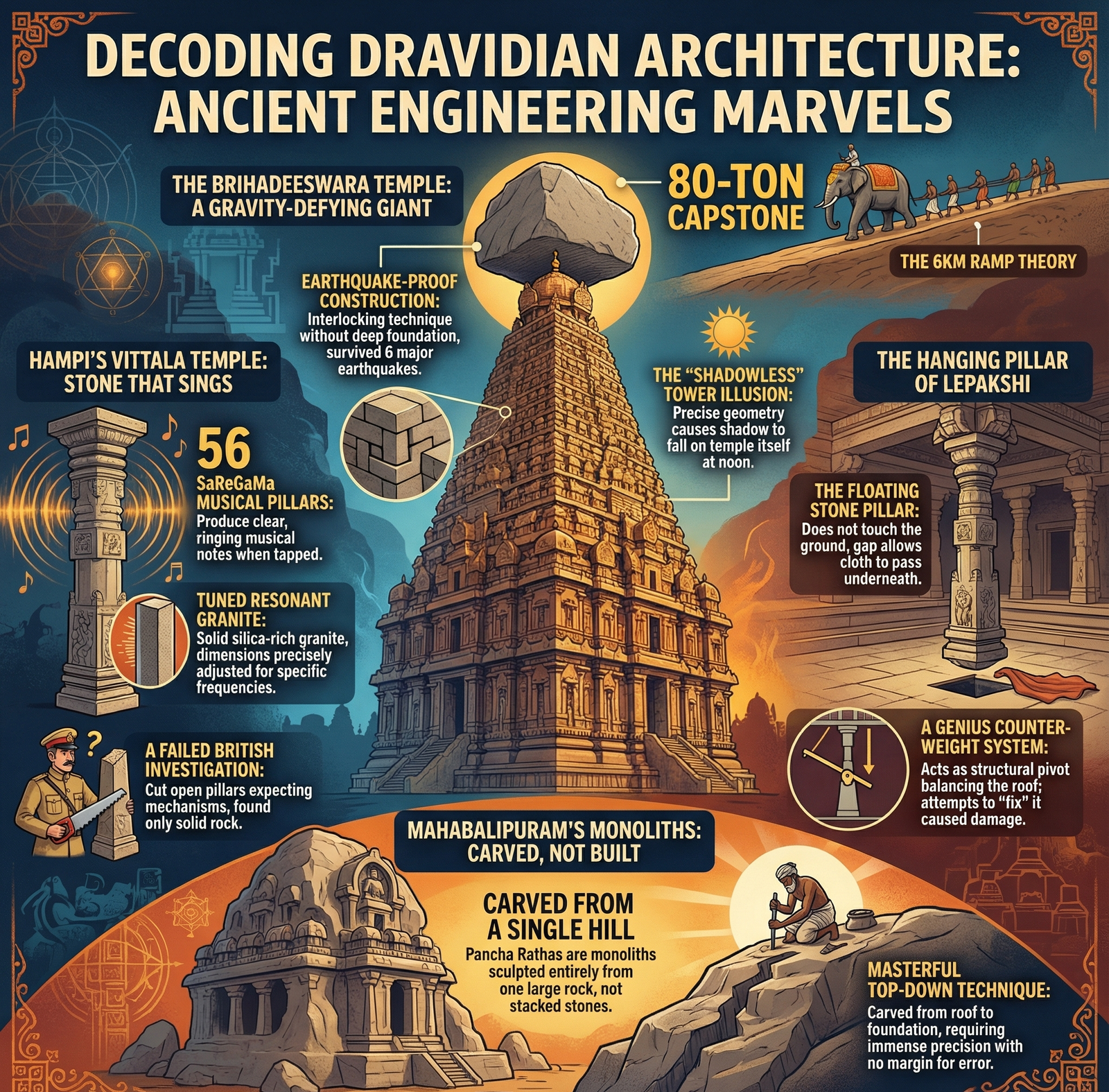
| Core Mystery | The “Shadowless” Vimana & 80-ton Capstone of Thanjavur |
| Notable Feature | Pyramidal Towers (Vimanas/Gopurams), Musical Pillars |
What is Dravidian Architecture? Dravidian architecture is the distinct temple style of South India, emerging in the 6th century under the Pallava dynasty. It is characterized by pyramid-shaped towers (Vimanas), immense gateway towers (Gopurams), and intricate pillared halls (Mandapas). Famous examples include the Brihadeeswarar Temple and Meenakshi Amman Temple.The Granite Giants That Defy Time
The midday sun in Thanjavur beats down relentlessly on the granite pavement, yet visitors standing beneath the towering vimana of the Brihadeeswarar Temple notice something peculiar. While every other structure casts a distinct shadow upon the ground, the shadow of this colossal 216-foot tower seems to vanish. This is the captivating world of Dravidian temple architecture, a realm where art, spirituality, and impossible engineering converge. For centuries, these stone sentinels have stood guard over South India, whispering stories of emperors who wanted to touch the sky and artisans who breathed life into cold rock.
Dravidian temple architecture is not merely about piling stones; it is a testament to human will. It represents a journey of evolution that began with humble rock-cut caves and blossomed into sprawling temple cities that function like intricate stone machines. This distinct style captures the soul of the South, offering a window into a time when builders worked without cement or steel, yet created structures that have outlasted empires.

The Evolution of a Stone Legacy
The story of this architectural grandeur begins not with towering spires, but with the quiet chipping of rock. The Pallava dynasty, ruling from the 7th century, laid the foundation for Dravidian temple architecture. In the coastal town of Mahabalipuram, they carved chariots and shrines directly out of living boulders. These “Rathas” were the prototypes, the sketches in stone that would inspire generations to come.
There is a fascinating anecdote about Mahabalipuram that surfaced relatively recently. For centuries, locals whispered legends of “Seven Pagodas” that stood on the shore, so beautiful that the gods grew jealous and sent a flood to swallow six of them. Modern historians dismissed this as folklore until the devastating tsunami of 2004 pulled the ocean back. For a brief, terrifying moment before the wave struck, bystanders saw the outlines of submerged structures and granite lions emerging from the seabed, proving that the legends of the lost Dravidian temple architecture were grounded in truth.
As the centuries rolled on, the Chola dynasty took this legacy and scaled it up to unimaginable heights. The Cholas were not just conquerors of land; they were conquerors of gravity. They moved away from rock-cut shrines to structural temples built block by block. It was during this golden era that the style solidified—the pyramid-shaped towers, the vast pillared halls, and the intricate water management systems that turned dry lands into fertile grounds.
The Anatomy of the Divine
Understanding Dravidian temple architecture is like reading a map of the cosmos. Every element has a specific place and purpose, designed to lead the devotee from the material world into the spiritual core.
Secret #1: The Vimana and The Gopuram
The most striking feature for any observer is the difference between the Vimana and the Gopuram. In the earlier Chola temples, the Vimana—the tower directly above the main sanctum—was the tallest structure. It symbolized the supreme mountain, Meru, reaching towards the heavens. However, as the style evolved into the Pandya and Nayak periods, the focus shifted to the entrance gateways, or Gopurams. These massive, trapezoidal towers, adorned with thousands of colorful sculptures, act as the guardians of the divine city, visible from miles away.
The Purulia Arms Drop Mystery 1995: When the Sky Rained Guns
Secret #2: The Mandapas and Water Tanks
Beyond the towers lie the Mandapas, or pillared halls. These are not just roofs held up by columns; they are forests of stone. In the Vijayanagara style, these pillars transformed into rearing horses and mythical beasts (Yalis), carved with such precision that they seem ready to leap off their pedestals. Accompanying these structures are the sacred temple tanks. These water bodies were engineered not just for ritual purification, but to cool the surrounding air and manage the groundwater levels, showcasing how Dravidian temple architecture integrated sustainability long before it was a modern buzzword.

Secret #3: The Mystery of the Shadowless Tower
Among all the wonders of Dravidian temple architecture, the Brihadeeswarar Temple in Thanjavur holds the most enduring mystery. Built by the great King Raja Raja Chola I in 1010 CE, this temple is a structural anomaly.
Secret #4: The 80-Ton Puzzle
The most baffling aspect sits right at the top. The Kumbam, or the rounded capstone crowning the Vimana, is carved from a single block of granite weighing approximately 80 tons. How did builders in the 11th century, without cranes or hydraulic lifts, hoist a stone the weight of a modern passenger plane to a height of 200 feet?
The prevailing theory suggests a triumph of patience and physics. It is believed that a massive earthen ramp was constructed, beginning nearly four miles away from the temple site. Elephants and men would have dragged the massive stone inch by inch up this gentle incline, a process that likely took years. Once the stone was placed, the earth was removed, leaving the tower standing tall. This feat alone makes the Pyramids of Giza seem like a close cousin in engineering ambition.
Amitabh Bachchan: Shahenshah of Bollywood (1942-Present)
Secret #5: The Vanishing Shadow
Then there is the optical mystery. Legend insists that the shadow of the main Vimana never falls on the ground. While skeptics argue that the shadow simply falls on itself due to the tower’s wide base and gradual taper, the visual effect remains startling. At noon, the tower appears to absorb its own shade, standing as a pillar of light. Whether a calculated architectural trick or a divine coincidence, it highlights the mastery inherent in Dravidian temple architecture.
Secret #6: The Musical Pillars of Hampi
Travel further north to the ruins of Hampi, the capital of the Vijayanagara Empire, and you encounter another marvel: stone that sings. In the Vittala Temple complex, the famous “Musical Pillars” challenge our understanding of acoustics.
These slender stone columns, when tapped gently with a thumb or a sandalwood stick, emit clear, bell-like musical notes. Some sound like a drum, others like a string instrument. There is a telling story from the British colonial era regarding these pillars. The British authorities were so perplexed by the sound that they reportedly cut open two pillars to check if there were hidden metal rods or hollows inside. To their astonishment, they found nothing but solid granite. The pillars had been destroyed in vain, proving that the architects of Dravidian temple architecture understood the resonant qualities of rock (lithophones) better than modern engineers. They tuned these stone pillars by varying their height, width, and volume, effectively creating a stone synthesizer that could accompany the dancers in the hall.
Secret #7: Construction Without Cement
One of the most overlooked “secrets” is the absence of binding material. Dravidian temple architecture does not rely on lime mortar or cement to hold its massive weight together. Instead, it uses a system of interlocking stones.
The builders employed a technique similar to a jigsaw puzzle. Stones were cut with precise grooves and protrusions that locked them into place. The sheer weight of the granite blocks, combined with gravity, keeps the entire structure stable. This “dry masonry” technique is the reason why these temples have survived earthquakes and tropical monsoons for over a millennium. The structures are flexible enough to move slightly during tremors without cracking, a feature that modern rigid concrete buildings often lack.
A Legacy Carved in Eternity
Walking through the corridors of a Dravidian temple, one cannot help but feel small—not just in size, but in perspective. We often pride ourselves on modern technology, believing we are at the pinnacle of human achievement. Yet, over a thousand years ago, people with nothing but chisels, hammers, and boundless devotion created structures that we still struggle to fully comprehend.
Dravidian temple architecture is more than just a style; it is a conversation between the past and the present. It reminds us that with enough passion and ingenuity, humanity can create things that are truly timeless. Whether it is the shadow that never falls or the pillar that sings a song, these stone mysteries invite us to look closer, stay longer, and marvel at the incredible capacity of the human spirit.
| Feature | Dravidian Style (South) | Nagara Style (North) |
| Main Tower | Vimana (Pyramid shape) | Shikhara (Curved shape) |
| Gateway | Gopuram (Huge & ornate) | Minimal or absent |
| Water Tank | Always present inside walls | rare |
| Top Stone | Stupika (Dome) | Amalaka (Disc) |
Curious Indian: Fast Facts
Granite Masterpiece: The Brihadeeswara Temple is the first all-granite temple in the world. It used 130,000 tons of granite—more than the Great Pyramid of Giza—despite there being no granite quarry within a 60km radius
The 1,000-Pillar Hall: The Meenakshi Temple in Madurai has a hall with 985 pillars (often rounded to 1,000). When viewed from any angle, they appear in a straight line.
The Shadow Illusion: The shadow of the main tower of Brihadeeswara does fall on the ground, but the base is so wide that the shadow is only visible in the early morning or late evening, creating the “shadowless at noon” myth.
Frequently Asked Questions (FAQs)
What is the main characteristic of Dravidian temple architecture?
The most distinct feature is the pyramid-shaped tower known as the Vimana (over the sanctum) or Gopuram (over the entrance), along with extensive pillared halls (Mandapas) and large water tanks.
How was the 80-ton capstone of the Brihadeeswarar Temple raised?
Historians believe a 4-mile long earthen ramp was constructed, allowing elephants and workers to drag the massive granite stone to the top of the 216-foot tower.
Do the musical pillars in Hampi really produce sound?
Yes. The pillars in the Vittala Temple are carved from resonant stone (lithophones). When tapped, they produce distinct musical notes representing different instruments.
What materials were used in Dravidian architecture?
The primary materials were hard rocks like granite, soapstone, and sandstone. Notably, they did not use cement or mortar; the structures rely on gravity and interlocking stone techniques.
Why are there so many sculptures on Dravidian temples?
The sculptures served as a visual library for the public. In an era when many could not read, these carvings told stories from epics like the Ramayana and Mahabharata, as well as depicting scenes of daily life, dance, and culture.
If you think you have rememberd everything about this topic take this QUIZ
Results


#1. What is the most widely accepted theory explaining how the 80-ton granite capstone was placed atop the Brihadeeswara Temple? ? Hint
Consider the method that would require a massive, long-term construction project outside the temple itself to achieve a gentle slope.
#2. What did British colonial officers discover when they cut open two of the musical pillars at the Vittala Temple in Hampi? ? Hint
The reality of the pillars’ construction was far simpler than the complex machinery the investigators expected.
#3. According to the text, what happened when a British engineer tried to dislodge the Hanging Pillar of Lepakshi? ? Hint
The engineer’s experiment revealed that the pillar’s ‘floating’ nature was not decorative but functional.
#4. What is the unique construction method used for the Pancha Rathas at Mahabalipuram? ? Hint
Think about the concept of ‘subtraction’ in carving, rather than ‘addition’ in building.
#5. What is the scientific explanation for the Brihadeeswara Temple’s tower appearing ‘shadowless’ at noon? ? Hint
The shadow exists, but its location at a specific time of day creates the famous illusion.
#6. The Brihadeeswara Temple has survived six major earthquakes primarily because of what architectural feature? ? Hint
The temple’s resilience comes from how its individual stone components fit together without binding agents.
#7. How do the musical pillars of Hampi produce different musical notes? ? Hint
Think about how the size and shape of an object, like a guitar string or a drum, affects the sound it makes.
#8. The text identifies the Brihadeeswara Temple as the world’s first temple to be constructed entirely from what material?
This material is known for being extremely hard, and the text notes there were no quarries for it within a 60km radius of the temple.