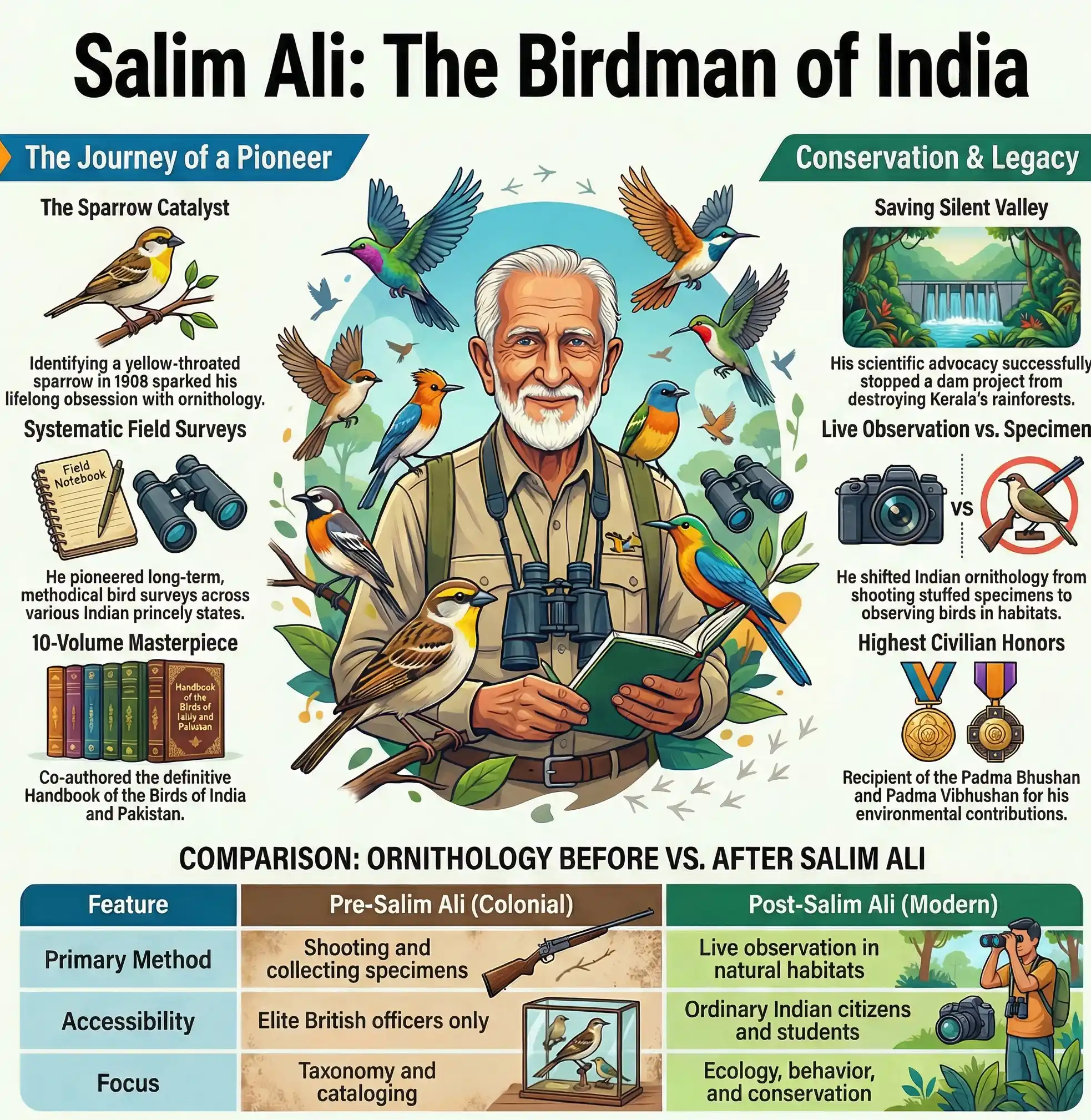
Dr. Salim Moizuddin Abdul Ali (1896–1987), universally revered as the "Birdman of India," was the preeminent ornithologist of the 20th century. Orphaned at a young age, a chance encounter with a yellow-throated sparrow at the Bombay Natural History Society (BNHS) ignited his lifelong passion for birds. Despite lacking formal higher scientific degrees initially and facing severe unemployment, he pioneered systematic, long-term bird surveys across the Indian subcontinent. His literary masterpieces, particularly The Book of Indian Birds and the 10-volume Handbook of the Birds of India and Pakistan, democratized birdwatching. A fierce conservationist, his advocacy directly saved the Keoladeo National Park in Bharatpur and the Silent Valley National Park in Kerala. He was awarded India's highest civilian honors, the Padma Bhushan and Padma Vibhushan.| Feature | Details |
| Name | Dr. Salim Ali |
| Lifespan | 1896 – 1987 |
| Birthplace | Bombay (Mumbai), India |
| Title | The Birdman of India |
| Field of Science | Ornithology, Natural History, Conservation |
| Key Catalyst | Identifying a Yellow-throated Sparrow |
| Famous Books | The Book of Indian Birds, The Fall of a Sparrow |
| Key Conservation | Saved Bharatpur Bird Sanctuary & Silent Valley |
| Civilian Honors | Padma Bhushan (1958), Padma Vibhushan (1976) |
The Sparrow That Changed Everything
Salim Ali’s story began with tragedy; born in Bombay in 1896, he lost both of his parents by the age of three and was raised by his maternal uncle, Amiruddin Tyabji.
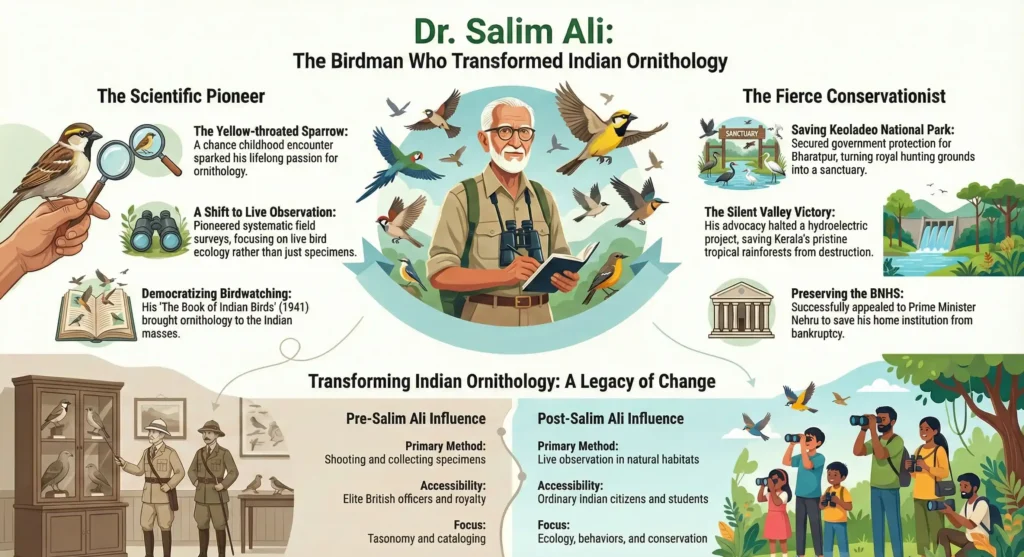
His defining moment came not in a classroom, but with a toy air-gun. As a pre-teen, Salim shot a seemingly ordinary house sparrow. However, he noticed an unusual yellow patch below its neck. His uncle, unable to identify it, sent him to the Bombay Natural History Society (BNHS). There, W.S. Millard identified it as a Yellow-throated Sparrow and showed the mesmerized boy the society’s vast collection of stuffed birds. In his famous autobiography, The Fall of a Sparrow, Salim Ali cites this exact moment as the turning point of his life.
From Museum Guide to Field Pioneer
Ali’s early educational path was rocky. He dropped out of St. Xavier’s College due to chronic headaches and went to Burma to help with his family’s timber and tungsten mining business. Rather than a setback, the Burmese jungles became his training ground, sharpening his skills as a naturalist.
Returning to India in 1917, he found that “ornithologist” was not a recognized career path for Indians under colonial rule. Struggling to find work, he eventually secured a position as a guide-lecturer at the Prince of Wales Museum in Mumbai in 1926. Realizing he needed formal training, he traveled to Germany in 1928 to work under Professor Erwin Stresemann at the Berlin Natural History Museum, where he mastered systematic bird study and bird banding (ringing).
Upon his return, unemployment struck again. Living in the coastal village of Kihim, he turned his lack of a job into an opportunity. He began conducting rigorous field observations, publishing a groundbreaking scientific paper on the complex, polygamous mating behavior of the Baya Weaver bird, which instantly established his credibility in the scientific community.
A Library of Indian Birds
Salim Ali believed that science belonged in the field, not just in a lab. He pioneered the practice of conducting methodical, extensive bird surveys across princely states like Hyderabad, Travancore, and Gwalior, meticulously documenting habitats and ecologies.
His greatest gift to the world was his writing, which brought ornithology out of the elite colonial sphere and to the Indian masses:
- The Book of Indian Birds (1941): This pictorial field guide, written in simple, engaging English, became an instant classic. It democratized birdwatching in India and remains an essential guide today.
- The Handbook of the Birds of India and Pakistan: Co-authored with American ornithologist S. Dillon Ripley, this monumental 10-volume opus systematized all known knowledge of the region’s birds, forming the bedrock of modern South Asian ornithology.
Manjul Bhargava: (1974- Present)
The Fierce Conservationist
Dr. Ali was not content just cataloging birds; he fought relentlessly to protect their habitats. He used his immense credibility and political influence to champion India’s natural heritage:
- Saving Bharatpur: He was instrumental in securing government protection for the Keoladeo Ghana National Park in Bharatpur, Rajasthan, transforming a former royal hunting ground into one of the world’s most important bird wintering sanctuaries.
- The Silent Valley Movement: In a landmark environmental battle, he strongly opposed a proposed hydroelectric dam project that would have drowned the pristine, irreplaceable tropical rainforests of Silent Valley in Kerala. His persuasive scientific advocacy directly led to the project’s cancellation, saving an ecological treasure.
Venkatraman Ramakrishnan: (1952- Present)
Quick Comparison Table: Pre-Salim Ali vs. Post-Salim Ali
| Feature | Ornithology Pre-Salim Ali (Colonial Era) | Ornithology Post-Salim Ali |
| Primary Method | Shooting and collecting stuffed specimens | Live observation in natural habitats |
| Accessibility | Elite British officers and royalty | Ordinary Indian citizens and students |
| Documentation | Scattered colonial journals | Comprehensive, standardized regional field guides |
| Focus | Taxonomy and cataloging | Ecology, mating behaviors, and conservation |
Curious Indian: Fast Facts
- The Legacy of Tehmina: Salim Ali’s wife, Tehmina, was his greatest confidante and actively traveled with him on his rugged field surveys. Her tragic death in 1939 devastated him, but he channeled his grief entirely into his work, never remarrying.
- Saving the BNHS: After India’s independence, the Bombay Natural History Society (BNHS) faced a severe financial crisis. Dr. Ali personally appealed to Prime Minister Jawaharlal Nehru, securing the necessary government funding to save the institution that had launched his career.
- A Living Legacy: The Salim Ali Centre for Ornithology and Natural History (SACON) in Coimbatore is named in his honor, continuing his mission of research and conservation.
Daulat Singh Kothari : (1906–1993)
Conclusion
Dr. Salim Ali was a man who looked at the sky and saw a library of living poetry. His journey proves that profound scientific achievements do not always begin in a university laboratory; sometimes, they begin with a curious child asking a simple question about a bird. By giving India’s feathered creatures a voice, he forced a rapidly modernizing nation to pause, listen, and protect the fragile biodiversity that sustains it.
Shivkar Bapuji Talpade: (1864- 1916)
If you think you have remembered everything about this topic take this QUIZ
Results


#1. What specific bird species sparked Salim Ali’s lifelong passion for ornithology after he found it as a pre-teen?
#2. Which 1941 pictorial field guide by Salim Ali is credited with democratizing birdwatching for the Indian masses?
#3. Living in the coastal village of Kihim, Salim Ali established his scientific credibility by publishing a paper on the complex mating behavior of which bird?
#4. Dr. Ali’s scientific advocacy directly led to the cancellation of a hydroelectric dam project that would have destroyed which pristine rainforest in Kerala?
#5. Who co-authored the monumental 10-volume Handbook of the Birds of India and Pakistan with Salim Ali?
#6. To receive formal training in systematic bird study and ringing, Ali traveled to Germany in 1928 to work under which professor?
#7. According to the comparison table, what was the primary method of ornithology before Salim Ali (during the Colonial Era)?
#8. After India’s independence, to whom did Dr. Ali personally appeal to secure funding and save the Bombay Natural History Society (BNHS) from a financial crisis?
Why is Salim Ali known as the Birdman of India?
He earned this title because he was the first Indian to conduct systematic bird surveys across the country, fundamentally establishing the field of modern ornithology in India.
What incident inspired Salim Ali to study birds?
As a child, he shot a yellow-throated sparrow and took it to the Bombay Natural History Society (BNHS) for identification. The secretary there showed him the society’s bird collection, sparking his lifelong passion.
What is his most famous book?
His most famous accessible work is “The Book of Indian Birds” (1941), while his ultimate scientific masterpiece is the 10-volume “Handbook of the Birds of India and Pakistan.”
Which major national parks did Salim Ali help save?
He was instrumental in the creation of the Keoladeo National Park in Bharatpur and successfully campaigned to stop a dam project that would have destroyed the Silent Valley National Park in Kerala.
What was his autobiography called?
His autobiography is titled “The Fall of a Sparrow,” referencing the childhood incident that changed his life.