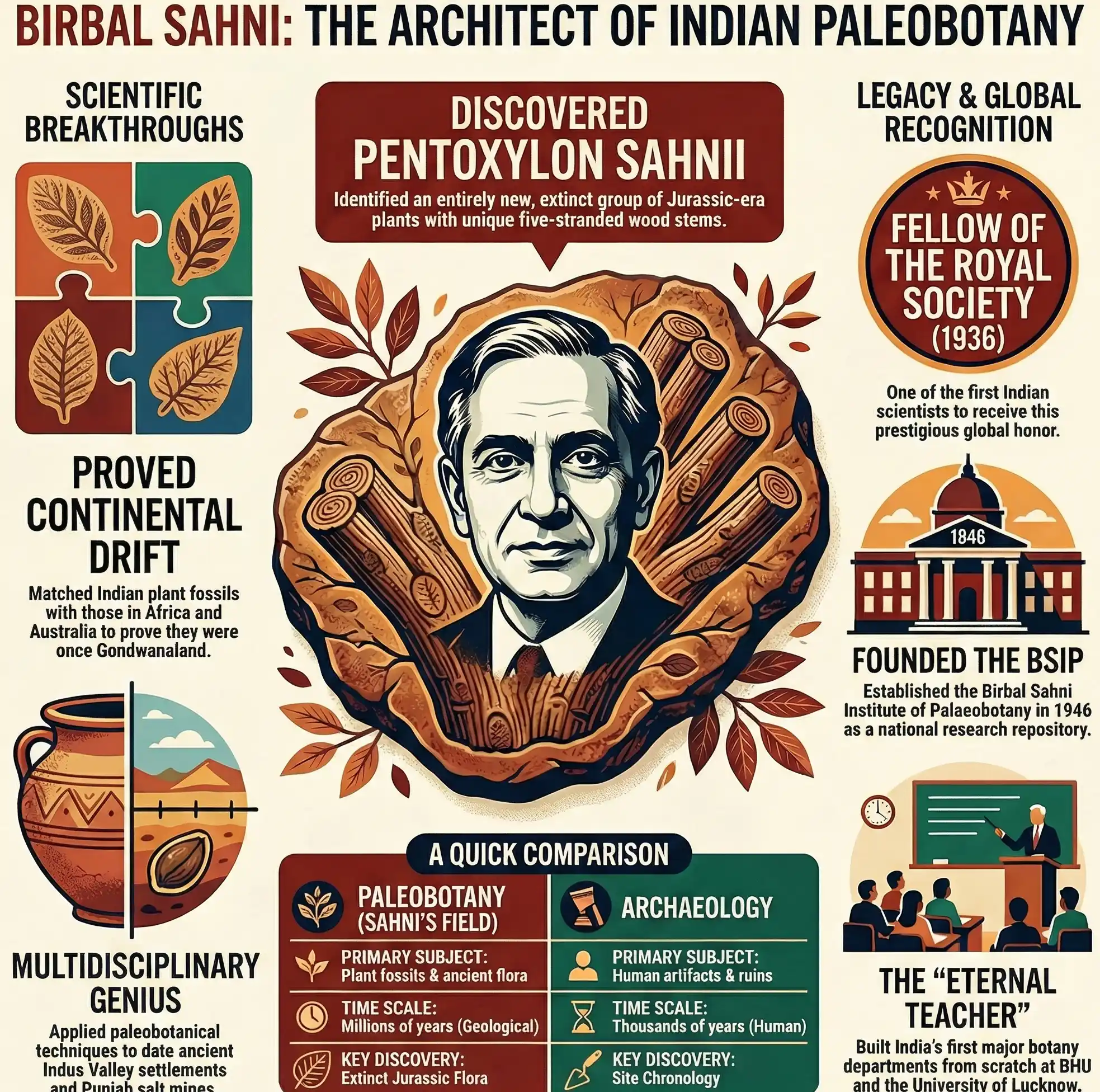
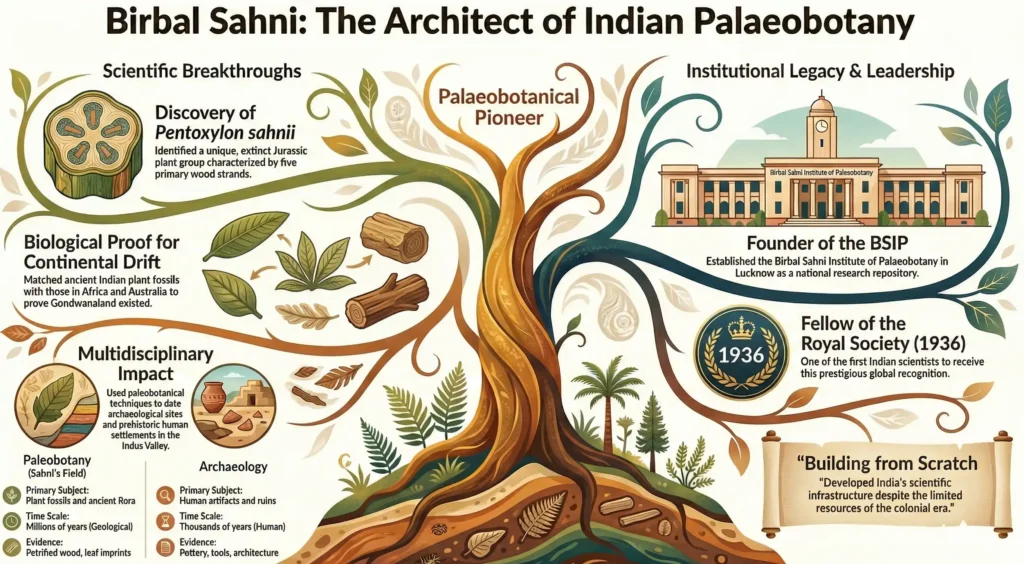
Professor Birbal Sahni (1891–1949) is universally recognized as the founder of Indian Paleobotany—the study of ancient, fossilized plant life. Born in British India, he studied at Cambridge under world-renowned paleobotanists before returning to India to establish the discipline from scratch. His monumental scientific achievements include the discovery of a completely new extinct plant group (Pentoxylon sahnii) in the Rajmahal Hills and establishing the geological timeline of the ancient supercontinent Gondwanaland. His meticulous research provided crucial biological evidence for the theory of continental drift. A passionate institution builder, he founded the world-renowned Birbal Sahni Institute of Palaeobotany (BSIP) in Lucknow and became one of the first Indian scientists to be elected a Fellow of the Royal Society (FRS).| Feature | Details |
| Name | Prof. Birbal Sahni |
| Lifespan | November 14, 1891 – April 10, 1949 |
| Birthplace | Bhera, British India (now in Pakistan) |
| Field of Science | Paleobotany, Geology |
| Key Discovery | Pentoxylon sahnii (Extinct Jurassic plant group) |
| Key Theory Supported | Continental Drift (via Gondwana flora) |
| Major Institution | Birbal Sahni Institute of Palaeobotany (BSIP), Lucknow |
| Global Recognition | Fellow of the Royal Society (FRS), 1936 |
Roots of Curiosity
Birbal Sahni was born on November 14, 1891, in Bhera. His family background played a pivotal role in shaping his scientific destiny. His father, Professor Ruchi Ram Sahni, was an eminent chemist and a deeply committed social reformer involved in India’s independence movement. Young Birbal grew up in a household in Lahore that was constantly buzzing with intellectual discussions, free-thinking, and a strong sense of patriotism.
Recognizing his son’s sharp intellect, his father encouraged him to pursue his studies abroad—a rare and privileged opportunity in colonial India. Sahni traveled to England and matriculated at the University of Cambridge. While initially studying botany and geology separately, he soon discovered his true passion at the intersection of these two fields: Paleobotany. He was mesmerized by the idea that studying the structure of a fossilized leaf could reveal the geological history of an entire landmass.
From Cambridge to Calcutta
After graduating from Cambridge, Sahni pursued his Doctor of Science (Sc.D.) degree from the University of London. During this crucial period, he was mentored by Professor Albert Charles Seward, one of the world’s leading paleobotanists. Seward’s rigorous training transformed Sahni into a meticulous researcher. Together, they studied the fossil flora of the Rajmahal Hills in India, a region that would define Sahni’s life’s work.
Upon returning to India in 1919, he faced an uphill battle. The scientific infrastructure in colonial India was rudimentary, and paleobotany was practically a non-existent field. Starting his academic career at Banaras Hindu University (BHU) and later moving to the University of Lucknow in 1921 as its first Professor of Botany, Sahni had to build departments, train students, and acquire research materials from absolute scratch.
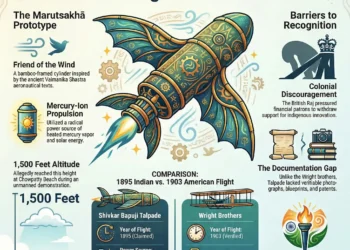
Shivkar Bapuji Talpade: (1864- 1916)
Unlocking the Secrets of Gondwanaland
Professor Sahni’s scientific achievements revolutionized our understanding of Earth’s history.
- The Discovery of Pentoxylon sahnii: His single most famous paleobotanical discovery was the identification of a unique fossil plant group called Pentoxylales. Centered around the plant genus Pentoxylon sahnii, this was a group of extinct Jurassic-era plants entirely new to science, characterized by possessing five primary strands of wood in its stem. This finding provided crucial insights into the evolutionary path of ancient flora.
- Proving Continental Drift: Sahni spent years studying fossil plants in the Gondwana rock formations of India. He established a definitive timeline of plant succession across the Permian, Triassic, and Jurassic eras. By showing that ancient Indian plant fossils perfectly matched those found in Africa, Australia, and South America, his work provided undeniable biological proof for the theory of Continental Drift—the idea that these landmasses were once joined together as the supercontinent Gondwanaland.
- Archaeological Intersections: Sahni’s genius was multidisciplinary. He used paleobotanical techniques to determine the age of archaeological sites, using fossil evidence from salt mines in the Punjab to date geological deposits and aiding in dating prehistoric human settlements in the Indus Valley.
Manjul Bhargava: (1974- Present)
Building Institutions Against the Odds
Sahni’s journey was defined by his sheer determination to establish pure scientific research in a country focused primarily on immediate economic survival. His global credibility skyrocketed in 1936 when he was elected a Fellow of the Royal Society (FRS), making him one of the few Indian scientists to achieve this profound honor at the time.
Using this global clout, he championed his ultimate dream: the creation of an independent national repository for prehistoric research. In 1946, he founded the Birbal Sahni Institute of Palaeobotany (BSIP) in Lucknow. Tragically, Sahni passed away prematurely on April 10, 1949, just a few months after Prime Minister Jawaharlal Nehru laid the foundation stone of the Institute’s new building.
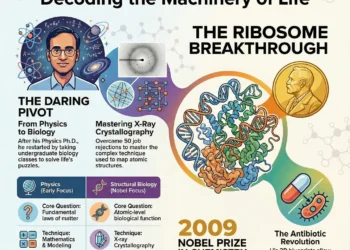
Venkatraman Ramakrishnan: (1952- Present)
Quick Comparison Table: Understanding Sahni’s Field
| Feature | Paleobotany (Sahni’s Field) | Archaeology |
| Primary Subject | Plant fossils, ancient flora, pollen | Human artifacts, ruins, cultural remains |
| Time Scale | Millions of years (Geological time) | Thousands of years (Human history) |
| Core Questions | How did plant life evolve? How did continents move? | How did early humans live and build societies? |
| Key Evidence | Petrified wood, leaf imprints in shale | Pottery, tools, architecture, coins |
| Sahni’s Contribution | Discovered Jurassic plant species (Pentoxylon) | Used plant remains to date Indus Valley sites |
Curious Indian: Fast Facts
- The Hobbyist Numismatist: Besides paleobotany, Sahni had a deep fascination with ancient Indian coins. He extensively studied the techniques used in ancient India to cast coins, eventually publishing a highly regarded monograph on the subject.
- Wife and Co-Founder: His wife, Savitri Sahni, was instrumental in his success. After his sudden death in 1949, she took over the administrative responsibilities of the BSIP, ensuring that his vision for the institute was fully realized.
- The Himalayas: Sahni was deeply passionate about the geological uplift of the Himalayas, actively studying how the dramatic rise of the mountain range impacted the distribution and evolution of plant species in the Indian subcontinent.
Conclusion
Professor Birbal Sahni did not just study the past; he built the future of Indian science. He proved that high-quality, fundamental research could be conducted effectively on Indian soil despite immense colonial constraints. By looking closely at overlooked details—a fossilized leaf, a piece of petrified wood—he connected India’s geology to the grand, sweeping narrative of Earth’s history. Today, the Birbal Sahni Institute of Palaeobotany stands as a towering “scientific temple,” continuing the work of the eternal teacher who showed India how to read the stones.
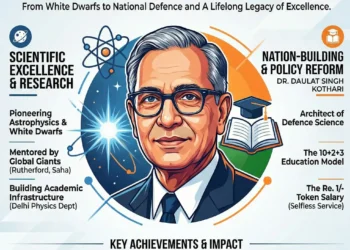
Daulat Singh Kothari : (1906–1993)
If you think you have remembered everything about this topic take this QUIZ
Results


#1. Professor Birbal Sahni is universally recognized as the founder of which scientific discipline in India?
#2. What was the name of the completely new extinct Jurassic plant group discovered by Birbal Sahni in the Rajmahal Hills?
#3. By matching ancient Indian plant fossils with those in Africa, Australia, and South America, Sahni provided biological proof for which geological theory?
#4. In 1936, Birbal Sahni became one of the few Indian scientists to achieve global recognition by being elected as a Fellow of which prestigious organization?
#5. Who mentored Birbal Sahni at the University of London and helped transform him into a meticulous researcher?
#6. According to the comparison table, what is the primary subject of study in the field of Paleobotany?
#7. Which national institution did Birbal Sahni found in Lucknow in 1946 to serve as a repository for prehistoric research?
#8. Besides paleobotany, Sahni had a deep fascination with and published a highly regarded monograph on which other historical subject?
What is Paleobotany?
Paleobotany is a branch of botany and paleontology that involves the recovery and identification of plant remains (fossils) from geological contexts to reconstruct past environments and evolutionary history.
Why is Birbal Sahni known as the Father of Indian Paleobotany?
He was the first Indian scientist to systematically study the fossil flora of the Indian subcontinent, establishing its geological timelines and founding the first dedicated institute for paleobotany in the country.
What is Pentoxylon sahnii?
It is an extinct group of Jurassic-era seed plants discovered by Birbal Sahni in the Rajmahal Hills of Bihar. It was entirely new to science, displaying unique anatomical features like five primary strands of wood.
How did Sahni’s work relate to Continental Drift?
By proving that the fossilized plants found in India’s Gondwana rock formations matched those found in Australia, South America, and Africa, he provided solid biological evidence that these continents were once physically connected.
What institute did he establish?
He founded the Birbal Sahni Institute of Palaeobotany (BSIP) in Lucknow in 1946, which remains a premier global research center today.