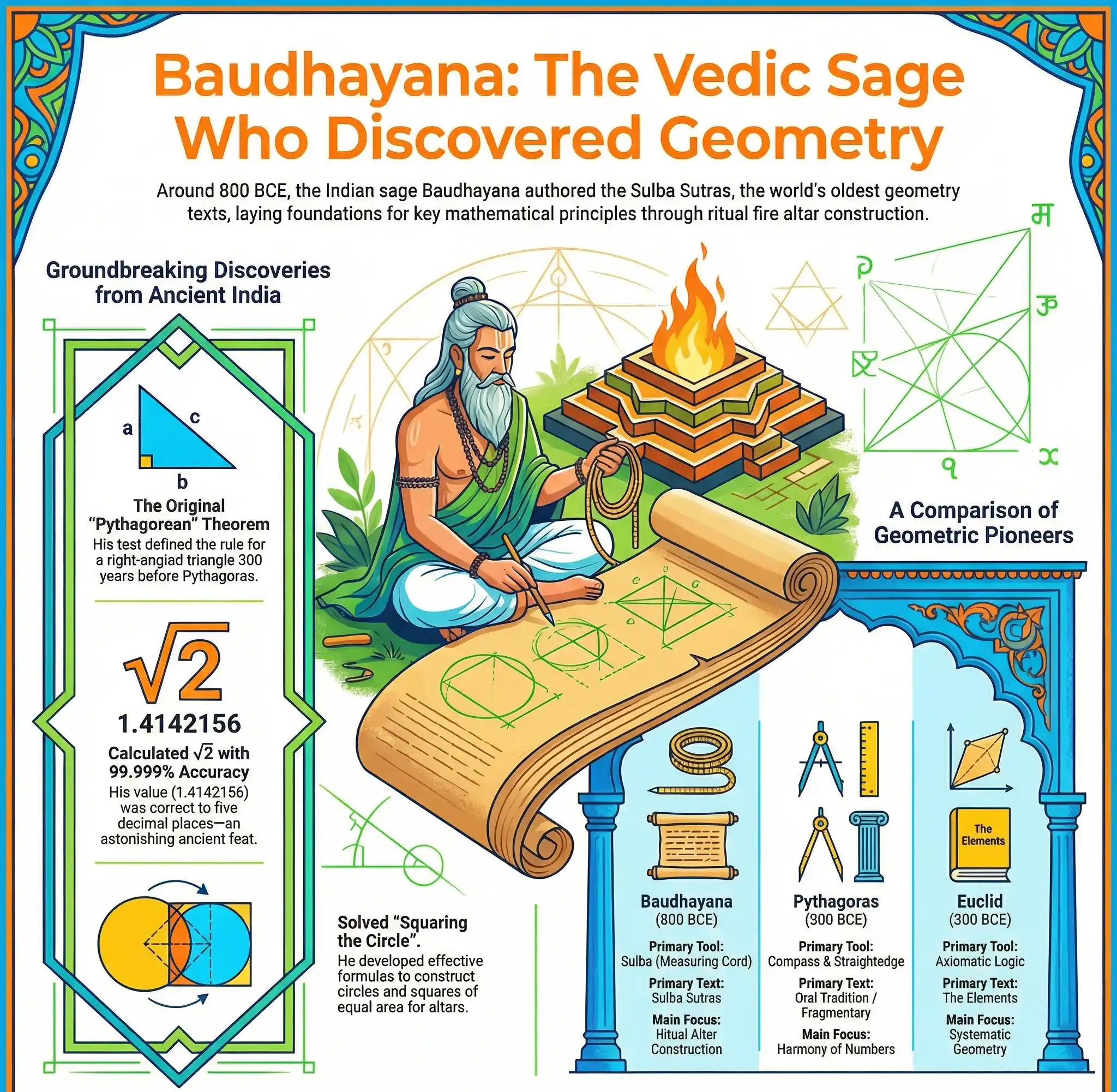
He stated the theorem we call Pythagoras’ three centuries early, as a working instruction for laying out a fire altar
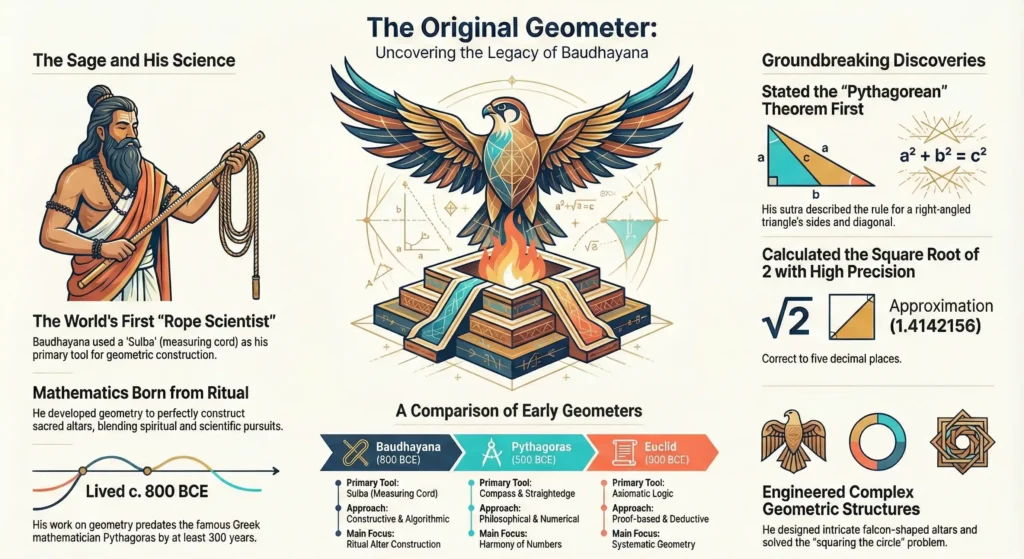
Sulba means cord. The geometry in the Sulbasutras is done on open ground with a rope and some pegs, and nothing else.
Here is how it works. Take a cord twelve units long with marks at three and at seven. Peg the two ends together, pull the cord taut from the two marks, and you have a triangle with sides of three, four and five, and a corner that is exactly square. Any priest could do it, on any morning, on any patch of levelled earth.
No compass, no straightedge, no drawing. A rope, some pegs, and the fact that three squared plus four squared is five squared.
The statement
Baudhayana puts the general rule this way: the cord stretched along the diagonal of a rectangle produces the area that the two sides produce separately.
That is the theorem. He then lists the rectangles in which it comes out in whole numbers, which are the pairs a rope-worker would actually want: three and four, five and twelve, eight and fifteen, seven and twenty-four, twelve and thirty-five, fifteen and thirty-six.
The text is usually dated to somewhere between 800 and 500 BC. Pythagoras belongs to the sixth century.
It is not written as a theorem, because he was not proving anything. He was telling somebody how to get a corner square.
Exploring The Deep Namdapha National Park Rainforest
Why anyone needed this
Vedic ritual required fire altars of particular shapes and particular areas, and an altar that was wrong was a rite that did not work. The shapes were not simple: a falcon with outstretched wings, a tortoise, a chariot wheel with spokes, a rhombus, a trough.
Then there was the rule that generated the real mathematics. When a rite was repeated, the new altar had to have the same shape as the old one and a larger area, often one and a half times or twice as large.
Same shape, different size, exactly. That single ritual requirement is the whole of transformation geometry, and it is what pushed these people into turning rectangles into squares of equal area, squares into circles, and two squares into one.
The square root of two
To double a square you need its diagonal, and the diagonal of a unit square is the square root of two, which cannot be written down as a fraction.
The Sulbasutras give a recipe instead: increase the measure by its third, and that third by its own fourth, less the thirty-fourth part of that fourth. Work it through and you get 1.4142156. The value is 1.4142136.
That is right to five decimal places, in a text with no decimal notation, no symbol for a root and no algebra, meant to be recited from memory. The text also calls it an approximation, which matters: they knew they had not finished.
A number that cannot be written exactly, given to five places, as an instruction you could follow with a marked rope.
The Heritage Of Northeast India Local Brews Unveiled
Circles
Circular altars had to be turned into squares of the same area and back again, which is the problem Europe later called squaring the circle and eventually proved impossible. The Sulbasutras give working rules for it, implying a value for the ratio of circumference to diameter of around 3.09 to 3.13 depending on which rule is used, and again they are offered as approximations rather than exact.
Who he was
Almost nothing. Baudhayana is the name attached to a Shrautasutra of the Krishna Yajurveda, a manual of ritual procedure, and the Sulbasutra is the section of it that deals with measurement. Two more survive, by Apastamba and Katyayana, a century or two later. His is the oldest.
He is a name on a text that was composed to be memorised, in a society with a formidable oral tradition and no particular interest in recording the biographies of the people who wrote its manuals.
6 Unfoldings in the Subrahmanyan Chandrasekhar Biography
What the Greeks added
It is worth saying plainly what is not in the Sulbasutras, because the claim that they are the true origin of geometry goes further than the evidence.
There are no proofs. The results are correct and the constructions work, and nowhere does the text argue that they must work, for every rectangle, always. Demonstration of that kind is what Greek geometry contributed, and it is a genuinely different intellectual act.
Both things can be true. A man laying out a bird-shaped altar in the ninth century BC knew a relation that a fourteen-year-old now learns with somebody else’s name attached to it, and he knew it because he needed it, not because he had proved it.
He was solving a problem about bricks and gods. The answer outlasted both.
7 Secrets of Padmanabhaswamy Temple Treasure
8 Defining Chapters in the Vikram Sarabhai Biography
If you think you have remembered everything about this topic take this QUIZ
Results


#1. What was the primary practical reason that drove Baudhayana and other Vedic sages to develop advanced geometry?
#2. The term ‘Sulba’ in the ‘Baudhayana Sulba Sutra’ refers to which primary tool used for measurement?
#3. Which famous mathematical theorem did Baudhayana describe at least 300 years before its namesake lived in Greece?
#4. Baudhayana provided a calculation for the square root of two ($sqrt{2}$) that was accurate to how many decimal places?
#5. What was the ‘ultimate challenge’ of squaring the circle that Baudhayana addressed?
#6. According to the ‘Quick Comparison’ table, what was the primary approach to geometry taken by Baudhayana compared to Euclid?
#7. The ‘Shyena-chiti’ altar, designed by Baudhayana, was built in the shape of which creature?
#8. How were Baudhayana’s mathematical sutras originally preserved for centuries before they were written down?
Did Baudhayana really discover the Pythagorean theorem?
Yes. The Baudhayana Sulba Sutra contains a clear statement of the theorem regarding the diagonal of a rectangle, written centuries before Pythagoras.
What are the Sulba Sutras?
They are ancient Indian texts that provide instructions for the measurement and construction of sacrificial altars, containing the earliest known geometric principles.
How did he calculate the square root of 2?
He used a fractional series that allowed him to approximate the value of √2 with incredible accuracy for that era, essential for doubling the area of a square.
Why was geometry so important in the Vedic period?
Rituals required fire altars to have specific shapes and areas. If the geometry was wrong, it was believed the ritual would not be effective, necessitating high mathematical precision.
How does Baudhayana influence modern math?
His work represents the birth of combinatorics and irrational numbers, forming the earliest roots of the mathematical traditions that would later be developed by Aryabhata and Indian scholars.
Read More: https://curiousindian.in/kanada-6th-century-to-2nd-century-bce/
Sources & References
MacTutor History of Mathematics Archive, University of St Andrews (“The Indian Sulbasutras”) — the dating of the texts, the statement of the diagonal rule and the approximation for the square root of two.
S.N. Sen and A.K. Bag, The Sulbasutras (Indian National Science Academy, 1983) — the critical edition and translation of Baudhayana’s text.
Kim Plofker, Mathematics in India (Princeton University Press, 2009) — the ritual setting of the altar constructions and the absence of proof in the tradition.
Encyclopaedia Britannica (“Sulvasutra”) — the place of these texts within the Vedic ritual literature.
Author


Exploring the Soul of Bharat through History, Science, Culture, and its Diversity
Our Mission
Curious Indian is a definitive knowledge portal dedicated to chronicling the events, personalities, and cultural shifts that defined the Indian subcontinent. From the ancient Vedic Period to the complexities of 21st-century politics, our goal is to provide deep-dive analysis that inspires.
Editorial Standards & E-E-A-T
Every article published under our brand undergoes a rigorous fact-checking process. We prioritize primary historical records, academic citations, and credible archives to ensure our readers receive accurate, high-authority information.
Historical Integrity Directly sourcing from ASI archives and academic journals.Topical Authority Comprehensive clustering of Indian Science, Biographies, and Wars.Managed by Paripurna Datta and TEAM | Dedicated to the Knowledge of India.