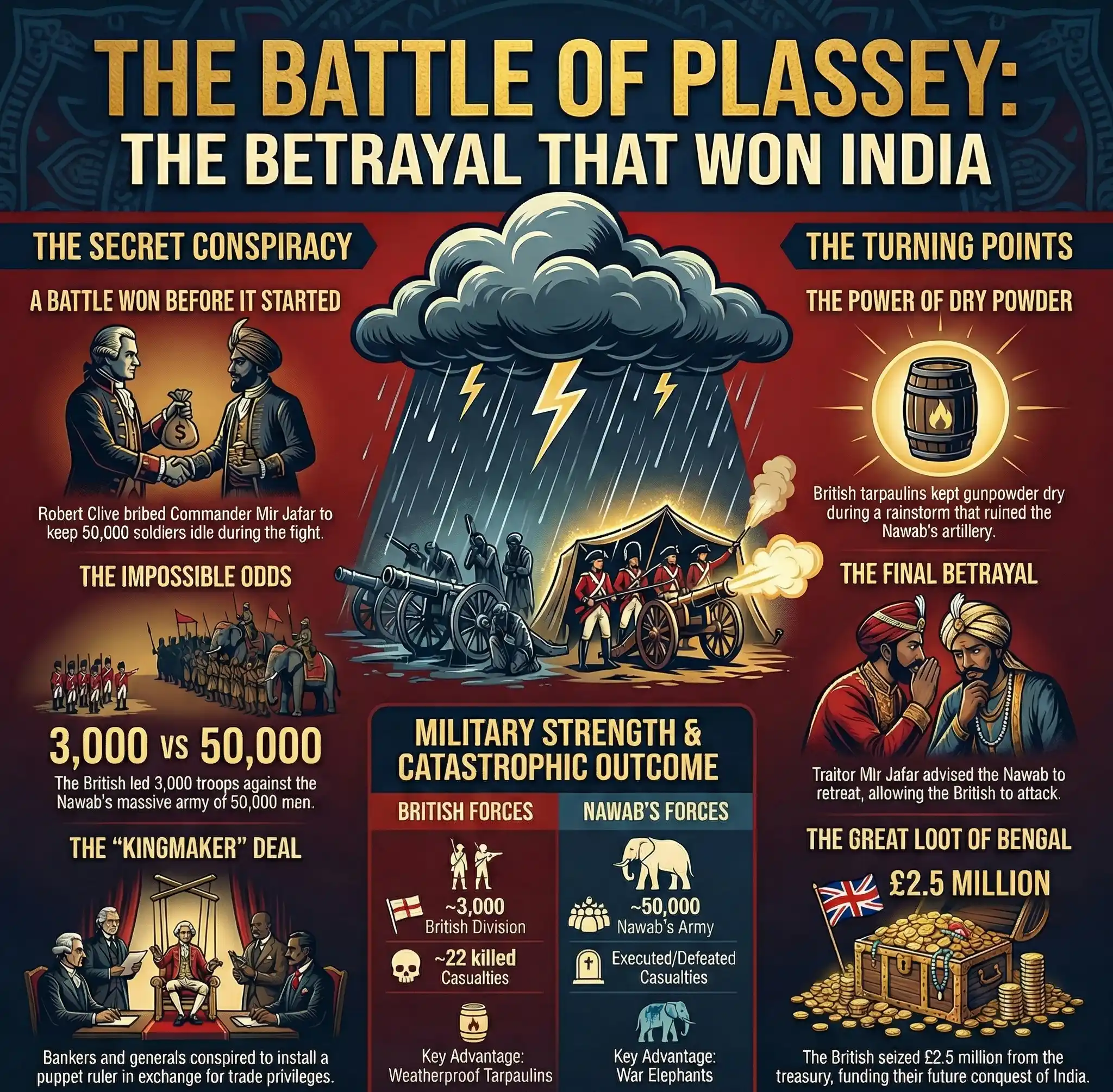
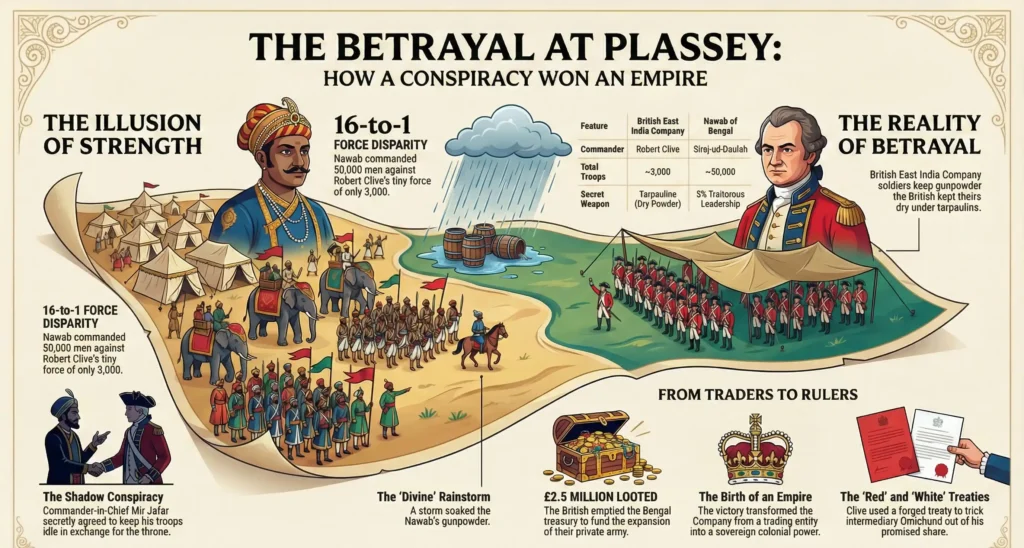
The Battle of Plassey, fought on June 23, 1757, marks the true beginning of the British Empire in India. It was fought between the forces of the British East India Company, led by the astute Robert Clive, and the Nawab of Bengal, Siraj-ud-Daulah. The battle took place in Palashi (Plassey), Bengal. While the Nawab commanded a massive army of 50,000 men compared to Clive’s 3,000, the outcome was decided before the first shot was fired. Siraj’s commander-in-chief, Mir Jafar, betrayed him, keeping the majority of the army idle during the fight. This victory allowed the Company to install Mir Jafar as a puppet ruler, seizing control of Bengal’s vast wealth and transforming from a trading entity into a colonial power.| Feature | Details |
| Date | June 23, 1757 |
| Location | Palashi (Plassey), Bengal |
| British Commander | Robert Clive |
| Indian Ruler | Siraj-ud-Daulah (Nawab of Bengal) |
| Force Strength | British: ~3,000 vs. Nawab: ~50,000 |
| Key Betrayer | Mir Jafar (Commander-in-Chief) |
| Key Financiers | Jagat Seths (Bankers) |
| Outcome | Decisive British Victory; Start of British Rule |
| Casualties | British: ~22 killed |
The Rise of Siraj-ud-Daulah
In 1756, the 23-year-old Siraj-ud-Daulah became the Nawab of Bengal, the richest province in India. He was young, impulsive, and deeply suspicious of the British East India Company, which was fortifying Calcutta without his permission. When the British refused to stop, Siraj attacked and captured Calcutta in June 1756.
This led to the infamous Black Hole of Calcutta incident, where British prisoners were allegedly crammed into a tiny dungeon, leading to many deaths from suffocation. While historians debate the number of casualties, the incident gave the British in Madras the excuse they needed to launch a full-scale retaliation.
Battle of Buxar 1764: The Victory That Made British Rule Inevitable
The Conspiracy in the Shadows
Robert Clive arrived in Bengal not just with soldiers, but with a plan to divide the enemy. He realized that Siraj had many enemies in his own court.
- Mir Jafar: The ambitious commander-in-chief who wanted the throne.
- Jagat Seths: The powerful banking family of India who felt threatened by Siraj’s unpredictable temper.
- Omichund: The intermediary who brokered the deal.
Clive struck a secret deal: Mir Jafar would be made Nawab if he supported the British. In return, the Company would get massive financial rewards and trade privileges. It was a corporate takeover disguised as a war.
The Battle: June 23, 1757
The armies met at Palashi on the banks of the Bhagirathi River. The Nawab’s army was massive—50,000 men, war elephants, and French artillery. Clive had only 3,000 men, mostly Indian sepoys.
The battle began at 8:00 AM. However, at 11:00 AM, a heavy rainstorm drenched the battlefield. The British, prepared with tarpaulins, kept their gunpowder dry. The Nawab’s powder was soaked. Assuming the British guns were also useless, the Nawab’s cavalry commander, Mir Madan, led a charge. He was instantly killed by British cannon fire.
The death of his only loyal general panicked Siraj. He turned to Mir Jafar for advice. Mir Jafar, the traitor, advised him to retreat. As the Nawab pulled back, Mir Jafar’s huge division stood still, watching the British advance without firing a shot. Realizing the betrayal, Siraj fled the battlefield on a camel.
Establishment of the British Raj 1858: The Dawn of Imperial India
The Aftermath: The Loot of Bengal
The battle was over by 5:00 PM. It was hardly a battle—more of a skirmish. But the consequences were colossal.
- Mir Jafar was crowned Nawab, but he was merely a puppet.
- The Treasury: The British loaded boats with over £2.5 million (in 1757 currency) from the Bengal treasury and sailed it down to Calcutta.
- Siraj’s End: The young Nawab was captured a few days later and executed by Mir Jafar’s son, Miran.
From Traders to Rulers
Plassey changed the DNA of the East India Company. They were no longer merchants begging for permits; they were kingmakers. The revenues from Bengal allowed them to build a massive army, which they used to conquer the rest of India over the next century. As historians note, “The British Empire in India was built on the money of Bengal.”
Quick Comparison Table: Plassey vs. Buxar
| Feature | Battle of Plassey (1757) | Battle of Buxar (1764) |
| Nature | Political Conspiracy / Betrayal | Full-Scale Military Conflict |
| Opponent | Siraj-ud-Daulah (Bengal) | Alliance (Bengal, Awadh, Mughal) |
| British Commander | Robert Clive | Hector Munro |
| Outcome | Installation of Puppet Nawab | Sovereign Control (Diwani Rights) |
| Significance | The Foothold | The Empire |
Curious Indian: Fast Facts
- The Mango Grove: The battle was fought in a vast orchard of Lakshbag, famous for its mango trees. The British troops famously took shelter behind the trees during the artillery fire.
- Omichund’s Fate: The middleman Omichund demanded a huge cut (5% of the treasury) to keep the conspiracy quiet. Clive tricked him by drawing up two treaties—a fake one on red paper promising him the money, and a real one on white paper giving him nothing. When Omichund found out after the battle, he reportedly went insane from shock.
- The Rain: If it hadn’t rained that afternoon, the Nawab’s artillery might have kept the British at bay. The rain was the only “divine intervention” Clive received.
- Clive’s Wealth: When Clive returned to England, he was one of the richest men in Europe. When questioned by Parliament about his loot, he famously replied, “By God, Mr. Chairman, at this moment I stand astonished at my own moderation.”
Conclusion
The Battle of Plassey 1757 was a tragedy for India, not because of the military defeat, but because of the moral collapse. It showed that a handful of foreigners could conquer a vast land if the natives were divided. The betrayal of Mir Jafar remains a stain on Indian history, a cautionary tale that internal disunity is the greatest enemy of sovereignty.
Death of Tipu Sultan: The Fall of the Tiger of Mysore
If you think you have remembered everything about this topic take this QUIZ
Indian Rebellion of 1857: The First War of Independence
Who fought in the Battle of Plassey?
The battle was fought between the British East India Company (led by Robert Clive) and the Nawab of Bengal, Siraj-ud-Daulah.
Who betrayed Siraj-ud-Daulah?
His commander-in-chief, Mir Jafar, betrayed him by entering into a secret pact with the British and refusing to fight during the battle.
When was the Battle of Plassey fought?
It was fought on June 23, 1757.
What was the Black Hole of Calcutta?
It was an incident in 1756 where British prisoners were allegedly held in a cramped dungeon by Siraj-ud-Daulah, leading to many deaths. It became the justification for the British attack.
What was the main result of the battle?
The British installed Mir Jafar as a puppet ruler, gained control over Bengal’s revenues, and established their first major political foothold in India.