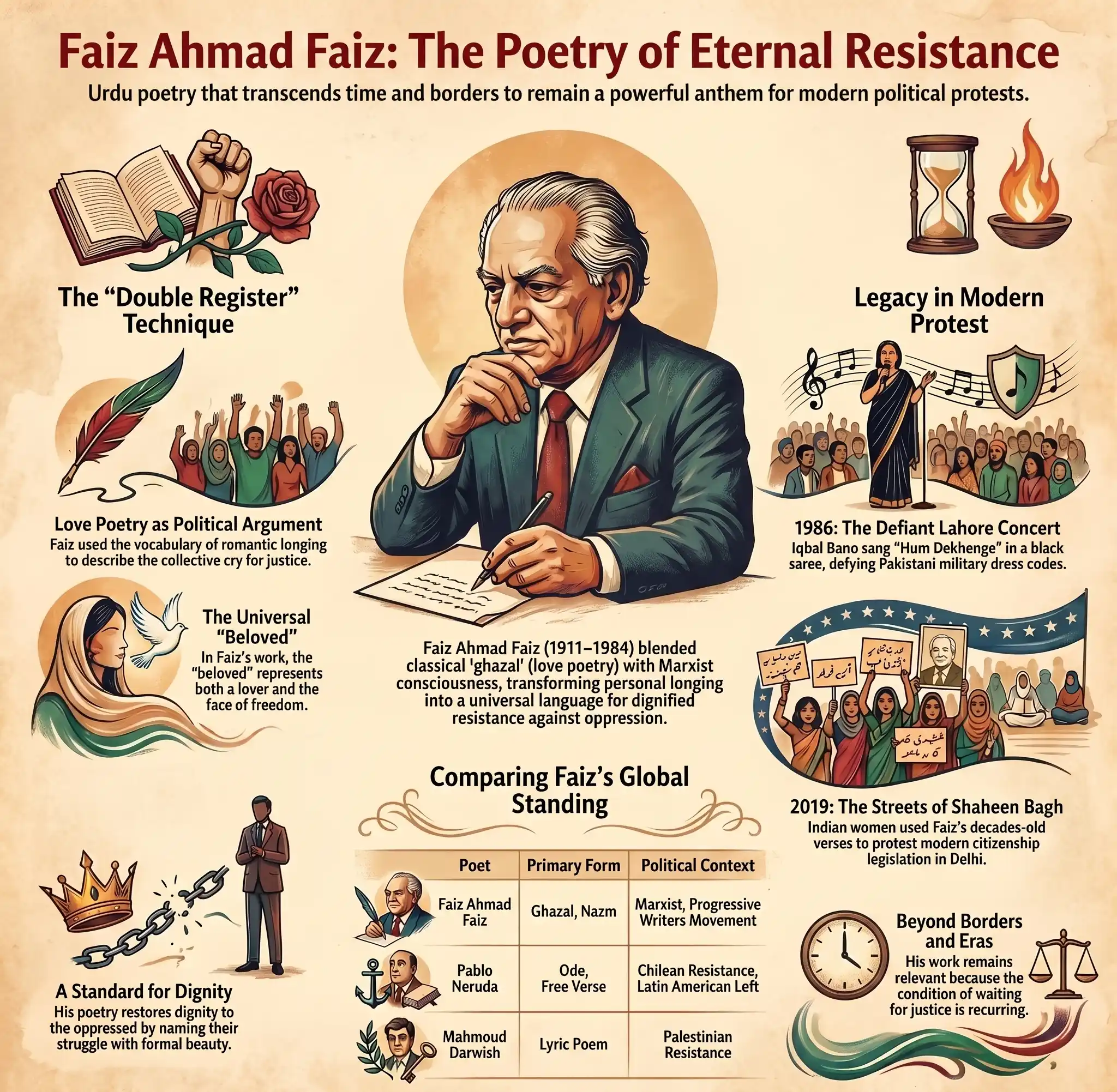
Faiz Ahmad Faiz was the most celebrated Urdu poet of the twentieth century and one of the most consequential political poets in the history of South Asian literature, whose work combined the formal beauty of the classical ghazal tradition with a Marxist political consciousness of extraordinary sophistication to produce a body of poetry whose resonance in moments of political crisis has proven essentially inexhaustible across seven decades and three countries. Born in Sialkot in 1911, imprisoned twice under Pakistani military governments, exiled under Zia ul Haq's dictatorship, and awarded the Lenin Peace Prize in 1962, he lived a political life whose intensity and personal cost are inseparable from the specific quality of moral authority that his poetry carries. His poem Hum Dekhenge, composed under military dictatorship and sung at the Shaheen Bagh protests in Delhi in 2019 to 2020, is the most recent demonstration of a pattern that has repeated across South Asia since his first publications in the 1940s: that when political crisis reaches a certain pitch, people reach for Faiz because his language does something that political speech cannot do, it transforms the experience of oppression into the language of dignified resistance without diminishing the reality of the oppression or the cost of the resistance.| Detail | Information |
| Full Name | Faiz Ahmad Faiz |
| Born | 13 February 1911, Sialkot, Punjab, British India |
| Died | 20 November 1984, Lahore, Pakistan |
| Nationality | Pakistani, born British Indian |
| Primary Art Form | Urdu poetry, ghazal, nazm |
| Political Affiliation | Communist Party of Pakistan, progressive left |
| Literary Movement | Progressive Writers Movement, All India Progressive Writers Association |
| Most Celebrated Works | Hum Dekhenge, Mujhse Pehli Si Mohabbat, Bol Ki Lab Azad Hain Tere |
| Imprisonments | 1951 to 1955 under Rawalpindi Conspiracy Case, further imprisonment under Zia ul Haq |
| Awards | Lenin Peace Prize 1962, Nishan-e-Imtiaz Pakistan posthumous |
| Exile | Beirut, London, Moscow, 1979 to 1982 under Zia ul Haq’s military regime |
| Associated Publications | Pakistan Times, Imroze, as editor |
| UNESCO Relevance | Recognised as a major figure of world literature |
| Contemporary Resonance | Hum Dekhenge sung at Shaheen Bagh protests 2019 to 2020, CAA protests across India |
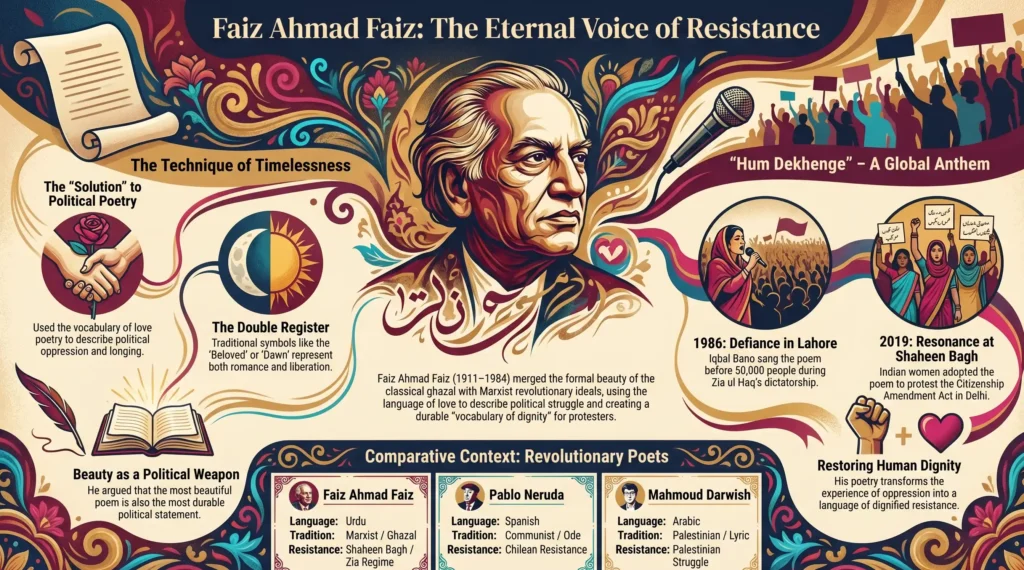
Why the Poetry of Faiz Ahmad Faiz Still Resonates in Modern Protests
There is a specific problem with political poetry, and it is a problem that most political poetry does not solve and that Faiz Ahmad Faiz solved so completely and so quietly that the solution is almost invisible until you compare his work to the political poetry that surrounds it in the tradition.
The problem is this: political poetry that is primarily about its political moment dies with that moment. The specific grievance, the specific oppressor, the specific demand, the specific emotion of a particular political crisis are real and urgent when the crisis is happening and increasingly difficult to access as the crisis recedes into history. The poetry that was written to capture and express that urgency becomes a historical document rather than a living thing, something to be studied rather than sung, something that tells you what it felt like to be alive then rather than what it feels like to be alive now.
Faiz solved this problem through a technique that is so elegant it looks like it is not a technique at all. He wrote about political oppression using the emotional and imagistic vocabulary of love poetry. Not as a disguise, not as a code to evade censors, but as a genuine poetic argument: that the experience of political oppression and the experience of longing for what has been lost or denied are the same experience, that the beloved in the ghazal tradition and the lost freedom in the revolutionary tradition are the same absence, that the heart’s cry for the lover and the people’s cry for justice are the same cry expressed in different registers.
This is not a metaphor. It is a philosophical position. And it is the position that makes Faiz’s poetry available to every generation that finds itself in the condition his poetry describes, the condition of loving what has been denied you and refusing to stop loving it despite the denial.
The Man Behind the Verses
Faiz Ahmad Faiz was born on 13 February 1911 in Sialkot, in the Punjab of British India, into a family of modest means but significant educational aspirations. Sialkot was already, by the early twentieth century, a city with a literary tradition that included the great Urdu poet and philosopher Allama Iqbal, whose influence on Faiz’s early literary formation was substantial and whose shadow Faiz would spend his career both honoring and departing from.
He was educated at Government College Lahore, one of the premier educational institutions of colonial Punjab, where he absorbed the English literary tradition with the thoroughness that the colonial curriculum demanded and the Urdu literary tradition with the passion of a young man who understood instinctively that this was the language in which his own most important expression would eventually find its form. He received a master’s degree in English literature and another in Arabic, academic achievements that placed him in the small elite of South Asian intellectuals who could move with equal fluency across the literary traditions of the subcontinent and the colonial metropole.
His political consciousness developed through the specific intellectual climate of 1930s British India, when the influence of the Soviet Union as a model of socialist transformation was at its most powerful on the South Asian left, when the Progressive Writers Movement was beginning to articulate an aesthetic programme for literature in the service of social and political liberation, and when the combined urgencies of the independence movement, the peasant and worker movements, and the growing awareness of fascism’s threat in Europe were creating an intellectual environment in which political commitment felt not only possible but morally required.
He joined the British Indian Army during the Second World War, rising to the rank of Lieutenant Colonel, an experience that gave him direct exposure to both the military machinery of empire and the specific quality of solidarity that develops among people who are facing death together, a solidarity that would later inflect his understanding of what political community means and costs.
He married Alys George, a British communist and activist, in 1941, a marriage that was both a personal love match and a political alliance of the kind that characterised the best of the progressive left’s personal relationships, in which political commitment and personal love were not separate dimensions of life but expressions of the same fundamental orientation toward the world.
The Progressive Writers Movement and the Aesthetic Programme
The All India Progressive Writers Association, founded in London in 1935 and launched in India at its first conference in Lucknow in 1936, was the institutional framework through which Faiz’s generation of Urdu and Hindi writers developed the aesthetic and political programme that would define the most significant literary production of the mid-twentieth century in South Asia.
The AIPWA’s founding manifesto, signed by writers including Munshi Premchand, called for literature to be placed in the service of social and political liberation, to engage with the realities of poverty, oppression, and exploitation that the dominant literary traditions had aestheticised or ignored, and to develop forms and languages adequate to the experience of the people rather than the refined sensibilities of the elite.
Faiz’s engagement with this programme was genuine but not uncritical. He was not a poet who subordinated aesthetic quality to political utility, who treated the poem as a vehicle for delivering a political message in the most efficient possible form. His commitment to the formal beauty of the Urdu poetic tradition, to the specific pleasures of the ghazal’s intricate rhyme and radif structures, to the density of allusion and the precision of image that the classical tradition demanded, was as deep as his political commitment and was understood by him as continuous with it rather than in tension with it.
The aesthetic argument that Faiz was implicitly and sometimes explicitly making was that beauty is not the enemy of political seriousness but its highest expression, that the most powerful political statement is also the most beautiful one, and that the poem which moves its reader most deeply is also the poem whose political force is most durable. This argument was not simply a defence of his own preference for formal elegance. It was a considered position on the relationship between aesthetic experience and political consciousness, on why art that is only about politics is less politically effective than art that is genuinely art.
The Progressive Writers Movement’s influence on Urdu literature in the twentieth century has been examined by scholars including Carlo Coppola, whose research published through academic journals and through the Michigan State University Press provides the most comprehensive available English-language account of the movement’s history, its aesthetic programme, and its relationship to the broader political landscape of South Asian literary history.
The Ghazal as Political Form
To understand why Faiz’s poetry works the way it works, specifically why it generates the resonance in political crises that it does, requires understanding the ghazal form and what Faiz did with it.
The ghazal is one of the oldest and most formally demanding poetic forms in the Urdu and Persian literary tradition. Its structural requirements include a fixed rhyme and refrain pattern called the radif and qafia, a self-contained couplet structure in which each sher must be complete in itself while also functioning as part of the whole poem, and a concluding couplet called the maqta in which the poet typically names himself, a formal convention that places the poet’s personal identity at the explicit centre of the poem’s conclusion.
The ghazal’s traditional subject matter is love, specifically the love of a devotee for a beloved who is absent, inaccessible, or indifferent, a love that intensifies through denial rather than diminishing, that finds its most complete expression in the language of pain and longing rather than in the language of fulfilment. This structure of love through denial, of desire for what is withheld, maps onto political experience with a precision that is not coincidental. The beloved who denies the lover and the state that denies its citizens their rights are structurally identical in the emotional experience they produce, and the vocabulary that the ghazal tradition developed across centuries for describing the first experience is perfectly suited for describing the second.
Faiz exploited this structural correspondence with the complete mastery of a poet who had absorbed the tradition so completely that departing from it and extending it felt like a natural continuation rather than a deliberate innovation. He used the traditional vocabulary of the ghazal, the shama and parwana, the candle and the moth, the gul and bulbul, the rose and the nightingale, the wine and the beloved, and charged these images with political meaning that the tradition had not explicitly carried while the emotional structure of the tradition had always been capable of carrying.
The result was a poetry that operated simultaneously on at least two levels: the formal level of the classical ghazal, with all its beauty and its tradition’s accumulated emotional weight, and the political level of revolutionary commitment, with all its urgency and its moral seriousness. A reader who came to the poem with only the literary tradition in mind would find a beautiful ghazal. A reader who came with political consciousness would find a revolutionary manifesto. A reader who came with both would find something that neither description alone could capture, a poem that demonstrated that the two things were always the same thing.
The specific technique through which Faiz achieved this double register was the charged image, the image that carried its traditional meaning and its political meaning simultaneously without the two meanings cancelling each other out or requiring the reader to choose between them. The beloved’s face in Faiz is both a lover’s face and the face of freedom. The dawn that the poet awaits is both the arrival of the beloved after a night of separation and the arrival of liberation after years of oppression. The intoxication of the wine is both the Sufi’s divine ecstasy and the revolutionary’s certainty in the face of the enemy.
This technique is what gives his poetry its specific durability. The images do not age because they operate at the level of fundamental human experience, love and loss and hope and endurance, rather than at the level of specific political circumstance. When the political circumstances of a new crisis resemble the emotional structure of the experience his poetry describes, the poetry becomes available again, as fresh and as urgent as it was when it was written, because what it describes has not changed even as the specific historical coordinates have.
The Fearless Verses of Kabir That Challenged Orthodox Society
Hum Dekhenge and the Moment It Was Born
The poem Hum Dekhenge, meaning we shall witness or we shall see that day, was composed by Faiz Ahmad Faiz during the darkest period of Pakistan’s political history, the military dictatorship of General Zia ul Haq, who seized power in 1977 and proceeded to impose a version of political and cultural repression that made the previous military governments of Pakistan look relatively mild.
Zia’s regime combined military authoritarianism with a programme of Islamic Islamisation, the imposition of a specific and highly restrictive interpretation of Islamic law on Pakistani public life, that targeted in particular the cultural and intellectual freedoms that the Pakistani left and the broader progressive culture had developed across the preceding decades. Music was restricted. Women’s public presence was regulated. Dissent was brutally suppressed. The progressive cultural tradition of which Faiz was both a symbol and a practitioner was specifically targeted as incompatible with the regime’s vision of an Islamic state.
In this context, the concert at which Hum Dekhenge was first publicly performed, organised in Lahore in 1986 by the singer Iqbal Bano, who wore a black saree in defiance of the regime’s dress codes and sang Faiz’s poem to an audience of fifty thousand people, was itself an act of political courage of the most direct and most embodied kind. The audience’s response, the collective singing of the poem’s chorus, the weeping that multiple accounts describe as spreading through the crowd, was not a response to a literary performance. It was a response to the experience of hearing their own situation, their own endurance, their own refusal to give up, expressed in language of such beauty and such precision that the recognition was physical rather than simply intellectual.
The poem’s formal structure is a nazm, a form that allows for more sustained narrative development than the ghazal, and its argument is simple and complete: there will come a day when the thrones of oppression will be overturned, when the arrogant will be brought low, when the earth will shake with the footsteps of those who have been denied their inheritance. The day is called Hum Dekhenge, we shall witness it, and the we is both the poet and every person in every audience who has ever been in the position of waiting for a justice that has not yet arrived.
The poem uses imagery drawn from Islamic theology, the Day of Judgment, the falling of idols, the revelation of the divine, not as a concession to the regime’s religious framework but as a specific appropriation of that framework’s most radical elements against the regime that was using it for purposes of oppression. If Islam speaks of a day when all earthly power will be revealed as transient before the divine, and if the military dictatorship claims the authority of Islam for its power, then the poem is using Islam’s own most fundamental theological claim to declare that the dictatorship’s power is transient, that the day of its overturning is coming, and that the poet and the people who sing with him will be there to witness it.
This is a poetic argument of extraordinary precision and daring, using the oppressor’s language against the oppressor, finding within the religious framework that the regime has weaponised the theological resources for resisting the regime’s specific applications of it.
The Journey to Shaheen Bagh
The journey of Hum Dekhenge from a Lahore concert in 1986 to the streets of Shaheen Bagh in Delhi in 2019 is the journey that demonstrates most clearly why Faiz’s poetry works the way it works and why its resonance in political crisis is not a coincidence but a structural feature of the poetry itself.
The Shaheen Bagh protests, organised primarily by Muslim women in a neighbourhood in southeast Delhi against the Citizenship Amendment Act of 2019, were one of the most remarkable political events in recent Indian history. The CAA, which created a pathway to Indian citizenship for religious minorities from three neighbouring countries but explicitly excluded Muslims, was understood by its opponents as a violation of the constitutional principle of religious equality and as a statement about Muslim belonging in India that carried implications far beyond the specific legislation.
The women of Shaheen Bagh, sitting in the cold of a Delhi winter, maintaining an indefinite sit-in protest that became the most sustained and most discussed of the many CAA protests across India, reached for Hum Dekhenge. They sang it. They sang it in Arabic-inflected Urdu, in Hindi transliteration, in the specific way that a community of people who are being told they do not belong find the language that most precisely expresses their insistence that they do.
The choice of a Pakistani poet’s poem about Pakistani military dictatorship to express an Indian Muslim community’s experience of feeling excluded from the idea of India is, on the surface, the kind of choice that analysts of political protest would spend considerable time explaining. On closer examination, it requires no explanation at all. The poem describes the experience of waiting for justice in conditions of oppression with a precision that is not specific to any particular oppression. The we who will witness the day of justice is not specified as Pakistani or Muslim or any other particular identity. It is the we of everyone who has ever been in the position of waiting, with dignity intact, for the overturning of what is unjust.
The Shaheen Bagh women were in that position. The poem was written for that position. The transfer across borders and decades required no adaptation because the poem’s emotional and philosophical structure was already precisely adequate to the new context.
This is what durability in political poetry means. Not that the poem’s original context is forgotten or transcended, but that its emotional and philosophical structure is adequate to contexts that its author could not have anticipated, because the structure operates at the level of fundamental human experience, love and loss and hope and endurance, rather than at the level of specific political circumstance.
The controversy that the use of Hum Dekhenge generated in some sections of Indian discourse, the argument that a Pakistani poet’s poem was inappropriate for an Indian protest, revealed precisely the kind of political anxiety that great poetry is specifically equipped to dissolve. The poem does not belong to Pakistan. It does not belong to Islam. It belongs to whoever is in the position it describes, whoever is waiting for the day when thrones are overturned and the arrogant are brought low and justice arrives for those who have been waiting for it.
Bol Ki Lab Azad Hain Tere
While Hum Dekhenge is the poem that has received the most recent and the most widely covered political deployment, it is not the only Faiz poem that has functioned as a protest anthem across different political contexts and different generations. Bol Ki Lab Azad Hain Tere, meaning speak, for your lips are free, is perhaps an even more elemental expression of the political philosophy that underlies all of Faiz’s work.
The poem is a command. Its opening word, Bol, speak, is the most direct possible instruction to a person who has been silenced. The entire poem is built around this instruction, developing the argument for speaking against silence with a sustained and varied intensity that uses the body, the earth, the sky, and the human voice itself as its primary images.
Bol ki lab azad hain tere. Bol ki jaan ab bhi teri hai. Speak, for your lips are free. Speak, for your life is still yours. The second line is the most important one, because it names the specific condition that the poem is addressing: the condition of a person who is still alive, who still has a life that is theirs, and who has allowed that life to be lived in silence when it should be lived in speech. The poem is not addressed to the dead or the imprisoned. It is addressed to the living who have chosen silence in conditions that demand speech.
This poem has been sung at protests in Pakistan under every military government since Zia. It has been recited at student protests in India. It has been quoted in the speeches of political leaders who have since betrayed the values it articulates, which is itself a measure of the poem’s power: it is available to be claimed by those who betray it as well as those who honour it, and when it is claimed by those who betray it, the betrayal becomes more visible rather than less, because the gap between what the poem demands and what the claimer does is measurable against the poem’s own standard.
This is one of the specific properties of great political poetry: it creates a standard against which political behaviour can be measured. A politician who quotes Faiz and then acts in ways that contradict Faiz’s values does not thereby weaken Faiz. He strengthens Faiz, by making the gap between the poem’s demand and political reality more visible and more indicting.
The Prison Poems and What They Teach
Faiz was imprisoned twice for political reasons. The first imprisonment, from 1951 to 1955, followed the Rawalpindi Conspiracy Case, in which he was accused of involvement in a plot to overthrow the government of Liaquat Ali Khan. The charges were contested then and have been questioned by historians since, with the scholarly consensus suggesting that the case reflected the Pakistani establishment’s desire to suppress the communist and progressive left rather than a genuine conspiracy of the kind charged.
The poetry that Faiz wrote in prison, published as Dast-e-Saba, meaning the hand of the morning breeze, and Zindan Nama, meaning prison writings, constitutes some of the most sustained and most philosophically developed political poetry in the Urdu tradition. The prison became, for Faiz, what the prison had been for Ram Prasad Bismil in Gorakhpur and for Kushal Konwar in Jorhat: not the end of political and creative life but its intensification, the specific conditions under which the questions that his poetry was trying to answer became most urgent and most clearly defined.
The prison poems have a quality of stillness that distinguishes them from the political poems written in freedom, a quality that is not passivity or resignation but the specific stillness of a mind that has been stripped of everything external and has found, in that stripping, its most essential concerns. The imagery of these poems is interior, concentrated, precise: the cell, the sky visible through the window, the passage of seasons, the sounds of the world outside that reach the prisoner without his being able to reach back.
The Compassionate Teachings of Sant Tukaram in Maharashtra
From within this stillness, Faiz develops the philosophical argument that underlies all his political poetry: that the human capacity for beauty, for love, for the imagination of justice, is not diminished by oppression but intensified by it, that the prisoner who can still imagine freedom is already partially free, and that the imagination of freedom is not separate from its eventual achievement but the first and most necessary step toward it.
This is the philosophical position that makes Faiz’s prison poems the most powerful political poetry of his career rather than the least powerful. The expectation might be that imprisonment would diminish a poet’s voice, reduce it to lamentation or bitterness or silence. In Faiz’s case, the imprisonment concentrated his voice, stripped it of its less essential elements, and produced a poetry whose formal beauty and philosophical depth are in inverse proportion to the material deprivation of the conditions under which it was produced.
The scholarship on Faiz’s prison poetry has been most rigorously pursued by scholars including Agha Shahid Ali, the Kashmiri-American poet whose translations of Faiz’s work into English, published through academic and literary presses, remain the most widely read and most aesthetically accomplished available, providing English-language readers with genuine access to the formal beauty that the Urdu originals contain.
Mujhse Pehli Si Mohabbat
To understand the full range of what Faiz’s poetry does and why it works across so many different political contexts, it is necessary to spend time with a poem that is not primarily a protest poem at all, that is not immediately available as a political anthem, and that demonstrates the depth of philosophical and emotional intelligence that underlies even his most explicitly political work.
Mujhse Pehli Si Mohabbat Meri Mehboob Na Maang, meaning do not ask of me, my love, that love I once had for you, is considered by many scholars of Urdu poetry to be Faiz’s greatest single poem. It is a love poem, addressed to a beloved, and its subject is the transformation of the poet’s capacity for love by his political consciousness, specifically by his awareness of the suffering of the world that his love for the beloved had previously allowed him to ignore.
The poem’s argument is that the experience of witnessing poverty, oppression, and suffering has transformed the poet’s relationship to private love, not by destroying it but by contextualising it, by placing it within a larger field of love and concern that includes the suffering of strangers and the demands of justice as well as the happiness of the beloved. He still loves the beloved. He can no longer love only the beloved, because the world’s suffering has become too present to ignore and too real to exclude from the emotional landscape that love inhabits.
This poem is not primarily about politics. It is about the transformation of a person’s emotional life by their political consciousness, about what happens to private love when it encounters public suffering and refuses to look away. And it is in this sense the most honest and the most complete expression of the philosophical position that underlies all of Faiz’s political poetry: that the political and the personal are not separate domains of human experience but dimensions of a single life, and that the person who takes both seriously finds themselves permanently in a state of beautiful and productive tension between them.
This tension is what makes Faiz’s political poetry more than political poetry. It is what makes it poetry in the fullest sense, work that engages the whole human being rather than only the political part, that asks of its reader not only intellectual assent but emotional and philosophical transformation.
The scholarly examination of Mujhse Pehli Si Mohabbat and its place in the Faiz corpus has been undertaken by literary scholars including Mehr Afshan Farooqi, whose research on Urdu literary history published through academic presses including Oxford University Press India provides the most rigorous available context for understanding Faiz’s work within the tradition it both continues and transforms.
Why Protest Reaches for Poetry
The question of why political protests specifically reach for Faiz, why the women of Shaheen Bagh sang him and not a political speech or a contemporary song or a slogan, is a question about what poetry does that other forms of political language cannot do.
Political speeches deliver arguments. Slogans deliver demands. News reports deliver facts. Political songs in the popular tradition deliver solidarity and emotional energy. All of these are necessary and all of them have their functions in political movements. What poetry of the quality that Faiz produced does that none of these can do is deliver dignity.
Dignity is the specific gift of great political poetry, and it is the gift that political crisis most urgently requires. When people are in the position of being told, by law or by force or by cultural exclusion, that they do not fully belong, that their claims are not fully legitimate, that their experience is not fully real, what they most need is a language that restores to them the full weight of their own experience, that names their situation with precision and beauty, and that places them within a tradition of human endurance that is larger than the specific crisis they are living through.
How Bulleh Shah’s Poetry Transformed the Sufi World of Punjab
Faiz’s poetry does this. It takes the experience of oppression, of waiting, of the denial of what is rightly yours, and it gives that experience the formal beauty of the ghazal tradition, the philosophical depth of the progressive political tradition, and the emotional truth of a man who lived the experience he was describing. The person who sings Hum Dekhenge is not only expressing their political position. They are claiming membership in a community of those who have endured, who have waited, who have refused to give up, that extends across time and across the specific coordinates of any particular struggle.
This is the gift that the women of Shaheen Bagh received from Faiz. Not an argument. Not a slogan. A dignity. A language that said: what you are feeling is real, what you are enduring is real, what you are waiting for is coming, and the waiting itself, conducted with this quality of beauty and this quality of refusal, is already a form of victory.
The Lenin Peace Prize and the Global Left
Faiz received the Lenin Peace Prize in 1962, making him one of a small number of South Asian cultural figures to receive this recognition from the Soviet Union during the Cold War period, and placing him within the global network of left intellectual and artistic figures that the Soviet cultural diplomacy of the period assembled and supported.
The Lenin Peace Prize is a politically specific recognition that has, in retrospect, a complicated relationship to Faiz’s actual poetic achievement. The Soviet Union that gave it to him was itself a system of political oppression, one that the most honest applications of Faiz’s own political philosophy would have required him to criticise with the same rigour that he applied to Pakistani military dictatorship and Indian bourgeois nationalism. The degree to which Faiz’s relationship with the Soviet Union reflected genuine ideological conviction, strategic political calculation, or the specific blindnesses that characterise committed members of a political tradition with respect to their own tradition’s failures, is a question that his biography raises without fully resolving.
What the Lenin Peace Prize recognition does establish is the global reach of Faiz’s reputation by the early 1960s, a reach that reflected both the intrinsic quality of his work and its specific resonance within the international left’s cultural networks. His poetry was being translated into Russian, into German, into Spanish, and into English during this period, giving it access to audiences beyond South Asia that no Urdu-language poet had previously achieved.
The translation problem that Faiz poses is one of the most discussed in South Asian literary studies. The formal beauty of his ghazals, which depends on the specific musicality of Urdu, on the intricate rhyme and refrain structures, on the density of literary allusion available only to readers deeply familiar with the classical tradition, is almost impossible to fully render in translation. The translations that exist in English, including those of Agha Shahid Ali and the prose translations of Victor Kiernan published through Oxford University Press and Vanguard Books, capture different aspects of the originals but none can deliver the complete experience of reading Faiz in Urdu.
This translation difficulty is itself an argument for the importance of knowing Urdu as the specific language in which some of the most significant political and aesthetic thinking of the twentieth century in South Asia was conducted, and for treating the Urdu literary tradition with the seriousness and the scholarly resources that the depth of its achievement warrants.
The Exile Years
Faiz’s exile from Pakistan under Zia ul Haq’s dictatorship, from 1979 to 1982, took him to Beirut, where he edited the PLO’s cultural magazine Lotus, and to London and Moscow, where he continued to write and to speak against the military government that had made his presence in Pakistan impossible.
The exile years produced a body of work that is among his most personally direct, in which the distance from home generates a quality of longing that is distinguishable from the generalised longing of his earlier work by its specific geographical character. These are poems that know the smell of a particular city, the quality of light at a particular latitude, the specific texture of a landscape that is not the landscape in which the poem is being written.
The Beirut period gave Faiz proximity to the Palestinian struggle, which he understood as structurally analogous to the struggles he had devoted his life to in South Asia: the struggle of a people to maintain their identity, their dignity, and their claim to the land under conditions of military occupation and international political indifference. The poems he wrote in response to the Palestinian experience, and to the Israeli invasion of Lebanon in 1982 which he witnessed from Beirut, carry the specific moral outrage of a man who has spent his life naming oppression and who finds, in the international arena, the same structures of power and the same possibilities of resistance that he has been analyzing in the South Asian context for four decades.
The exile years ended in 1982 when Faiz returned to Pakistan, where he died in Lahore on 20 November 1984, two years after his return and one year before the death of Zia ul Haq, whom he had spent years opposing and whom he did not live to see removed from power.
He was buried in Lahore. His grave has become a pilgrimage site. People bring flowers and recite his poems. The attendance at his grave on his death anniversary has, in recent years, grown rather than diminished, which is the specific measure of a literary life that continues to accumulate meaning rather than fading into historical record.
The Musical Revolution of Chaitanya Mahaprabhu in Medieval India
What Great Political Poetry Does
The specific things that great political poetry does, the things that make Faiz’s work available to protest movements across different nations, different generations, and different specific political crises, can be named with some precision even as the full experience of the poetry exceeds any description of what it does.
Great political poetry names the experience of oppression with a precision and a beauty that restores dignity to those experiencing it. It places individual suffering within a tradition of human endurance that is larger than any particular crisis. It refuses the false choice between beauty and political engagement, demonstrating by its existence that the most beautiful poem can also be the most politically serious and the most politically powerful. It uses the formal resources of its literary tradition as weapons of resistance rather than instruments of consolation, finding within the inherited forms the specific capacities for subversion that those forms have always contained but that less radical poets have been unwilling to deploy.
And it endures. Not because it is timeless in the vague sense of being about universal human nature, but because it is so precisely true about the specific experience it describes that the experience’s recurrence in new historical contexts makes the poem available again, as immediate and as necessary as the day it was written.
Faiz’s poetry endures because oppression endures, because the experience of waiting for justice in conditions of injustice endures, because the human need to have that experience named with dignity and beauty and philosophical precision endures. Every protest movement that reaches for Hum Dekhenge is not simply using a poem. It is claiming membership in a tradition of human resistance that the poem represents, saying with the act of singing it: we know what we are, we know what we are doing, we know that we are not the first to wait and we will not be the last, and we will witness the day that we are singing about.
That is what poetry can do that nothing else can. That is what Faiz spent his life doing. That is why his poems keep showing up in streets and squares and protest sites decades after his death, finding new voices and new contexts and new necessities without losing any of the specific power that the original context gave them.
The day they are singing about has not yet arrived. The singing continues. Faiz would have recognised the situation. He wrote the song for exactly this.
Quick Comparison Table
| Dimension | Faiz Ahmad Faiz | Pablo Neruda | Bertolt Brecht | Mahmoud Darwish |
| Period | 1911 to 1984 | 1904 to 1973 | 1898 to 1956 | 1941 to 2008 |
| Primary Language | Urdu | Spanish | German | Arabic |
| Political Tradition | Marxist, Progressive Writers Movement | Communist, Latin American left | Marxist, German communist tradition | Palestinian nationalist, Arabic left |
| Primary Form | Ghazal, nazm | Ode, free verse, sonnet | Epic theatre, lyric poem | Lyric poem, prose poem |
| Imprisonment | Yes, twice, 1951 to 1955 and later | Exile rather than imprisonment | Exile from Nazi Germany | Exile from Israel, Tunisia, France |
| Protest Deployment | Shaheen Bagh 2019, Pakistani protest movements across decades | Chilean resistance, Latin American protest movements | East German dissent, global anti-fascist movements | Palestinian resistance movements globally |
| Translation Challenge | Very high, formal Urdu structures | Moderate, widely translated | Moderate, widely translated | High, Arabic formal structures |
| Lenin Peace Prize | Yes, 1962 | Yes, 1953 | Yes, 1955 | No |
Curious Indian: Fast Facts
- Faiz Ahmad Faiz’s poem Hum Dekhenge was composed under Zia ul Haq’s military dictatorship in Pakistan and first publicly performed at a concert in Lahore in 1986 by singer Iqbal Bano, who wore a black saree in deliberate defiance of the regime’s dress codes before an audience of fifty thousand people whose collective singing of the poem became one of the most documented acts of cultural resistance in Pakistani history.
- He was imprisoned from 1951 to 1955 under the Rawalpindi Conspiracy Case, charges that historians have consistently questioned as reflecting the Pakistani establishment’s desire to suppress the communist left rather than evidence of an actual conspiracy, and the poetry he wrote during this imprisonment was published as Dast-e-Saba and Zindan Nama, considered among the finest prison poetry in the Urdu tradition.
- Faiz was educated at Government College Lahore, the same institution that produced Allama Iqbal, and received master’s degrees in both English literature and Arabic, giving him the specific combination of formal literary training across multiple traditions that allowed him to deploy the classical Urdu ghazal form in the service of a Marxist political philosophy without either tradition diminishing the other.
- His marriage to Alys George, a British communist activist, in 1941 was simultaneously a personal love match and a political alliance that placed him within the international communist cultural networks through which his work eventually reached audiences in the Soviet Union, Europe, and beyond, contributing to his Lenin Peace Prize recognition in 1962.
- The specific technique that makes Faiz’s poetry available to protest movements across generations and across national boundaries is his use of the ghazal tradition’s vocabulary of love and longing to describe the experience of political oppression, creating a double register in which the beloved’s absence and freedom’s absence are the same absence expressed in different terms.
- During his exile under Zia ul Haq from 1979 to 1982, Faiz lived in Beirut where he edited the PLO’s cultural magazine Lotus, a role that gave him direct proximity to the Palestinian struggle and produced some of his most internationally engaged poetry, written from the position of a man who recognised in the Palestinian experience the same structures of oppression he had spent his career naming in the South Asian context.
- The controversy generated by the singing of Hum Dekhenge at the Shaheen Bagh protests in India in 2019 to 2020, including arguments that a Pakistani poet’s poem was inappropriate for an Indian protest, demonstrated precisely the kind of political anxiety that great political poetry is specifically equipped to dissolve, because the poem’s emotional and philosophical structure is adequate to any context in which people are waiting for justice in conditions of injustice regardless of national or religious identity.
- Faiz’s poem Mujhse Pehli Si Mohabbat Meri Mehboob Na Maang is considered by many scholars of Urdu poetry to be his greatest single poem, not a protest poem but a love poem that describes the transformation of private love by political consciousness, and that represents the most complete expression of his philosophical position that the political and the personal are dimensions of a single life rather than separate domains of human experience.
- His grave in Lahore has become a pilgrimage site whose attendance on his death anniversary has grown rather than diminished in the four decades since his death, a measure of a literary life that continues to accumulate meaning and relevance rather than receding into historical record, and that continues to provide new generations with the specific gift that his poetry has always offered, a language for endurance that does not diminish the reality of what is being endured.
- The translation problem that Faiz poses for English-language readers, the near impossibility of fully rendering the formal beauty of his Urdu ghazals with their intricate rhyme and refrain structures and their dense literary allusions, is itself an argument for the importance of the Urdu literary tradition as a primary site of some of the most significant political and aesthetic thinking of the twentieth century in South Asia.
Conclusion
Faiz Ahmad Faiz solved the central problem of political poetry. He solved it so elegantly that the solution looks natural rather than achieved, and the naturalness is itself part of the achievement.
The solution was this: write about the experience of political oppression using the vocabulary of love, because love and political longing are the same experience viewed from different angles, because the beloved who is absent and the freedom that is denied are the same absence felt in the same way, and because the vocabulary that a tradition has developed across centuries for describing one of these experiences is perfectly adequate to describing the other.
The consequence of this solution is a poetry that does not age with its specific political moment because it operates at the level of fundamental human experience rather than at the level of specific political circumstance. The beloved is always absent. Freedom is always, somewhere, denied. The waiting continues. The poetry remains available to whoever is in the condition it describes, wherever they are, whenever they are.
The women of Shaheen Bagh were in that condition in December 2019. They sang Hum Dekhenge. They were not using a Pakistani poet’s poem as a political strategy or a cultural reference. They were reaching for the most precise available language for what they were living, and that language happened to have been written thirty-five years earlier by a man who was himself living a version of the same thing under a military dictatorship in Pakistan and who, in writing about it with sufficient precision and sufficient beauty, had accidentally written about all future versions of it simultaneously.
How Swami Vivekananda Brought Vedanta to the Modern World
This is what great political poetry does. It does not speak to a moment. It speaks to the condition. The condition recurs. The poem is there.
Faiz died in 1984. His grave receives pilgrims. His poems show up in protests. The thrones he was singing about are still standing. The day he was singing about has not yet arrived.
Hum Dekhenge. We shall witness it.
He was confident. The confidence was not optimism, which is the belief that things will get better. It was something more disciplined and more durable than optimism. It was the refusal, conducted with full knowledge of the cost of refusal, to accept that injustice is permanent.
That refusal is what the poem teaches. That refusal is what the singing practices. That refusal is what makes the poem, forty years after its composition, as current and as necessary as the day it was written.
The singing continues. Faiz would have expected nothing less.
If you think you have remembered everything about this topic take this QUIZ
Results


#1. Which iconic protest poem by Faiz Ahmad Faiz was famously sung by the women of Shaheen Bagh in Delhi during the 2019–2020 civilian protests?
#2. Faiz Ahmad Faiz solved the structural problem of political poetry by rendering political oppression through the emotional vocabulary of what genre?
#3. Under which Pakistani military dictator’s repressive regime was the revolutionary poem Hum Dekhenge originally composed?
#4. At a legendary 1986 Lahore concert, which celebrated singer defiantly performed Hum Dekhenge in a black saree before 50,000 people?
#5. In which city of British India was Faiz Ahmad Faiz born on February 13, 1911?
#6. Faiz Ahmad Faiz was a central and defining figure in which highly influential 20th-century South Asian literary collective?
#7. Which major international honor was bestowed upon Faiz Ahmad Faiz in 1962, reflecting his prominence on the global left?
#8. During his years of exile from 1979 to 1982, which international cultural magazine did Faiz edit while living in close proximity to the Palestinian struggle in Beirut?
Why does Faiz Ahmad Faiz’s poetry resonate so powerfully in modern protest movements?
Faiz’s poetry resonates in modern protest movements because it operates at the level of fundamental human experience rather than at the level of specific political circumstance. His central technique, using the classical ghazal tradition’s vocabulary of love and longing to describe the experience of political oppression, creates a double register in which the beloved’s absence and freedom’s absence are the same absence felt in the same way. This means the poetry does not age with its specific political moment. When the emotional structure of a new political crisis resembles the experience his poetry describes, the poems become immediately available as protest anthems, as precise and as urgent as the day they were written, because what they describe has not changed even as the specific historical coordinates have.
What is Hum Dekhenge and why was it sung at the Shaheen Bagh protests?
Hum Dekhenge is a nazm poem composed by Faiz Ahmad Faiz during Pakistan’s Zia ul Haq military dictatorship and first publicly performed by singer Iqbal Bano at a concert in Lahore in 1986. Its central argument is that there will come a day when the thrones of oppression will be overturned and those who have been denied justice will witness its arrival. It was sung at the Shaheen Bagh protests in Delhi in 2019 to 2020 against the Citizenship Amendment Act because its emotional and philosophical structure, the experience of waiting for justice in conditions of oppression with dignity intact, was precisely adequate to the situation of Muslim women in Delhi asserting their belonging in India against legislation that challenged it. The poem required no adaptation because it was already precisely adequate to the new context.
What was Faiz Ahmad Faiz’s relationship with the Progressive Writers Movement?
Faiz was one of the most important figures of the All India Progressive Writers Association, the literary movement founded in 1935 to 1936 that sought to place South Asian literature in the service of social and political liberation. His contribution to the Progressive Writers programme was distinctive because he refused to subordinate aesthetic quality to political utility, maintaining his commitment to the formal beauty of the classical Urdu ghazal tradition alongside his Marxist political consciousness. He argued implicitly and explicitly that the most powerful political statement is also the most beautiful one, and that the poem which moves its reader most deeply is also the most politically durable. This position distinguished his work from political poetry that is primarily about delivering a message and placed it in the category of poetry that is genuinely art.
How did Faiz’s imprisonment shape his poetry?
Faiz was imprisoned from 1951 to 1955 under the Rawalpindi Conspiracy Case, charges that historians have consistently questioned as politically motivated suppression of the communist left. The poetry written during this imprisonment, published as Dast-e-Saba and Zindan Nama, constitutes some of the most sustained and most philosophically developed political poetry in the Urdu tradition. Rather than diminishing his voice, imprisonment concentrated it, stripping away less essential elements and producing a poetry whose formal beauty and philosophical depth are in inverse proportion to the material deprivation of the conditions in which it was produced. The prison poems develop the philosophical argument that the human capacity for beauty, love, and the imagination of justice is not diminished by oppression but intensified by it.
What is the relationship between Faiz’s love poetry and his political poetry?
Faiz’s love poetry and political poetry are not separate categories but expressions of the same philosophical position, which is that the political and the personal are dimensions of a single life rather than separate domains of human experience. His poem Mujhse Pehli Si Mohabbat Meri Mehboob Na Maang is considered his greatest single poem and is a love poem that describes the transformation of private love by political consciousness, by the awareness of the world’s suffering that his political life had forced him to acknowledge. His political poems use the vocabulary and emotional structure of love poetry to describe political experience. The two bodies of work together constitute a unified philosophical position about the relationship between love, loss, and the imagination of justice.